GLM-5.2: China’s open LLM narrows the gap with US AI models
Why in News?
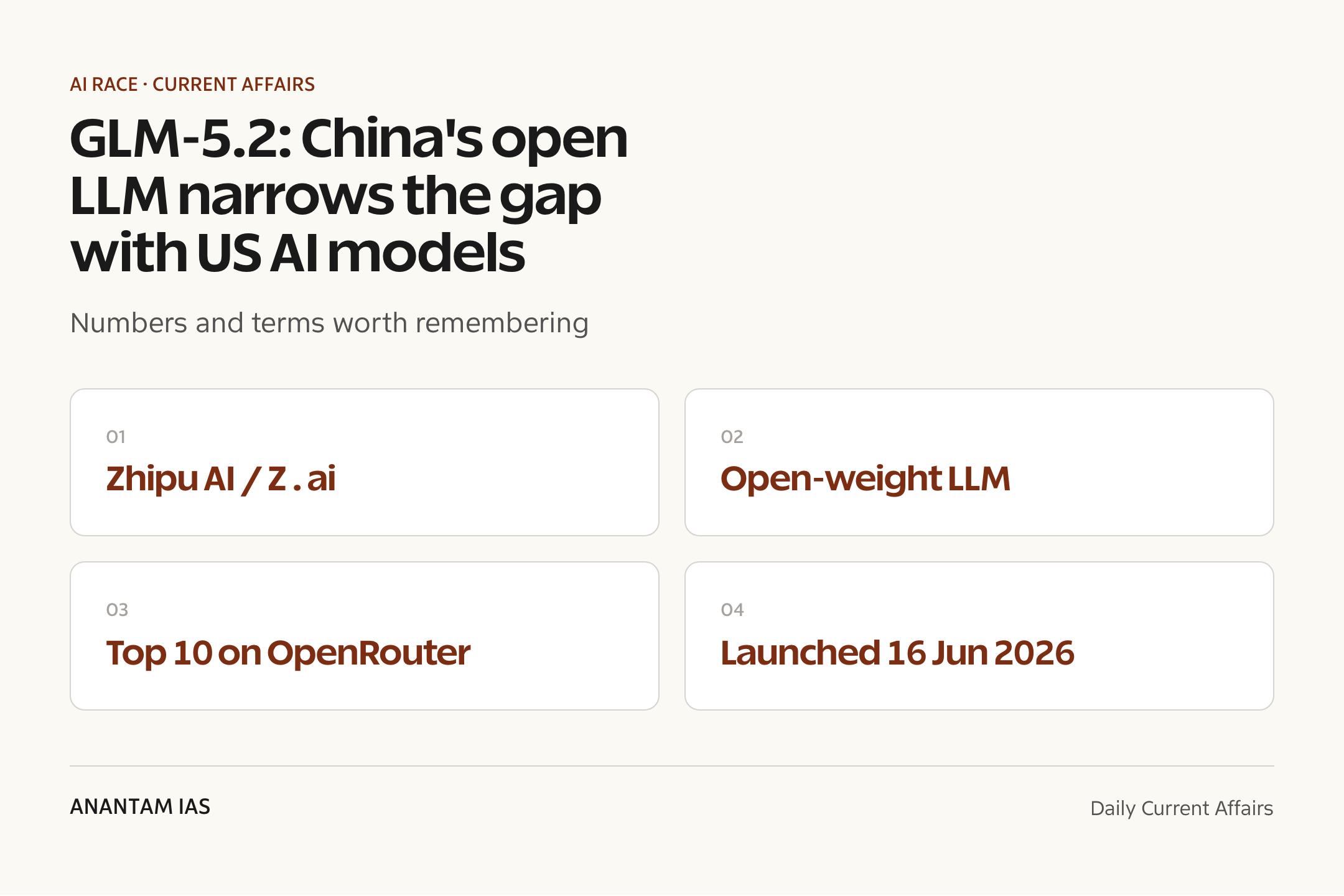
On 16 June 2026, China’s Zhipu AI (branded Z.ai, listed in Hong Kong as Knowledge Atlas Technology) unveiled GLM-5.2, its most advanced large language model yet, alongside a coding platform called ZCode. The Hindu reported that researchers see it as among the first Chinese models to seriously challenge leading US systems on specialised coding and cybersecurity tasks.
Crucially, GLM-5.2 is released as an open-weight model — developers can download, modify and run it on their own hardware. In tests by cybersecurity firm Semgrep, it outperformed a frontier US model on certain software-engineering tasks, and it has climbed into the top 10 most-used systems on the developer platform OpenRouter, prompting talk of a second ‘DeepSeek moment’ for China’s open-source AI.
- GLM = Generative Pre-trained Language Models; GLM-5.2 is Zhipu AI’s biggest generational leap so far.
- Zhipu AI was founded in 2019 as a Tsinghua University spin-off by chief scientist Tang Jie, creator of the AMiner academic search engine.
- Semgrep found GLM-5.2 could match the bug-finding ability of US frontier models and beat one on select tasks.
- Released as open-weight (per The Wall Street Journal), unlike closed US systems from OpenAI and Anthropic.
- Z.ai claims near-frontier performance at a fraction of the price of comparable proprietary models.
- Comes as the US tightens export controls on advanced AI chips to slow Beijing’s progress.
The development matters in the context of:
- Sits in a wave of capable Chinese models — DeepSeek, Alibaba, Baidu and Moonshot AI — that have narrowed the US lead over the past year.
- A US advisory body has warned that China’s open-source dominance could threaten the American AI lead.
- Frames India’s own foundation-model ambitions under the IndiaAI Mission and sovereign-LLM efforts.
UPSC Relevance
Prelims Relevance
- GLM-5.2 — Zhipu AI (Z.ai), Tsinghua spin-off; GLM = Generative Pre-trained Language Models.
- Large Language Model (LLM) — a foundation model trained on vast text to predict and generate language.
- Open-weight vs closed/proprietary models — weights downloadable and modifiable vs API-only access.
- DeepSeek — Chinese startup whose low-cost model triggered the 2025 ‘DeepSeek moment’.
- IndiaAI Mission — Rs 10,371.92 crore Union Cabinet-approved (Mar 2024) mission under MeitY.
- US chip export controls — curbs on advanced AI semiconductors (e.g., high-end GPUs) to China.
- Foundation model — a large, general-purpose model adaptable to many downstream tasks.
- Sarvam AI / BharatGPT — India’s indigenous LLM efforts; Sarvam picked as IndiaAI’s first sovereign-LLM developer.
- OpenRouter — developer platform aggregating access to hundreds of AI models.
Mains Relevance
GS Paper 3
- Emerging technologies: significance of LLMs/foundation models and the open- vs closed-weight debate for innovation, cost and security.
- India’s technology-readiness — building indigenous foundation-model capacity, compute and semiconductor resilience under IndiaAI.
GS Paper 2
- International relations: the US-China technology contest, export controls, and implications for India’s strategic autonomy and digital sovereignty.
Essay
- Technology as the new theatre of great-power competition.
- Openness versus control: who should own the frontier of artificial intelligence?
Background and Context
What GLM-5.2 is — and why it matters
GLM-5.2 is the latest in Zhipu AI’s family of general-purpose language models, pitched as near-frontier at low cost.
- Large language models (LLMs) are foundation models — trained on massive text corpora to predict the next token and generate human-like language, then adapted to tasks like coding, translation and reasoning.
- The GLM (‘Generative Pre-trained Language Models’) series has released successive generations since 2019, each edging closer to top US systems; GLM-5.2 is billed as the company’s biggest leap.
- Launched with ZCode, a coding assistant that can write, edit and manage software projects with minimal human input.
- Independent testing by Semgrep found GLM-5.2 could match the bug-finding of US frontier models and outperform one on certain software-engineering tasks.
- It entered the top 10 most-used models on OpenRouter, a sign of real developer adoption, not just benchmark scores.
- Z.ai frames the two products as making AI a more capable partner for software developers, automating routine build-and-debug work.
- The company says GLM-5.2 delivers near-frontier performance at a fraction of the price charged by comparable proprietary systems.
Open-weight vs closed models
GLM-5.2’s release as an open-weight model is its defining feature — and its main controversy.
- Open-weight: the trained model’s parameters (weights) are published, so anyone can download, modify and self-host it on their own hardware, cutting cost and dependence on a vendor’s servers.
- Closed / proprietary (OpenAI’s ChatGPT, Anthropic’s Claude): accessed only via an API; weights stay private, and the provider controls usage and safeguards.
- Supporters argue open weights make cutting-edge AI cheaper and more accessible, spurring downstream innovation and local control.
- Critics warn the same openness lets malicious actors strip out safety guardrails and deploy the model without the safeguards commercial providers impose.
- Open-weight is not the same as fully open-source — training data and code are often not released, limiting reproducibility.
- Zhipu AI’s head of global operations struck a collaborative tone, writing that ‘competition and collaboration’ push everyone forward.
- The affordability and self-hosting of open models can pressure the pricing and business models of closed frontier labs.
The US-China AI contest
GLM-5.2 lands squarely inside a widening technology rivalry between Washington and Beijing.
- The US has tightened export controls on advanced AI chips and technologies to slow China’s frontier progress.
- China has responded by doubling down on home-grown innovation — DeepSeek, Alibaba, Baidu and Moonshot AI have all shipped increasingly capable models over the past year.
- Silicon Valley developers reportedly called GLM-5.2 another ‘DeepSeek moment’, praising its coding ability and affordability.
- A US advisory body has warned that China’s open-source dominance could erode the American AI lead, since widely adopted free models set global defaults.
- Chinese firms still face constraints from restricted access to advanced semiconductors, and GLM-5.2 still trails US leaders on several complex reasoning and general-purpose tasks.
- The launch also drew comparison with DeepSeek’s 2025 breakthrough, which had already jolted the global AI industry and equity markets.
- For the wider world, cheap and capable Chinese models widen the pool of usable AI but deepen questions about data security and dependence.
Compute, chips and the hardware bottleneck
Behind every frontier model sits a race for compute — the real chokepoint the US is targeting.
- Training and running frontier LLMs needs vast GPU compute; access to high-end accelerators is the binding constraint.
- US export controls aim to deny China the most advanced chips, pushing Chinese labs toward efficiency gains and open-weight distribution to maximise impact per chip.
- Low-cost, open models like GLM-5.2 are partly a strategic response — spreading influence and adoption even under a hardware disadvantage.
- For any aspiring AI power, sovereign compute capacity and a resilient semiconductor supply are as decisive as model design.
- This is why India’s AI push pairs model-building with a national compute / GPU capacity plan under IndiaAI.
- Energy and data-centre capacity are the next constraints — frontier training is power-hungry and needs reliable grid and cooling.
- Efficiency innovations (better training methods, smaller high-quality models) let hardware-constrained labs punch above their compute weight.
Where India stands — IndiaAI Mission & sovereign LLMs
The GLM-5.2 story sharpens India’s question: can it build its own frontier-class foundation models?
- The IndiaAI Mission (approved March 2024, ~Rs 10,371.92 crore, under MeitY) funds compute, datasets, a safety institute, skilling and indigenous foundation models.
- India is subsidising a shared GPU compute pool and has begun selecting developers to build sovereign LLMs trained on Indian languages and context.
- Sarvam AI was chosen as an early developer of an indigenous foundation model; efforts like BharatGPT target multilingual, India-first use cases.
- The open-weight route offers India a shortcut — build on open models to save cost — but raises the same safety and dependence trade-offs GLM-5.2 highlights.
- India’s advantage is data diversity and a large developer base; its gap is frontier compute and top-end chips.
- India also runs the Semiconductor Mission to build fabrication and assembly capacity, tackling the chip side of the AI stack.
- A sovereign, India-context LLM matters for public services, languages and data localisation — reducing reliance on foreign closed systems.
AI safety and governance
Powerful, freely downloadable models force the governance question to the front.
- Open weights make misuse harder to police — once released, a model cannot be recalled, unlike a hosted API that can be shut off.
- Cybersecurity is double-edged: GLM-5.2’s bug-finding skill helps defenders but equally aids offensive hacking.
- Global governance is fragmenting — differing US, EU and Chinese approaches to AI safety, transparency and liability.
- India is standing up an AI Safety Institute under IndiaAI and favours a pro-innovation, risk-based regulatory stance over a hard AI law for now.
- The core policy tension: openness and access versus control and safety — with no settled global answer.
- Concentration of frontier AI in a few firms and states raises concerns over market power and geopolitical leverage.
- Multilateral efforts — from the Bletchley/AI safety summits to the Global Partnership on AI — seek shared norms but remain non-binding.
Way Forward
Build sovereign capacity
- Scale India’s shared compute pool and pursue domestic semiconductor and chip-design capability to cut the hardware bottleneck.
- Back indigenous foundation models (Sarvam, BharatGPT-type efforts) on Indian languages while pragmatically building on strong open models.
Govern openness responsibly
- Operationalise the AI Safety Institute and clear red-teaming, evaluation and disclosure norms for open-weight deployment.
- Balance access and innovation with safeguards against misuse in cybersecurity and other high-risk domains.
- Adopt a risk-based, pro-innovation framework rather than a blanket AI law, updating it as capabilities evolve.
Grow talent and partnerships
- Deepen university-industry links — the Tsinghua-to-Zhipu spin-off model shows how research labs become frontier firms.
- Engage in international AI standard-setting so India shapes global rules rather than only importing models, and diversify chip and compute partnerships.
Treat AI as strategic infrastructure: sustained public investment in compute, chips, energy and skilling, paired with a vibrant open ecosystem, is what converts model access into genuine national capability.
Conclusion
GLM-5.2 shows the frontier of artificial intelligence is no longer a US monopoly: a Chinese open-weight model now competes on coding and cybersecurity at a fraction of the cost, even under chip export controls. The centre of gravity is shifting from a few closed labs toward a contested, increasingly open ecosystem.
For India, the lesson is twofold — the open-weight wave lowers the barrier to building capable AI, but true strategic autonomy still rests on sovereign compute, chips and foundation models. The IndiaAI Mission’s bet on shared compute, indigenous LLMs and an AI safety institute is the right frame; the test is execution against a fast-moving global race.
UPSC Practice Questions
Prelims MCQ 1
With reference to GLM-5.2, consider the following statements:
- It is a large language model developed by the Chinese company Zhipu AI (Z.ai).
- It has been released as an open-weight model that developers can download and run on their own hardware.
- It was developed as a spin-off of the Massachusetts Institute of Technology (MIT).
How many of the above statements are correct?
(a) Only one (b) Only two (c) All three (d) None
Answer: (b) Only two
Explanation:
Statements 1 and 2 are correct — GLM-5.2 is Zhipu AI’s open-weight LLM. Statement 3 is wrong: Zhipu AI is a Tsinghua University spin-off, not MIT.
Prelims MCQ 2
The IndiaAI Mission, in the news in this context, is implemented primarily under which Union ministry?
(a) Ministry of Science and Technology (b) Ministry of Electronics and Information Technology (MeitY) (c) NITI Aayog (d) Ministry of Commerce and Industry
Answer: (b) Ministry of Electronics and Information Technology (MeitY)
Explanation:
The IndiaAI Mission (approved 2024, ~Rs 10,371.92 crore) is anchored under MeitY, covering compute, datasets, a safety institute, skilling and indigenous foundation models.
UPSC Mains Questions
- The release of powerful open-weight AI models has been called both a democratising force and a security risk. Critically examine the open-weight versus closed-model debate and its implications for India’s foundation-model strategy. (250 words)
- “Sovereign compute and semiconductor resilience are as decisive as model design in the artificial-intelligence race.” Discuss in the light of US-China technology competition and India’s IndiaAI Mission. (250 words)
Sources: The Hindu and The Wall Street Journal / South China Morning Post.
Frequently Asked Questions
What is GLM-5.2?
GLM-5.2 is the most advanced large language model from China’s Zhipu AI (branded Z.ai), unveiled on 16 June 2026. ‘GLM’ stands for Generative Pre-trained Language Models. Researchers say it now competes closely with leading US systems on specialised coding and cybersecurity tasks, and it was released alongside a coding assistant called ZCode.
What does open-weight mean?
An open-weight model publishes its trained parameters, so developers can download, modify and run it on their own hardware rather than only calling a vendor’s API. This cuts cost and increases control. It differs from closed models like ChatGPT or Claude, and from fully open-source releases, which also share training data and code.
Who is Zhipu AI and Tang Jie?
Zhipu AI (Z.ai) is a Chinese AI firm founded in 2019 as a Tsinghua University spin-off, listed in Hong Kong as Knowledge Atlas Technology. Its co-founder and chief scientist is Tang Jie, a Tsinghua computer-science professor who earlier created AMiner, a widely used academic search and knowledge-graph platform.
Why does GLM-5.2 matter for the US-China AI race?
It shows Chinese labs can approach US frontier performance cheaply and via open weights, even under US export controls on advanced chips. Silicon Valley developers called it another ‘DeepSeek moment’. A US advisory body has warned that China’s open-source strength could erode the American AI lead by setting global defaults.
How is GLM-5.2 relevant to India’s IndiaAI Mission?
It frames India’s push to build indigenous foundation models. The IndiaAI Mission (approved 2024, ~Rs 10,371.92 crore, under MeitY) funds shared compute, datasets, an AI safety institute and sovereign LLMs, with developers like Sarvam AI building India-first models. Open models lower the entry barrier, but strategic autonomy still needs sovereign compute and chips.
What are the risks of open-weight AI models?
Once weights are public, a model cannot be recalled, and malicious actors can remove safety guardrails and self-host it. Strong cybersecurity skills can aid attackers as well as defenders. This is why governments, including India through its planned AI Safety Institute, are working on evaluation, red-teaming and disclosure norms for open-weight deployment.