GFRA 2025: India Ranks 9th in Global Forest Area — FAO Findings
Introduction
On 23 October 2025, the Food and Agriculture Organization (FAO) released the Global Forest Resources Assessment 2025 (GFRA 2025), the seventh edition of its quinquennial flagship report on the state of the world’s forests. India ranked 9th globally by total forest area, with approximately 72 million hectares of forest cover — a positive net gain driven largely by plantation drives, even as concerns over the steady erosion of natural forests continue to dominate the conservation discourse. The findings, released alongside companion data from the Forest Survey of India (FSI), place India among the few large developing economies registering net forest expansion since 1990. Yet the headline figure masks a more complicated reality: a country planting trees faster than it loses them, but losing the wrong trees. For UPSC aspirants tracking GS-III Environment & Ecology, GFRA 2025 is essential reading because it stitches together India’s forest story across the Compensatory Afforestation framework, the Green India Mission, and the FRA 2006-led community forestry push.
Quick Facts
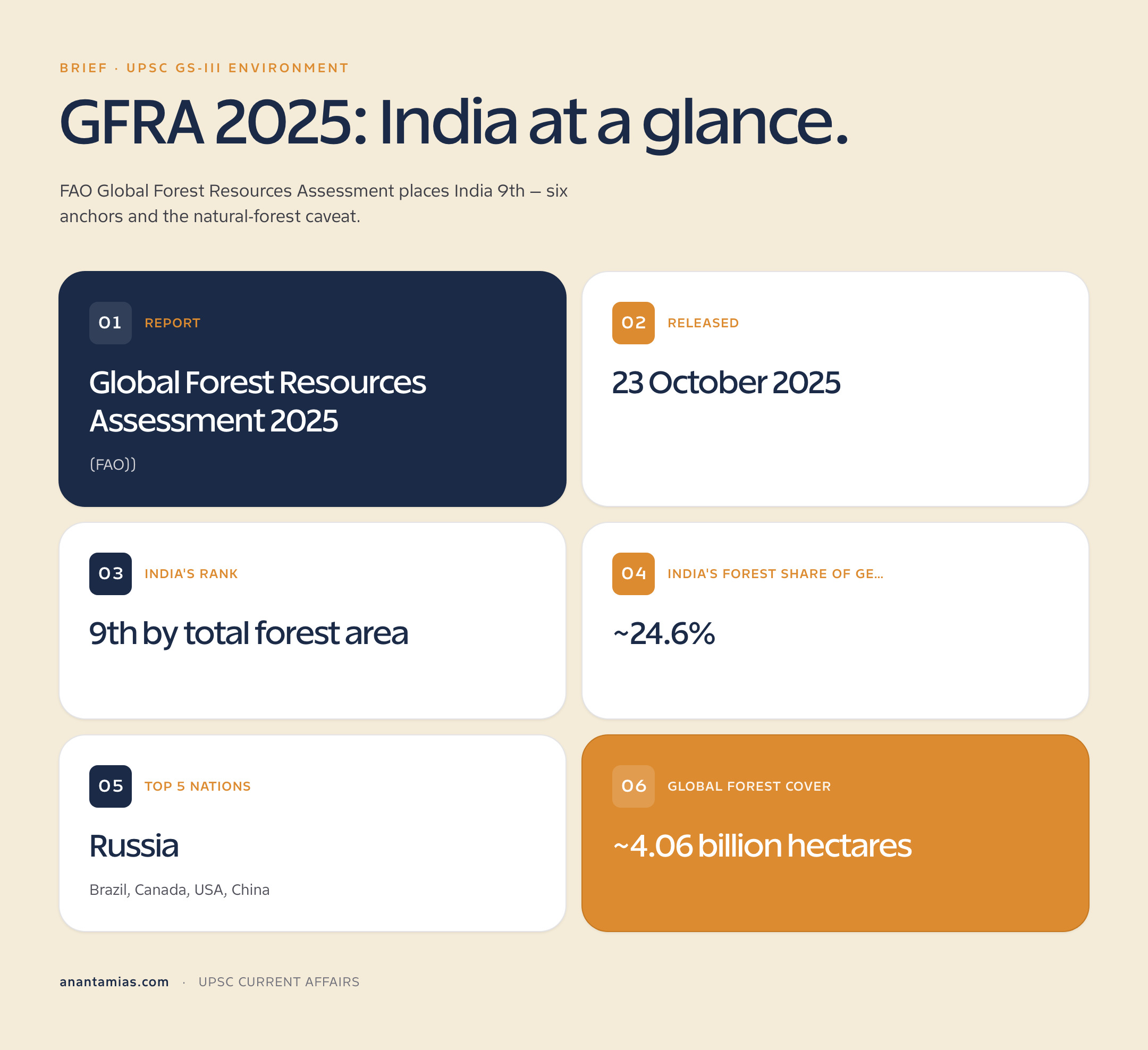
| Parameter | Detail | Significance |
|---|---|---|
| Report | Global Forest Resources Assessment 2025 (FAO) | 7th edition; quinquennial cycle |
| Released | 23 October 2025 | Pre-COP30 baseline document |
| India’s rank | 9th by total forest area | ~72 million hectares |
| India’s forest share of geographic area | ~24.6% | Below the 33% National Forest Policy target |
| Top 5 nations | Russia, Brazil, Canada, USA, China | Together hold >50% of world forests |
| Global forest cover | ~4.06 billion hectares | Roughly 31% of land area |
| Net annual loss (global) | ~10 million ha/year | Slowed from previous cycle |
| India’s net change since 1990 | Positive (+) | One of few G20 nations gaining |
| Domestic source | India State of Forest Report (ISFR) 2023, FSI | Biennial complement to GFRA |
Background and Historical Context
The Global Forest Resources Assessment is FAO’s longest-running monitoring exercise on forests, originating in 1948 and currently published every five years. Each cycle aggregates country-reported data on more than 60 variables — area, growing stock, carbon, biodiversity, ownership, disturbances, and policy — providing the most authoritative baseline for global forest accounting. The 2020 edition, released amid the pandemic, had flagged that the world’s forests were shrinking at a slower rate than in the 1990s but that natural-forest loss in tropical zones remained acute. GFRA 2025 builds on that trajectory.
India’s domestic forest accounting runs in parallel through the Forest Survey of India, established in 1981 and headquartered in Dehradun. FSI publishes the biennial India State of Forest Report (ISFR), the most recent being ISFR 2023, which uses satellite remote sensing combined with ground-truthing to map forest and tree cover at 23.5-metre resolution. ISFR data feeds into India’s GFRA submission. India’s forest policy architecture rests on the National Forest Policy 1988 (target: 33% forest and tree cover), the Forest Conservation Act 1980 (now amended in 2023), the Forest Rights Act 2006 (FRA) recognising community forest rights, and major schemes like the Compensatory Afforestation Fund (CAMPA) and the Green India Mission under the National Action Plan on Climate Change.
India’s positive net forest gain since 1990 is anomalous in the developing-tropical context. Most peer nations — Indonesia, Myanmar, the Democratic Republic of the Congo — continue to lose forests rapidly. The Indian gain is statistical and policy-driven: large-scale plantations, agroforestry on private land, and the inclusion of orchards, plantations, and bamboo within the broad ISFR definition of “forest cover.” Whether this expansion translates into ecological gain is the question GFRA 2025 forces India to answer.
Key Features of GFRA 2025
India’s 9th Position by Total Forest Area
India’s ranking at 9th place globally with approximately 72 million hectares of forest reflects the country’s dual identity as a megadiverse nation and a high-population developing economy. The top eight countries — Russia, Brazil, Canada, the United States, China, Australia, the Democratic Republic of the Congo, and Indonesia — together account for over 60% of global forest cover. India sits ahead of Peru, Mexico, Colombia, and Angola. The ranking is steady from the 2020 cycle, but the absolute figure has grown marginally, anchored in plantation expansion under MoEFCC programmes.
Net Forest Gain Driven by Plantations
GFRA 2025 confirms that India’s positive net change is overwhelmingly attributable to planted forests — afforestation under CAMPA, social forestry, agroforestry on private holdings, and large block plantations of fast-growing species like eucalyptus, acacia, and poplar. Planted forests now account for an increasing share of India’s total forest area. While this delivers carbon sequestration and timber, the biodiversity and hydrological functions of monoculture plantations are demonstrably weaker than those of intact natural forests.
Concerns on Natural Forest Decline
The flip side of the ledger is sobering. The report and parallel FSI assessments indicate continued degradation of dense and very dense natural forest in biodiversity hotspots — the Western Ghats, the Northeast, and parts of Central India. Mining, linear infrastructure, hydropower, encroachment, and forest fires drive incremental loss of primary forests that no plantation can replace within a human lifetime. The Northeastern states, in particular, have shown a net decline in tree cover in successive ISFR cycles.
Significance for UPSC Aspirants
- Direct relevance to GS-III Environment & Ecology — conservation, biodiversity, climate change.
- Cross-linkages with GS-II Governance — federalism, FRA 2006 implementation, centre-state friction over forest clearances.
- Anchors prelims questions on FAO, FRA, CAMPA, Green India Mission, ISFR, and REDD+.
- Mains essay material on the plantation-versus-natural forest debate and India’s NDC commitments.
- Connects with current affairs on the Forest Conservation (Amendment) Act 2023 and the Supreme Court’s T.N. Godavarman jurisprudence.
- Useful comparative data point against China’s afforestation push and Brazil’s deforestation reversal under Lula.
- Anchors interview questions on India’s climate diplomacy and the international environmental governance architecture.
Detailed Analysis
The table below presents the top 10 countries by total forest area as per GFRA 2025, followed by India’s leading states by forest cover from ISFR 2023.
| Rank | Country | Forest area (million ha) | % of land area |
|---|---|---|---|
| 1 | Russian Federation | ~815 | ~49% |
| 2 | Brazil | ~497 | ~58% |
| 3 | Canada | ~347 | ~38% |
| 4 | United States | ~310 | ~34% |
| 5 | China | ~220 | ~23% |
| 6 | Australia | ~134 | ~17% |
| 7 | DR Congo | ~126 | ~56% |
| 8 | Indonesia | ~92 | ~49% |
| 9 | India | ~72 | ~24.6% |
| 10 | Peru | ~72 | ~57% |
| Rank | State (ISFR 2023) | Forest cover (sq km) | % of state area |
|---|---|---|---|
| 1 | Madhya Pradesh | ~85,724 | ~27.8% |
| 2 | Arunachal Pradesh | ~65,882 | ~78.7% |
| 3 | Maharashtra | ~50,800 | ~16.5% |
| 4 | Chhattisgarh | ~55,717 | ~41.2% |
| 5 | Odisha | ~52,156 | ~33.5% |
| 6 | Karnataka | ~38,730 | ~20.2% |
| 7 | Telangana | ~21,295 | ~19.0% |
| 8 | Assam | ~28,312 | ~36.1% |
India’s forest accounting is more generous than several global peers because the FSI definition treats any patch over one hectare with canopy density above 10% as “forest cover,” regardless of legal status or species composition. This means commercial plantations, urban tree clusters, and agroforestry parcels all enter the national tally. The methodology is internationally compliant — FAO uses similar broad definitions — but it also means that the headline “9th rank” or “24.6% green cover” understates the loss of what ecologists call natural-origin forest.
India’s plantation-led growth is anchored in the Compensatory Afforestation Fund Management and Planning Authority (CAMPA), set up to channel funds collected from project proponents who divert forest land. The corpus, which crossed Rs 1 lakh crore, finances state-level afforestation. Critics, including parliamentary panels and the CAG, have flagged that monoculture compensatory plantations rarely match the ecological function of the diverted forest. The Green India Mission, which targeted increasing forest cover by 5 million hectares and improving forest quality on another 5 million hectares, has missed several intermediate milestones, and a revised 2024 framework recalibrated targets to 2030.
Challenges: Natural-Forest Loss vs Plantation Expansion
The headline gain conceals four structural challenges. First, biodiversity loss — monoculture plantations support a tiny fraction of the species hosted by mixed natural forests. Second, hydrological function — fast-growing exotics like eucalyptus draw down water tables in already stressed catchments such as the Krishna, Cauvery, and parts of Bundelkhand. Third, carbon accounting illusion — young plantations sequester carbon faster but lock in less long-term carbon than mature primary forest, and a single fire or harvesting cycle releases what took decades to accumulate. Fourth, community displacement — plantation drives on revenue land and “wasteland” frequently overlook the customary use rights of forest-fringe communities, despite the FRA 2006 mandate.
The Forest Conservation (Amendment) Act 2023 further reshaped the terrain by exempting categories of land — including strategic infrastructure within 100 km of international borders — from forest clearance, drawing concern from conservationists about Northeast forests. The Supreme Court’s February 2024 interim order in Ashok Kumar Sharma v. Union of India directed states to continue treating “deemed forests” identified post-Godavarman as forest land for clearance purposes, partially restoring protection. India’s REDD+ engagement under the UNFCCC, meanwhile, remains modest in scale, and benefit-sharing with forest-dwelling communities is yet to operationalise at scale.
Prelims Pointers
- GFRA is published by FAO every five years; 2025 is the 7th edition.
- India ranks 9th globally by total forest area in GFRA 2025, with about 72 million hectares.
- The top three forest nations are Russia, Brazil, Canada.
- Forest Survey of India (FSI), established 1981, headquartered at Dehradun, publishes the biennial ISFR.
- National Forest Policy 1988 target: 33% forest and tree cover.
- India’s forest cover share of land area: about 24.6% (ISFR 2023 / GFRA 2025).
- State with highest forest cover (sq km): Madhya Pradesh.
- State with highest percentage forest cover among full-fledged states: Mizoram (Arunachal close behind).
- CAMPA = Compensatory Afforestation Fund Management and Planning Authority; CAF Act 2016.
- Green India Mission is one of the eight missions under NAPCC (2008).
- FRA 2006 recognises individual and community forest rights for Scheduled Tribes and OTFDs.
- India is part of REDD+ under UNFCCC.
- Forest Conservation (Amendment) Act 2023 renamed the principal Act as Van (Sanrakshan Evam Samvardhan) Adhiniyam.
Mains Practice Questions
- Critically examine India’s positive net forest gain reported in GFRA 2025 against the simultaneous decline of natural forests. What policy correctives would you propose? (GS-III, 250 words)
- “Compensatory afforestation has expanded India’s tree cover but not its ecological capital.” Discuss with reference to CAMPA and the Green India Mission. (GS-III, 250 words)
- Evaluate the implications of the Forest Conservation (Amendment) Act 2023 for India’s biodiversity hotspots, particularly the Northeast and the Western Ghats. (GS-II/III, 250 words)
- How can the Forest Rights Act 2006 be leveraged to align community livelihoods with India’s net-zero and 30×30 commitments? (GS-III, 150 words)
Conclusion
India’s 9th-place finish in GFRA 2025 is a genuine policy achievement — at a time when much of the tropical world is losing forest, India is gaining it. But the rank flatters. A nation that plants more trees than it cuts is not the same as a nation that conserves more forest than it loses. The next decade demands a quieter, less photogenic agenda: protecting what remains of the Western Ghats and Northeast, recognising community forest rights at scale under FRA 2006, recalibrating compensatory afforestation away from monocultures, and building a verifiable REDD+ pathway. GFRA 2025 should not become a complacency document. For policymakers and aspirants alike, it is a prompt to read past the rank and into the species composition. Stay tuned to anantamias.com for continuing coverage of forest, climate, and biodiversity policy.
Frequently Asked Questions
Q1. What is the Global Forest Resources Assessment (GFRA)?
The Global Forest Resources Assessment is FAO’s flagship quinquennial report on the world’s forests, tracking area, growing stock, carbon, biodiversity, ownership, and disturbances. The 2025 edition, released on 23 October 2025, is the seventh in the series and serves as a key input to UNFCCC and CBD processes.
Q2. Where does India rank in GFRA 2025?
India ranks 9th globally by total forest area, with approximately 72 million hectares — roughly 24.6% of the country’s geographic area. The top three are Russia, Brazil, and Canada.
Q3. Why is India’s forest gain considered controversial?
Because most of the gain comes from plantations and agroforestry — including monocultures of eucalyptus and acacia — while natural forests in the Western Ghats, Northeast, and Central India continue to lose canopy density and biodiversity. The headline rank does not capture this qualitative substitution.
Q4. What does India’s State of Forest Report (ISFR) measure?
The ISFR, published biennially by the Forest Survey of India since 1987, uses satellite remote sensing combined with field plots to map forest and tree cover at 23.5-metre resolution. ISFR 2023 is the latest edition and is the principal domestic data source feeding into India’s GFRA submission.
Q5. What is CAMPA?
CAMPA — the Compensatory Afforestation Fund Management and Planning Authority — administers funds collected from project proponents whose proposals divert forest land. Established by the CAF Act 2016, the corpus has crossed Rs 1 lakh crore and finances state-level afforestation drives.
Q6. How does the Forest Rights Act 2006 fit into the GFRA story?
FRA 2006 recognises individual and community forest rights of Scheduled Tribes and Other Traditional Forest Dwellers. Strong implementation can align community livelihoods with conservation, reducing pressure on natural forests, and is essential to India’s REDD+ and 30×30 commitments.
Q7. What is the Green India Mission?
The Green India Mission is one of the eight missions under the National Action Plan on Climate Change (2008). Originally targeting a 5 million-hectare expansion in forest cover and 5 million hectares of forest-quality improvement, the mission has been recalibrated to a 2030 horizon with revised intermediate milestones.
Q8. How is GFRA 2025 relevant for the UPSC examination?
GFRA 2025 is high-yield material for prelims (FAO, ISFR, CAMPA, FRA, REDD+, ranking facts) and for GS-III mains answers on biodiversity, climate change, and conservation. It also supports GS-II questions on federal forest governance and the Forest Conservation (Amendment) Act 2023.