CAQM Sub-Committee invokes Stage-III of revised GRAP across the entire NCR
Why in News?
Activation of Stage-III of revised GRAP signals a severe air-quality emergency across the National Capital Region, triggering legally mandated restrictions on construction, transport and industrial operations with immediate public-health and urban governance implications.
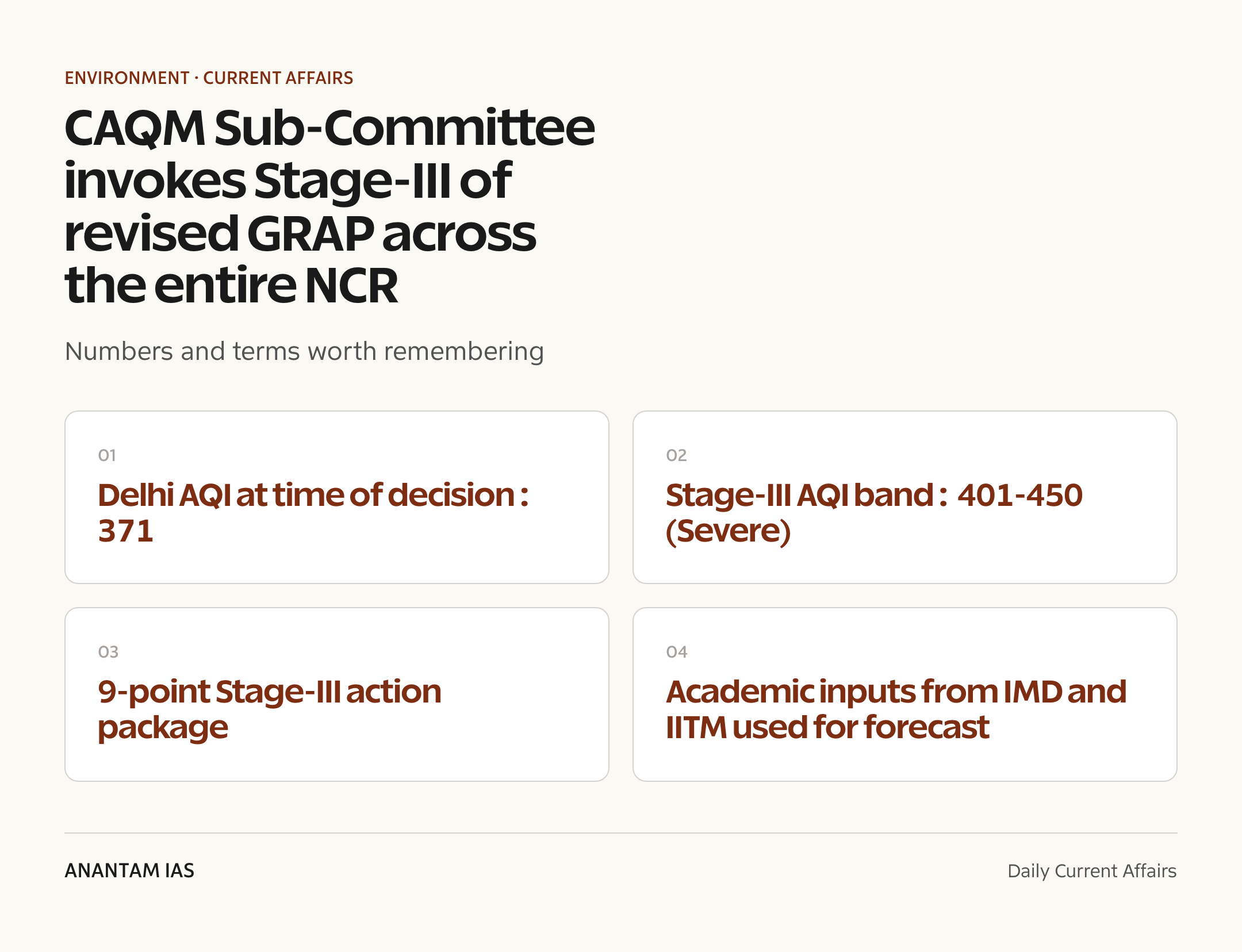
- CAQM Sub-Committee invoked Stage-III of revised GRAP with immediate effect for the entire NCR as Delhi’s average AQI breached 350 and trended upward.
- Stage-III corresponds to Severe air quality (Delhi AQI band 401-450) and brings a 9-point action package across sectors.
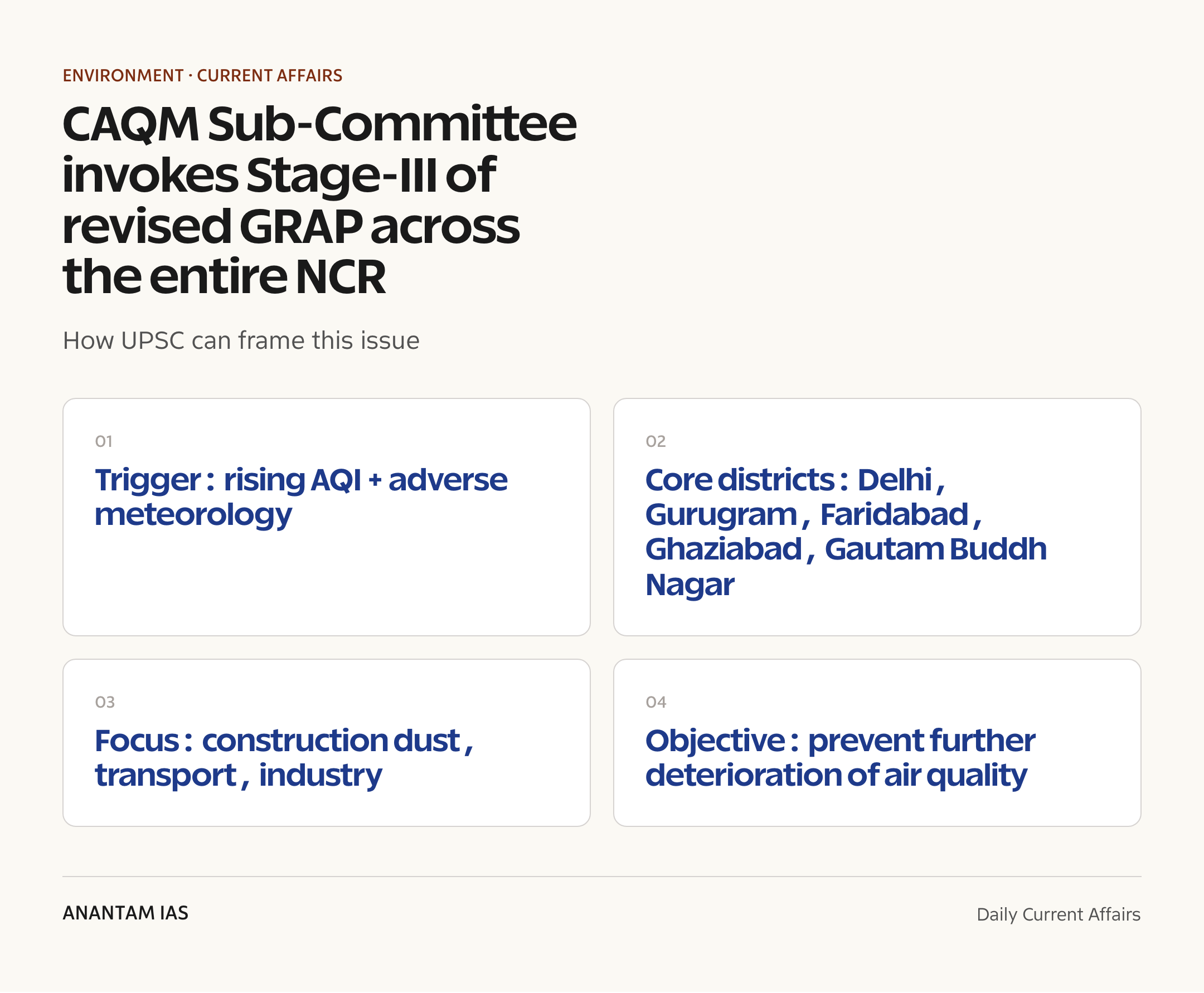
- Measures include curbs on construction and demolition activities, tighter controls on dust-generating operations, staggered public office timings and hybrid schooling for young students in core districts.
- Action is based on real-time monitoring data and IMD/IITM forecasts indicating continued adverse meteorological conditions such as low mixing height and dense fog.
- The move activates compliance responsibilities for Pollution Control Boards, municipal bodies and district administrations across NCR districts.
The development matters in the context of:
- GRAP is a legally binding, graded action plan designed to respond to worsening air quality in NCR through progressive restrictions calibrated to AQI bands.
- The revised GRAP (December 2024) replaced earlier versions to broaden geographic coverage and update sectoral measures and enforcement roles for Commission for Air Quality Management (CAQM).
- Stage thresholds under the revised GRAP classify air quality into bands; Stage-III aligns with the ‘Severe’ range meant to prevent further deterioration to emergency levels.
- NCR comprises NCT of Delhi and adjoining districts in Haryana, Uttar Pradesh and Rajasthan; coordinated action is necessary because pollution transport and meteorology cross administrative boundaries.
- Winter months typically see higher pollution in NCR due to low temperatures, temperature inversion, reduced boundary layer mixing and increased emissions from heating, diesel transport and biomass burning.
- CAQM, supported by CPCB and state PCBs, issues directives under GRAP that carry mandatory compliance obligations for local agencies and listed sectors.
- Previous activations of GRAP stages have shown temporary AQI improvements when measures were strictly enforced, but sustained gains need structural emission controls.
UPSC Relevance
Prelims Relevance
- Know the GRAP stages and AQI band thresholds; Stage-III corresponds to the ‘Severe’ range in the revised GRAP.
- Be aware that CAQM has jurisdiction for NCR and issues mandatory directives under the revised GRAP.
- Recognize the meteorological drivers such as low mixing height and calm winds that lead to winter pollution spikes in North India.
Mains Relevance
GS3 Environment
- Policy implication: Role of graded emergency action plans like GRAP in urban air-quality governance and inter-state coordination.
- Administrative challenge: Implementation and enforcement constraints across multiple jurisdictions in NCR; balance between short-term restrictions and long-term emission reduction.
- Science-policy linkage: Use of meteorological forecasts and monitoring data (IMD, IITM, CPCB) to trigger graded responses.
Essay
- Debate angle: Public health, economic cost and individual freedoms during environmental emergencies; resilience of cities to episodic pollution.
- Structure: Use GRAP activation as a case study to discuss urban environmental governance, technological, regulatory and behavioural solutions for air pollution.
Background and Context
What is GRAP and how it works
GRAP is a staged response mechanism to manage air-quality deterioration in NCR with defined actions for each severity level.
- Originally developed to provide a time-bound, action-oriented response to episodic pollution events with defined responsibilities for agencies.
- Revised GRAP (December 2024) updated thresholds, expanded measures and clarified roles for CAQM, CPCB, state PCBs and local bodies.
- It uses AQI bands to move from advisory measures to legally binding curbs; each stage adds measures atop earlier ones.
- Triggers are data-driven using real-time AQI and model forecasts from IMD and IITM to anticipate persistent poor conditions.
- The plan is intended to be temporary and emergency-focused, not a substitute for structural pollution-control policies.
Why NCR is vulnerable in winter
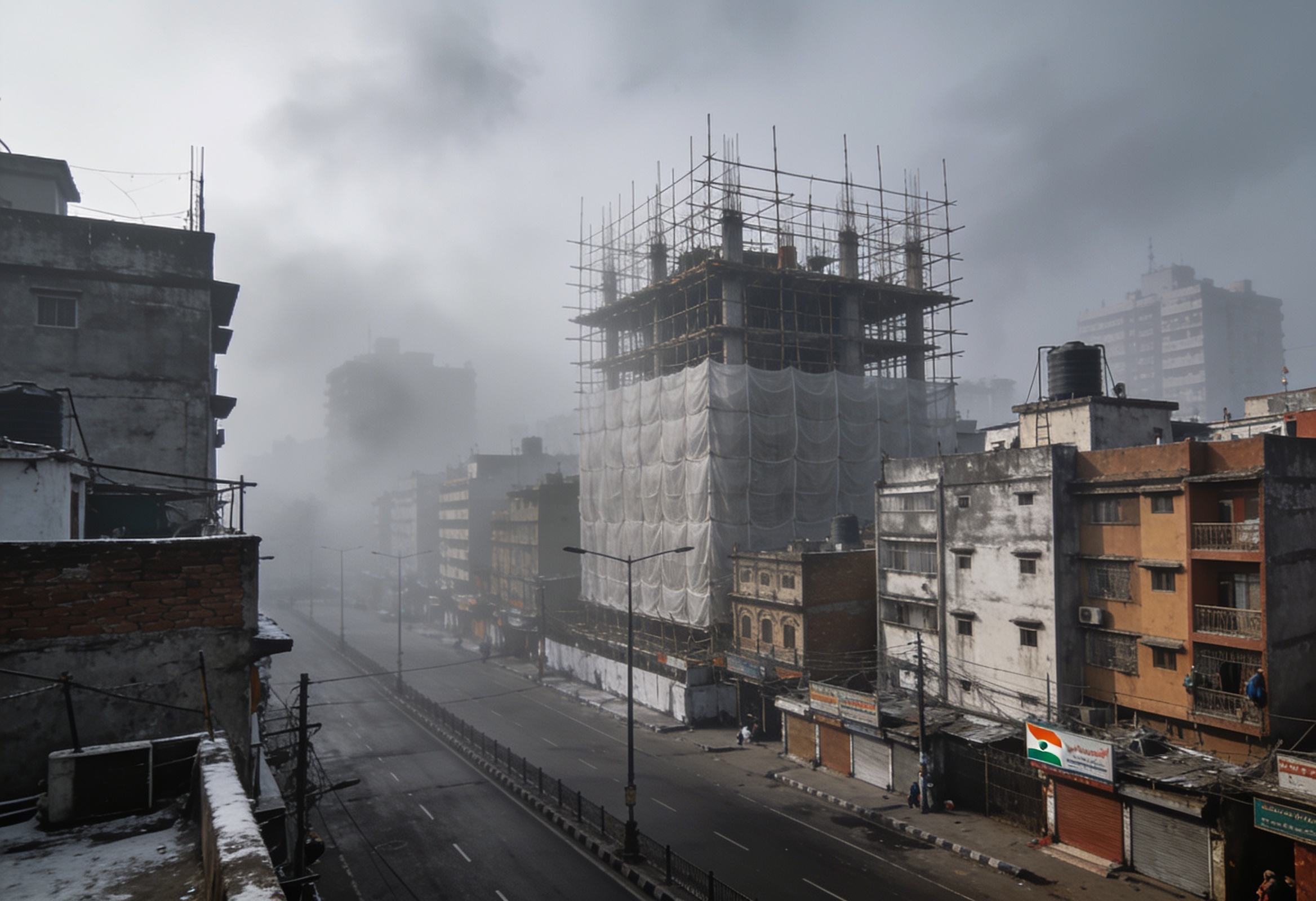
Meteorology and emissions combine to produce frequent winter pollution episodes in NCR.
- Temperature inversions trap pollutants close to the surface, reducing vertical dispersion and lowering the mixing height.
- Calm winds and stable atmospheric conditions reduce horizontal dilution and transport out of the basin.
- Seasonal increases in emissions from heating, diesel transport and open burning amplify pollutant loads.
- Regional sources such as crop residue burning in parts of Punjab and Haryana add to the local emissions burden.
- Secondary aerosol formation from precursor gases (NOx, SO2, VOCs) is favoured under cold, humid conditions.
Key instruments and agencies
Multiple agencies share data, regulatory authority and implementation duties under GRAP.
- Commission for Air Quality Management (CAQM) leads regional coordination and issues enforceable directives in NCR.
- Central Pollution Control Board (CPCB) provides monitoring data, Daily AQI bulletins and technical support.
- State Pollution Control Boards and DPCC are responsible for on-ground enforcement of sectoral restrictions.
- IMD and IITM supply meteorological forecasts and modelling inputs that inform GRAP triggers.
- Local municipal bodies manage construction permits, road cleaning and waste management measures required under GRAP.
Stage-III: What changes operationally
Stage-III activates a 9-point action plan combining restrictions and advisories to limit further deterioration.
- Strict restrictions on dust-generating construction and demolition activities across NCR with limited exceptions.
- Continuation of less polluting construction works subject to strict dust control and C&D waste rules.
- Staggered office timings in core districts and hybrid schooling for students up to Class V in specified areas.
- Targeted curbs on industrial units and increased compliance checks by PCBs and municipal authorities.
- Citizen advisories to reduce outdoor exposure, limit private vehicular trips and follow the GRAP citizen charter.
Public-health implications
Severe AQI levels have immediate and short-term health impacts especially for vulnerable groups.
- High PM2.5 and PM10 concentrations increase risks of respiratory and cardiovascular events in children, elderly and people with preexisting illnesses.
- Advisories under Stage-III aim to reduce population exposure through behavioural guidance and institutional measures like hybrid schooling.
- Healthcare facilities may see an uptick in respiratory complaints and must be prepared for surge responses.
- Long-term exposure to recurrent severe episodes increases population-level burden of chronic disease.
Limitations of episodic GRAP measures
Emergency measures can reduce peak pollution but do not substitute for structural reforms.
- Short-term curbs can shift or delay emissions rather than eliminate them unless paired with permanent controls.
- Enforcement variability across districts weakens overall effectiveness, especially for diffuse sources like road dust.
- Social and economic costs to construction, small industries and daily-wage workers arise during repeated activations.
- Lasting improvement requires emission inventories, clean-fuel transitions, public transport strengthening and stricter industrial norms.
Way Forward
Strengthen enforcement and inter-agency coordination
Make GRAP measures effective by ensuring timely, uniform action across NCR jurisdictions.
- Set unified operational checklists for PCBs and municipal agencies with daily monitoring and public reporting.
- Use joint task forces for rapid response to violations in construction, industry and road-dust control.
- Deploy mobile compliance teams to inspect high-risk hotspots and issue on-the-spot penalties where permitted.
- Institutionalize weekly coordination calls among CAQM, CPCB, state PCBs and district magistrates during winter months.
Improve forecasting and early warning
Refine trigger accuracy so measures are preventive rather than reactive.
- Integrate near-real-time observations with IITM/IMD model outputs to develop probabilistic AQI forecasts for 72 hours.
- Publish simple, actionable forecasts for citizens and sectoral agencies with graded triggers and lead times.
- Expand low-cost sensor networks to increase spatial coverage and identify local hot spots.
- Invest in data platforms that allow district-level dashboards accessible to enforcement agencies and the public.
Reduce source emissions through structural reforms
Complement emergency actions with long-term policies that permanently cut emissions.
- Accelerate transition to cleaner fuels and stricter vehicular emission norms, including fast-tracking public transport electrification.
- Mandate and fund road-sweeping, sprinkling and pavement repairs to tackle road dust, an important local source.
- Implement tighter controls on small-scale industries, brick kilns and diesel generators with timelines for compliance.
- Promote decentralised heating solutions and subsidies for household clean cooking/heating to reduce winter emissions.
Public engagement and risk communication
Sustain citizen cooperation by making advisories clear, equitable and actionable.
- Disseminate plain-language health advisories tied to AQI bands with targeted guidance for schools, workplaces and vulnerable groups.
- Provide alternatives for daily-wage workers and small contractors affected by construction restrictions, such as compensated work rescheduling.
- Run behaviour-change campaigns on reduced private vehicle use, car-pooling and adoption of non-combustion heating.
- Publish transparent compliance data and enforcement actions to maintain public trust and accountability.
Conclusion
Invoking Stage-III of the revised GRAP is a necessary emergency step to limit health harms during a period of adverse meteorology and rising AQI. Short-term restrictions can blunt peaks but lasting improvement requires coordinated enforcement, better forecasting, structural emission reductions and consistent public engagement. Policymakers must balance immediate protection with measures that reduce recurrence of severe episodes.
UPSC Practice Questions
Prelims MCQ 1
Which authority has the mandate to issue enforceable directives under the revised GRAP for the National Capital Region?
(a) A. Central Pollution Control Board (CPCB) (b) B. Commission for Air Quality Management (CAQM) (c) C. Ministry of Environment, Forest and Climate Change (MoEFCC) (d) D. National Disaster Management Authority (NDMA)
Answer: B
Explanation:
The Commission for Air Quality Management (CAQM) is the statutory regional authority tasked with issuing enforceable directives and coordinating actions under the revised GRAP for the NCR. CPCB provides monitoring and technical support but CAQM leads GRAP implementation.
Prelims MCQ 2
Under the revised GRAP invoked in January 2025, Stage-III corresponds to which air-quality categorization for Delhi AQI?
(a) A. Good (0-50) (b) B. Moderate (51-100) (c) C. Poor to Very Poor (201-300) (d) D. Severe (401-450)
Answer: D
Explanation:
Stage-III in the revised GRAP corresponds to the ‘Severe’ AQI band, which for Delhi is identified as the range 401-450. The CAQM invoked Stage-III after the AQI crossed 350 and forecasts predicted worsening conditions.
UPSC Mains Questions
- {‘question’: ‘Examine the strengths and limitations of a graded emergency response plan like GRAP in managing urban air pollution. Suggest measures to increase its effectiveness in the NCR.’, ‘model_answer’: ‘Start by defining GRAP as a data-triggered, staged emergency response that imposes graduated restrictions as air quality worsens. Strengths include clear triggers, sector-specific actions, legal enforceability via CAQM and the ability to rapidly cut peak exposures. Limitations include short-term focus that does not address structural emission sources, enforcement variability across jurisdictions, economic impacts on informal workers, and potential for leakage of activities to nearby areas. To increase effectiveness recommend: (1) strengthen enforcement with unified checklists and joint task forces; (2) improve forecasting and early-warning systems with probabilistic AQI and wider sensor coverage; (3) combine GRAP with long-term measures like vehicle electrification, cleaner fuels and industrial controls; (4) expand public communication and social protection measures for affected workers; (5) institutionalize inter-state coordination with legally binding compliance timelines.’}
- {‘question’: ‘Assess the role of meteorological factors in triggering regional air-quality emergencies in North India and discuss how forecasting can be integrated into pollution management policy.’, ‘model_answer’: ‘Explain how meteorological phenomena such as low temperatures, surface inversions, low mixing heights, and calm winds limit dispersion of pollutants, creating high concentration episodes in winter. Discuss regional transport from crop-burning and upwind sources. Emphasize the use of IMD and IITM model forecasts coupled with monitoring to predict persistence of adverse conditions. For policy integration propose: (1) lead-time based graded actions where forecasts trigger preemptive measures; (2) operational dashboards combining observations and model outputs for district magistrates and PCBs; (3) routine seasonal preparedness plans for winter with pre-authorized restrictions; (4) capacity-building for local agencies to interpret forecasts and act promptly; (5) public-facing forecast products with clear behavioral guidance tied to AQI bands.’}
Source: PIB, Ministry of Environment, Forest & Climate Change.
Frequently Asked Questions
q
a
q
a
q
a
q
a
q
a
q
a