Green Urea: India’s roadmap for fossil-free fertilizer using green ammonia
Why in News?
The Department of Fertilizers (DoF) has issued an Invitation for Expression of Interest (EOI) to set up Green Urea plants in India, and held a high-level Pre-EOI meeting with industry at the Projects and Development India Limited (PDIL) headquarters in Noida. The move aims to make urea production fossil-free by replacing natural-gas-based ammonia with green ammonia made from renewable-powered electrolysis.
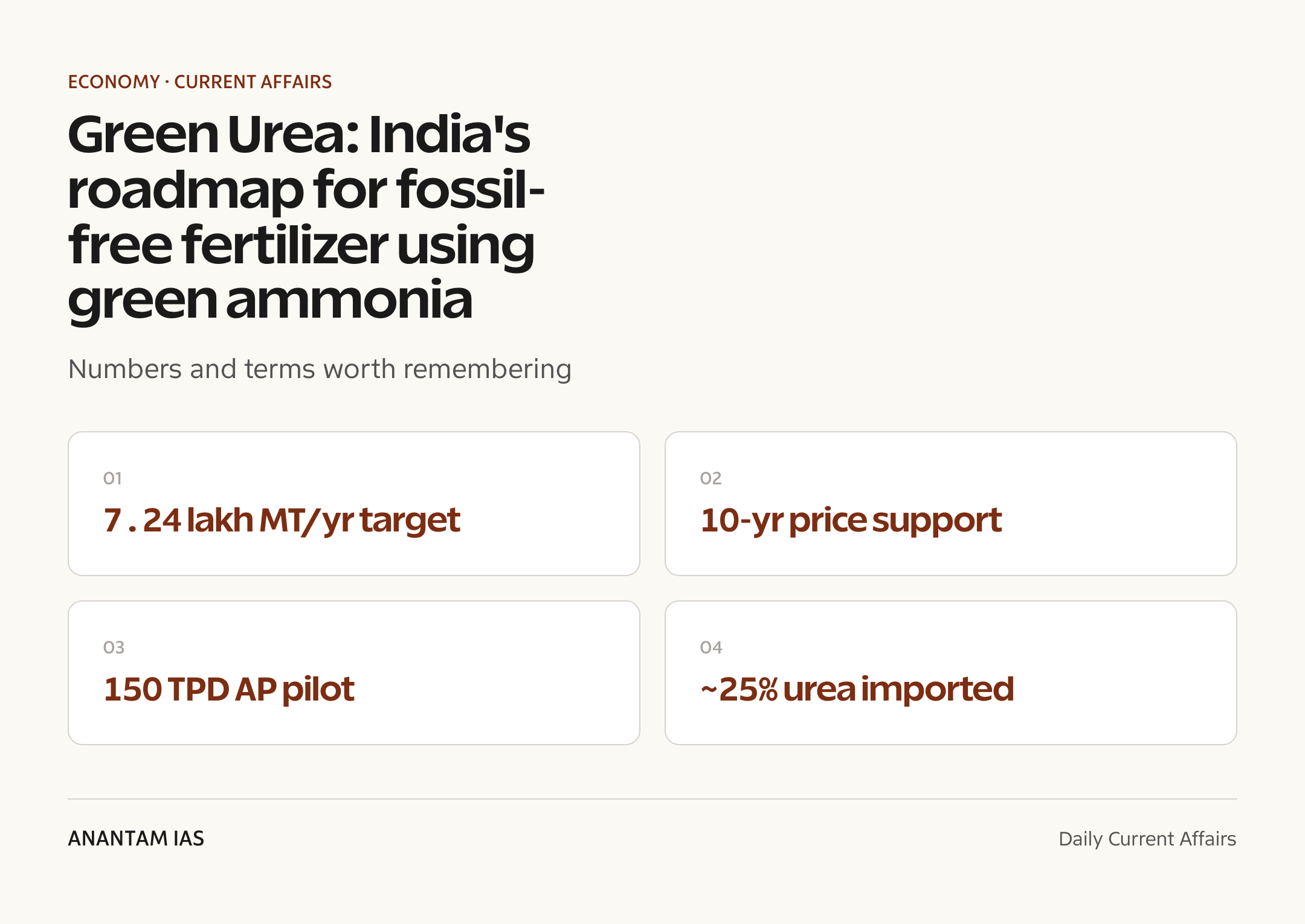
The design pairs three instruments that earlier worked in silos: MNRE funding under the National Green Hydrogen Mission, a procurement and price-support role for the Solar Energy Corporation of India (SECI), and the fertilizer-subsidy machinery of the DoF. The reported procurement target is 7.24 lakh tonnes per annum of green ammonia, to be awarded through a competitive e-reverse auction.
- DoF EOI invites developers to build Green Urea plants; a Pre-EOI consultation was held with industry at PDIL, Noida.
- SECI will purchase green ammonia from producers and supply it to domestic fertilizer companies at market-linked grey-ammonia prices, absorbing the green premium.
- A reported 7.24 lakh MT/year green-ammonia procurement target is to be allocated via a SECI-managed e-reverse auction.
- Incentives run from the date of commercial supply and are locked for 10 years through binding agreements, giving developers long-term certainty.
- A 150 tonnes-per-day Green Urea pilot at Pudimadaka, Andhra Pradesh is being developed by NETRA, the R&D arm of NTPC.
The development matters in the context of:
- Urea is the world’s most-used nitrogen fertilizer; conventionally it is made by reacting ammonia (NH3) with carbon dioxide, and the ammonia itself comes from the Haber-Bosch process using grey hydrogen stripped from natural gas.
- Green urea swaps grey hydrogen for green hydrogen (water split by electrolysers run on solar or wind), so the resulting green ammonia and urea carry near-zero production emissions.
- India imports roughly 25-26% of its urea demand and about 85% of the natural gas used to make urea domestically, so the feedstock is a strategic and fiscal vulnerability.
UPSC Relevance
Prelims Relevance
- Green hydrogen is produced by electrolysis of water using renewable electricity; grey hydrogen uses fossil natural gas without carbon capture.
- Ammonia (NH3) is synthesised from nitrogen and hydrogen via the Haber-Bosch process; it is the precursor for urea.
- The National Green Hydrogen Mission (2023) has an outlay of Rs 19,744 crore and targets at least 5 MMT/year of green hydrogen by 2030.
- The Mission targets about 125 GW of added renewable capacity and aims to avoid nearly 50 MMT of CO2 per year by 2030.
- SECI (Solar Energy Corporation of India) is a CPSE under MNRE that runs renewable-energy auctions and aggregation.
- Urea stays outside the Nutrient Based Subsidy (NBS) regime; its MRP is fixed by the Centre at about Rs 242 per 45-kg bag.
- Non-urea fertilizers such as DAP and MOP are covered under NBS, where subsidy is linked to nutrient content.
- The SIGHT programme (Strategic Interventions for Green Hydrogen Transition) is the largest financial component of the Green Hydrogen Mission.
Mains Relevance
GS Paper 3
- Energy security and decarbonisation: how a green-hydrogen-to-fertilizer value chain reduces both import dependence and the carbon footprint of agriculture.
- Fertilizer subsidy reform and fiscal sustainability: whether a differential-pricing model can deliver green urea without inflating an already large subsidy bill.
- Industrial policy and demand creation: using public procurement (SECI aggregation, e-reverse auctions) to seed an early market for green ammonia.
Essay
- Self-reliance and sustainability are not rivals: India’s path to fertilizer security can also be its path to decarbonisation.
- Technology is only as transformative as the institutions that price it.
Background and Context
What green urea and green ammonia actually are
The chemistry tells you exactly where the carbon hides and how it is removed.
- Urea production needs ammonia; ammonia needs hydrogen. Conventionally the hydrogen is grey hydrogen reformed from natural gas, which releases CO2.
- Green hydrogen replaces that step: water is split into hydrogen and oxygen by electrolysers powered by solar or wind, with no carbon emitted at the point of production.
- Combining green hydrogen with nitrogen from air via the Haber-Bosch process yields green ammonia, which is then reacted with CO2 to make green urea.
- The label green refers to the fossil-free feedstock, not a different molecule. Green urea is chemically identical to ordinary urea (the same 46% nitrogen content) but produced without natural gas.
The EOI and scheme design
The novelty is the pricing plumbing, not the chemistry.
- The Department of Fertilizers EOI invites developers to build Green Urea plants, with a Pre-EOI consultation held at PDIL, Noida to surface industry concerns.
- Because green ammonia costs more than conventional grey ammonia, a differential subsidy bridges the gap: the DoF covers the premium so manufacturers receive green ammonia at parity with grey feedstock.
- SECI aggregates demand, buys green ammonia from producers, and on-sells it to fertilizer companies at market-linked grey-ammonia prices, taking on the price-discovery and contracting role.
- Allocation runs through a competitive e-reverse auction for a reported 7.24 lakh tonnes per annum, with support fixed for 10 years from the start of commercial supply.
Link to the National Green Hydrogen Mission
Green urea is the demand anchor the hydrogen mission has been looking for.
- The National Green Hydrogen Mission (2023), with a Rs 19,744 crore outlay, targets at least 5 MMT/year of green hydrogen by 2030 and around 125 GW of new renewable capacity.
- MNRE support flows largely through the SIGHT programme, which incentivises both electrolyser manufacturing and green-hydrogen production.
- Fertilizer is one of the hardest-to-electrify, ammonia-hungry sectors, so guaranteed green-ammonia offtake creates the stable demand that makes electrolyser investment bankable.
- Read our explainer on the Green Hydrogen Policy and National Mission for the full mission architecture.
Why it matters: urea import and subsidy burden
The economic case rests on two stubborn dependencies.
- India imports about 25-26% of its urea, and roughly 85% of the natural gas feeding domestic urea plants is imported, exposing farmers and the budget to global price swings.
- The fertilizer subsidy has ballooned, with urea alone accounting for close to two-thirds of the total subsidy bill in recent years.
- Urea remains outside the Nutrient Based Subsidy regime, sold at a Centre-fixed MRP of about Rs 242 per 45-kg bag, which keeps demand high and the subsidy open-ended.
- Domestically produced green urea, run on Indian renewables, can chip away at both the natural-gas import bill and the long-run subsidy exposure to volatile gas prices.
Challenges and the cost question
The premium is real, and so are the execution risks.
- Cost parity is not yet here: green ammonia is dearer than grey, and the differential subsidy shifts that gap onto the exchequer rather than eliminating it.
- Electrolyser capacity, cheap firm renewable power, and water availability all have to scale together; intermittency raises the effective cost of running ammonia plants continuously.
- The model depends on credible 10-year contracts and timely auctions; weak demand aggregation or price disputes could stall offtake.
- Pilots such as the 150 TPD plant at Pudimadaka (NETRA/NTPC) are essential to validate costs before any large-scale, nationwide rollout.
Way Forward
Drive down the green premium
- Scale electrolyser manufacturing under SIGHT and secure low-cost firm renewable power so the differential subsidy shrinks over time rather than becoming permanent.
- Use long-tenure offtake and round-the-clock renewable contracts to cut the cost of continuous ammonia synthesis.
Sequence pilots before scale
- Use the Pudimadaka pilot and similar projects to lock down real-world capital and operating costs before committing to mass procurement.
- Publish transparent auction outcomes so price discovery improves with each tranche.
Protect fiscal discipline
- Cap and ring-fence the differential subsidy with a glide path, tying support to declining green-ammonia costs.
- Pair green urea with demand-side reform (balanced fertilization, nano urea, soil-health-led efficiency) so the subsidy base does not keep expanding.
Conclusion
Green urea stitches together three policy worlds that rarely talk to each other: renewable energy, fertilizer self-reliance, and climate action. By letting SECI aggregate demand and the Department of Fertilizers absorb the green premium, the EOI tries to convert a clean-fuel ambition into a bankable industrial market.
The test will be cost. If the green premium falls as electrolysers and renewables scale, India gains a domestic, low-carbon fertilizer base and trims a structural import dependence. If it does not, the country merely shifts one subsidy for another. The pilots and the early auctions will decide which way the roadmap runs.
UPSC Practice Questions
Prelims MCQ 1
With reference to green ammonia and green urea, consider the following statements:
- Green ammonia is produced using hydrogen obtained from the electrolysis of water powered by renewable energy.
- Green urea differs chemically from conventional urea and contains a higher percentage of nitrogen.
- The Haber-Bosch process is used to synthesise ammonia from nitrogen and hydrogen.
How many of the above statements are correct?
(a) Only one (b) Only two (c) All three (d) None
Answer: (b) Only two
Explanation:
Statements 1 and 3 are correct. Statement 2 is wrong: green urea is chemically identical to conventional urea (same ~46% nitrogen); only the feedstock (green vs grey hydrogen) differs.
Prelims MCQ 2
Which of the following best describes the proposed role of the Solar Energy Corporation of India (SECI) in India’s Green Urea roadmap?
(a) It will manufacture green urea directly and sell it to farmers at a fixed MRP. (b) It will purchase green ammonia from producers and supply it to fertilizer companies at grey-ammonia-linked prices. (c) It will regulate the maximum retail price of all fertilizers under the Nutrient Based Subsidy. (d) It will fund electrolyser imports through the Department of Fertilizers.
Answer: (b) It will purchase green ammonia from producers and supply it to fertilizer companies at grey-ammonia-linked prices.
Explanation:
SECI aggregates demand, buys green ammonia, and on-sells it at market-linked grey-ammonia prices; the Department of Fertilizers covers the differential. SECI does not set fertilizer MRPs or make urea.
UPSC Mains Questions
- Green urea links the National Green Hydrogen Mission to fertilizer self-reliance. Examine the design of the proposed differential-pricing model and the fiscal and technological challenges it must overcome. (GS Paper 3)
- India’s urea sector is doubly exposed, to imported fertilizer and imported natural gas. Discuss how a green-ammonia value chain could address this, and the reforms needed to keep the fertilizer subsidy sustainable. (GS Paper 3)
Source: PIB, Department of Fertilizers.
Frequently Asked Questions
What is green urea?
Green urea is ordinary urea made without fossil fuels. Its feedstock is green ammonia, produced from green hydrogen (water split by renewable-powered electrolysers) instead of natural-gas-based grey hydrogen. The fertilizer itself is chemically identical to conventional urea.
How is green ammonia different from grey ammonia?
Both are the same molecule (NH3). The difference is the hydrogen source: green ammonia uses green hydrogen from renewable electrolysis, while grey ammonia uses hydrogen reformed from natural gas, which emits CO2.
What is the differential-pricing mechanism in the Green Urea plan?
Because green ammonia costs more than grey, the Department of Fertilizers covers the price gap so manufacturers receive green ammonia at parity with conventional feedstock. SECI buys the green ammonia and supplies it at grey-ammonia-linked prices.
How does this connect to the National Green Hydrogen Mission?
Fertilizer is a major ammonia consumer. Guaranteed green-ammonia offtake creates stable demand for green hydrogen, helping the Mission (Rs 19,744 crore outlay, 5 MMT/year target by 2030) build a viable market for electrolysers and renewables.
Why does India need green urea at all?
India imports about a quarter of its urea and roughly 85% of the natural gas used to make urea at home. Domestic green urea, run on Indian renewables, reduces both import exposure and the carbon footprint of fertilizer.
What is the Pudimadaka pilot?
A 150 tonnes-per-day Green Urea pilot plant at Pudimadaka in Andhra Pradesh, developed by NETRA, the R&D arm of NTPC, to validate costs and technology before any large-scale rollout.