Ground control – ISRO must focus on space technology as a tool for development
Why in news ?
Recently, ISRO successfully launched EOS-05, India’s first dedicated earth imaging satellite placed into a geosynchronous orbit using the GSLV-F17 rocket. However, on that very same day, a coalition of nine employee associations representing approximately 5,000 workers (about 27% of ISRO’s workforce) submitted a five-page letter to ISRO Chairman V. Narayanan demanded written clarity on the space agency’s long-term privatization roadmap raising questions over its objectives.
UPSC Relevance
Prelims
GS3, Awareness in the fields of IT, Space, Computers, Robotics, Nano-technology, Bio-technology and issues relating to Intellectual Property Rights.
Recent Space Policy Transition
- From Provider to Facilitator: The Indian Space Policy 2023 pivots ISRO’s role toward high-value R&D, space exploration, and deep-space missions, while delegating routine operational, satellite, and launch activities to private entities via IN-SPACe and NSIL.
- Institutional Framework:
- IN-SPACe (Indian National Space Promotion and Authorization Centre): Acts as a single-window autonomous agency to promote, authorize, and hand-hold private space activities.
- NSIL (NewSpace India Limited): The commercial arm of ISRO, focused on acquiring technology transfers, commercializing space assets, and building launch capacity.
- Institutional Framework:
- India aims to expand its share of the global space economy from 2% to 10% by 2030.
- FDI Relaxation: 100% Foreign Direct Investment is permitted under the automatic route for space component manufacturing, up to 74% for satellite operations, and up to 49% for launch vehicles.
- Global Precedents: Aligns with NASA’s commercialization model (e.g., Commercial Crew Program), transitioning the public agency from a primary manufacturer to an anchor customer.
Concerns with the shift
- Capital & Industrial Realities: Unlike traditional Indian defense and aerospace partners (e.g., L&T, Walchandnagar Industries) built on domestic manufacturing capacity, the new space ecosystem features venture-backed startups focused primarily on downstream digital applications like Satellite-Data-as-a-Service (SDaaS).
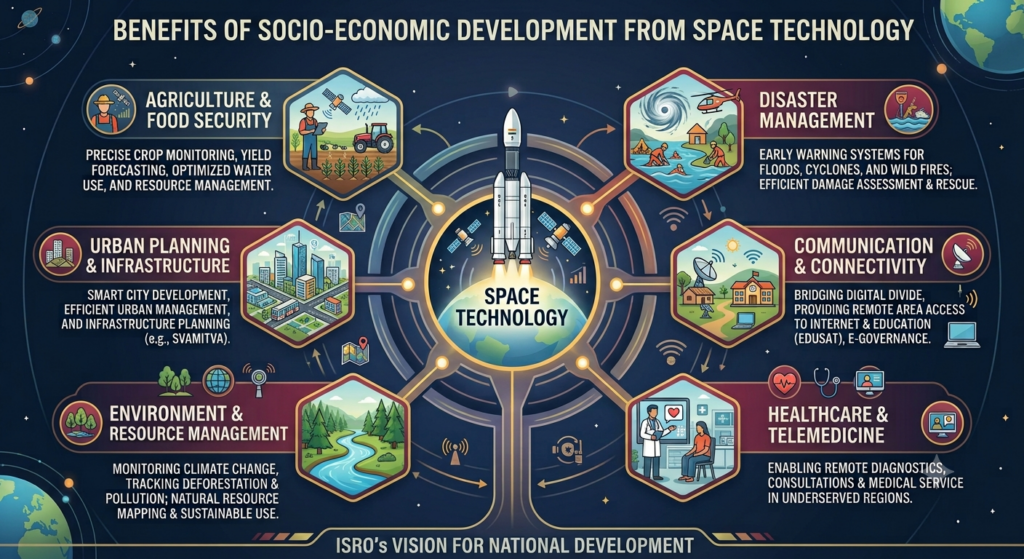
- Foundational Mission vs. Commercial Focus: Reconciling the founding principle envisioned by Dr. Vikram Sarabhai—utilizing space technology primarily as an instrument for socioeconomic development (e.g., EDUSAT, AGRISAT, disaster management)—with high-cost exploratory missions and commercial profitability.
- Socioeconomic Applications: Space assets drive critical development initiatives, including PM Gati Shakti (geospatial mapping), SVAMITVA (land rights mapping), Kisan Drones, and the NavIC positioning system.
- Workforce Anxiety: Uncertainty regarding long-term cadre strength, potential job displacement, and the outsourcing of core technical functions as commercial operations transition out of ISRO’s direct purview.
- Geostrategic Imperatives: Navigating Asian space dynamics requires addressing China’s rapidly expanding civil and military space capacity through sustainable domestic manufacturing, robust supply chain resilience, and precise long-term strategic planning. It can’t be delegated to private players.
Strategies to balance these goals
- Enact a Statutory Space Act: Replace policy guidelines with legislative clarity by enacting a dedicated Space Activities Act. This should define IP ownership, liability frameworks, and insurance norms to provide regulatory certainty for private capital without sacrificing public interest.
- Strengthen IN-SPACe as an Independent Regulator: Elevate IN-SPACe into an autonomous statutory body independent of the Department of Space to avoid conflict-of-interest between ISRO’s operational mandate and commercial regulation.
- Mandate Public-Good Universal Service Obligations (USO): Reserve a specific percentage of private satellite bandwidth and downstream imaging data for public-good applications (e.g., PM Gati Shakti, SVAMITVA, disaster warning) at subsidized rates.
- Institutionalize Technology Transfer Mechanisms: Strengthen NewSpace India Limited’s (NSIL) framework to license ISRO’s legacy technologies to local private firms via fair terms, allowing ISRO to pivot exclusively toward fundamental scientific research.
- Dual-Mission Procurement Strategy: Transition ISRO into an “Anchor Customer” by procuring routine launch services and satellite platforms from private Non-Governmental Entities (NGEs), freeing up public funds for deep-space missions (e.g., Gaganyaan, Chandrayaan).
- Open-Access Data Policy for Development: Maintain ISRO’s satellite data platforms (like BHUVAN) as open-access resources for academic research, climate action, and rural governance, while monetizing high-resolution commercial applications.
- Workforce Protection & Upskilling: Restructure ISRO’s cadre through specialized retraining programs to shift personnel smoothly from industrial manufacturing roles toward advanced deep-tech research and regulatory governance.
- Incubation & PPP Models: Create regional Space Tech Incubation Centres (STIC) focused specifically on social-impact space applications (such as agritech, water management, and urban planning startups) alongside commercial rocket ventures.
India must harmonize commercial space ambitions with Sarabhai’s socio-economic vision, leveraging private innovation for market efficiency while safeguarding ISRO’s deep-tech expertise for national development.
Practice MCQ
Q. With reference to India’s evolving space sector framework, consider the following statements:
- IN-SPACe operates as a statutory regulatory body established under the Space Activities Act to authorize non-governmental entities.
- Under current FDI guidelines, up to 100% foreign direct investment is permitted under the automatic route for satellite manufacturing and operations.
- NewSpace India Limited (NSIL) is mandated to commercially exploit products and services emanating from Indian space research.
Which of the statements given above is/are correct?
(a) 1 and 2 only
(b) 3 only
(c) 2 and 3 only
(d) 1, 2, and 3
Correct Answer: (b) 3 only
Statement 1 is incorrect: IN-SPACe was created via executive notification under the Department of Space, not through a legislative Space Activities Act. Hence, it is not a statutory body.
Statement 2 is incorrect: 100% FDI under the automatic route is allowed for manufacturing of components/sub-systems, but limited to 74% under the automatic route for satellite manufacturing and operations.
Statement 3 is correct: NSIL is the commercial arm of ISRO tasked with technology transfer and commercializing space assets.
Practice Question
“The commercialization of India’s space sector represents a vital paradigm shift, yet it must not dilutive ISRO’s foundational vision of space technology as an instrument for socio-economic development.” Discuss the emerging friction between commercial objectives and public-good development in India’s space policy. (10 Marks | 150 Words)