Gujarat High Court Links Starvation, Dignity and Welfare Failure
Why in News?
The Gujarat High Court granted bail to an impoverished woman accused of murdering her daughter, with The Hindu reporting that the court considered the background of poverty and starvation.
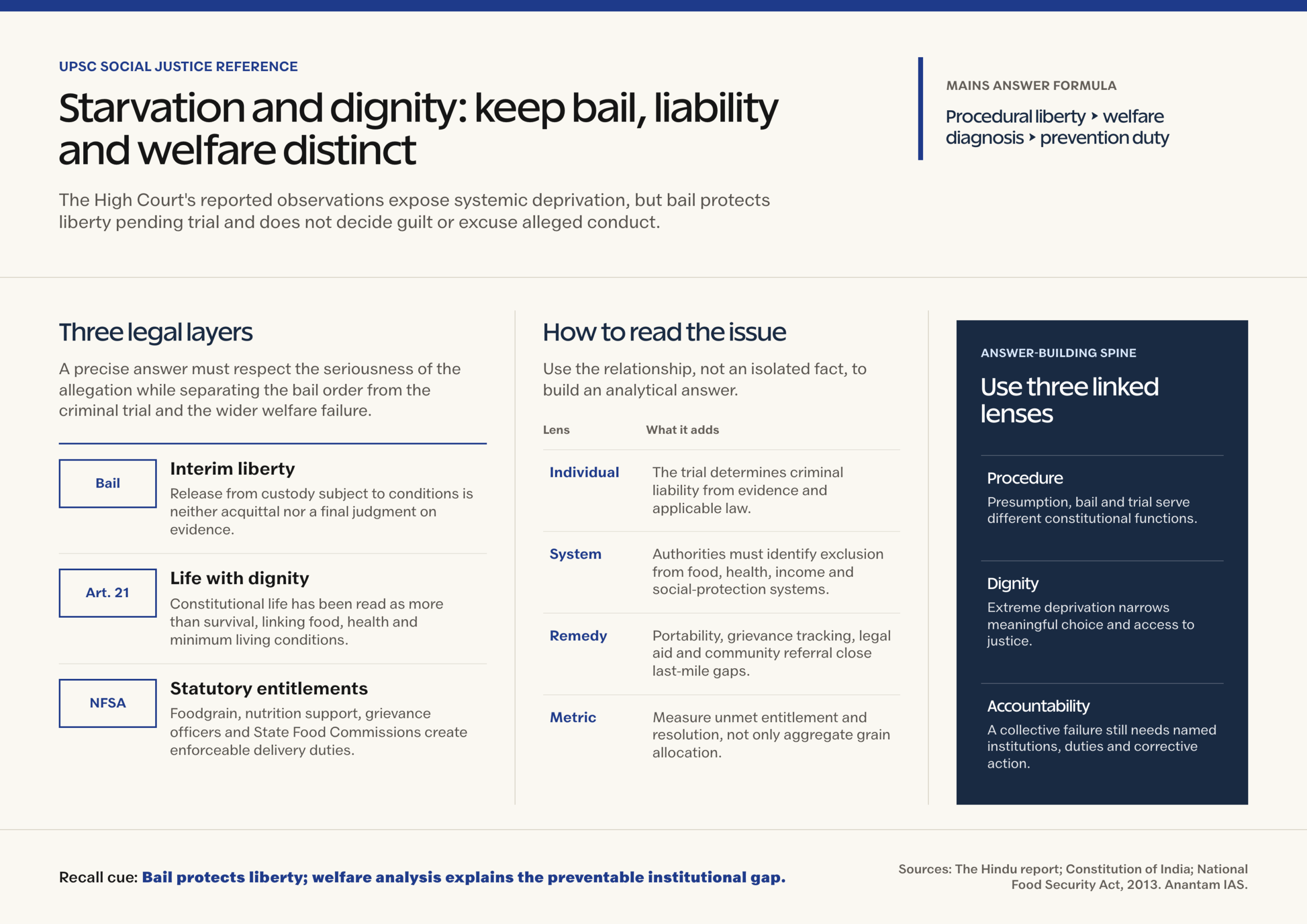
- The order arose at the bail stage. A bail court decides whether continued custody is justified while proceedings continue; it does not conduct the full criminal trial.
- The woman remains an accused person. Grant of bail is neither acquittal nor a final finding that poverty legally excuses the alleged offence.
- The reported observations ask a wider constitutional question: what responsibility do the State, community and welfare systems bear when a household cannot secure food, healthcare and minimum living conditions?
- The case highlights the difference between individual criminal liability, which the trial must determine from evidence, and public responsibility for preventing hunger and destitution.
- Any discussion of the child’s death must retain the seriousness of the allegation while avoiding a conclusion on facts that the trial court has not yet adjudicated.
- Article 21 protects life and personal liberty, and Supreme Court jurisprudence has read life with dignity more broadly than mere animal existence.
- Articles 39(a), 39A and 47 direct the State toward adequate livelihood, equal justice, nutrition, public health and improved living standards, although Directive Principles are not directly enforceable like Fundamental Rights.
- The National Food Security Act, 2013 converts specified food and nutrition support into statutory entitlements and creates grievance-redress mechanisms.
UPSC Relevance
Prelims Relevance
- Article 21 states that no person shall be deprived of life or personal liberty except according to procedure established by law.
- Article 39(a) asks the State to direct policy toward securing an adequate means of livelihood for citizens, men and women equally.
- Article 39A concerns equal justice and free legal aid so that economic or other disabilities do not deny access to justice.
- Article 47 makes raising the level of nutrition, standard of living and public health a primary duty of the State.
- Articles 39 and 47 are part of the Directive Principles of State Policy; Article 37 says these principles are not enforceable by courts but are fundamental in governance.
- The National Food Security Act, 2013 provides subsidised foodgrain entitlements for eligible households and nutritional support for specified categories of women and children.
Mains Relevance
GS Paper 2
- Examine the relationship between Article 21 dignity, Directive Principles and statutory food-security entitlements.
- Assess why welfare delivery fails despite formal coverage, with attention to identification, portability, documentation, grievance redress and local accountability.
GS Paper 1
- Analyse how poverty, gender, unpaid care work and insecure livelihoods can combine to deepen household vulnerability.
- Distinguish structural explanation from the denial of individual agency or the erasure of a child’s rights.
Essay
- A constitutional democracy is tested not only by the rights it declares but by whether a person in acute distress can actually reach food, care and justice.
Background and Context
What the High Court order does and does not decide
Procedural posture is the first fact to get right in any answer on this case.
- The High Court was considering bail, which concerns release from custody subject to conditions while the criminal process continues. The court was not delivering a final judgment after a complete trial.
- At this stage, courts may consider the nature and gravity of the accusation, material available at a prima facie level, likelihood of absconding, risk of witness intimidation or evidence tampering, custody, health and other case-specific circumstances.
- A grant of bail protects liberty pending adjudication. It does not erase the FIR, terminate the prosecution or declare that the alleged conduct did not occur.
- The reported remarks about starvation and collective failure supply context for judicial discretion. Whether every allegation is proved, what mental element existed and what criminal provision applies remain questions for the competent trial court.
- UPSC answers should use precise verbs: the court observed or noted at bail stage; it did not finally hold the State liable for the death or adjudicate the accused’s innocence.
Dignity under Article 21
Indian constitutional law treats life as more than physical survival.
- Article 21’s guarantee of life and personal liberty has been judicially interpreted to protect a life of human dignity, subject to constitutionally valid procedure and reasonable State action.
- Food, shelter, health and livelihood are interconnected because their absence can make other liberties nominal. A person cannot meaningfully exercise choice or access institutions while facing immediate hunger and untreated illness.
- The right-to-life framework does not make every policy preference a directly enforceable Fundamental Right. Courts connect the text of Article 21 with statutory duties, Directive Principles and the facts before them.
- Dignity belongs to both the deceased child and the accused mother. A rights-based approach must protect the child’s life and bodily integrity while ensuring the accused receives fair procedure, legal representation and freedom from prejudgment.
- Constitutional compassion is not a defence created outside criminal law. It is a demand that State power, including detention and prosecution, operate with fairness, proportionality and attention to vulnerability.
Directive Principles create a governance mandate
The Constitution’s social-welfare commitments guide legislation and public administration even when they are not independently enforceable.
- Article 39(a) calls for an adequate means of livelihood, Article 39(e) protects the health and strength of workers, and Article 39(f) seeks conditions in which children develop with freedom and dignity.
- Article 47 makes improved nutrition, living standards and public health a primary duty of the State. Article 39A links economic vulnerability with equal justice and free legal aid.
- Article 37 provides the constitutional balance: Directive Principles are not enforceable by any court, yet they are fundamental in governing the country and the State must apply them in making laws.
- Parliament and State legislatures translate these directives into enforceable schemes and statutes. Once legislation creates a concrete entitlement, administrative failure can be tested against that law and ordinary public-law standards.
- Calling deprivation a collective failure widens attention from a single office to the chain of responsibility: Union and State policy, district administration, local bodies, frontline workers, family networks and community institutions. It should not blur who.
National Food Security Act as an entitlement framework
The National Food Security Act moves food support from discretionary relief toward identified legal entitlements.
- The Act provides foodgrain entitlements for eligible priority and Antyodaya households and nutritional support to pregnant women, lactating mothers and children through specified institutional channels.
- Its design recognises that food security requires more than grain availability. Identification, regular delivery, maternal support, child nutrition and access to a functioning outlet or meal service all affect real outcomes.
- Section 8 provides for a food security allowance when an entitled person does not receive foodgrain or meals. This turns a delivery failure into a question of remedy rather than charity alone.
- The Act provides internal grievance mechanisms, a District Grievance Redressal Officer and State Food Commissions. These bodies matter only when beneficiaries know where to complain, officials respond quickly and orders are implemented.
- Social audits, vigilance committees, disclosure and records can identify leakage or exclusion, but acute hunger needs an emergency response that does not wait for a long appellate process.
Way Forward
Create a no-wrong-door hunger response
- Authorise district helplines, local bodies, hospitals, anganwadi centres and fair-price shops to arrange time-bound emergency food support and refer the household for a fuller assessment.
- Do not make temporary relief conditional on completing every documentation correction first; verify eligibility in parallel where the law permits.
- Assign one case coordinator for households facing multiple risks so that food, health, child protection, legal aid and livelihood services do not operate as isolated files.
Conclusion
- The Gujarat High Court’s reported observations convert an individual bail matter into a difficult governance question: how can a constitutional welfare system fail to reach a household facing extreme deprivation?
- The legal boundary remains equally important.
UPSC Practice Questions
Prelims MCQ 1
With reference to constitutional and statutory food security in India, consider the following statements:
- Article 47 identifies raising nutrition and the standard of living and improving public health as a primary duty of the State.
- The National Food Security Act provides for a food security allowance when entitled foodgrain or meals are not supplied, subject to its provisions.
- Directive Principles of State Policy are enforceable by courts in the same manner as Fundamental Rights.
How many of the above statements are correct?
(a) Only one (b) Only two (c) All three (d) None
Answer: (b) Only two
Explanation:
Statements 1 and 2 are correct. Article 47 sets the nutrition, living-standard and public-health duty, and Section 8 of the National Food Security Act provides a food security allowance for non-supply of entitlements. Article 37 says Directive Principles are not enforceable by courts, though they are fundamental in governance.
Prelims MCQ 2
Which one of the following most accurately describes the legal effect of granting bail to an accused person?
(a) It amounts to acquittal of the accused (b) It permanently terminates the criminal proceedings (c) It permits release from custody, usually subject to conditions, while proceedings continue (d) It shifts the burden to the victim to prove the FIR was true
Answer: (c) It permits release from custody, usually subject to conditions, while proceedings continue
Explanation:
Bail concerns liberty pending investigation or trial and may carry conditions. It is not an acquittal or termination of the case. Final guilt is determined through the criminal process on evidence and the applicable standard of proof.
UPSC Mains Questions
- The right to food in India lies at the intersection of Article 21, Directive Principles and statutory entitlements. Explain, and identify the reforms needed to prevent last-mile exclusion. (250 words)
- Social context can inform bail without deciding criminal guilt. Discuss with reference to poverty, dignity, legal aid and the presumption of innocence. (250 words)
Sources: India Code, National Food Security Act, 2013 and The Hindu.
Frequently Asked Questions
Did the Gujarat High Court acquit the woman?
No. The High Court granted bail, which permits release from custody subject to legal conditions while proceedings continue. The reported observations about poverty and starvation were made at that preliminary stage. The trial court must still assess the evidence.
Does poverty excuse a criminal offence?
Poverty is not an automatic legal excuse for causing harm. It may be relevant to social context and, depending on proven facts and applicable law, to bail or other judicial decisions. The prosecution must still prove the charged offence, while.
Is the right to food expressly written in Article 21?
Article 21 expressly protects life and personal liberty; it does not list food in those words. Courts have interpreted life to include human dignity, while the National Food Security Act and Directive Principles provide more specific food and nutrition.
What remedy exists when an NFSA entitlement is not supplied?
Section 8 of the National Food Security Act provides for a food security allowance when entitled foodgrain or meals are not supplied, subject to the Act’s framework. Complaints can also move through the internal mechanism, District Grievance Redressal Officer and.
Why is Article 39A relevant to this case?
Article 39A directs the State to secure equal justice and provide free legal aid so that economic disability does not deny access to justice. Poor accused persons may struggle to obtain counsel, documents or workable release conditions. Legal-services authorities help.