Guwahati Declaration: BRICS anti-drug agencies agree on joint action against trafficking
Why in News?
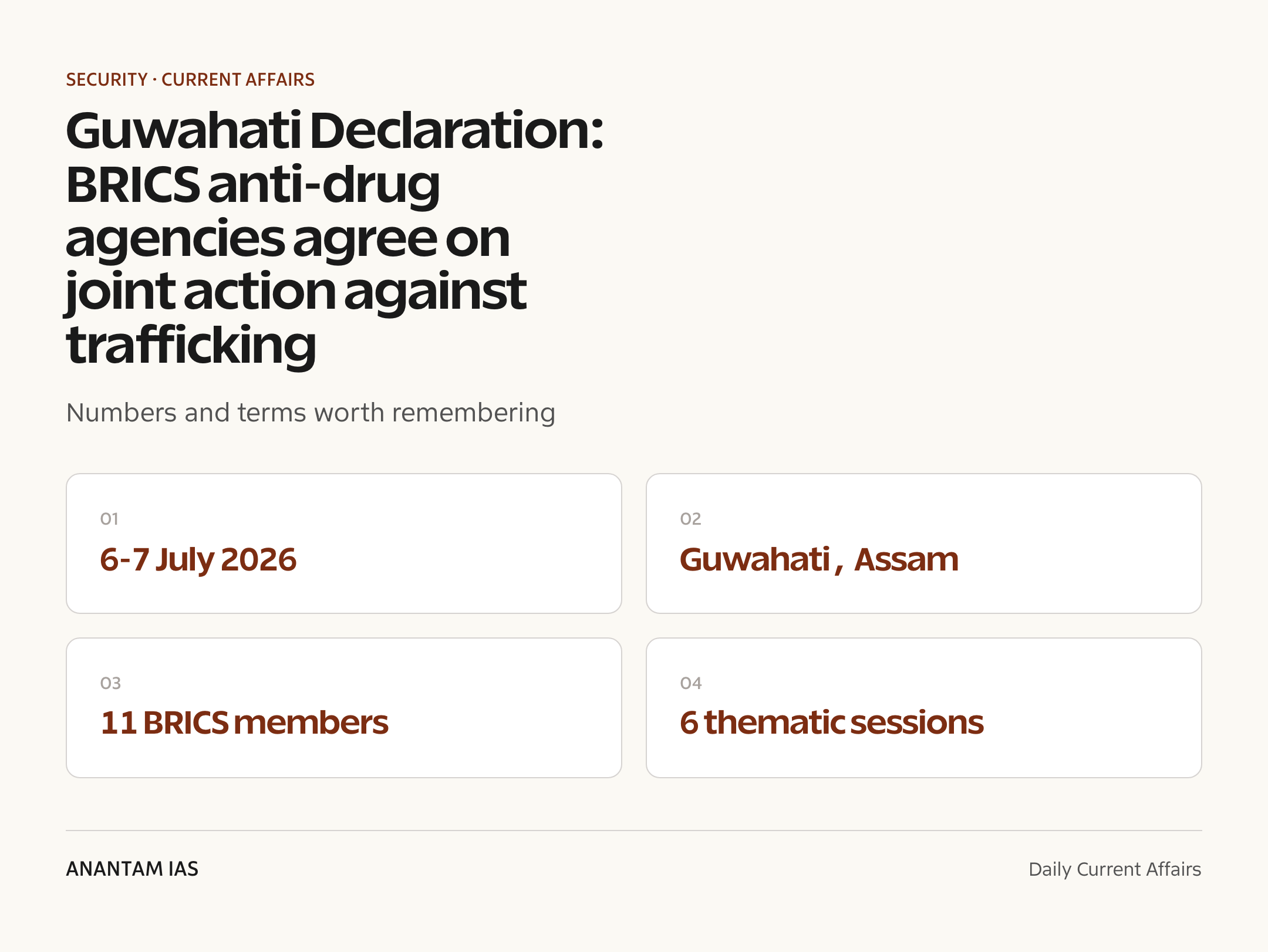
The heads of anti-drug agencies of the BRICS grouping, meeting in Guwahati on 6–7 July 2026 under India’s chairship, adopted the Guwahati Declaration — a joint commitment to coordinated action against illicit drug trafficking and transnational organised crime. The two-day meeting was hosted by the Narcotics Control Bureau (NCB) under the Ministry of Home Affairs. It marks the first time a BRICS counter-narcotics conclave has been held in India’s Northeast, a region that sits directly on the trafficking routes running out of the Golden Triangle.
As per PIB and reports from India Today NE, the declaration prioritises real-time intelligence sharing, tackling synthetic drugs and precursor diversion, and countering darknet– and cryptocurrency-enabled trafficking. India proposed a BRICS Virtual Working Group for faster operational coordination. The move signals a broadening of BRICS from a mainly economic and financial platform into a working forum for internal-security and law-enforcement cooperation, an agenda India has pushed through its 2026 chairship.
- Meeting held 6–7 July 2026 in Guwahati, Assam, hosted by the NCB, Ministry of Home Affairs.
- Culminated in the adoption of the Guwahati Declaration (a Joint Declaration) on 7 July.
- NCB Director General Anurag Garg proposed a BRICS Virtual Working Group and enhanced cross-border training for real-time intelligence sharing.
- Deliberations spanned six thematic sessions on emerging challenges — darknet, NPS, precursor leakage, digital interdiction.
- Held under India’s 2026 BRICS Chairship, themed “Building for Resilience, Innovation, Cooperation and Sustainability”.
The development matters in the context of:
- India sits between the world’s two largest opium-producing belts — the Golden Crescent (Afghanistan-Iran-Pakistan) and the Golden Triangle (Myanmar-Laos-Thailand) — making it both a transit and consumption zone.
- Follows India’s release of the Vision Document on Drug Control (2026–2029) and the NCB Annual Report 2025, signalling a shift from dialogue to action-oriented enforcement.
UPSC Relevance
Prelims Relevance
- Guwahati Declaration — adopted at BRICS Heads of Anti-Drug Agencies Meeting, July 2026
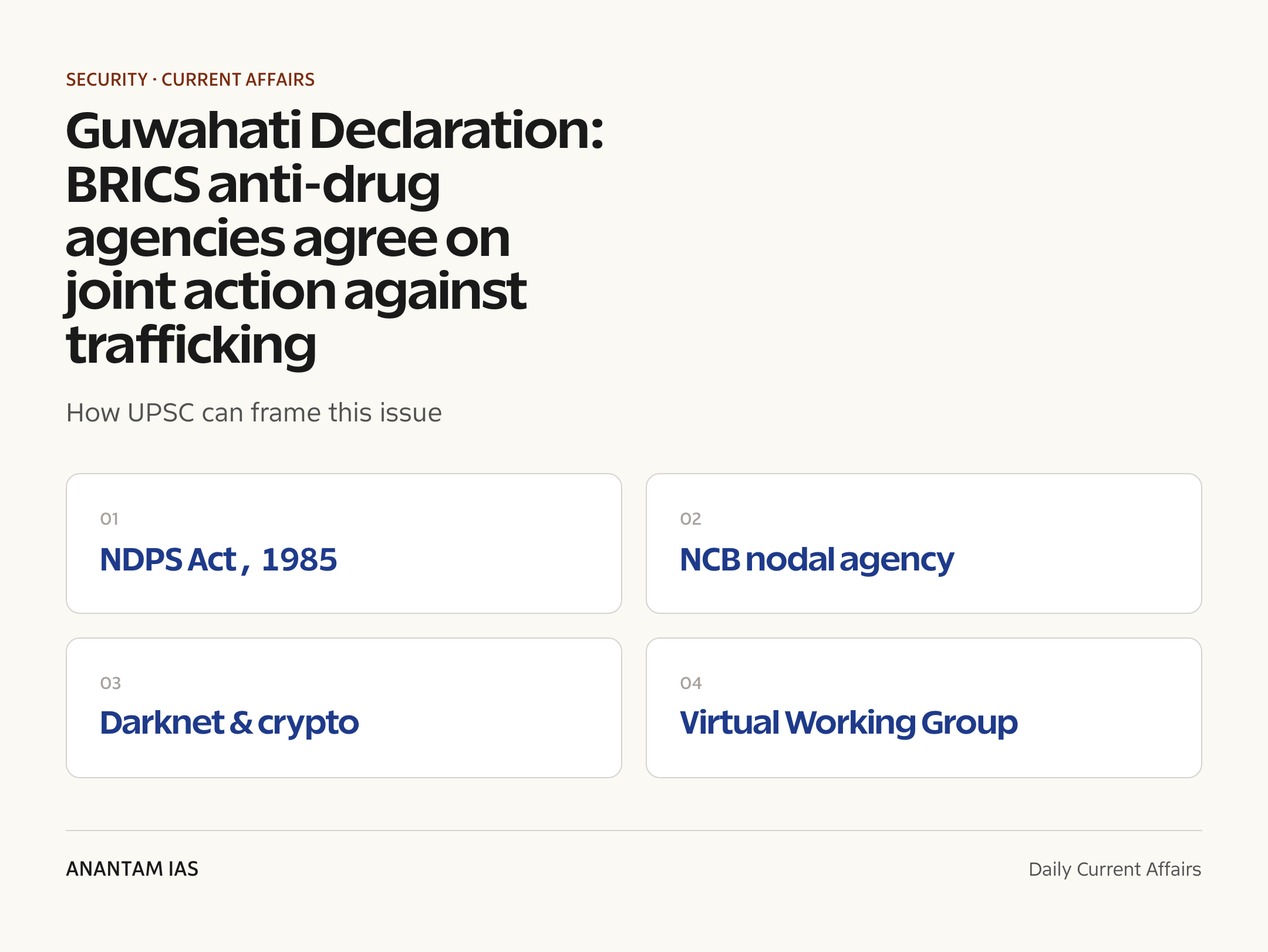
- Narcotics Control Bureau (NCB) — central nodal agency under Ministry of Home Affairs
- NDPS Act, 1985 — governs narcotic drugs and psychotropic substances in India
- New Psychoactive Substances (NPS) and synthetic drugs — emerging threat category
- Precursor chemicals — substances used to manufacture illicit drugs; diversion is a key concern
- MANAS-1933 — National Narcotics Helpline (Madak Padarth Nishedh Asoochna Kendra)
- NCORD — Narco-Coordination Centre, four-tier drug-enforcement coordination mechanism
- BRICS membership — 11 nations after 2024–25 expansion (Brazil, Russia, India, China, South Africa + Egypt, Ethiopia, Iran, Saudi Arabia, UAE, Indonesia)
- India’s 2026 BRICS Chairship theme and priorities
- Vision Document on Drug Control (2026–2029); Nasha Mukt Bharat Abhiyaan
- “Detect, Disrupt and Destroy” — India’s narcotics-control strategy
Mains Relevance
GS Paper 3
- Linkages of organised crime with terrorism; role of external state and non-state actors in creating challenges to internal security — drug trafficking, darknet, crypto-enabled finance.
- Money-laundering and its prevention; use of technology in internal security and border management.
GS Paper 2
- Bilateral, regional and global groupings involving India and their interests; effect of policies of developed and developing countries on India’s interests — BRICS as a security-cooperation platform.
Essay
- Borderless crime, bordered enforcement: cooperation as the frontline against synthetic drugs.
- Technology as both the enabler and the antidote of transnational trafficking.
Background and Context
What the Guwahati Declaration commits to
The declaration converts BRICS drug-control dialogue into an action-oriented framework.
- Reaffirms commitment to combating illicit drug trafficking and transnational organised crime, anchored in national laws and international obligations.
- Pledges timely exchange of information, intelligence and best practices among member anti-drug agencies.
- Promotes innovative technologies, digital tools and data-driven approaches to counter trafficking.
- Flags concern over synthetic drugs, misuse of emerging technologies, and virtual assets (cryptocurrencies) in illicit finance.
- Prioritises protection of children and youth through evidence-based prevention and demand reduction.
- Situates the pledge within the three UN drug-control conventions and the mandate of the UNODC, keeping the framework consistent with the global regime rather than parallel to it.
- Being a declaration, it is politically binding but not a treaty — its value depends on member agencies converting the language into standing operating channels.
India's proposal: a Virtual Working Group
New Delhi pushed for a permanent, always-on coordination mechanism.
- NCB DG Anurag Garg called for a partnership built on “speed, mutual trust and real-time intelligence sharing.”
- Proposed a BRICS Virtual Working Group to enable near-instant exchange on clandestine labs and synthetic-drug trends.
- The group is conceived as an always-on digital channel, so a seizure or a new NPS analogue detected in one country can be flagged to the others within hours, not months.
- Sought cross-border training programmes, expert exchanges and shared best practices among enforcement officers.
- Aim: dismantle transnational drug syndicates through a unified enforcement network rather than episodic dialogue.
- Complements existing bilateral and UN channels but is faster and narrower — a peer network of agencies that already speak the same operational language.
The three priority areas and six sessions
The agenda was structured around present-day trafficking realities.
- Priority areas: combating synthetic drugs and precursor diversion; strengthening intelligence sharing and operational coordination; capacity building and institutional cooperation.
- Thematic sessions covered real-time drug interdiction via digital technology and neutralising trafficking over the darknet.
- Sessions on tackling New Psychoactive Substances (NPS) and securing global supply chains against precursor and chemical leakage.
- Further sessions on drug-demand reduction and strengthening institutional mechanisms for follow-through.
- The structure mirrors the modern trafficking chain — chemistry (precursors), logistics (supply chains), marketplace (darknet) and money (crypto) — so cooperation targets every link rather than only the finished consignment.
The NDPS Act, 1985 and its statutory scheme
India’s entire drug-control effort rests on one framework law.
- The Narcotic Drugs and Psychotropic Substances (NDPS) Act, 1985 is the parent statute prohibiting the production, manufacture, cultivation, possession, sale, purchase, transport and consumption of narcotic drugs and psychotropic substances, except for medical and scientific purposes.
- It gives effect to India’s obligations under the three UN conventions — the 1961 Single Convention on Narcotic Drugs, the 1971 Convention on Psychotropic Substances and the 1988 Convention against Illicit Traffic.
- Amended in 1988, 2001 and 2014 — the 2001 amendment rationalised punishment by quantity slabs (small / commercial), and the 2014 amendment eased access to essential narcotic drugs for pain relief.
- Provides for stringent bail conditions, property forfeiture of illegally acquired assets, and preventive detention under the linked PIT-NDPS Act, 1988.
- The Act also empowers the government to regulate controlled substances and precursor chemicals, the upstream inputs synthetic-drug makers depend on.
The NCB and India's coordination architecture
One nodal agency sits atop a multi-tier coordination grid.
- The Narcotics Control Bureau (NCB), created in 1986 under the NDPS Act and attached to the Ministry of Home Affairs, is the apex agency to coordinate drug law enforcement across states and central agencies.
- It liaises with customs, DRI, state police, BSF, SSB, Coast Guard and the Directorate of Revenue Intelligence, and is India’s point of contact for the UNODC and INTERPOL on narcotics.
- The NCORD (Narco-Coordination Centre) mechanism, restructured into a four-tier structure (apex, executive, state and district committees), knits together central and state agencies for joint action.
- The NIDAAN portal and a national narcotics database help pool seizure, arrest and case data across agencies.
- The strategy is summed up as “Detect, Disrupt and Destroy” — blending human, technical and community intelligence into a whole-of-government, network-centric approach.
Golden Crescent vs Golden Triangle: India's geography of risk
India is wedged between the world’s two great opium belts.
- The Golden Crescent spans Afghanistan, Iran and Pakistan to India’s west and northwest — historically the largest source of illicit opium and heroin, feeding routes into Punjab, Rajasthan, Gujarat and the Kashmir Valley.
- The Golden Triangle spans Myanmar, Laos and Thailand to the east — now a major hub for methamphetamine and synthetic drugs, feeding routes into the Northeast.
- This dual exposure makes India simultaneously a transit corridor and a growing consumption market, with maritime routes along the coasts adding a third vector.
- Seizures of heroin, methamphetamine tablets (yaba) and hashish along both frontiers underline the two-front nature of the problem.
- The location explains why India frames narcotics not merely as a public-health issue but as a national-security and border-management challenge.
Why the threat has changed: synthetics, precursors and NPS
The trafficking landscape has migrated from bulk consignments to chemistry.
- Synthetic drugs — methamphetamine, tramadol, and fentanyl-class New Psychoactive Substances (NPS) — can be cooked in mobile labs, bypassing crop-based supply and weather dependence.
- Precursor chemicals such as ephedrine, pseudoephedrine and acetic anhydride are diverted from legitimate pharma and chemical industry into clandestine manufacture.
- NPS are engineered to stay a step ahead of scheduling — a molecule is tweaked so it falls outside the controlled list until regulators catch up, which is why real-time information-sharing matters.
- Being potent by weight, synthetics are easier to conceal and courier than bulky opium or hashish, raising the premium on intelligence over physical interdiction.
- India, with a large legitimate pharmaceutical sector, faces a specific challenge in plugging precursor leakage without choking genuine industry.
The digital shift: darknet and crypto-enabled trafficking
Dealing and laundering have moved onto encrypted rails.
- Darknet marketplaces and encrypted messaging apps anonymise buyer, seller and courier, replacing street dealing with drop shipments hidden in ordinary parcels.
- Cryptocurrency and other virtual assets launder proceeds beyond conventional banking trails, complicating the money-following that traditionally cracked syndicates.
- Payments split across wallets, mixers and stablecoins make financial forensics a specialised, cross-border task requiring cooperation with financial-intelligence units.
- Fragmented, borderless and largely digital networks outpace single-country enforcement, making intelligence-led cooperation the only workable response.
- This is precisely the gap the Virtual Working Group and the declaration’s technology-cooperation clauses are designed to close.
India's demand-side and citizen architecture
Enforcement is paired with prevention, reporting and rehabilitation.
- The MANAS-1933 national narcotics helpline (Madak Padarth Nishedh Asoochna Kendra) offers a toll-free, anonymous line for tip-offs, counselling and de-addiction referrals.
- The Nasha Mukt Bharat Abhiyaan (NMBA), run by the Ministry of Social Justice and Empowerment, drives community outreach, awareness and de-addiction across identified vulnerable districts.
- A network of de-addiction and rehabilitation centres and the earlier drug-demand-reduction schemes address the health side of the problem.
- The Vision Document on Drug Control (2026–2029), released by the Union Home Minister with the NCB Annual Report 2025, sets a three-year roadmap blending supply control, demand reduction and harm reduction.
- The design reflects a settled principle: interdiction alone cannot succeed without cutting demand and protecting youth, the constituency the Guwahati Declaration singles out.
BRICS, India's 2026 chairship and the security turn
A security angle expands what BRICS traditionally does.
- BRICS now spans 11 members after its 2024–25 expansion — Brazil, Russia, India, China, South Africa plus Egypt, Ethiopia, Iran, Saudi Arabia, UAE and Indonesia.
- Delegations from Brazil, China, Ethiopia, India, Indonesia, Iran, Russia and the UAE deliberated at Guwahati.
- India’s 2026 chairship theme — “Building for Resilience, Innovation, Cooperation and Sustainability” — foregrounds resilience and people-centred cooperation.
- Counter-narcotics cooperation extends BRICS beyond its economic and financial core (the New Development Bank, local-currency trade) into internal-security and law-enforcement ground.
- Several member states — Iran on the Golden Crescent, and consumer and transit economies across the bloc — have a direct stake in coordinated interdiction, giving the platform natural convergence.
The Northeast dimension
Hosting the meeting in Guwahati was a deliberate signal.
- The Northeast shares a long, porous frontier with Myanmar, placing it on the front line of Golden-Triangle trafficking of heroin and methamphetamine.
- Difficult terrain, riverine borders and cross-border ethnic linkages make interdiction and monitoring harder than on a settled land boundary.
- The drug economy in the region intersects with insurgency financing and organised crime, deepening the internal-security stakes.
- Choosing Guwahati spotlights the region’s exposure and ties a multilateral commitment to a live domestic vulnerability.
- It also fits the government’s broader push to place the Northeast at the centre of India’s Act East and border-security agenda rather than at its margins.
Way Forward
Operationalise the Virtual Working Group
- Stand up the proposed BRICS Virtual Working Group with clear protocols, secure channels and named nodal officers for round-the-clock exchange.
- Build interoperable databases on precursors, clandestine labs and NPS analogues.
Follow the money and the code
- Pair anti-drug agencies with financial intelligence units to trace crypto flows and virtual assets.
- Invest in darknet-monitoring and forensic capacity, plus joint takedowns of trafficking marketplaces.
Balance enforcement with health
- Sustain demand reduction, treatment and rehabilitation alongside interdiction, protecting youth as the declaration urges.
- Convert commitments into measurable, time-bound outcomes to avoid a purely declaratory framework.
Conclusion
The Guwahati Declaration matters less for the paper and more for the plumbing it promises — real-time channels, shared training and a standing working group among agencies that rarely coordinate at speed. Against a threat that has shifted from crop-based opium to lab-made synthetics, encrypted marketplaces and crypto money, the value of a peer network that can move information in hours is exactly where enforcement has been losing ground.
For India, hosting it in the Northeast under its BRICS chairship ties a durable domestic push — the NDPS framework, the NCB, the NCORD grid and the 2026–29 Vision Document — to a multilateral front against a threat that no border, and no single country, can hold alone. The test now is delivery: whether the declaration hardens into working channels and measurable seizures, or remains one more well-drafted statement of intent.
UPSC Practice Questions
Prelims MCQ 1
With reference to the Guwahati Declaration (2026), consider the following statements:
- It was adopted at a meeting of the heads of anti-drug agencies of BRICS nations.
- The meeting was hosted by the Narcotics Control Bureau under the Ministry of Home Affairs.
- It proposed a permanent BRICS military command for counter-narcotics operations.
How many of the above statements are correct?
(a) Only one (b) Only two (c) All three (d) None
Answer: (b) Only two
Explanation:
Statements 1 and 2 are correct. India proposed a BRICS Virtual Working Group for intelligence sharing — not a military command — so statement 3 is wrong.
Prelims MCQ 2
The Narcotics Control Bureau (NCB) functions as the central nodal agency under which of the following laws?
(a) The Unlawful Activities (Prevention) Act, 1967 (b) The Narcotic Drugs and Psychotropic Substances Act, 1985 (c) The Prevention of Money Laundering Act, 2002 (d) The Arms Act, 1959
Answer: (b) The Narcotic Drugs and Psychotropic Substances Act, 1985
Explanation:
The NCB, set up under the Ministry of Home Affairs, is the apex coordinating agency for drug law enforcement under the NDPS Act, 1985.
UPSC Mains Questions
- The migration of drug trafficking from bulk crop-based consignments to synthetic drugs, darknet marketplaces and crypto-enabled finance has outpaced traditional enforcement. Examine how multilateral mechanisms like the Guwahati Declaration can address this, using India’s experience.
- “Internal security is increasingly shaped by transnational networks that no single state can police alone.” Discuss with reference to India’s location between the Golden Crescent and the Golden Triangle and its narcotics-control architecture.
Sources: PIB, Ministry of Home Affairs and India Today NE.
Frequently Asked Questions
What is the Guwahati Declaration?
It is a joint declaration adopted on 7 July 2026 by the heads of anti-drug agencies of BRICS nations, meeting in Guwahati under India’s chairship. It commits members to coordinated action against illicit drug trafficking, real-time intelligence sharing, and countering synthetic drugs, darknet trafficking and crypto-enabled drug finance.
Who hosted the BRICS anti-drug agencies meeting?
The Narcotics Control Bureau (NCB), under the Ministry of Home Affairs, Government of India, hosted the two-day meeting on 6–7 July 2026 in Guwahati, Assam, as part of India’s 2026 BRICS Chairship.
What is the BRICS Virtual Working Group?
It is a mechanism proposed by NCB Director General Anurag Garg to enable near-instant, always-on intelligence sharing among BRICS anti-drug agencies. The idea is to move from periodic dialogue to real-time operational coordination against transnational drug syndicates, backed by cross-border training.
What is the NCB and under which law does it work?
The Narcotics Control Bureau is India’s central nodal agency for drug law enforcement. It coordinates action under the Narcotic Drugs and Psychotropic Substances (NDPS) Act, 1985, and works with state agencies, customs and financial intelligence units to combat trafficking.
Why is India especially exposed to drug trafficking?
India lies between the two largest illicit opium-producing regions — the Golden Crescent (Afghanistan-Iran-Pakistan) to the west and the Golden Triangle (Myanmar-Laos-Thailand) to the east. This makes it both a transit corridor and a consumption market, with the Northeast particularly vulnerable to Golden-Triangle routes.
What are precursor chemicals and why do they matter?
Precursor chemicals are legitimate industrial or pharmaceutical substances that can be diverted to manufacture illicit synthetic drugs. Controlling their diversion — a key priority in the Guwahati Declaration — chokes drug production upstream, before finished narcotics reach the market.