H-1B Fee Proposal: Why the New Legal Route Matters for Indian Workers
Why in News?
On August 26, the US Department of Homeland Security proposed an additional $103,265 fee for cap-subject H-1B petitions, but the proposal is open for comment and is not yet law.
- The proposed charge would be paid by the petitioning employer when filing and would sit on top of other applicable H-1B fees.
- It would cover cap-subject petitions, including the advanced-degree exemption, while cap-exempt petitions would remain outside this particular proposal.
- DHS has opened a 30-day public-comment process; it must consider relevant submissions before deciding whether and how to issue a final rule.
- The proposal follows the judicial vacatur of a separate $100,000 proclamation-based payment; the government’s appeal in that case remains pending.
- Indian professionals are the largest national-origin group among approved H-1B beneficiaries, making changes to employer filing costs especially important for India-US labour mobility.
- The dispute connects migration policy with separation of powers, delegated fee-setting authority, administrative procedure and the economic choices of sponsoring employers.
UPSC Relevance
Prelims Relevance
- H-1B is a US non-immigrant classification for specialty-occupation workers sponsored through employer petitions.
- The annual regular cap is 65,000, with a separate exemption for up to 20,000 beneficiaries holding qualifying advanced US degrees.
- Universities and certain affiliated nonprofit or government research organisations may file cap-exempt petitions.
- A notice of proposed rulemaking invites public comment; it is not the same as a final, effective regulation.
- Section 286 of the US Immigration and Nationality Act concerns immigration fees and the Immigration Examinations Fee Account.
Mains Relevance
GS Paper 2
- Assess skilled-worker mobility as a component of India-US relations and the Indian diaspora’s economic linkages.
- Use the episode to explain delegated legislation, judicial review and procedural limits on executive power.
GS Paper 3
- Evaluate how sharply higher employer costs could reshape outsourcing, local hiring and the movement of Indian technology professionals, without treating projected effects as accomplished facts.
Essay
- Rules governing skilled migration show how domestic administrative choices can redistribute opportunity across borders.
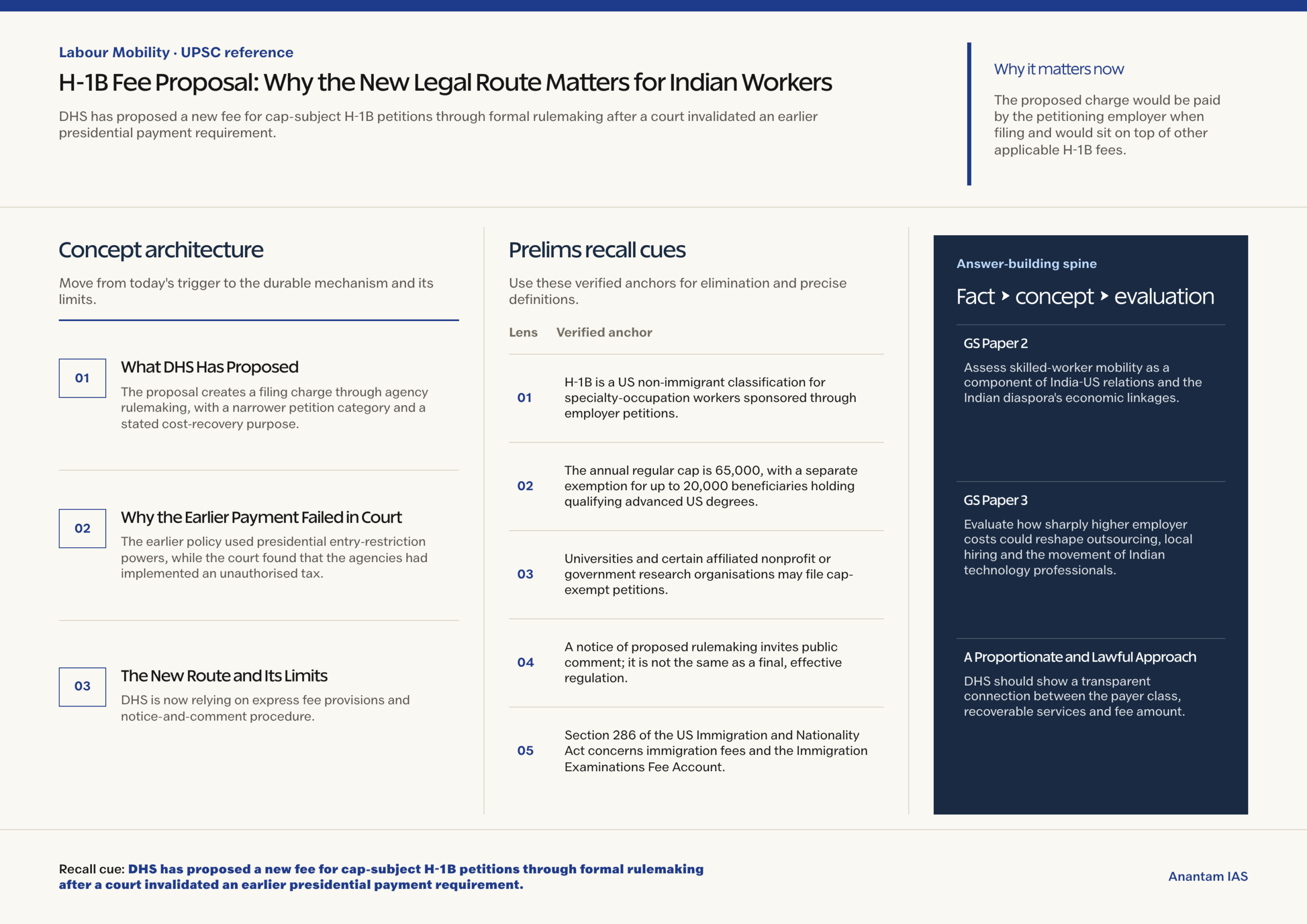
Background and Context
What DHS Has Proposed
The proposal creates a filing charge through agency rulemaking, with a narrower petition category and a stated cost-recovery purpose.
- Under the DHS notice, the additional $103,265 fee would apply to every H-1B petition counted against the annual statutory cap.
- The covered set includes petitions under the advanced-degree exemption; it does not convert every H-1B filing, extension or cap-exempt university petition into a fee-paying case.
- DHS proposes depositing the receipts in the Immigration Examinations Fee Account to recover a portion of immigration-system costs incurred across several federal departments.
- The agency also presents the charge as a labour-market signal that could make employers reassess whether a foreign hire’s specialised skills justify the added filing cost.
- These are proposed effects, not present obligations: publication, public comments, agency consideration and a final rule must precede any announced effective date.
Why the Earlier Payment Failed in Court
The earlier policy used presidential entry-restriction powers, while the court found that the agencies had implemented an unauthorised tax.
- A September 2025 presidential proclamation relied on INA Sections 212(f) and 215(a), which concern restrictions on entry, to require a $100,000 payment with certain new petitions.
- In California v. Mullin, the District of Massachusetts treated the payment as a tax because it raised revenue and burdened otherwise lawful conduct.
- The court held that Congress had not clearly delegated to the President the power to impose that tax, making the policy inconsistent with separation of powers.
- It also found the implementing agency actions unlawful under the Administrative Procedure Act and vacated them; the First Circuit later declined to stay that judgment.
- The government’s appeal remains pending, so the litigation is unfinished even though the earlier agency payment policy presently lacks legal force.
The New Route and Its Limits
DHS is now relying on express fee provisions and notice-and-comment procedure, but that choice does not guarantee judicial approval.
- The new notice invokes INA Section 286, including provisions authorising fees for immigration adjudication and naturalisation services, rather than resting primarily on presidential exclusion power.
- Formal notice-and-comment rulemaking creates a public record: affected employers, workers and institutions can submit data, legal objections and alternative designs for agency consideration.
- A final rule must respond to significant comments and remain within statutory authority; courts may still review whether the fee’s amount, payer class and spending purposes fit that authority.
- For Indian workers, the immediate fact is regulatory uncertainty, not an implemented six-figure charge; employers’ future hiring responses cannot yet be stated as measured outcomes.
- For India, the policy is a bilateral mobility issue rather than a visa entitlement dispute: US domestic law controls the programme, while its effects spill into talent and services ties.
Way Forward
A Proportionate and Lawful Approach
- DHS should show a transparent connection between the payer class, recoverable services and fee amount, and answer substantial objections in the final-rule record.
- Indian firms should model multiple scenarios while avoiding irreversible decisions based only on an unfinalised proposal.
- India-US dialogue should separate legitimate programme-integrity concerns from measures that unnecessarily disrupt high-skill mobility and innovation partnerships.
- Aspirants should track the final rule and appellate outcome separately; they arise from different legal authorities and procedural records.
Conclusion
- The key change is not only the proposed amount but the legal route: DHS is attempting delegated fee-setting through public rulemaking after a court rejected proclamation-based implementation.
- In an answer, distinguish proposal from law, presidential entry power from statutory agency fee power, and likely economic incentives from effects that have actually been observed.
UPSC Practice Questions
Prelims MCQ 1
With reference to the proposed additional H-1B fee, consider the following statements:
- It would apply to cap-subject petitions, including those under the advanced-degree exemption.
- It automatically applies to every cap-exempt university petition.
- Publication of the proposal itself makes the fee immediately payable.
How many of the above statements are correct?
(a) Only one (b) Only two (c) All three (d) None
Answer: (a) Only one
Explanation:
Only statement 1 is correct. The proposal targets cap-subject petitions, not every cap-exempt filing, and a proposed rule is not an immediately effective final rule.
Prelims MCQ 2
What best distinguishes the new DHS proposal from the earlier $100,000 H-1B payment policy?
(a) It grants an automatic visa to every fee-paying applicant (b) It relies on INA fee provisions and notice-and-comment rulemaking (c) It is an Indian government levy on overseas employment (d) It has already been upheld by the US Supreme Court
Answer: (b) It relies on INA fee provisions and notice-and-comment rulemaking
Explanation:
DHS invokes Section 286 fee authority and formal rulemaking. The earlier policy was implemented under a presidential proclamation relying on entry-restriction provisions.
UPSC Mains Questions
- The H-1B fee controversy is as much about administrative law as labour mobility. Discuss with reference to delegated authority, rulemaking and judicial review.
- Assess how major changes in US skilled-worker visa costs could affect India-US economic relations and Indian technology professionals.
Sources: US Department of Homeland Security, Federal Register public inspection and US District Court for the District of Massachusetts, California v. Mullin.
Frequently Asked Questions
Is the proposed $103,265 H-1B fee already in force?
No. DHS has issued a notice of proposed rulemaking and invited public comments. A final rule and effective date would be required before the proposed fee becomes operative.
Which H-1B petitions would the proposal cover?
It would cover petitions subject to the annual H-1B cap, including the advanced-degree exemption. Cap-exempt petitions are outside this specific proposed charge.
Why was the earlier $100,000 payment struck down?
A federal district court treated it as an unauthorised tax, found no clear congressional delegation for the presidential action, and invalidated the agencies’ implementation under the APA.
What is different about the new legal route?
DHS invokes statutory fee authority under INA Section 286 and uses notice-and-comment rulemaking, creating a procedural record before any final regulation is issued.
Why does the proposal matter for India?
Indian professionals form the largest group among approved H-1B beneficiaries, so employer cost changes could disproportionately affect Indian talent mobility and technology-services ties.