Gaza Transition: Hamas Dissolves Its Government for a UN-Backed Committee
Why in News?
On 6 July 2026, Hamas announced it had dissolved its government in the Gaza Strip and is preparing to transfer civil power to a technocratic body backed by the United Nations, as required under the US-brokered ceasefire deal. The Hindu reported, carrying an AP dispatch, that Ismail al-Thawabta, head of the Hamas-run Government Media Office, made the announcement in Deir al-Balah.
The handover is a core step in the peace architecture built by UN Security Council Resolution 2803 (17 November 2025), which endorsed the 20-point Comprehensive Plan to End the Gaza Conflict, welcomed a transitional Board of Peace and authorised an International Stabilization Force. But Hamas stayed silent on the harder question — disarmament — and Israel dismissed the move as cosmetic.
- Hamas said only “technical and professional staff” will stay in their posts to run day-to-day services in the enclave.
- The successor body is the National Committee for the Administration of Gaza — Cairo-based technocrats chaired by Ali Shaath, a Gaza-born engineer and former Palestinian Authority official.
- The Board of Peace, led by US President Donald Trump, said it would judge the step by “actions, not promises” and insisted the committee must control all weapons in Gaza.
- Israel called the resignation “a spin that has no significance”, since Hamas-era employees stay in their positions.
- The ceasefire took effect on 10 October 2025; nine months on, phase-two talks on Hamas’s disarmament and reconstruction remain deadlocked.
The development matters in the context of:
- The transition tests whether the UN peace architecture can convert a truce into functioning governance — a rare live experiment in externally supervised administration.
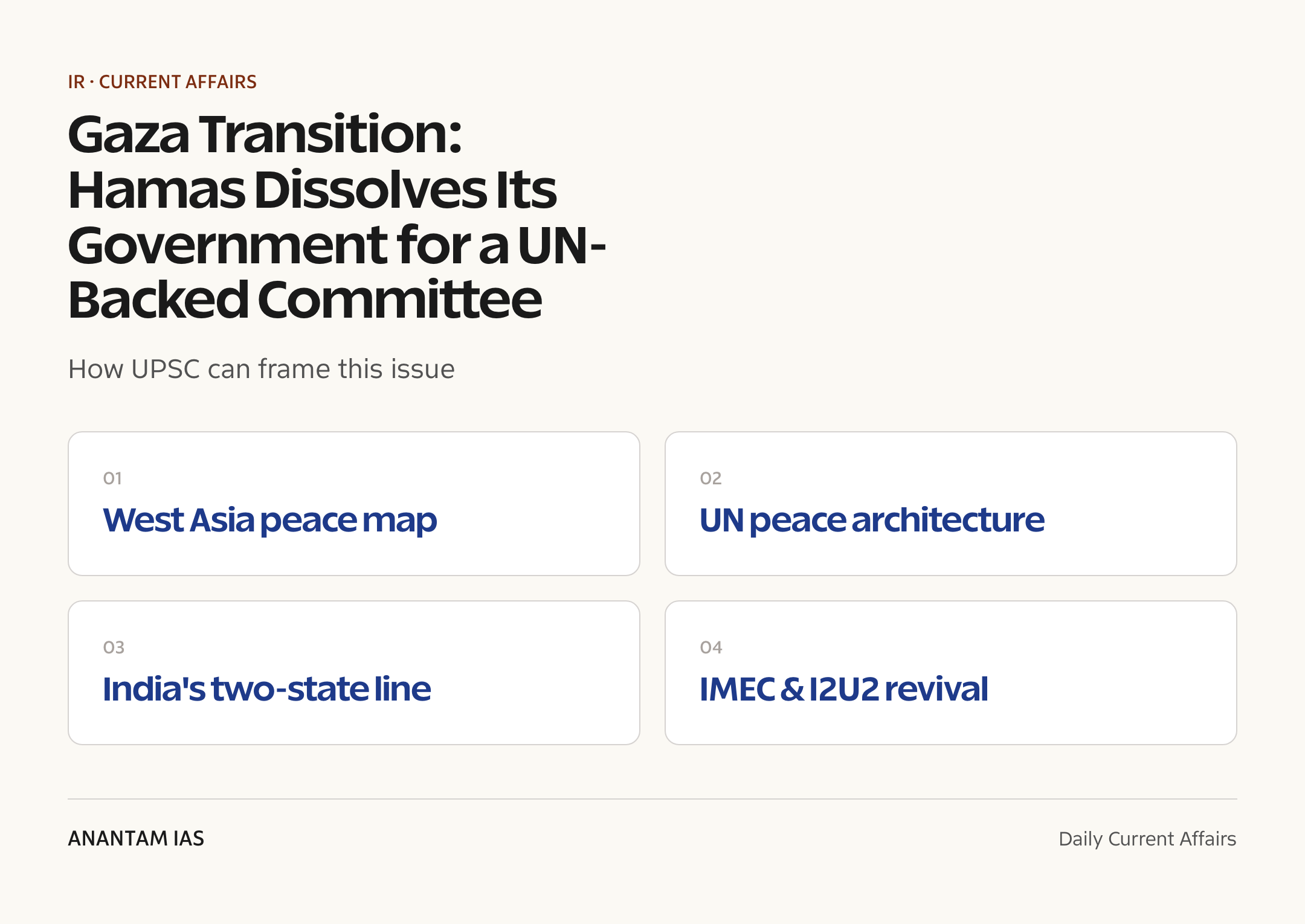
- For India, the stakes run through its two-state policy, the Gulf diaspora, energy and shipping security, and stalled projects such as IMEC and I2U2.
UPSC Relevance
Prelims Relevance
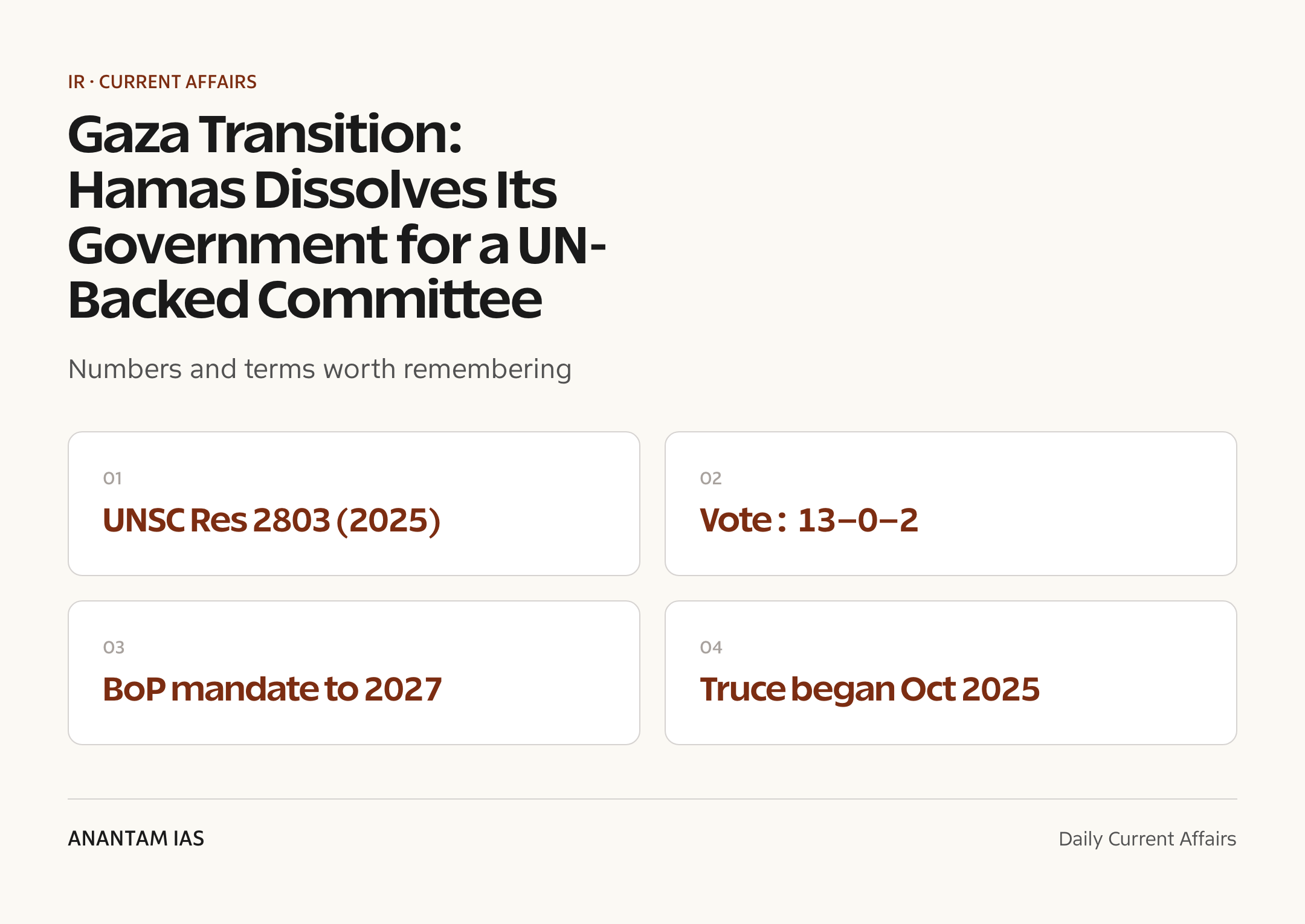
- UNSC Resolution 2803 (2025): adopted 17 November 2025; 13 votes in favour, Russia and China abstained, none against.
- It endorsed the 20-point Comprehensive Plan to End the Gaza Conflict behind the October 2025 ceasefire.
- Board of Peace (BoP): transitional body chaired by Donald Trump; authorised until 31 December 2027; reports to the Council every six months.
- International Stabilization Force (ISF): temporary force for border security, protecting civilians and aid corridors, supporting demilitarisation, and training a vetted Palestinian police force.
- National Committee for the Administration of Gaza: Cairo-based technocratic committee chaired by Ali Shaath; restores services and oversees civilian affairs under UN and BoP supervision.
- Timeline: 7 October 2023 attack (about 1,200 killed in Israel, 251 hostages) → ceasefire effective 10 October 2025.
- Hamas won the 2006 Palestinian Legislative Council elections and has controlled Gaza since June 2007 after splitting with Fatah.
- The Oslo Accords (1993) created the Palestinian Authority; Israel unilaterally disengaged from Gaza in 2005.
- UNRWA: UN agency for Palestine refugees (est. 1949); India contributes US$5 million a year.
- Abraham Accords (2020); I2U2 (India-Israel-UAE-US); IMEC announced at the G20 New Delhi Summit, September 2023.
Mains Relevance
GS Paper 2
- Effect of West Asian politics on India’s interests: energy, diaspora, connectivity corridors and de-hyphenated ties with Israel and Palestine.
- UN peace architecture in practice: Resolution 2803’s shift from classical peacekeeping to stabilisation-and-administration mandates.
- Transitional administrations as a governance model: legitimacy, local ownership and exit strategy (compare Kosovo and East Timor).
GS Paper 3
- Disarmament, demobilisation and reintegration (DDR) of non-state armed groups as the hardest phase of any peace deal.
- Security of trade and energy routes: Red Sea shipping disruptions and the economics of IMEC.
Essay
- Peace is not merely the absence of war but the presence of institutions.
- Can the UN still build states, or only freeze conflicts?
Background and Context
From 7 October 2023 to the October 2025 Ceasefire
The current transition sits at the end of a two-year war and a phased, US-brokered peace plan.
- On 7 October 2023, a Hamas-led attack killed about 1,200 people in Israel; 251 hostages were taken into Gaza.
- Israel’s retaliatory offensive killed 73,098 Palestinians per the Gaza Health Ministry — figures UN agencies treat as broadly reliable; women and children are around half the toll.
- In late September 2025, the US unveiled the 20-point Comprehensive Plan to End the Gaza Conflict; a ceasefire based on it took effect on 10 October 2025.
- Phase one delivered hostage releases, a partial Israeli redeployment and a scale-up of humanitarian aid.
- Phase two — Hamas’s disarmament and reconstruction — has been deadlocked for nine months; Hamas insists phase one must finish before it discusses its weapons.
- Violence continues: Israeli strikes killed at least five people on the announcement day; five Israeli soldiers have died since the truce began.
What Hamas Announced — and What It Left Out
The dissolution is significant on paper but heavily hedged in practice.
- Speaking at Al-Aqsa Hospital in Deir al-Balah, al-Thawabta said service employees are ready to work under the National Committee for the Administration of Gaza.
- Hamas made no commitment on disarming or handing security to an international force — the ceasefire’s most difficult clause.
- Hamas spokesperson Hazem Qassem framed the move as “a positive step forward” for the deal.
- An Israeli official dismissed it as “spin”: Hamas members simply remain in their positions under a new label.
- The Board of Peace said it would assess the impact based on “actions, not promises”, stressing the committee must control all weapons in Gaza.
The National Committee for the Administration of Gaza
The successor body is technocratic, externally supervised and still untested on the ground.
- A committee of technocrats based in Cairo, chaired by Ali Shaath, a Gaza-born engineer and former Palestinian Authority official.
- Mandate: restore essential services and oversee civilian affairs under the supervision of the UN and the Board of Peace.
- It flows from Resolution 2803, which empowers the Board of Peace to appoint a Palestinian technocratic committee for day-to-day governance.
- The design separates politics from administration: the Board holds transitional political authority while the committee delivers services — a classic post-conflict model.
- Open questions: control of the payroll of former government employees, the policing interface with the ISF, and when Gaza folds back under a reformed Palestinian Authority.
UNSC Resolution 2803: The Legal Scaffolding
Resolution 2803 is the durable, examinable core of this story — learn its provisions, not just the headline.
- Adopted on 17 November 2025 by 13 votes with abstentions by China and Russia; full text on the UN documents portal (S/RES/2803).
- It endorses the Comprehensive Plan and welcomes the Board of Peace as the transitional body supporting Gaza’s administration and reconstruction.
- It authorises a temporary International Stabilization Force to secure border areas, protect civilians and aid corridors, support demilitarisation, and train a vetted Palestinian police force.
- The Board and international presences are authorised until 31 December 2027, with written progress reports every six months.
- It holds out a conditional pathway to Palestinian self-determination and statehood once the Palestinian Authority’s reform programme is carried out.
- Critics, echoed in the two abstentions, flagged weak Palestinian ownership and sweeping powers for an unelected international board.
Who Has Governed Gaza? A 75-Year Institutional History
Gaza’s administration has changed hands repeatedly — a useful map for both Prelims and Mains.
- 1949–1967: Egyptian military administration after the first Arab-Israeli war.
- 1967: Israel captured Gaza in the Six-Day War and ran it under military occupation.
- 1993–94: the Oslo Accords created the Palestinian Authority with partial self-rule.
- 2005: Israel’s unilateral disengagement from Gaza.
- 2006–07: Hamas won the 2006 elections, then seized full control of Gaza in June 2007 after its split with Fatah; the PA was confined to parts of the West Bank.
- 2026: the first externally supervised technocratic administration under a UNSC-endorsed framework — if the handover proceeds beyond paper.
India's Stakes and Stated Positions
India reads the Gaza transition through a de-hyphenated West Asia policy that pairs principle with interests.
- India backs a negotiated two-state solution — a sovereign, viable Palestine within secure, recognised borders, at peace with Israel — and welcomed the October 2025 ceasefire.
- Humanitarian track: multiple consignments of medicines and relief material to Gaza routed through Egypt, plus US$5 million annually to UNRWA.
- India’s UN voting balanced both principles: it abstained on an October 2023 General Assembly resolution that omitted the terror attacks, then backed the December 2023 humanitarian-ceasefire resolution.
- Hard interests: roughly nine million Indians in the Gulf, heavy crude-oil dependence, and Red Sea shipping disruptions that raised freight costs.
- A stabilised Gaza improves the prospects of IMEC and I2U2, both slowed by the conflict since 2023.
- Track the wider arc in our current affairs digests and monthly compilations.
Way Forward
Sequencing disarmament with governance
- A verifiable weapons-control mechanism — inventories, decommissioning timelines, ISF monitoring — is the test the Board of Peace has set; announcements alone won’t move phase two.
- A phased DDR programme with livelihood options for cadres reduces the risk that armed men migrate to clan militias.
- A vetted Palestinian police force, trained under the ISF mandate, must fill the policing gap before criminal networks do.
Making the technocratic committee credible
- Early, visible service delivery — power, water, payrolls, rubble clearance — will decide whether Gazans treat the committee as a government or a letterhead.
- Reconstruction finance needs transparent channels: donor pledges tied to audited damage assessments, insulated from capture.
- A stated timeline to fold Gaza back under a reformed Palestinian Authority would restore Palestinian ownership and answer the legitimacy critique.
What India can do
- Scale up humanitarian and UNRWA support, and offer ITEC-style capacity-building for Palestinian administrators.
- Keep backing the statehood pathway diplomatically while deepening the strategic partnership with Israel — de-hyphenation in practice.
- Position Indian firms for Gaza’s reconstruction economy and push the IMEC file as stability returns.
Conclusion
Hamas dissolving its Gaza government is the kind of step peace plans are built on — and the kind that can remain a press conference unless it is followed by verifiable transfers of power, payrolls and, hardest of all, weapons. The gap between Israel’s “spin” and Hamas’s “positive step” shows how thin the trust beneath Resolution 2803 still is.
Gaza is now a live case study in transitional administration: a UNSC-endorsed board, a technocratic committee and a stabilisation force attempting to rebuild governance itself. Whether the model earns legitimacy will shape UN practice beyond West Asia.
India’s interest is direct: a stable Gaza anchors the wider calm on which its diaspora, energy security and IMEC ambitions depend, while a credible statehood pathway vindicates the two-state position New Delhi has held for decades.
UPSC Practice Questions
Prelims MCQ 1
With reference to UN Security Council Resolution 2803 (2025), consider the following statements:
- It endorsed the Comprehensive Plan to End the Gaza Conflict and welcomed the establishment of a transitional Board of Peace.
- It authorised the deployment of a temporary International Stabilization Force (ISF) in Gaza.
- Russia and China voted against the resolution.
How many of the above statements are correct?
(a) Only one (b) Only two (c) All three (d) None
Answer: (b) Only two
Explanation:
Statements 1 and 2 are correct: Resolution 2803 (17 November 2025) endorsed the Comprehensive Plan, welcomed the Board of Peace and authorised the ISF until 31 December 2027. Statement 3 is wrong — the vote was 13 in favour, none against; Russia and China abstained.
Prelims MCQ 2
The ‘National Committee for the Administration of Gaza’, recently in the news, is best described as:
(a) An elected Palestinian legislature replacing the Palestinian Authority (b) A technocratic transitional body for Gaza’s civil administration under UN and Board of Peace supervision (c) A UN peacekeeping mission deployed under the UN Charter (d) A joint Israeli-Egyptian mechanism to administer Gaza’s border crossings
Answer: (b) A technocratic transitional body for Gaza's civil administration under UN and Board of Peace supervision
Explanation:
It is a Cairo-based technocratic committee chaired by Ali Shaath, mandated to restore essential services and oversee civilian affairs under UN and Board of Peace supervision, within the framework of UNSC Resolution 2803.
UPSC Mains Questions
- The Gaza transition under UNSC Resolution 2803 marks a rare experiment in externally supervised territorial administration. Examine the opportunities and risks of such transitional governance models for durable peace, drawing on earlier UN experiences.
- India’s West Asia policy rests on de-hyphenation, diaspora welfare, energy security and connectivity. Discuss how a stabilised Gaza and a revived peace process would affect India’s strategic and economic interests in the region.
- “Ceasefires end wars; institutions end conflicts.” In the light of the Gaza peace architecture — the Board of Peace, the International Stabilization Force and a technocratic administration — critically analyse the conditions necessary for post-conflict governance to succeed.
Sources: The Hindu (AP) and United Nations (Security Council press release on Resolution 2803).
Frequently Asked Questions
Why did Hamas dissolve its government in Gaza?
Hamas announced on 6 July 2026 that it had dissolved its Gaza government to transfer civil power to a UN-backed technocratic committee, as required under the US-brokered ceasefire and UNSC Resolution 2803. It framed the move as proof of its commitment to Gaza’s reconstruction.
What is the National Committee for the Administration of Gaza?
It is a Cairo-based committee of Palestinian technocrats chaired by Ali Shaath, a Gaza-born engineer and former Palestinian Authority official. Its mandate is to restore essential services and oversee civilian affairs in Gaza under the supervision of the United Nations and the transitional Board of Peace.
What is UNSC Resolution 2803?
Adopted on 17 November 2025 by 13 votes with Russia and China abstaining, Resolution 2803 endorsed the Comprehensive Plan to End the Gaza Conflict, welcomed the Board of Peace as Gaza’s transitional authority and authorised an International Stabilization Force. The arrangements run until 31 December 2027, with six-monthly reports.
What is the Board of Peace?
The Board of Peace is the transitional international body created under the Gaza peace plan and welcomed by Resolution 2803, chaired by US President Donald Trump. It supports Gaza’s governance and reconstruction, appoints the technocratic administration committee, and can establish the temporary International Stabilization Force.
What will the International Stabilization Force do?
The ISF is a temporary multinational force authorised by Resolution 2803. Its tasks include securing Gaza’s border areas, protecting civilians and humanitarian corridors, supporting the demilitarisation of the territory, and training a vetted Palestinian police force that can take over day-to-day law and order.
What is India’s position on the Gaza transition?
India supports a negotiated two-state solution — a sovereign, viable Palestine within secure, recognised borders, at peace with Israel. It welcomed the October 2025 ceasefire, has sent humanitarian aid through Egypt, contributes US$5 million a year to UNRWA, and ties regional stability to its diaspora and IMEC.