Hazardous Cleaning and Manual Scavenging
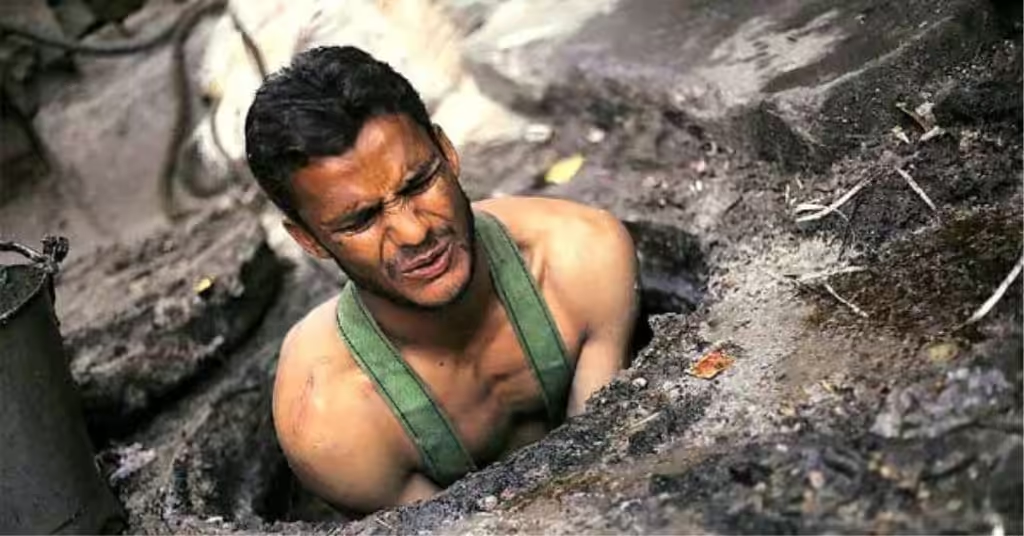
Context : Over 90% of workers who died while cleaning sewers did not have any safety gear or personalised protective equipment (PPE) kits, according to a recent social audit commissioned by the Union government to look into hazardous sewer and septic tank cleaning across the country.
Observations of study
In September 2023, the Social Justice Ministry commissioned a study into hazardous cleaning deaths, which analysed the circumstances surrounding 54 such deaths in 17 districts across eight States and Union Territories that occurred in 2022 and 2023.
- Government data show 150 people across the country died due to hazardous cleaning in 2022 and 2023.
- No safety gear in 49 out of 54 deaths i.e. 90%.
- In 5 cases merely boots and gloves were given.
- No consent was taken in 27 cases while in 18 cases the consent was not backed with awareness of the hazards involved in the work.
Does Manual Scavenging exist in India?
Government of India : Manual scavenging has ended in the country, and it is the problem of hazardous cleaning of sewers and septic tanks that now needs attention.
- It draws this distinction based on a technical difference in how manual scavenging and hazardous cleaning are defined in the Prohibition of Employment as Manual Scavengers and their Rehabilitation Act.
- Under the previous Self Employment Scheme for Rehabilitation of Manual Scavengers (SRMS) scheme, the government had identified 58,098 manual scavengers till 2018. Since then, it has insisted that no other manual scavengers have been identified, claiming that none of the 6,500-plus complaints reporting manual scavenging could be verified.
Social Activists and Critics: Today the term ‘manual scavenging’ has taken another form. When a person enters a sewer line, he is drenched in dirt.
What does the law say?
- Any form of discriminatory practice such as Manual scavenging and forced hazardous cleaning, forcing an individual or group to do an undignified job based on birth or a job which threatens his/ her life and well being clearly violates Article 14, 15, 19 and 21 of the Constitution.
- As per the Prohibition of Employment as Manual Scavengers and their Rehabilitation (PEMSR) Act, 2013, no person, local authority or any agency shall employ any person for hazardous cleaning of either a sewer or septic tank.
- Contravening the provisions will result in imprisonment for up to five years and a fine of up to ₹5 lakh
The Supreme Court on January 29, 2025 ordered a complete stop to the practice of manual scavenging and hazardous manual cleaning of sewers and septic tanks in top metros across the country. The court appropriately observed that the claims of fraternity, equality and dignity among citizens remain a mere illusion if a sizeable section of society was forced to enter sewers for a living and die trapped in them even a decade after the introduction of the Prohibition of Employment as Manual Scavengers and their Rehabilitation Act 2013.
Government Initiative
National Action for Mechanised Sanitation Ecosystem (NAMASTE) : This scheme aims at the formalization and rehabilitation of manual scavengers and their dependents.
Launched by the Union Ministries of Social Justice and Empowerment and Housing and Urban Affairs in 2023-24.
It includes components such as:
- Profiling of Sewer/Septic Tank Workers (SSWs).
- Occupational safety training and distribution of Personal Protective Equipment (PPE) kits.
- Health insurance coverage under the Ayushman Bharat-Pradhan Mantri Jan Arogya Yojana (AB-PMJAY).
- Upfront capital subsidy for sanitation-related projects and enterprises under the SRMS and SUY, aiming to make individuals “Saniprenures“.
So far, the NAMASTE scheme has identified 84,902 sewer and septic tank workers in 36 States and UTs across the country, of which a little over half have been provided with PPE kits and safety gear.
Challenges in eliminating manual hazardous cleaning:
- Technological and Financial Barriers: Modern sanitation technologies like automated sewer cleaning machines and robots are expensive, making them unaffordable for many municipalities. Additionally, the lack of locally produced equipment and specialized skills for maintenance can lead to operational failures.
- Administrative and Political Hurdles: In many regions, a lack of political will and administrative inefficiencies hinder the widespread adoption of mechanized solutions. Sally Cawood and Amita Bhakta note in their blog that administrative hurdles can delay progress in mechanization.
- Caste-Based Discrimination and Social Stigma: Manual scavenging and sewage cleaning are deeply rooted in a caste system, with individuals from marginalized communities traditionally performing these tasks. This historical association creates a social stigma, leading to discrimination and a reluctance from some to engage in sanitation work, even with improved conditions or training.
- Of the identified manual scavengers, the government said it had data on the social categories of 43,797, showing that 97.2% of them were from SC communities. The share of STs, OBCs, and others were each around 1%.
- Worker Protests and Resistance: Workers may protest against mechanization due to concerns about job security, as seen in some regions where they fear losing their livelihoods if machines replace manual labor.
- Lack of Enforcement and Rehabilitation: Despite laws prohibiting manual scavenging and promoting alternatives, enforcement remains weak. Comprehensive rehabilitation programs that include education, skill development, and access to dignified employment for those engaged in manual cleaning are crucial but not always fully implemented.
Solutions for Eliminating Manual Sewage Cleaning:
Technology-driven Solutions:
- Sewer Camera Inspections: Utilizing drain cameras and sewer camera inspections to assess the condition of pipes and identify blockages non-intrusively.
- Septic Tank Cleaning Robots: Introducing robotic solutions for cleaning septic tanks, such as the Homosep Atom, to efficiently remove waste.
- Innovation in Sewer Cleaning Devices: Encouraging the development of cost-effective and technologically advanced sewer cleaners, like the “Sewage Squad” developed by students, capable of operating in various environments. Deploying robots like Bandicoot for manhole and sewer line cleaning.
Policy and Legal Frameworks:
- Amending Laws: The government has announced amendments to the Prohibition of Employment as Manual Scavengers and their Rehabilitation Act, 2013, to mandate mechanized cleaning.
- Strengthening Enforcement: Ensuring strict enforcement of existing laws like the SC/ST (Prevention of Atrocities) Act, 1989, which criminalizes manual scavenging.
- Safaimitra Suraksha Challenge: A government initiative encouraging cities to adopt mechanized cleaning for septic tanks and sewer lines.
Infrastructure Upgrades:
- Modern Sanitation Infrastructure: Investing in the construction of modern toilets, sewage treatment plants, and efficient waste management systems.
- Improving Existing Systems: Upgrading older sewage systems to accommodate mechanized cleaning and reduce the reliance on manual intervention.
Skill Development and Rehabilitation:
- Strengthening Emergency Response Sanitation Units (ERSUs): Equipping these units to ensure safe and mechanized delivery of sanitation services.
- Vocational Training: Providing training to affected individuals in safer and more dignified professions like plumbing, electrical work, and entrepreneurship.
- Empowering Sanitation Workers: Training sanitation workers to run sanitation enterprises and promote mechanization of cleaning operations.