Heatwaves and Disaster Finance: What Notified Calamity Status Changes
Why in News?
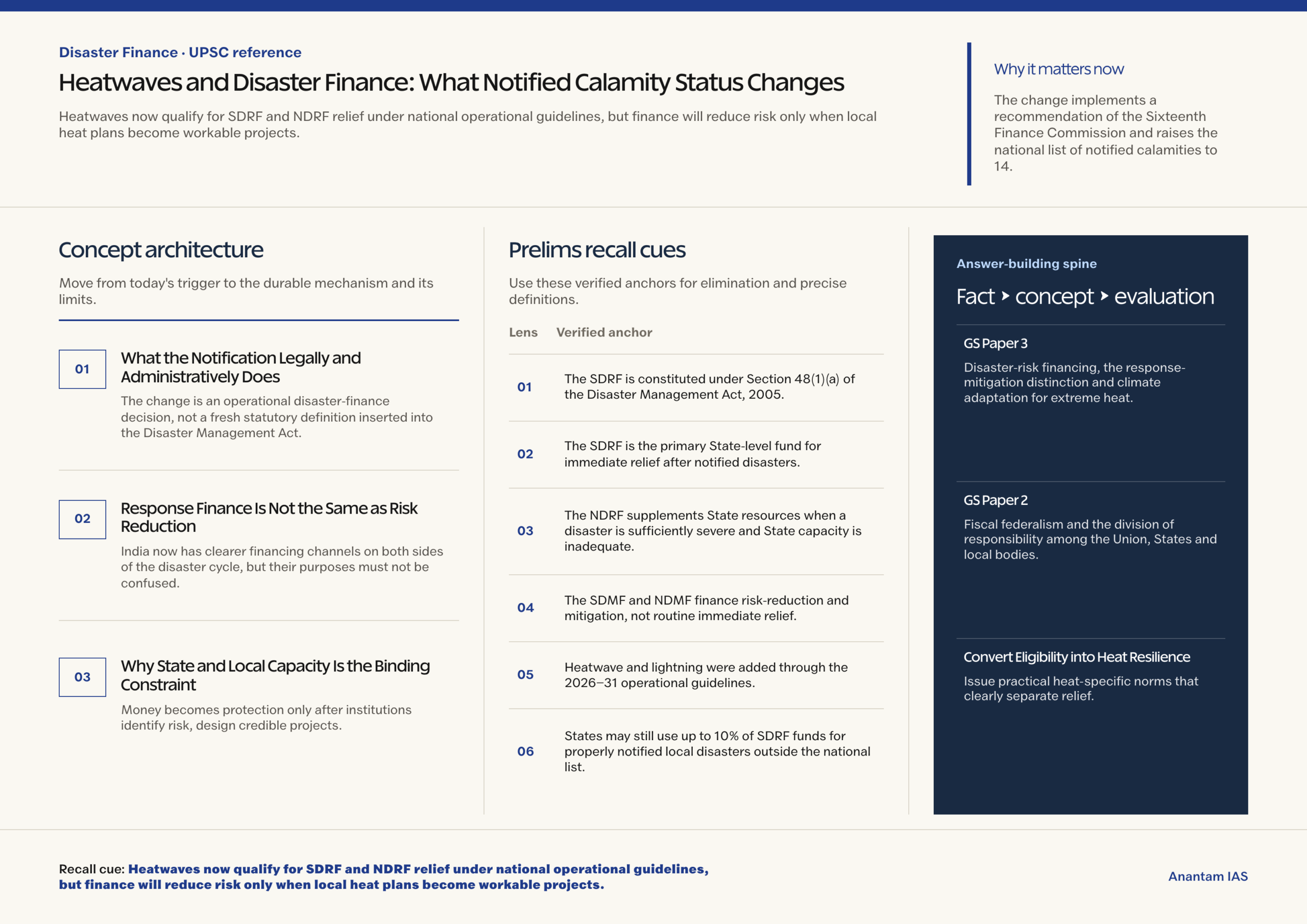
The Ministry of Home Affairs confirmed that heatwaves and lightning are now notified natural calamities under the SDRF and NDRF operational guidelines for 2026–31.
- The change implements a recommendation of the Sixteenth Finance Commission and raises the national list of notified calamities to 14.
- The operational guidelines were issued on June 30, 2026, creating a policy framework for relief assistance through SDRF and NDRF.
- Heatwave projects were already eligible for financing through disaster mitigation funds after the mitigation guidelines were amended in 2024.
- National notification removes the earlier dependence on the limited State-specific disaster window for immediate heatwave relief.
- The change improves financial eligibility; it does not prove that heat exposure, illness or mortality has fallen.
- Effective protection still depends on local risk assessment, health surveillance, workable Heat Action Plans and the capacity to prepare fundable projects.
- UPSC answers should separate response finance for immediate relief from mitigation finance that reduces future heat risk.
UPSC Relevance
Prelims Relevance
- The SDRF is constituted under Section 48(1)(a) of the Disaster Management Act, 2005.
- The SDRF is the primary State-level fund for immediate relief after notified disasters.
- The NDRF supplements State resources when a disaster is sufficiently severe and State capacity is inadequate.
- The SDMF and NDMF finance risk-reduction and mitigation, not routine immediate relief.
- Heatwave and lightning were added through the 2026–31 operational guidelines, not through an amendment naming them in the Disaster Management Act.
- States may still use up to 10% of SDRF funds for properly notified local disasters outside the national list.
Mains Relevance
GS Paper 3
- Disaster-risk financing, the response-mitigation distinction and climate adaptation for extreme heat.
- Heat Action Plans, early warning, public-health surveillance and measurable risk reduction.
GS Paper 2
- Fiscal federalism and the division of responsibility among the Union, States and local bodies.
- State and municipal capacity to convert national finance rules into equitable last-mile protection.
Essay
- Recognising a hazard in public finance matters only when institutions can convert eligibility into protection for vulnerable people.
Background and Context
What the Notification Legally and Administratively Does
The change is an operational disaster-finance decision, not a fresh statutory definition inserted into the Disaster Management Act.
- MHA has placed heatwaves and lightning on the nationally notified calamity list used by the SDRF and NDRF operational guidelines for the Finance Commission award period 2026–31.
- This gives States a common national basis to claim eligible immediate-relief expenditure for heatwave impacts, subject to approved assistance norms, documentation and fund-administration rules.
- Earlier, a State could treat heatwave as a local disaster, notify transparent norms and draw from the SDRF’s local-disaster window, capped at 10% of available funds.
- National inclusion removes that particular 10% local-window constraint for heatwaves; it does not turn the SDRF into an unlimited compensation account or guarantee additional money automatically.
- The NDRF is a supplementary national response fund; access for a severe event follows assessment and approval processes rather than arising automatically from a heat alert.
Response Finance Is Not the Same as Risk Reduction
India now has clearer financing channels on both sides of the disaster cycle, but their purposes must not be confused.
- The SDRF and NDRF support immediate relief after eligible losses, including assistance governed by notified norms; they do not by themselves redesign hot settlements or prevent exposure.
- The SDMF and NDMF finance mitigation measures intended to reduce future disaster risk, and heatwave mitigation projects have been eligible under these funds since the 2024 guideline amendment.
- A Heat Action Plan should connect hazard forecasts, exposure and vulnerability to specific actions such as cooling access, health preparedness, worker protection and heat-resilient urban design.
- A city can have a written plan yet remain unsafe if responsibilities are unfunded, warnings miss informal workers, health facilities lack readiness or agencies cannot act before temperatures peak.
- Success should be measured through reduced illness, mortality and exposure, faster response and equitable protection, not merely by fund release, expenditure totals or the number of plans adopted.
Why State and Local Capacity Is the Binding Constraint
Money becomes protection only after institutions identify risk, design credible projects, coordinate departments and document outcomes.
- State disaster authorities must set clear assistance norms, coordinate health and revenue departments, maintain loss records and ensure that vulnerable households can access relief without excessive procedural burdens.
- Districts and urban local bodies need staff able to conduct heat-risk assessments, translate plans into costed proposals and manage procurement, implementation, maintenance and evaluation.
- Heat risk varies between dry inland and humid coastal settings; copying a standard package can misallocate funds because temperature, humidity, housing, work and health vulnerability interact differently.
- Health surveillance must capture timely, credible heat-related illness and death data while recognising that extreme heat can worsen cardiovascular, respiratory and kidney conditions beyond narrowly certified heatstroke.
- Public accountability requires publishing risk maps, approved projects, spending and outcomes, with independent evaluation showing whether interventions reached outdoor workers, older people, low-income settlements and other high-risk groups.
Way Forward
Convert Eligibility into Heat Resilience
- Issue practical heat-specific norms that clearly separate relief, preparedness and mitigation expenses while keeping approval and reporting requirements usable for districts and municipalities.
- Create model project templates for cool roofs, cooling centres, heat-health systems and worker protection, but require adaptation to local climate and vulnerability evidence.
- Fund technical support for local bodies to prepare proposals, procure responsibly and track health and exposure outcomes rather than only financial utilisation.
- Link IMD warnings, health surveillance and social-protection delivery through pre-agreed triggers, with special protocols for outdoor workers, informal settlements and people living alone.
Conclusion
- Notified status corrects a financing asymmetry: heatwave relief can now use the national SDRF and NDRF framework instead of relying on the restricted local-disaster window.
- In a Mains answer, add the essential qualification: fund access is an input; reduced deaths and exposure require capable local institutions, credible data, prevention projects and public accountability.
UPSC Practice Questions
Prelims MCQ 1
With reference to disaster-management funds in India, consider the following statements:
- The State Disaster Response Fund is constituted under Section 48(1)(a) of the Disaster Management Act, 2005.
- The State Disaster Mitigation Fund is intended exclusively for immediate relief after a notified disaster.
- Heatwaves are included in the notified calamity list under the SDRF and NDRF operational guidelines for 2026–31.
How many of the above statements are correct?
(a) Only one (b) Only two (c) All three (d) None
Answer: (b) Only two
Explanation:
Statements 1 and 3 are correct. Statement 2 is incorrect because mitigation funds finance risk reduction; immediate relief is the function of response funds.
Prelims MCQ 2
What is the most accurate effect of adding heatwaves to the national list of notified calamities?
(a) Every heat warning automatically releases money from the NDRF (b) States may use SDRF relief finance for heatwaves without relying on the 10% local-disaster window (c) Heatwaves have been inserted as a separately named disaster through a new amendment to the Disaster Management Act (d) All Heat Action Plan expenditure must now come only from the SDRF
Answer: (b) States may use SDRF relief finance for heatwaves without relying on the 10% local-disaster window
Explanation:
National notification removes dependence on the restricted local-disaster route. It neither makes NDRF release automatic nor converts all heat planning into response expenditure.
UPSC Mains Questions
- Explain how national notification of heatwaves changes India’s disaster-finance framework. Why does access to response funds not necessarily mean that heat risk has been reduced?
- State and local implementation capacity is the bridge between Heat Action Plans and measurable protection. Discuss the institutional reforms needed to make heatwave finance effective and equitable.
Sources: Ministry of Home Affairs, Lok Sabha Unstarred Question 2541 and The Hindu.
Frequently Asked Questions
Are heatwaves now nationally notified calamities in India?
Yes. MHA has included heatwaves and lightning in the notified list under the SDRF and NDRF operational guidelines for the 2026–31 Finance Commission award period.
Was the Disaster Management Act amended to name heatwaves?
The confirmed change is administrative: heatwaves were included through operational fund guidelines. It should not be described as a statutory amendment separately naming heatwaves in the Act.
What changed from the earlier local-disaster arrangement?
Previously, States could notify heatwaves locally and use a window capped at 10% of available SDRF funds. National inclusion removes reliance on that restricted route.
What is the difference between response and mitigation finance?
Response funds support immediate relief after eligible losses. Mitigation funds support measures that reduce future risk, such as heat-health systems, cooling access and heat-resilient infrastructure.
Why may heat risk remain high despite more funding access?
Finance cannot substitute for local risk data, trained staff, workable projects, coordinated health systems and accountable delivery. Outcomes must be judged by reduced exposure, illness and mortality.