High-Altitude Parachute: Controlling Descent in Thin Air
Why in News?
On 6 October 2026, the Ministry of Defence reported DRDO’s maiden live jump of the Advanced High-Altitude Parachute at Nyoma’s Mudh drop zone.
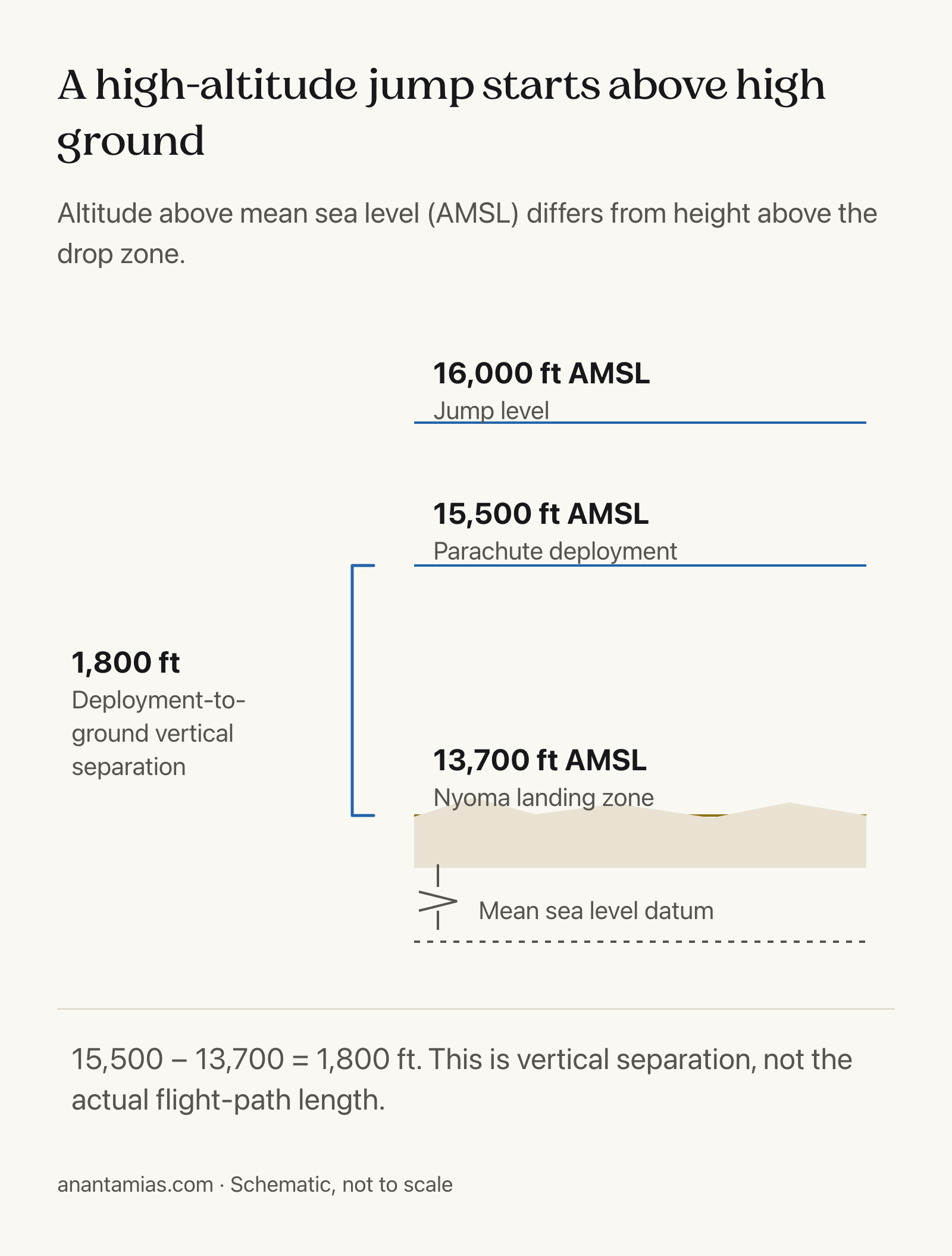
- The jump altitude was 16,000 feet above mean sea level; the parachute deployed at 15,500 feet, while the drop zone stood at 13,700 feet.
- ADRDE, Agra designed and developed AHAP as a static-line parachute system for mass drops of paratroopers; Ordnance Parachute Factory, Kanpur manufactured it.
- The Ministry reported inspection by DGAQA and certification by CEMILAC, RCMA Kanpur, alongside the successful live jump.
- The release highlights opening shock and descent rate as high-altitude challenges, but supplies no numerical descent speed or complete performance record.
- Mountain terrain combines elevated landing areas with demanding atmospheric conditions; a parachute must provide controlled descent within the height actually available above the ground.
- Test evidence should connect a demonstrated result to its conditions, keeping developmental success distinct from claims about every possible operational situation.
UPSC Relevance
Prelims Relevance
- AHAP: Advanced High-Altitude Parachute, developed by ADRDE.
- Static-line deployment and its distinction from manual free-fall activation.
- Air density, aerodynamic drag and descent control.
- Above mean sea level versus height above a landing site.
- Nyoma (Mudh drop zone) as the location of the reported trial.
Mains Relevance
GS Paper 3
- Indigenous defence technology adapted to high-altitude operating conditions.
- Testing, certification and the limits of claims based on a single demonstrated trial.
Essay
- Technical capability depends on how well systems meet real environmental constraints.
Background and Context
What Does a Static-Line Parachute Do?
AHAP is an aerial-delivery system for controlled human descent, with a deployment mechanism suited to organised paratrooper drops.
- Static-line deployment uses a line attached to the aircraft to initiate parachute deployment as the jumper leaves. It does not depend on the jumper choosing when to pull a main-parachute release during free fall.
- Mass-drop design concerns delivering multiple paratroopers through a coordinated operation. The announced purpose should not be mistaken for a claim that this particular maiden live jump demonstrated a complete large-scale troop deployment.
- The canopy creates aerodynamic resistance, while suspension lines and the harness transfer forces to the jumper. Successful descent depends on the system working together rather than on the fabric alone.
- Opening shock is the transient force associated with deployment and deceleration. It is a different engineering concern from the subsequent descent rate; a safe design must address both phases of the jump.
- Indigenous development links design, manufacturing, inspection and certification. The release identifies these functions separately, showing that producing equipment and evaluating its suitability are related steps with different responsibilities and evidence needs.
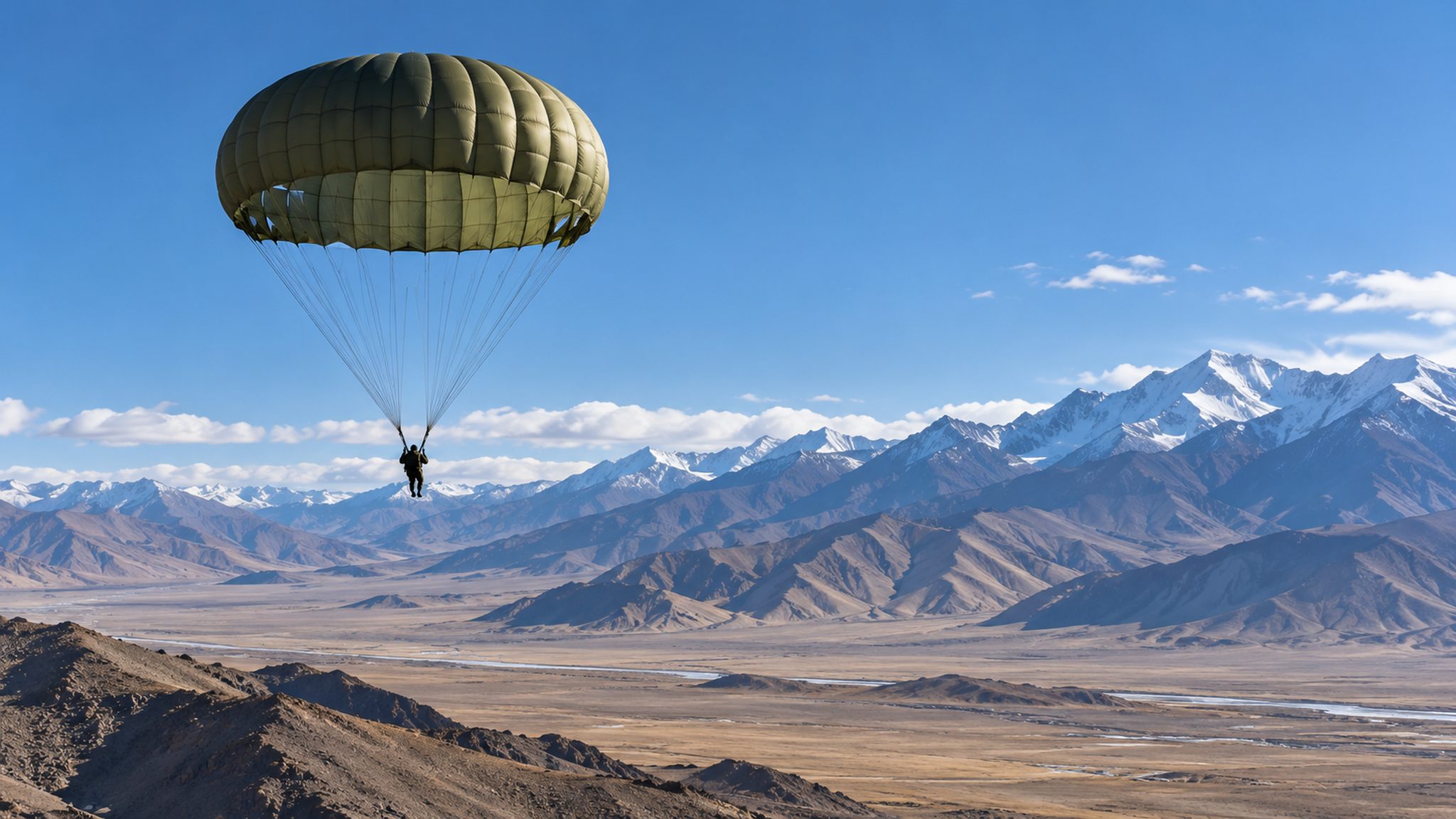
Why Does Thin Air Complicate Descent?
A parachute relies on moving air to resist falling; the surrounding atmosphere changes the force available from a given configuration.
- Air density generally decreases with altitude. For the same speed, reference area and drag coefficient, the NASA drag equation gives less aerodynamic drag at lower density, affecting parachute performance.
- Descent speed tends to be higher in thinner air when other relevant conditions are unchanged. That physical tendency explains the design challenge; it does not establish AHAP’s actual descent speed in this trial.
- Canopy area and shape influence drag, alongside air density and speed. Designers must assess their combined effect rather than assuming that altitude alone fixes the performance of every parachute carrying the same load.
- Deployment dynamics concern the changing forces as a packed canopy opens. A steady drag relationship cannot, by itself, predict the full opening shock or certify that the system meets safety requirements.
- Evidence limits matter when reading official performance language. The Ministry describes AHAP’s descent performance favourably, but an aspirant should not turn that description into an invented speed, comparative safety ranking or universal guarantee.
Sea-Level Altitude Is Not Height Above the Drop Zone
The reported heights share a sea-level reference; subtracting the landing-site elevation reveals the vertical separation relevant to the descent.
- Above mean sea level, or AMSL, measures altitude against a common reference surface. It does not measure the distance between a jumper and the elevated terrain directly below or at the intended landing site.
- The three reported levels describe separate stages: the jump at 16,000 feet AMSL, deployment at 15,500 feet AMSL and the Nyoma landing site at 13,700 feet above the same reference.
- Jump-to-site separation follows by subtracting the landing elevation from the jump altitude. The same subtraction from deployment altitude gives the nominal vertical distance remaining after deployment; neither equals the full sea-level altitude.
- Vertical separation is not a measurement of the exact flight path. Wind, lateral movement and terrain can affect the journey, so these reference heights alone cannot establish descent time or the distance actually travelled.
- Trial interpretation must preserve its scope: the reported jump demonstrates performance under the stated test conditions. It does not prove unrestricted deployment across every weather condition, equipment load, aircraft or high-altitude landing area.
Way Forward
Match Capability Claims to Test Evidence
- Evaluate opening forces and descent behaviour across authorised test conditions, documenting the loads and atmospheric circumstances needed to interpret each result.
- Keep reference heights explicit in public explanations so sea-level altitude is not confused with available descent height or a measured flight-path length.
- Connect manufacturing quality, inspection and user feedback with continued evaluation; avoid treating an encouraging maiden jump as a substitute for all subsequent evidence.
Conclusion
- AHAP connects indigenous aerial delivery with a specific mountain-environment challenge: the parachute must manage deployment forces and descent in thinner air above an already elevated landing site.
- The durable exam distinction is between altitude AMSL and height relative to the drop zone. Read the reported success alongside its stated conditions, without inventing a descent speed or claiming universal operational performance.
UPSC Practice Questions
Prelims MCQ 1
With reference to the Advanced High-Altitude Parachute trial at Nyoma, consider the following statements:
- AHAP is described as a static-line parachute system.
- The reported jump altitude above mean sea level is identical to the vertical distance above the drop zone.
- ADRDE designed and developed the system.
How many of the above statements are correct?
(a) Only one (b) Only two (c) All three (d) None
Answer: (b) Only two
Explanation:
Statements 1 and 3 are correct. The elevated drop zone must be subtracted from the AMSL altitude to obtain nominal vertical separation from that site.
Prelims MCQ 2
For a fixed reference area, speed and drag coefficient, what happens to aerodynamic drag when air density decreases?
(a) It decreases. (b) It increases automatically. (c) It remains unchanged in all cases. (d) It becomes independent of the surrounding air.
Answer: (a) It decreases.
Explanation:
The drag equation makes drag directly proportional to air density when the other stated quantities are unchanged. Actual parachute performance also depends on configuration and operating conditions.
UPSC Mains Questions
- Explain how atmospheric conditions and terrain elevation shape the engineering requirements of high-altitude parachute systems.
- How should a successful indigenous defence-technology trial be assessed without confusing demonstrated capability with unrestricted operational readiness?
Sources: PIB, Ministry of Defence and NASA Glenn Research Center, Drag Equation.
Frequently Asked Questions
What is AHAP?
AHAP is the Advanced High-Altitude Parachute, designed and developed by ADRDE for static-line mass drops of paratroopers. The Ministry of Defence reported its maiden live jump at Nyoma in October 2026.
Why is the reported jump altitude not the full descent height?
The jump altitude is measured above mean sea level, while the landing site is itself highly elevated. Subtracting the site elevation gives nominal vertical separation; it does not describe the exact flight path.
Why does lower air density matter for a parachute?
At otherwise unchanged speed, reference area and drag coefficient, lower air density produces less drag. Parachute performance must account for this relationship, alongside deployment dynamics and the system’s actual operating conditions.
Did the release specify AHAP’s descent speed?
No numerical descent speed is provided in the cited release. Its favourable performance description should not be converted into an invented rate, a comparative safety ranking or a guarantee for every operational condition.