High-Pressure Quenching & Superconductivity
Why in News?
In a recent study, scientists used a new technique called ‘high-pressure quenching’ to achieve superconductivity at a higher temperature than usual.
| UPSC Relevance: (GS-3 Science and Technology: New Emerging Technology) Prelims: Potential applications of Superconductors; High-Pressure Quenching |
What are Superconductors?
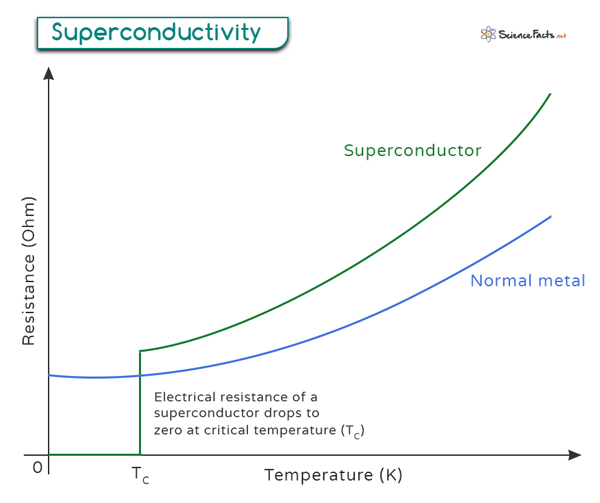
- Superconductors are materials that have zero resistance (do not resist the flow of current) when cooled to temperatures ranging near absolute zero (0 degrees Kelvin/ -273 degrees Celsius).
- Critical temperature (Tc) is the temperature at which the electrical resistance of a given material becomes zero. This temperature is characteristic of the material.
- Examples of Superconductors: Mercury, Lead, Aluminium, Niobium, Magnesium Diboride, Yttrium Barium Copper Oxide etc.
What is the significance of Superconductors?
- Superconductors exhibit zero electrical resistance when cooled below a specific critical temperature (Tc). Since the resistance is zero, no electrical energy is lost as heat (no Joule heating). Therefore, an electric current, once initiated in a superconducting loop, can continue to flow indefinitely without additional power input.
- Potential Applications of Superconductors:
- Longer-lasting batteries and more-efficient power grids
- Efficient electric motors
- Faster MRI machines
- Better transportation systems E.g., Magnetic levitation trains
- Magnetic-energy storage systems
- Superconducting magnetic refrigerators
- Cheaper renewable energy infrastructure
- Quantum Computing (superconductors can exhibit quantum phenomena).
What are the challenges associated with Superconductors?
- High-pressure requirement: Superconductors require extraordinarily high pressures (millions of Pascals) and very low temperatures. E.g., Aluminium becomes superconducting at a temperature of (minus) -250° C.
- Maintaining low temperature: To exhibit superconductivity, the material needs to be cooled to temperatures which normally range near absolute zero. This is done by using liquid helium or liquid nitrogen, which makes superconductivity expensive to maintain.
As a result, manufacturing and deploying superconducting materials at an industrial scale remain challenging to date. Scientists are looking for materials/techniques that can be utilised to achieve superconductivity at room temperature.
Until recently, the highest temperature at which a material (Mercury-based superconductor: Hg1223) became superconducting at room pressure was -140 °C. Some other materials become superconducting close to room temperature, but only under extraordinary pressure (pressure equivalent to near the Earth’s core).
Breakthrough in Superconductivity: High-Pressure Quenching:
- Scientists have recently developed a new technique called high-pressure quenching to improve the performance of a superconductor material, Hg1223. The researchers were able to increase the superconducting temperature of the material from about -140°C to around -122°C.
- High-pressure quenching is a technique in which:
- A material is subjected to extremely high pressure to change the arrangement of its atoms.
- The material is then rapidly cooled (quenched) while still under pressure.
- Finally, the pressure is removed, but the atoms remain locked (frozen) in their high-performance arrangement. This allows the material to retain enhanced properties, such as superconductivity, even at normal atmospheric pressure.
This is a record high temperature to attain superconductivity at ambient pressure, and a notable advance toward practical superconducting systems. Still, scientists are a long way from achieving superconductivity at room temperature under normal atmospheric pressure.
Practice MCQs:
Q1. Which of the following are potential applications of superconductors?
1. Magnetic levitation trains
2. MRI machines
3. Lossless power transmission
4. Quantum computing
Select the correct answer using the code below:
(a) 1 and 2 only
(b) 1, 2 and 3 only
(c) 2, 3 and 4 only
(d) 1, 2, 3 and 4
Answer: (d)
Q2. Which of the following factors limits the widespread use of superconductors?
1. Requirement of extremely low temperature
2. Need for very high pressure in some materials
3. High cost of cooling systems
4. Inability to conduct electricity efficiently
Select the correct answer using the code below:
(a) 1 and 4 only
(b) 1, 2 and 3 only
(c) 2 and 3 only
(d) 1, 2, 3 and 4
Answer: (b)