High Seas Fishing Letters of Authorisation: India’s Push Beyond the EEZ
Why in News?
Vice-President C. P. Radhakrishnan launched the national programme for issuance of Letters of Authorisation (LoAs) for Sustainable Harnessing of Fisheries in the High Seas at Bhubaneswar on 9 July 2026, PIB confirmed. This is the first time India has rolled out a formal, nationwide permit system for its fishermen to fish in waters beyond the country’s Exclusive Economic Zone.
At the same event, organised by the Department of Fisheries, he released the Odisha Deep Sea Fishing Mission document and handed LoAs to ten Fish Farmer Producer Organisations (FFPOs), fisheries cooperatives and fishing-vessel owners from across the country — a decisive move in India’s Blue Economy strategy.
- The LoA is a mandatory permit under the Guidelines for Sustainable Harnessing of Fisheries in the High Seas by Indian-Flagged Fishing Vessels, 2025 — it is vessel-specific, non-transferable and fully online.
- Recipients included the National Cooperative Exports Limited (NCEL) and cooperatives from Gujarat, Maharashtra, Goa, Karnataka, Tamil Nadu and Odisha — including the Paradeep Marine and Malpe Fishermen’s societies.
- The framework operationalises the Union Budget 2025–26 announcement of an enabling framework for fisheries in India’s EEZ and the High Seas, alongside a new Access Pass system.
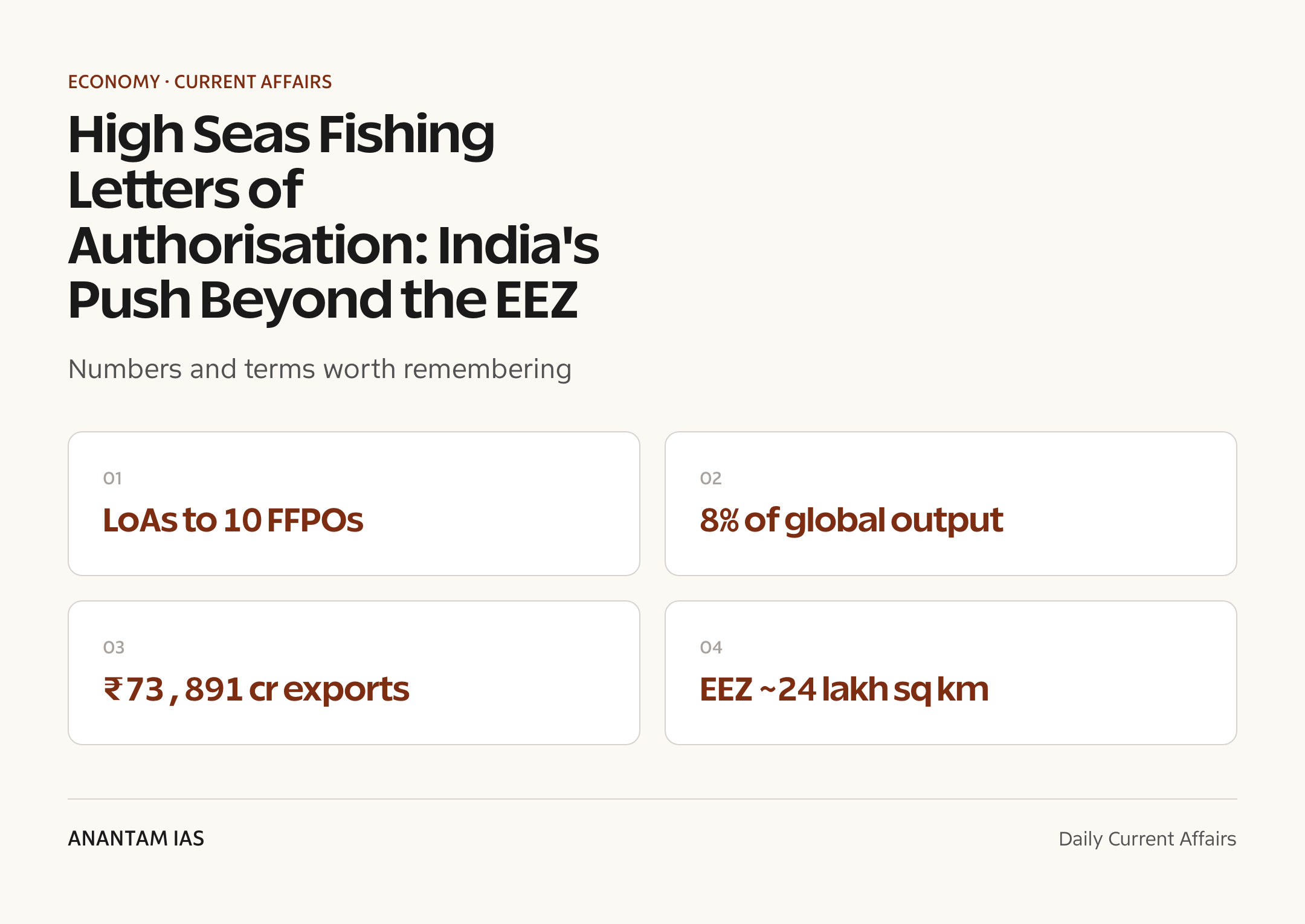
- India is the world’s second-largest fish producer, contributing about 8 per cent of global fish production; the sector supports nearly 3 crore fishers and fish farmers.
- Seafood exports touched a record ₹73,891 crore in 2025–26, and the Union Budget 2026–27 has made fish catch by Indian vessels in the EEZ and High Seas duty-free, with foreign port landings treated as exports.
- About 1,000 fish farmers and fishers, including women, attended the national launch in person along with officials from states, UTs and line ministries.
The development matters in the context of:
- Indian marine fishing has stayed concentrated near the shore; the deep waters of the EEZ and the high seas — rich in tuna and tuna-like species — remain largely untapped despite over 11,000 km of coastline and an EEZ of nearly 24 lakh sq km (PIB figures).
- Globally, high-seas fishing is regulated through Regional Fisheries Management Organisations (RFMOs) and disciplines against illegal, unreported and unregulated (IUU) fishing — India’s permit system plugs its fleet into that rulebook.
- The launch tests a recurring UPSC theme: how a country converts a legal entitlement under UNCLOS (freedom of fishing on the high seas) into actual economic capability for its coastal communities.
UPSC Relevance
Prelims Relevance
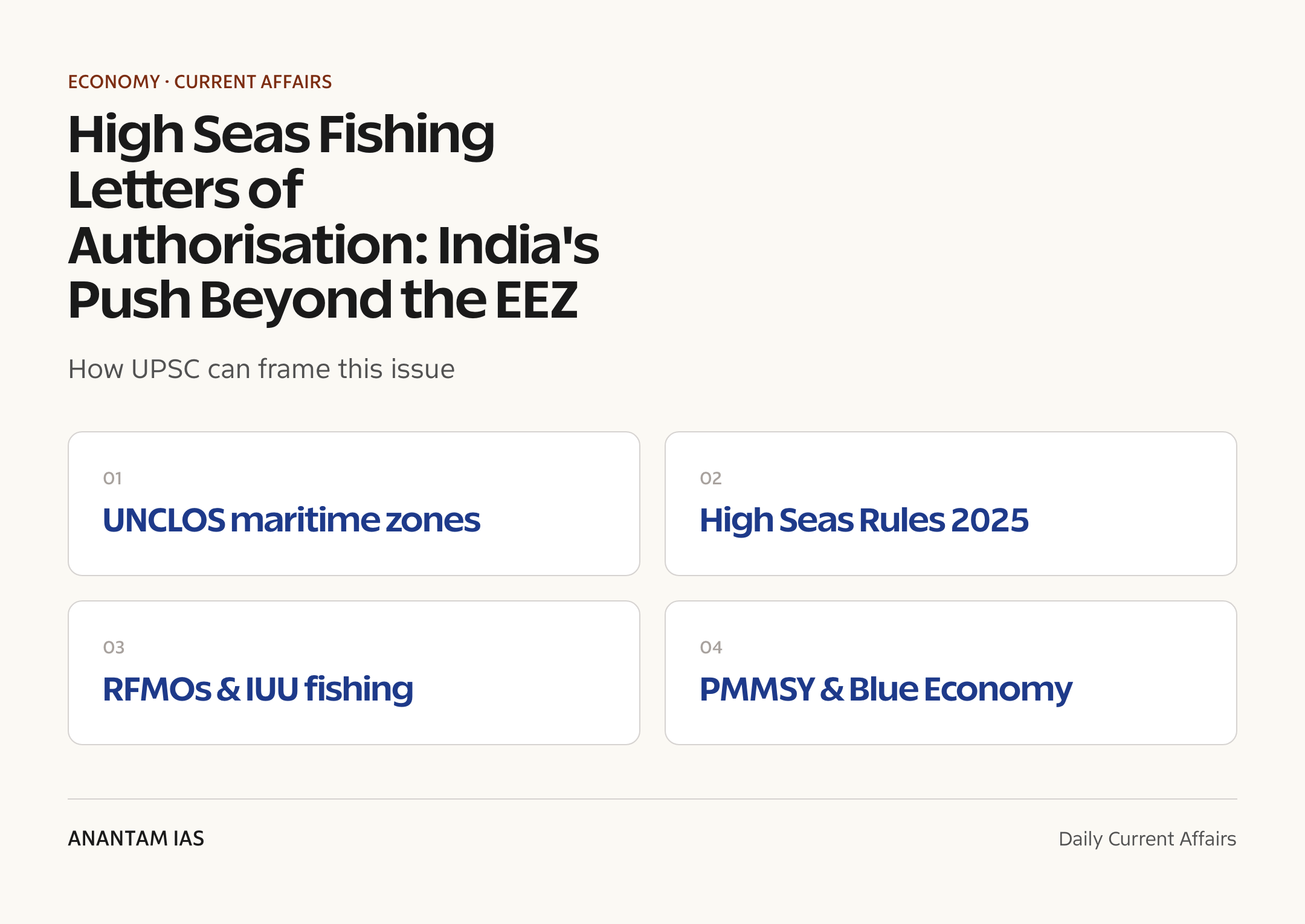
- High Seas — ocean areas beyond the 200-nautical-mile EEZ of any state; open to all states under UNCLOS, 1982 (freedom of fishing, navigation, overflight), but subject to conservation duties.
- Maritime zones under UNCLOS — territorial sea (12 nm), contiguous zone (24 nm), EEZ (200 nm), continental shelf; sovereign rights over resources in the EEZ rest with the coastal state.
- Letter of Authorisation (LoA) — vessel-specific, non-transferable high-seas fishing permit under the 2025 Guidelines; integrated with the ReALCraft fishing-vessel registration portal.
- EEZ Rules, 2025 and High Seas Fisheries Guidelines, 2025 — the twin notified frameworks for regulated fishing beyond territorial waters, cited by the Fisheries Secretary at the launch.
- FFPO — Fish Farmer Producer Organisation; FFPOs, fisheries cooperatives and Indian fishermen get priority in LoA issuance.
- Odisha Deep Sea Fishing Mission (2026–2036) — a 10-year state Blue Economy mission to build deep-sea fishing, processing and export capacity.
- Pradhan Mantri Matsya Sampada Yojana (PMMSY) — flagship fisheries scheme since 2020; total central investment in fisheries exceeds ₹39,000 crore across schemes, with 100%+ growth in fish production.
- RFMOs — treaty bodies (for example the Indian Ocean Tuna Commission, of which India is a member) that set catch limits, gear rules, bycatch mitigation and Fish Aggregating Device (FAD) management on the high seas.
- BBNJ Agreement (High Seas Treaty) — the UNCLOS implementing agreement on marine biodiversity beyond national jurisdiction, adopted in 2023 and signed by India in 2024.
Mains Relevance
GS Paper 3
- Blue Economy as a growth frontier — moving Indian fisheries from near-shore capture to regulated deep-sea and high-seas harvesting of high-value species.
- Doubling fishers’ incomes through value chains — harvesting, processing, cold chain, certification and exports — rather than subsidies alone.
- Sustainability guardrails: digital authorisation, vessel tracking, traceability, RFMO compliance and action against IUU fishing.
GS Paper 2
- Cooperative federalism in action — a Union permit framework launched jointly with a state deep-sea mission (Odisha).
- India’s obligations under UNCLOS and RFMOs; governance of the global commons after the BBNJ Agreement.
GS Paper 1
- Geography of India’s marine resources — coastline, continental shelf, EEZ and the distribution of pelagic fisheries like tuna.
Essay
- The ocean as the next frontier of development — prosperity and stewardship on the global commons.
- Empowering the last-mile producer: when fishermen, not fleets, get the licence.
Background and Context
What exactly are the High Seas?
The high seas are the parts of the ocean that belong to no country — and to everyone.
- Under the UN Convention on the Law of the Sea (UNCLOS), 1982, a coastal state’s zones run outward: territorial sea up to 12 nautical miles, contiguous zone up to 24 nm, and the Exclusive Economic Zone (EEZ) up to 200 nm, where it holds sovereign rights over living and non-living resources.
- Waters beyond every state’s EEZ are the high seas — roughly two-thirds of the world’s ocean — where all states enjoy freedoms of navigation, overflight and fishing, coupled with a duty to conserve living resources.
- Fishing there is not a free-for-all: states must cooperate through Regional Fisheries Management Organisations (RFMOs), and flag states are responsible for what their vessels do.
- India, as per PIB, has over 11,000 km of coastline and an EEZ of nearly 24 lakh sq km, yet its fleet has historically fished close to shore — leaving oceanic stocks such as tuna, tuna-like species and other pelagic resources under-harvested.
- The BBNJ Agreement (High Seas Treaty), adopted in 2023 to protect marine biodiversity beyond national jurisdiction, has sharpened global attention on who uses the high seas, and how.
The LoA framework: how the permit works
The Letter of Authorisation converts a vague freedom into a regulated, traceable right.
- The LoA is a mandatory requirement under the Guidelines for Sustainable Harnessing of Fisheries in the High Seas by Indian-Flagged Fishing Vessels, 2025, for any Indian vessel fishing or supporting fishing beyond the EEZ.
- It is vessel-specific and non-transferable, and integrated with the ReALCraft Fishing Vessel Registration Portal — so every authorised vessel is registered, traceable and monitored.
- The process is end-to-end online, time-bound, issued and renewed at minimal cost, with real-time application tracking — an ease-of-compliance design for small operators, PIB noted.
- Authorised vessels must follow the conservation and management measures of the relevant RFMOs: catch limits, gear regulations, bycatch mitigation, Fish Aggregating Device (FAD) management and voyage reporting.
- Fisheries cooperatives, FFPOs and Indian fishermen get priority in issuance — deliberately putting producer collectives, not just large corporate fleets, at the front of the queue.
- The framework sits alongside the newly notified EEZ Rules, 2025 and a new Access Pass, operationalising the Union Budget 2025–26 commitment on EEZ and high-seas fisheries.
Who received the first LoAs
The first tranche went to producer collectives spread across India’s coasts.
- LoAs were presented to ten FFPOs and fishermen from across the country, along with fisheries cooperative societies and fishing-vessel owners.
- Recipients included the National Cooperative Exports Limited (NCEL), the apex cooperative export body.
- Named cooperatives span the coastline: Shree Mahavir Machhimar Sahakari Mandali (Gujarat), Shri Martanda Prassanna Colaba society (Maharashtra), South Goa Mechanized Boat Owners society, Paradeep Marine society (Odisha), Thengapattanam Deep Sea Fish Producers society (Tamil Nadu) and Malpe Fishermen’s society (Karnataka).
- The spread signals intent: high-seas access is being distributed across both coasts rather than concentrated in one port or company.
India's fisheries economy: the numbers that matter
The sector this reform targets is already one of India’s quiet success stories.
- India is the second-largest fish producer in the world, contributing around 8 per cent of global fish production.
- The sector supports the livelihoods of nearly 3 crore fishermen and fish farmers.
- Seafood exports hit a record ₹73,891 crore in 2025–26 despite global trade headwinds, the Fisheries Minister said at the launch.
- Government investment in fisheries through flagship schemes — led by the Pradhan Mantri Matsya Sampada Yojana (PMMSY) — exceeds ₹39,000 crore, driving more than 100 per cent growth in fish production.
- The Union Budget 2026–27 made fish catch by Indian vessels in the EEZ and high seas duty-free and directed that foreign port landings be treated as exports — removing tax friction from oceanic fishing economics.
- Beyond the catch, the Vice-President flagged employment spillovers in processing, cold chain, transportation, packaging, logistics and export services.
Odisha Deep Sea Fishing Mission (2026–2036)
The host state paired the national launch with a ten-year mission of its own.
- The Mission is a flagship Blue Economy initiative of the Government of Odisha to unlock offshore and deep-sea fisheries and make the state a leading deep-sea fishing and marine export hub.
- Odisha produced 12.70 lakh tonnes of fish in 2025–26 — 8.27 lakh MT freshwater, 1.86 lakh MT brackish-water and 2.56 lakh MT marine — supporting over 16 lakh fishers and fish farmers.
- Its resource base: about 7.12 lakh hectares of freshwater area, 4.18 lakh hectares of brackish water and a 24,000 sq km continental shelf; roughly 95% of the state’s population eats fish (per capita 19.16 kg).
- The state exported 1,00,897 tonnes of seafood worth ₹5,428.67 crore in 2025–26, led by shrimp, from districts such as Balasore, Bhadrak, Jagatsinghpur and Puri.
- Under PMMSY, projects worth over ₹1,301 crore have been approved for Odisha since 2020, including hatcheries, cold storages, cage culture and group accident insurance for about 8.47 lakh fishermen.
- The Mission bets on modern fishing infrastructure, value chains, scientific fisheries management and market linkages over 2026–2036.
The global rulebook: RFMOs, IUU fishing and sustainability
India’s entry into high-seas fishing arrives with sustainability conditions built in.
- RFMOs such as the Indian Ocean Tuna Commission (IOTC) — of which India is a member — allocate quotas and set binding conservation measures for tuna and tuna-like stocks.
- IUU (illegal, unreported and unregulated) fishing is the sector’s biggest governance threat; the Vice-President stressed digital authorisation, vessel tracking, international certification and strict anti-IUU compliance.
- Traceability and quality certification decide market access: certified, traceable catch commands premium prices in the EU, US and Japan.
- Sustainable fishing is a moral responsibility, the Vice-President said — growth must go hand in hand with conservation of marine resources, echoing the SDG 14 (Life Below Water) agenda.
- A regulated Indian presence also carries a strategic dividend: flag-state activity, monitored fleets and data presence in the Indian Ocean where distant-water fishing fleets of other nations already operate.
Way Forward
Build the deep-water fleet and skills
- Support conversion and construction of tuna long-liners and multi-day vessels for FFPOs and cooperatives through PMMSY-linked credit and insurance.
- Train crews in deep-sea navigation, on-board handling and cold-chain practices so high-value catch survives the voyage to premium markets.
Harden the sustainability architecture
- Scale vessel tracking systems and electronic catch documentation across the authorised fleet; publish compliance data.
- Deepen engagement in RFMOs and align domestic rules with the BBNJ Agreement as the high-seas governance regime tightens.
Capture value, not just volume
- Invest in processing, certification and branding so Indian tuna competes on quality; use the 2026–27 duty-free and export-treatment provisions to anchor port-based value chains.
- Keep cooperatives and FFPOs at the centre so incomes accrue to fishing communities, not only aggregators.
Conclusion
The LoA launch is a small permit with a large meaning: India is formally converting its UNCLOS freedom to fish the high seas into an organised, monitored national capability — and it is handing the first keys to fishermen’s cooperatives and FFPOs rather than corporate fleets.
Its success will be measured on two axes at once: whether incomes of coastal communities actually rise across the value chain, and whether India’s new oceanic fleet stays demonstrably clean on IUU fishing and RFMO compliance. Get both right, and the Blue Economy stops being a slogan and becomes a sector.
UPSC Practice Questions
Prelims MCQ 1
With reference to the Letter of Authorisation (LoA) for high seas fishing, launched in July 2026, consider the following statements:
- The high seas are ocean areas lying beyond the Exclusive Economic Zone of any coastal state.
- The LoA is vessel-specific, non-transferable and integrated with the ReALCraft fishing-vessel registration portal.
- India is not a member of any Regional Fisheries Management Organisation.
How many of the above statements are correct?
(a) Only one (b) Only two (c) All three (d) None
Answer: (b) Only two
Explanation:
Statements 1 and 2 are correct: the high seas begin beyond the 200-nm EEZ, and the LoA is a vessel-specific, non-transferable permit linked to ReALCraft. Statement 3 is wrong — India is a member of the Indian Ocean Tuna Commission (IOTC), an RFMO whose conservation measures LoA-holding vessels must follow.
Prelims MCQ 2
Under the UN Convention on the Law of the Sea (UNCLOS), 1982, the ‘high seas’ begin beyond which of the following limits?
(a) The 12-nautical-mile territorial sea (b) The 24-nautical-mile contiguous zone (c) The 200-nautical-mile Exclusive Economic Zone (d) The outer edge of the legal continental shelf in all cases
Answer: (c) The 200-nautical-mile Exclusive Economic Zone
Explanation:
The high seas are waters beyond the EEZ of any state (beyond 200 nm from the baseline). Within the EEZ the coastal state holds sovereign rights over resources; on the high seas all states enjoy freedom of fishing subject to conservation duties and RFMO measures.
UPSC Mains Questions
- India has launched Letters of Authorisation for its fishing vessels to operate in the high seas. Discuss how this initiative can transform India’s marine fisheries economy, and examine the sustainability safeguards it must observe under international law. (250 words)
- The Blue Economy is as much about governance as about resources. In the light of the EEZ Rules, 2025, the High Seas Fisheries Guidelines, 2025 and India’s RFMO commitments, evaluate India’s readiness to become a responsible distant-water fishing nation. (250 words)
- Producer collectives, not corporate fleets, have been given priority in India’s high-seas fishing framework. Analyse the merits and risks of a cooperative-led model for deep-sea fisheries development. (150 words)
Sources: PIB, Vice-President's Secretariat and PIB, Ministry of Fisheries, Animal Husbandry & Dairying.
Frequently Asked Questions
What is a Letter of Authorisation for high seas fishing?
It is a mandatory, vessel-specific and non-transferable permit that allows an Indian-flagged fishing vessel to fish in the high seas. Issued under the 2025 High Seas Fisheries Guidelines through a fully online process linked to the ReALCraft portal, it was launched nationally at Bhubaneswar on 9 July 2026.
What are the high seas under UNCLOS?
The high seas are ocean areas beyond the 200-nautical-mile Exclusive Economic Zone of any country. All states enjoy freedoms of navigation and fishing there, but must conserve living resources and cooperate through Regional Fisheries Management Organisations that set catch limits and gear rules.
Who received the first LoAs?
Ten Fish Farmer Producer Organisations, fisheries cooperatives and vessel owners from across India, including National Cooperative Exports Limited (NCEL) and societies from Gujarat, Maharashtra, Goa, Karnataka, Tamil Nadu and Odisha such as the Paradeep Marine and Malpe Fishermen’s cooperatives.
What is the Odisha Deep Sea Fishing Mission?
A ten-year (2026–2036) Blue Economy mission of the Odisha government to unlock offshore and deep-sea fisheries. It invests in modern fishing infrastructure, value chains, scientific fisheries management and market linkages to make Odisha a leading deep-sea fishing and seafood export hub.
How big is India’s fisheries sector?
India is the world’s second-largest fish producer with about 8 per cent of global output. The sector supports nearly 3 crore fishers and fish farmers, and seafood exports reached a record ₹73,891 crore in 2025–26, backed by over ₹39,000 crore of government investment.
Why do RFMOs matter for Indian fishermen?
Regional Fisheries Management Organisations, like the Indian Ocean Tuna Commission, set binding catch limits, gear regulations and bycatch rules for high-seas stocks. Indian vessels holding an LoA must comply with these measures, which also determine access to premium export markets through traceability and certification.