Delayed Home Possession: Supreme Court Expands Buyer Remedies
Why in News?
The Supreme Court held that in a case of delayed home possession, a flat buyer does not automatically lose the right to claim compensation merely because possession was later accepted.
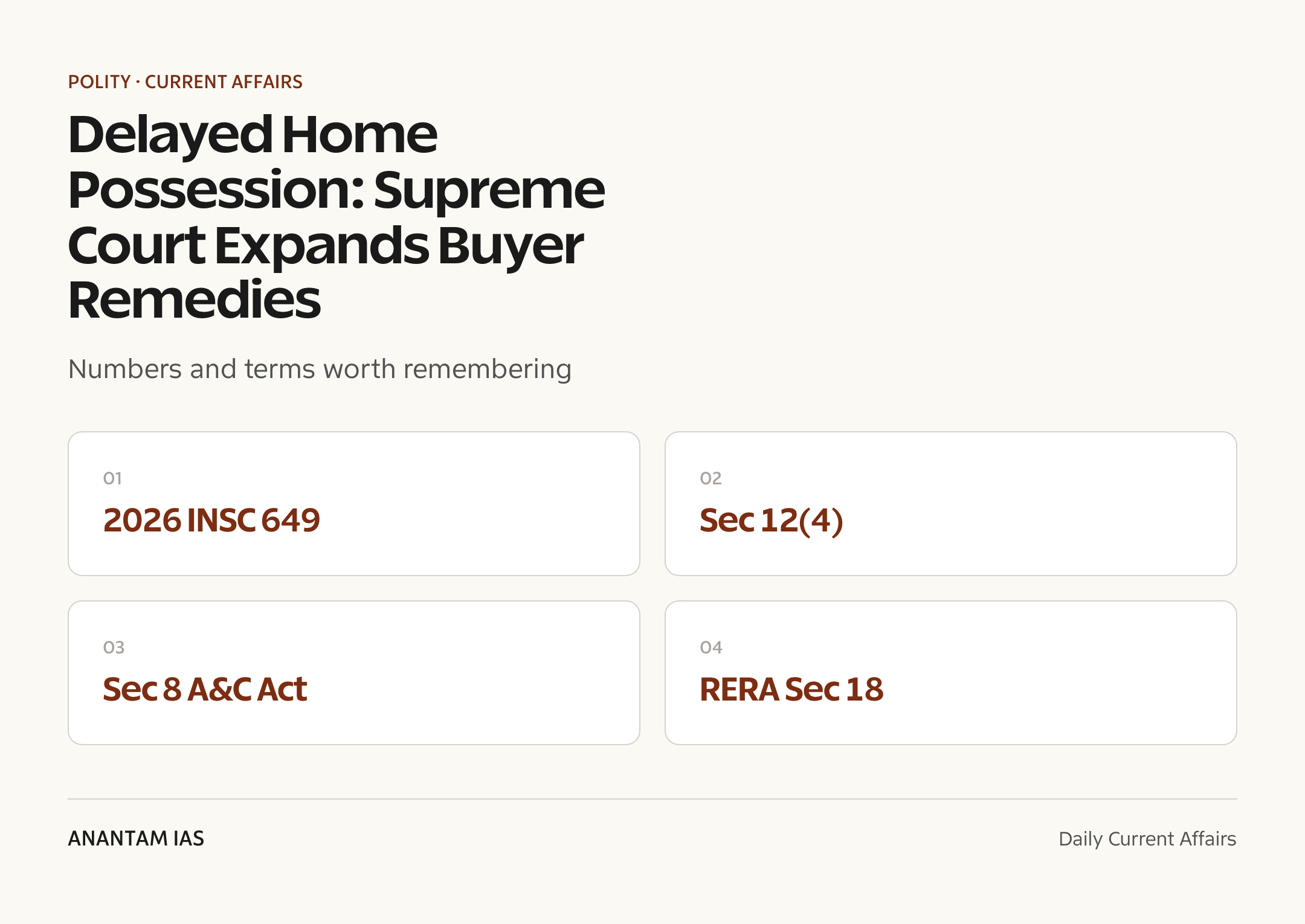
In T.K.A. Padmanabhan v. Abhiyan Cooperative Group Housing Society Ltd., decided on 4 June 2026, the Court also said a consumer complaint already admitted by a forum cannot be pushed into arbitration only because the buyer agreement contains an arbitration clause.
- Civil Appeal No. 10724 of 2016 arose from a housing dispute over Flat No. 232 in a cooperative group housing society in Delhi.
- The original consumer complaint was filed in 2005 before the District Consumer Forum, alleging deficiency in service because possession was delayed.
- The respondent society invoked Section 8 of the Arbitration and Conciliation Act, 1996, seeking reference of the dispute to arbitration.
- The Supreme Court set aside the District Forum, State Commission and NCDRC orders that had kept the complaint away from a merits hearing.
- The matter was restored to the District Consumer Disputes Redressal Commission, Dwarka, with an endeavour to decide it within one year.
The development matters in the context of:
- The ruling matters because many homebuyers accept possession under pressure and then face the argument that their legal claim has ended.
- It clarifies the relationship between consumer forums, private arbitration clauses and statutory housing remedies.
- It connects with the broader governance challenge of making real estate regulation faster, accessible and credible for ordinary buyers.
UPSC Relevance
Prelims Relevance
- Consumer Protection Act, 1986: Section 2(1)(d) defines consumer for services hired for consideration.
- Section 2(1)(o): service includes housing construction, bringing many builder-buyer disputes within consumer law.
- Section 3: consumer remedy is in addition to, and not in derogation of, other legal remedies.
- Section 12(4): once a complaint is admitted, it cannot be transferred to another court, tribunal or authority.
- Section 8 of Arbitration Act: enables reference to arbitration when a valid arbitration agreement exists, subject to statutory limits.
- RERA Section 18: provides refund with interest or delay interest when a promoter fails to give possession on time.
- NCDRC: National Consumer Disputes Redressal Commission is the apex consumer disputes body below the Supreme Court.
- Emaar MGF Land Ltd. v. Aftab Singh: earlier Supreme Court precedent on consumer forum jurisdiction despite arbitration clauses.
Mains Relevance
GS Paper 2
- Role of statutory remedies in protecting citizens against unequal private contracts.
- Access to justice through consumer forums and specialized tribunals.
- Judicial interpretation of welfare legislation such as the Consumer Protection Act.
GS Paper 3
- Real estate as a major part of the urban economy and household savings.
- Regulatory certainty under RERA and consumer law for housing-market trust.
Essay
- Law as a shield for the weaker party in unequal contracts.
- Urbanisation, housing dreams and the need for accountable markets.
Essay
- Access to justice matters most when the weaker party has already paid and has little bargaining power.
- Urban housing is not only a market transaction; it is tied to savings, dignity and family security.
Background and Context
What the dispute was about
The case began as an ordinary buyer grievance but raised larger questions about consumer jurisdiction.
- T.K.A. Padmanabhan became a member of the respondent cooperative housing society in January 2003 and claimed to have paid the full amount for allotment.
- The buyer was allotted Flat No. 232, and an agreement was entered into between the parties on 27 February 2004.
- On 8 August 2005, the buyer filed a consumer complaint seeking compensation for alleged delay in possession.
- The respondent society relied on an arbitration clause in the agreement and sought reference to arbitration under the 1996 Act.
- The District Forum first rejected the arbitration plea, but later referred the parties to arbitration after a High Court remand.
- The NCDRC dismissed the buyer’s revision petition, reasoning that after taking possession without protest, he had ceased to be a consumer.
Core holding of the Supreme Court
The Supreme Court restored the buyer’s complaint for a decision on merits instead of closing it at the threshold.
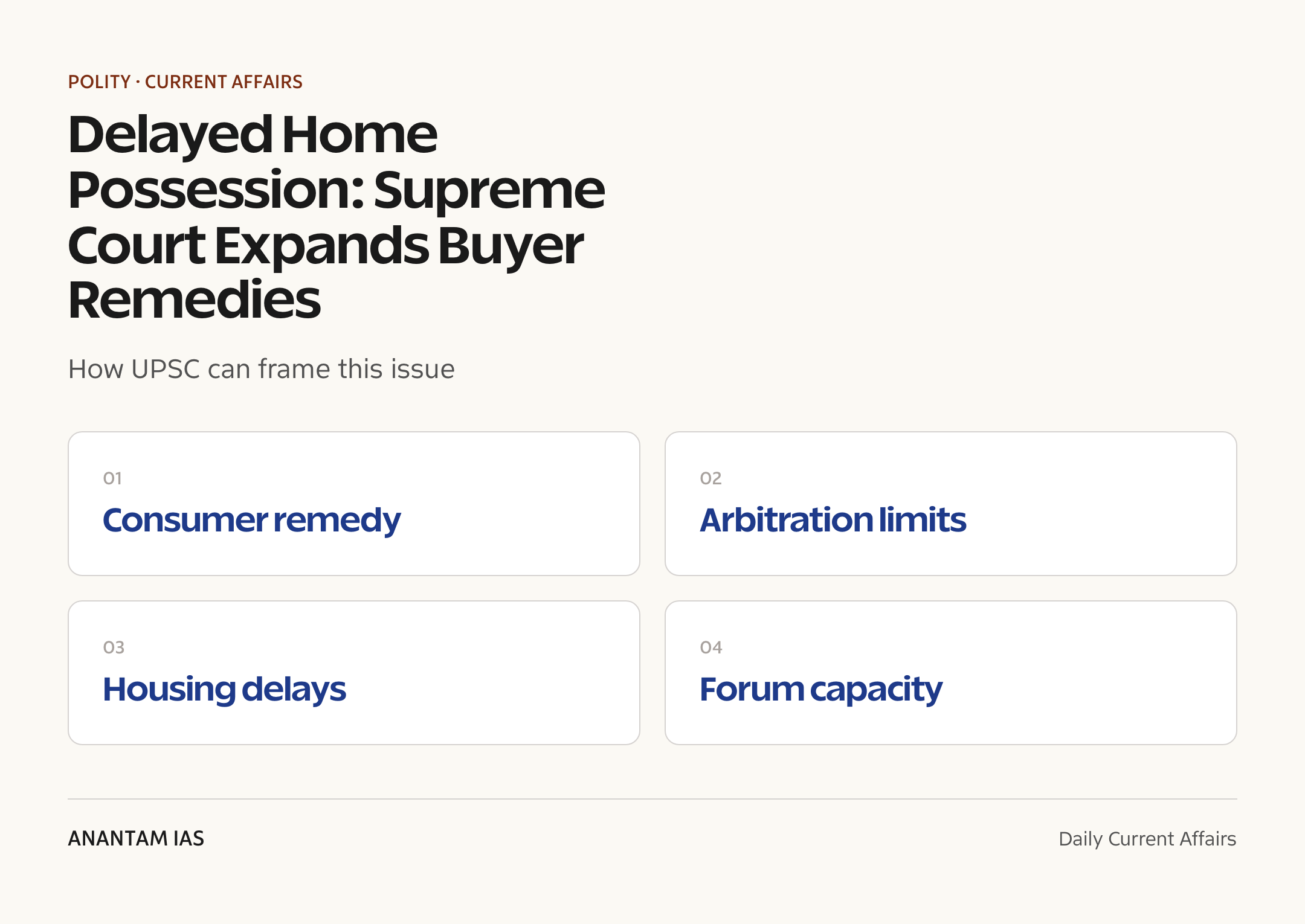
- The Court held that a private arbitration clause cannot defeat a statutory consumer remedy created by Parliament.
- It said the complaint was about compensation for delay, not merely delivery of possession.
- The later receipt of possession cannot by itself erase the buyer’s right to have the delay claim adjudicated.
- Questions such as whether delay occurred, who caused it, whether there was waiver and whether compensation is payable must be decided on evidence.
- The Court did not award compensation directly; it restored the matter to the Dwarka District Commission for a merits hearing.
- For aspirants, the case fits the Indian Polity theme of rights, remedies and institutional accountability.
Consumer law and arbitration
The judgment reinforces a long line of cases that treat consumer law as an additional remedy.
- Section 3 of the 1986 Act says consumer remedies are in addition to other remedies, which protects the forum choice of an aggrieved consumer.
- Section 12(4) becomes important after admission: an admitted complaint cannot be diverted to another court, tribunal or authority.
- The Court relied on precedents such as Fair Air Engineers, Thirumurugan Cooperative Agricultural Credit Society, National Seeds Corporation and Emaar MGF Land.
- The principle is not anti-arbitration; it says party autonomy in contract cannot override a specific statutory protection.
- This matters in standard-form contracts where buyers rarely negotiate clauses on forum, delay liability or dispute resolution.
- For governance answers, link this with the problem of access barriers when private contracts push citizens away from cheaper public remedies.
RERA and consumer remedies
RERA gives a sector-specific framework, while consumer law supplies an accessible adjudicatory route.
- RERA, 2016 was enacted to regulate real estate projects, improve transparency and protect the interests of allottees.
- Section 18 of RERA covers delayed possession: a buyer who exits can seek refund with interest and compensation, while a buyer who stays can claim interest for every month of delay.
- The Indian Express explained that RERA runs alongside consumer remedies rather than replacing them.
- The Supreme Court ruling is based mainly on the Consumer Protection Act, 1986, but its practical effect strengthens the broader buyer-remedy ecosystem.
- Consumer forums, RERA authorities and civil courts operate in a crowded space; exam answers should stress coordinated remedies, not forum-shopping as a cure-all.
- Related current affairs notes on governance should be read for the institutional angle rather than only the property-law detail.
Why accepting possession was not treated as waiver
The Court separated the delivery of the flat from the earlier period of alleged delay.
- A buyer may accept possession because refusing it can deepen financial loss, rental burden or family uncertainty.
- The claim for delay compensation relates to the period before actual possession, so it survives as an independent cause of action.
- The Court kept open whether the buyer accepted possession unconditionally and whether that fact affects compensation.
- The key point is procedural: such issues require a merits hearing, not dismissal at the admission or revision stage.
- This approach prevents powerful service providers from using post-delay possession as a complete defence against deficiency in service claims.
Governance and economy lens
Housing disputes are not private quarrels alone; they affect institutional trust and urban economic behaviour.
- Real estate absorbs large household savings, and delayed possession can create rent, EMI and opportunity-cost burdens.
- When remedies are slow, the deterrence value of RERA and consumer law weakens.
- When remedies remain accessible, builders and societies face stronger incentives to draft clearer timelines and honour possession commitments.
- The ruling can be used in GS2 answers on rule of law, tribunal design and citizen-centric grievance redressal.
- It also fits GS3 because predictable contract enforcement improves market confidence in a sector linked with construction, finance and urban growth.
Way Forward
Strengthen consumer forum capacity
- Fill vacancies and improve case-flow management in District Commissions so remanded consumer disputes do not remain symbolic victories.
- Use digital filing, cause-list transparency and time standards for older housing complaints.
- Publish plain-language summaries of important consumer rulings so buyers understand available remedies before limitation or documentation problems arise.
Improve real estate compliance
- Require clearer disclosure of possession timelines, force majeure clauses, delay-interest terms and refund rights in builder-buyer agreements.
- Align RERA portals with consumer fora by sharing project registration, completion and complaint-status data where legally possible.
- Treat repeated delay, misleading timelines and non-compliance with forum orders as governance risks, not isolated private disputes.
Protect buyers without weakening due process
- Preserve the right of builders or societies to present evidence on delay, waiver and responsibility.
- Ensure that compensation reflects actual delay, contractual terms, statutory standards and the conduct of both parties.
- Encourage buyers to accept possession, when necessary, with written reservation of rights so factual disputes are easier to decide later.
Conclusion
The ruling strengthens the idea that consumer protection is a public-law response to unequal bargaining power. A buyer who finally receives a delayed flat may still have a live claim for the period of delay.
For UPSC, the value of the case lies less in property law detail and more in the governance lesson: statutory remedies must remain accessible, contracts must not dilute welfare legislation and tribunals must decide citizen claims on merits.
UPSC Practice Questions
Prelims MCQ 1
With reference to T.K.A. Padmanabhan v. Abhiyan Cooperative Group Housing Society Ltd., consider the following statements:
- The Supreme Court held that an arbitration clause automatically bars a consumer forum from hearing a housing complaint.
- The Court held that accepting possession of a flat does not, by itself, extinguish a claim for compensation for delayed possession.
- The matter was restored to the District Consumer Disputes Redressal Commission, Dwarka.
How many of the above statements are correct?
(a) Only one (b) Only two (c) All three (d) None
Answer: (b) Only two
Explanation:
Statements 2 and 3 are correct. Statement 1 is incorrect because the Court said an arbitration clause cannot by itself oust the consumer forum’s statutory jurisdiction.
Prelims MCQ 2
Which provision of the Consumer Protection Act, 1986 states that consumer remedies are in addition to and not in derogation of other legal remedies?
(a) Section 2(1)(d) (b) Section 2(1)(o) (c) Section 3 (d) Section 12(4)
Answer: (c) Section 3
Explanation:
Section 3 preserves consumer remedies as additional remedies. Section 2(1)(d) defines consumer, Section 2(1)(o) defines service and Section 12(4) deals with admitted complaints.
UPSC Mains Questions
- The Supreme Court’s delayed-possession ruling shows how welfare legislation can limit unequal private contracts. Discuss with reference to consumer protection, arbitration clauses and access to justice in India’s housing market.
- Real estate disputes are both contract disputes and governance problems. Examine how RERA, consumer forums and judicial review can together improve accountability without creating procedural confusion.
- Acceptance of possession should not automatically erase a buyer’s claim for delay compensation. Critically analyse this proposition from the perspective of rule of law and market confidence.
Sources: Supreme Court of India and Indian Express Explained.
Frequently Asked Questions
What did the Supreme Court decide?
The Court held that accepting possession of a delayed flat does not by itself end the buyer’s right to seek compensation for the period of delay. It restored the complaint to the Dwarka District Commission for a merits hearing.
Was compensation awarded immediately?
No. The Supreme Court did not decide whether compensation was payable. It said issues such as actual delay, responsibility, waiver and entitlement to compensation must be examined through evidence by the consumer forum.
Why was arbitration rejected?
The Court said a private arbitration clause cannot defeat a statutory consumer remedy. Once a consumer complaint is admitted, Section 12(4) of the 1986 Act prevents shifting it to another court, tribunal or authority.
How does RERA fit here?
RERA provides sector-specific remedies for delayed possession, including refund with interest or monthly delay interest. The judgment mainly applies consumer law, but it supports the broader idea that buyer remedies survive standard-form contract clauses.
Why is this relevant for UPSC?
It links GS2 themes of rights, remedies, tribunals and access to justice with GS3 themes of real estate, household savings and market confidence. It also offers a clear example of courts protecting statutory welfare remedies.
What should homebuyers document?
Buyers should keep the agreement, payment records, promised possession date, correspondence, possession letter and any written reservation of rights. These documents help a forum decide delay, responsibility and compensation on evidence.