Homemakers as Nation Builders: Supreme Court’s ‘Loss of Domestic Care’ Head
Why in News?
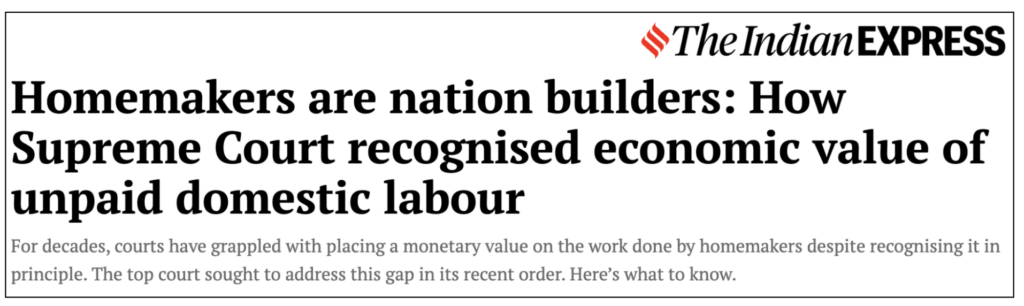
The Supreme Court of India, in Shishupal @ Shish Ram v. Surjeet (June 2026), for the first time created a distinct compensable head called ‘loss of domestic care’ in motor-accident claims, fixing the economic value of a homemaker’s unpaid labour at a baseline of Rs 30,000 per month.
A two-judge bench held that homemakers are not merely caregivers but ‘economic entities’, declaring that they ‘actually are the nation builders’.
The ruling arose from a 2001 Haryana road accident in which Reshma (aged 35) died. The Motor Accident Claims Tribunal had awarded her family Rs 2.42 lakh; the Court raised the total compensation to about Rs 62.77 lakh, with the new head replacing the old ‘notional income’ as the starting figure.
- Bench: Justices Sanjay Karol and N. Kotiswar Singh; case Shishupal @ Shish Ram v. Surjeet.
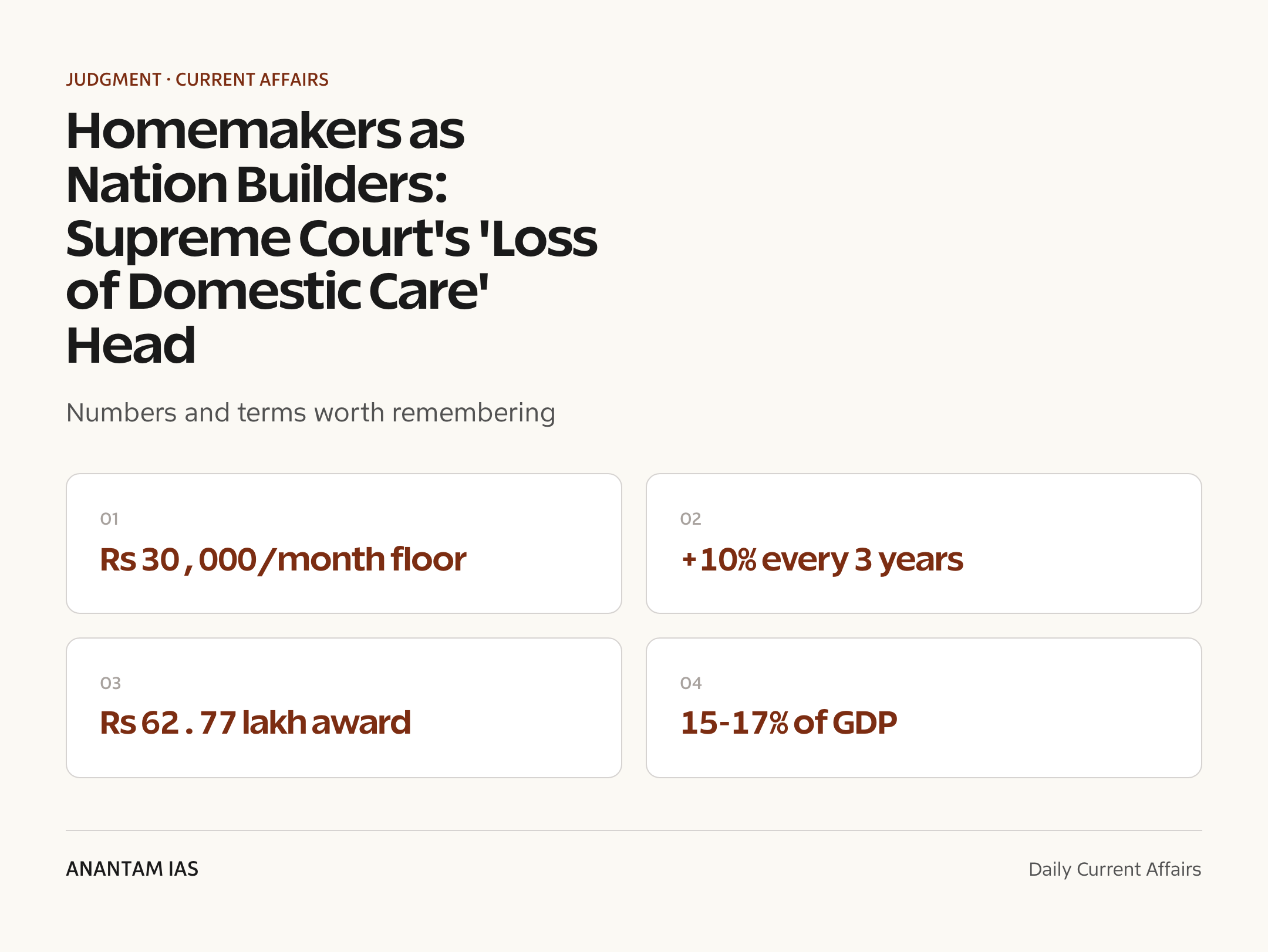
- New head ‘loss of domestic care’ set at a floor of Rs 30,000/month, revised up 10% every three years.
- Compensation journey: MACT Rs 2.42 lakh (initial) → Punjab & Haryana HC Rs 8.43 lakh (2024) → SC ~Rs 62.77 lakh.
- Where the homemaker also earned Rs 30,000 is added to her actual income, not substituted.
- The court relied on the NSO Time Use Survey 2019: women aged 15-59 spend over 7 hours/day on unpaid domestic work versus under 3 hours for men.
- Applies only to the Motor Vehicles Act, 1988 compensation; creates no salary, pension or employment relationship for homemakers.
The development matters in the context of:
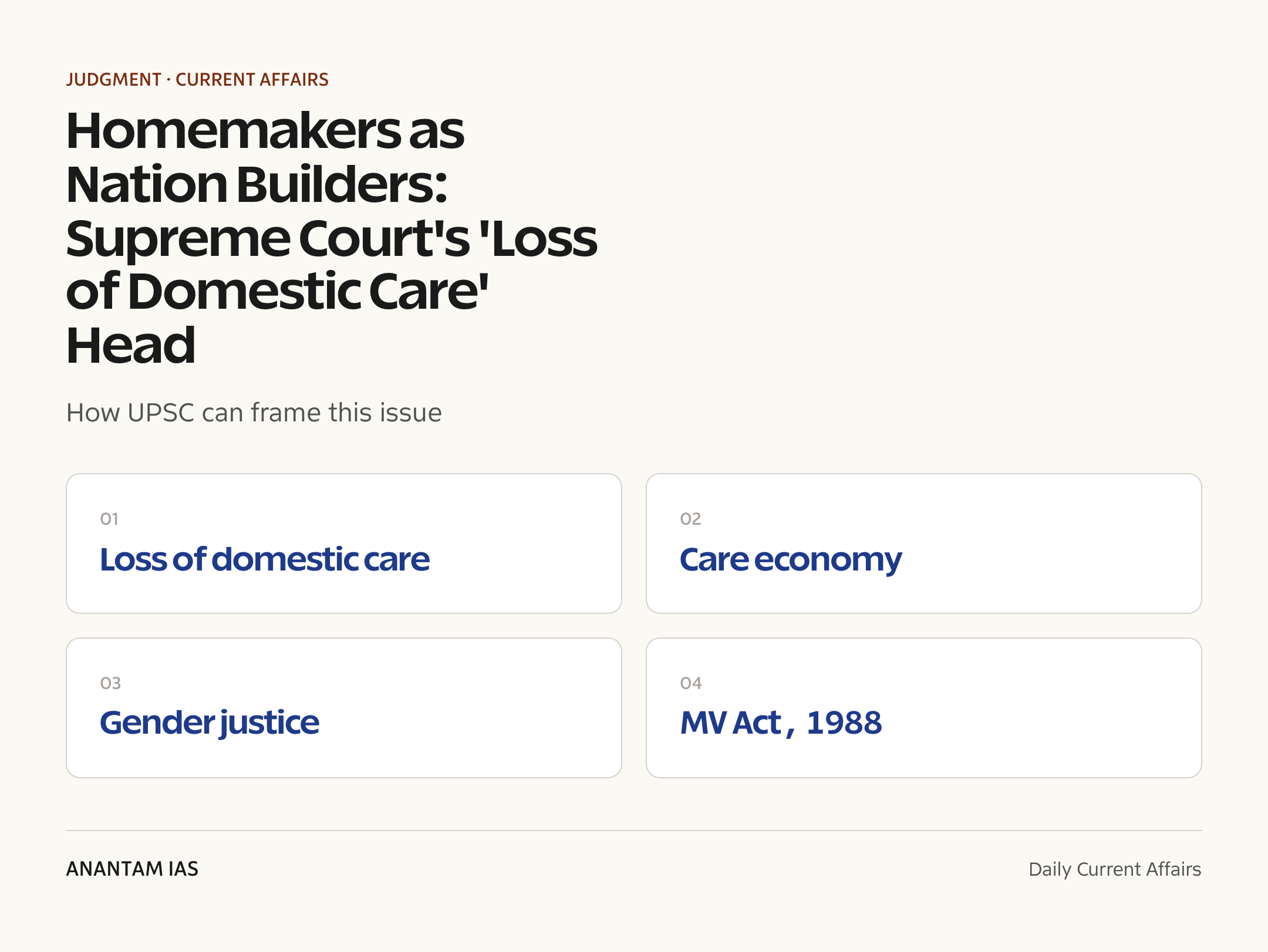
- It anchors the long-debated idea of the care economy in enforceable tort law, not just policy rhetoric.
- It links unpaid domestic labour to gender justice and India’s low female labour-force participation.
- It standardises a previously inconsistent practice of valuing homemakers through ad-hoc ‘notional income’ figures.
UPSC Relevance
Prelims Relevance
- Motor Vehicles Act, 1988 — statutory basis for accident compensation and MACT claims.
- Motor Accident Claims Tribunal (MACT) — adjudicates compensation; appeals go to the High Court, then the Supreme Court.
- ‘Loss of domestic care’ — new compensatory head, baseline Rs 30,000/month, +10% every 3 years.
- Notional income — figure imputed to non-earning persons to value unpaid work.
- Loss of consortium — fixed at Rs 40,000 per dependent under Pranay Sethi (emotional loss, distinct from domestic care).
- Key precedents: Lata Wadhwa (2001) Rs 3,000 notional income; Arun Kumar Agarwal (2010); Kirti v. Oriental Insurance (2021); National Insurance v. Pranay Sethi (2017).
- NSO Time Use Survey 2019 — unpaid caregiving estimated at 15-17% of India’s GDP.
- Compensation formula: income − personal expenses + future prospects × age-based multiplier.
- Case name and Bench: Shishupal @ Shish Ram v. Surjeet; Justices Sanjay Karol and N. Kotiswar Singh.
Mains Relevance
GS Paper 2
- Role of the judiciary in advancing social justice and gender equality through the interpretation of compensation law.
- Recognition of unpaid care work as a step toward substantive equality under Articles 14, 15 and 39.
GS Paper 1
- Women’s unpaid domestic labour, the gendered division of work, and its link to female labour-force participation.
GS Paper 3
- The care economy, GDP measurement gaps, and the economics of counting unpaid work.
Essay
- ‘The hand that rocks the cradle’: valuing the invisible economy of care.
- Justice delayed and justice quantified — courts and the worth of unpaid labour.
Background and Context
The Case and What the Court Held
The judgment converted a routine accident appeal into a structural rethink of how courts value a homemaker.
- Victim Reshma, a 35-year-old homemaker, died in a 2001 road accident in Haryana.
- The Supreme Court created a new head, ‘loss of domestic care’, with a baseline of Rs 30,000/month as the deceased’s notional monthly income.
- This figure replaces the old notional income as the starting number to which future prospects and the multiplier are then applied.
- It applies only where three conditions co-exist: the homemaker ran the household, children lost her care and guidance, and the spouse or parents lost support.
- Where the homemaker also held paid employment, Rs 30,000 is added to her actual income.
- The floor is to be revised upward by 10% every three years.
How Accident Compensation Is Calculated
The problem was structural — the formula leaned on a number that did not exist for homemakers.
- Under the Motor Vehicles Act, 1988, a court takes the deceased’s income, deducts personal expenses, adds future prospects, and multiplies by an age-based multiplier.
- The opening income figure drives almost the entire award.
- A salaried person has payslips and tax returns; a homemaker has none, so courts impute a ‘notional income’.
- Earlier, the Act treated a non-earning person as having an annual income of just Rs 15,000 — a number that crushed the final award.
- The Court found ‘notional income’ could never fully capture what a homemaker actually contributes.
The Trail of Precedent
Courts had recognised the value of domestic work in principle for over two decades, but never fixed a workable method.
- Lata Wadhwa v. State of Bihar (2001) — approved a modest Rs 3,000/month notional income for homemakers aged 34-59.
- Arun Kumar Agarwal v. National Insurance (2010) — called a homemaker’s services ‘invaluable’, beyond mere cooking or cleaning.
- National Insurance v. Pranay Sethi (2017) — a Constitution Bench standardised heads like loss of consortium, estate and funeral expenses.
- Kirti v. Oriental Insurance (2021) — held that a homemaker’s economic value cannot be discounted simply because the work is unpaid or done by women.
- Despite this, quantification stayed inconsistent — the gap the 2026 ruling closes.
Three Dimensions of Loss
The Court mapped exactly what a household loses when a homemaker dies.
- Household management — the daily running of the home that keeps the family functional.
- Loss of the ‘first teacher’ — transmission of skills, language and values to children that no paid arrangement replicates.
- Loss of the earning spouse of the domestic infrastructure that freed them to focus on paid work.
- These make a homemaker’s contribution ‘neither entirely economic nor entirely non-economic’.
- The Court separated this from loss of consortium (Rs 40,000), which covers only emotional loss — affection, companionship and solace.
The Data Behind the Verdict
The Court grounded its reasoning in national time-use evidence, not sentiment.
- It cited the NSO Time Use Survey 2019: women aged 15-59 spend over 7 hours/day on unpaid domestic tasks, against under 3 hours for men.
- Women’s unpaid caregiving is estimated at 15-17% of India’s GDP — a contribution that never enters GDP because unpaid work is not counted as productive.
- This invisibility in national accounts is precisely what the ‘loss of domestic care’ head seeks to correct in tort terms.
- It echoes the wider economic finding that suppressed valuation of domestic labour depresses female labour-force participation.
Significance and Ripple Effects
The narrow ruling on motor claims could radiate across maintenance, labour and insurance law.
- It is a ‘vital corrective to decades of economic erasure’, as The Hindu put it in its editorial.
- Homemakers seeking maintenance under the Hindu Marriage Act now have judicial reasoning backing the economic value of their work.
- Rural women who ‘assist in sowing, harvesting and cattle-tending’ can argue that their labour be valued higher rather than treated as incidental.
- Future litigation may test whether male homemakers can claim equivalent treatment.
- Insurers face larger average claim sizes — possibly applied retrospectively — pushing them to revise risk models and settle faster in Lok Adalats.
The Limits of the Ruling
The judgment is deliberately narrow and does not, by itself, change the status of homemakers in the economy.
- It creates no salary, wage, pension scheme or employment relationship for homemakers.
- It applies only to MACT compensation under the Motor Vehicles Act, 1988.
- The Rs 30,000 figure is itself notional — a floor, not a market wage.
- Counting care work in GDP/national accounts still requires statistical and policy reform beyond the courtroom.
- A flat baseline may under-value or over-value depending on household size, region and circumstance.
Way Forward
Measure the care economy
- Institutionalise a recurring Time Use Survey and pilot satellite accounts to record unpaid work alongside GDP.
- Use the data to inform social-security and care-infrastructure policy.
Extend the principle thoughtfully
- Allow consistent application of the reasoning to maintenance, succession and labour disputes through clear guidelines.
- Keep the head gender-neutral so male homemakers and diverse households are covered.
Build supporting infrastructure
- Invest in childcare, elder-care and public services that reduce and redistribute unpaid domestic burdens.
- Pair recognition with measures that lift female labour-force participation, not entrench role segregation.
Conclusion
By naming a ‘loss of domestic care’ head and calling homemakers ‘nation builders’, the Supreme Court has put a concrete, enforceable value on labour that national accounts have long ignored. The reform is narrow in law but large in symbolism, and its reasoning is likely to travel well beyond motor-accident tribunals.
The deeper task remains political and statistical: to count, fund, and fairly redistribute care work so that recognition on paper translates into real economic security for those who do it.
UPSC Practice Questions
Prelims MCQ 1
With reference to the Supreme Court’s judgment in Shishupal v. Surjeet (2026), consider the following statements:
- It created a new compensatory head called ‘loss of domestic care’ with a baseline of Rs 30,000 per month.
- It granted homemakers a statutory salary and pension under the Motor Vehicles Act, 1988.
- It relied on the NSO Time Use Survey 2019 to value unpaid domestic labour.
How many of the above statements are correct?
(a) Only one (b) Only two (c) All three (d) None
Answer: (b) Only two
Explanation:
Statements 1 and 3 are correct. Statement 2 is wrong — the Court expressly created no salary, pension or employment relationship; the ruling applies only to MACT compensation.
Prelims MCQ 2
The ‘loss of consortium’ head in motor-accident compensation, as standardised in National Insurance v. Pranay Sethi (2017), primarily compensates for which of the following?
(a) The economic value of a homemaker’s daily household management
(b) The emotional loss — affection, companionship and solace — suffered by dependants
(c) Funeral expenses and loss of estate
(d) Future medical costs of surviving dependants
Answer: (b) The emotional loss — affection, companionship and solace — suffered by dependants
Explanation:
Loss of consortium (fixed at Rs 40,000 per dependent) covers emotional loss only. The 2026 ruling created the separate ‘loss of domestic care’ head to capture the economic value of domestic work.
UPSC Mains Questions
- The Supreme Court’s recognition of ‘loss of domestic care’ values unpaid homemaker labour in tort law. Examine how this judgment advances gender justice and discuss why counting the care economy still needs statistical and policy reform beyond the courtroom. (250 words)
- ‘Homemakers are nation builders.’ In light of recent judicial reasoning and the NSO Time Use Survey, analyse the link between unpaid domestic labour, GDP measurement and female labour-force participation in India. (250 words)
Sources: The Indian Express (Explained) and The Hindu (editorial).
Frequently Asked Questions
What is the ‘loss of domestic care’ head?
It is a new compensatory head created by the Supreme Court in Shishupal v. Surjeet (2026) for motor-accident claims. It puts a baseline value of Rs 30,000 per month on the unpaid domestic work of a homemaker, replacing the old ‘notional income’ as the starting figure for calculating compensation when a homemaker dies in an accident.
Why did the Court call homemakers ‘nation builders’?
The Bench held that homemakers are not merely caregivers but ‘economic entities’ whose contribution has been consistently undervalued. Citing that women spend over seven hours a day on unpaid domestic work and that such caregiving equals 15-17% of GDP, it concluded that homemakers ‘actually are the nation builders’ and ought to be recognised as such.
Does the judgment give homemakers a salary or pension?
No. The Court was explicit that it creates no salary, wage entitlement, pension scheme or employment relationship. The Rs 30,000 figure is a notional floor used only to calculate compensation in Motor Accident Claims Tribunal cases under the Motor Vehicles Act, 1988 — not a real wage paid to homemakers.
How is the Rs 30,000 figure applied?
Where a homemaker dies and three conditions are met — she ran the household, children lost her care, and the spouse or parents lost support — Rs 30,000 per month becomes the base monthly income. Future prospects and an age-based multiplier are then applied to it. If she also earned, Rs 30,000 is added to her actual income, and the floor rises 10% every three years.
What earlier cases shaped this ruling?
Lata Wadhwa (2001) valued a homemaker’s services at Rs 3,000; Arun Kumar Agarwal (2010) called them ‘invaluable’; Pranay Sethi (2017) standardised compensation heads; and Kirti v. Oriental Insurance (2021) said domestic work cannot be discounted because it is unpaid. The 2026 judgment finally fixed a consistent method to quantify that value.
Why does this matter for UPSC?
It connects GS2 themes of judiciary and social justice with GS1 on gender and the GS3 care economy. It illustrates how courts can advance substantive equality, the link between unpaid labour and female labour-force participation, and the gap between recognising care work in principle and counting it in national accounts.