Houthi Red Sea Ban and Strait of Hormuz Tensions: India’s Energy-Security Squeeze
Two of the world’s busiest energy and trade chokepoints are under simultaneous strain. On 8 June 2026 the Houthi movement in Yemen declared what it called a “complete and total ban” on Israeli maritime navigation in the Red Sea, branding Israel-linked vessels legitimate targets, even as tensions over Iran’s Strait of Hormuz threatened to choke Gulf energy flows. For India, which buys most of its crude from West Asia and ships much of its trade through these waters, the convergence is a textbook energy-security and sea-lanes problem.
The numbers frame the stakes. The Red Sea route carries roughly $1 trillion of goods a year and about 12 percent of global maritime trade through the Bab-el-Mandeb strait, while the Strait of Hormuz moves close to a fifth of the world’s seaborne oil and gas. The Hindu’s analysis flagged the disruption as a “twin threat to India’s trade and energy security,” with Brent crude climbing about 4 percent toward $94 a barrel after the Houthi declaration and domestic LPG prices already revised upward.
An examiner will read this not as a war update but as a case study in chokepoint geography, sea lanes of communication, and how external shocks transmit into India’s import bill and inflation.
Quick Facts
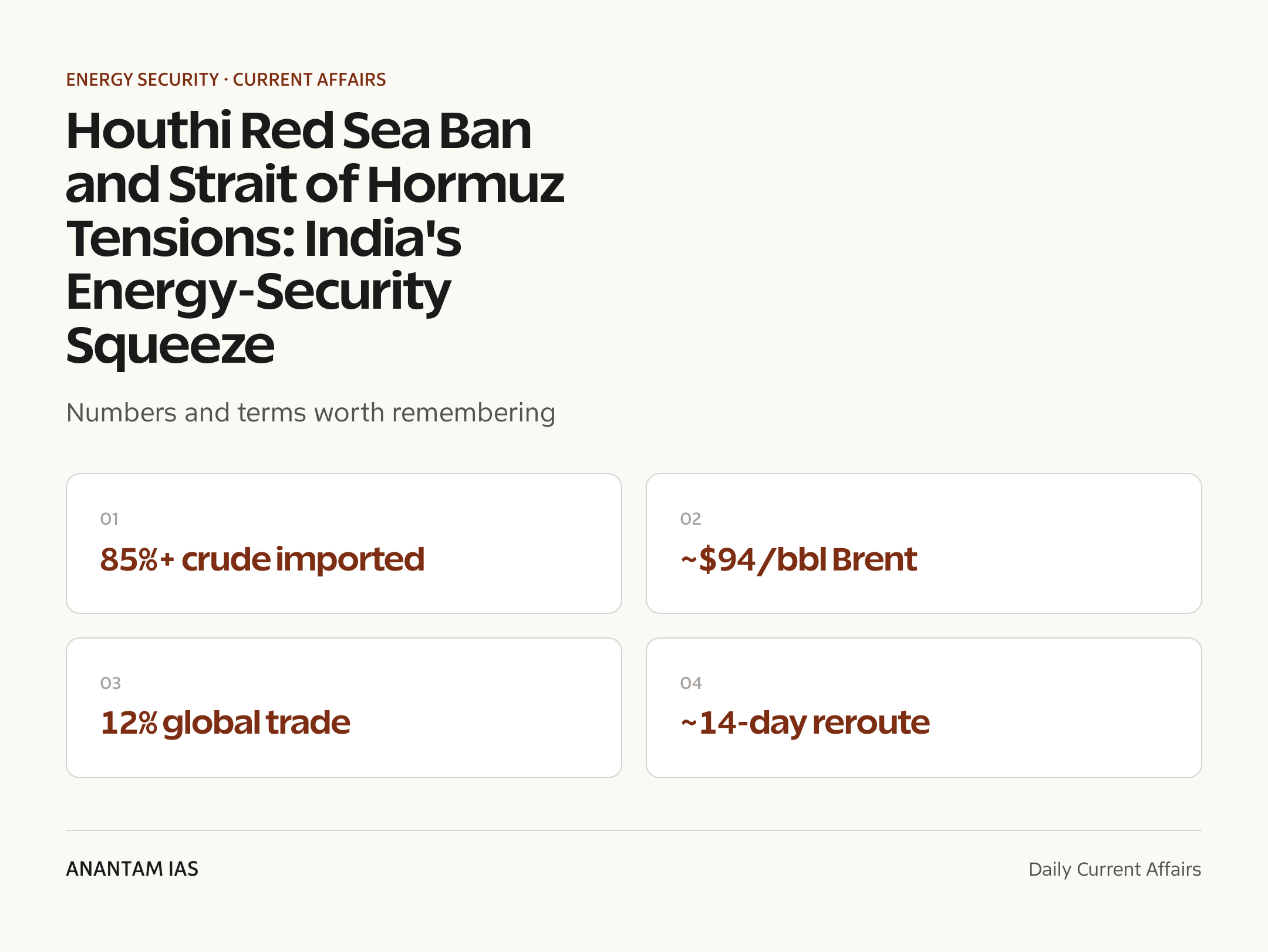
- On 8 June 2026 the Houthis declared a “complete and total ban” on Israeli maritime navigation in the Red Sea.
- The Bab-el-Mandeb strait is about 26 km wide at its narrowest and carries roughly 12 percent of global maritime trade.
- The Red Sea route handles around $1 trillion of goods every year.
- The Strait of Hormuz carries close to one-fifth of the world’s seaborne oil and gas.
- India imports more than 85 percent of its crude oil, a large share of it from West Asian Gulf suppliers.
- Roughly 40 to 50 percent of India’s crude imports transit the Strait of Hormuz, though about 70 percent is now sourced via routes outside it.
- Rerouting Asia-Europe cargo around the Cape of Good Hope adds about 14 days and heavy fuel and insurance costs.
- Brent crude rose about 4 percent to near $94 a barrel after the Houthi announcement, per The Hindu analysis.
- Sources: The Hindu (UPSC news analysis) and Euronews.
What Just Happened
The Houthi authorities in Sanaa announced on 8 June 2026 a total ban on Israeli shipping through the Red Sea, declaring that Israeli-flagged vessels and ships engaged in Israeli maritime commerce would be treated as legitimate military targets. The move revived the disruption pattern seen during the earlier Gaza conflict, when the group launched close to 200 attacks on shipping and pushed many carriers off the Red Sea entirely.
The shipping ban landed alongside heightened tension over the Strait of Hormuz, the narrow gateway between the Persian Gulf and the Gulf of Oman through which most Gulf crude and LNG reaches the world. With both the southern Red Sea entrance at Bab-el-Mandeb and the Gulf exit at Hormuz under pressure at once, planners describe a “double chokepoint squeeze” on the West Asia-to-world energy corridor.
The market reaction was immediate. The Hindu’s UPSC analysis recorded Brent crude rising about 4 percent toward $94.38 a barrel, domestic LPG cylinder prices revised up by about ₹29 in one step and roughly ₹89 across two revisions, and oil marketing companies absorbing under-recoveries on diesel and petrol. Euronews noted that during the earlier campaign, daily oil flows through Bab-el-Mandeb fell from about 8.8 million to roughly 4 million barrels as ships detoured around southern Africa.
Background and Context
The geography is the lesson. The Red Sea connects to the Indian Ocean through Bab-el-Mandeb (“the Gate of Tears”) in the south and to the Mediterranean through the Suez Canal in the north, making it the spine of the shortest sea route between Asia and Europe. Close the southern gate, and carriers must sail around the Cape of Good Hope at the tip of Africa, adding roughly two weeks of sailing, fuel, crew and capital costs to every voyage. The Strait of Hormuz, only about 33 km wide at its narrowest, is the single most important oil chokepoint, with no equally large bypass for Gulf exports.
These are India’s sea lanes of communication (SLOCs), the maritime arteries that carry trade and energy and that the Indian Navy is tasked to keep open. India imports more than 85 percent of its crude oil, drawing heavily on Saudi Arabia, Iraq, the UAE and other Gulf suppliers whose cargoes pass through Hormuz, while Suez-Red Sea shipping links India to European and Mediterranean markets. A chokepoint shock hits both the import bill and the export route at the same time.
India’s standing response is Operation Sankalp. The Navy first launched it in June 2019 in the Gulf of Oman and Persian Gulf to escort Indian-flagged ships near Hormuz, and re-energised it from December 2023 as the Red Sea crisis and Somali piracy spiked. Across that surge the Navy deployed dozens of warships, escorted hundreds of merchant vessels and responded to attacks and hijack attempts, becoming one of the largest national naval presences in the region and the practical face of India’s maritime-security doctrine.
Key Pressure Points for India
- Twin chokepoints: Bab-el-Mandeb (Red Sea) and Hormuz (Gulf) are strained together, hitting both India’s trade route and its energy import route.
- Crude exposure: India imports more than 85 percent of its oil, with a large share transiting Hormuz from Gulf suppliers.
- Reroute cost: Diverting around the Cape of Good Hope adds about 14 days plus fuel, crew and capital costs to each voyage.
- Freight and insurance: War-risk insurance premiums and container freight rates spike whenever Red Sea passage is judged unsafe.
- Inflation channel: Higher crude and shipping costs feed into LPG, diesel, petrol and imported-input prices at home.
- Strategic hedge: Strategic petroleum reserves, supplier diversification, Operation Sankalp and the IMEC corridor are India’s structural cushions.
Why It Matters for UPSC
This is a high-yield topic because it ties a current development to durable syllabus themes.
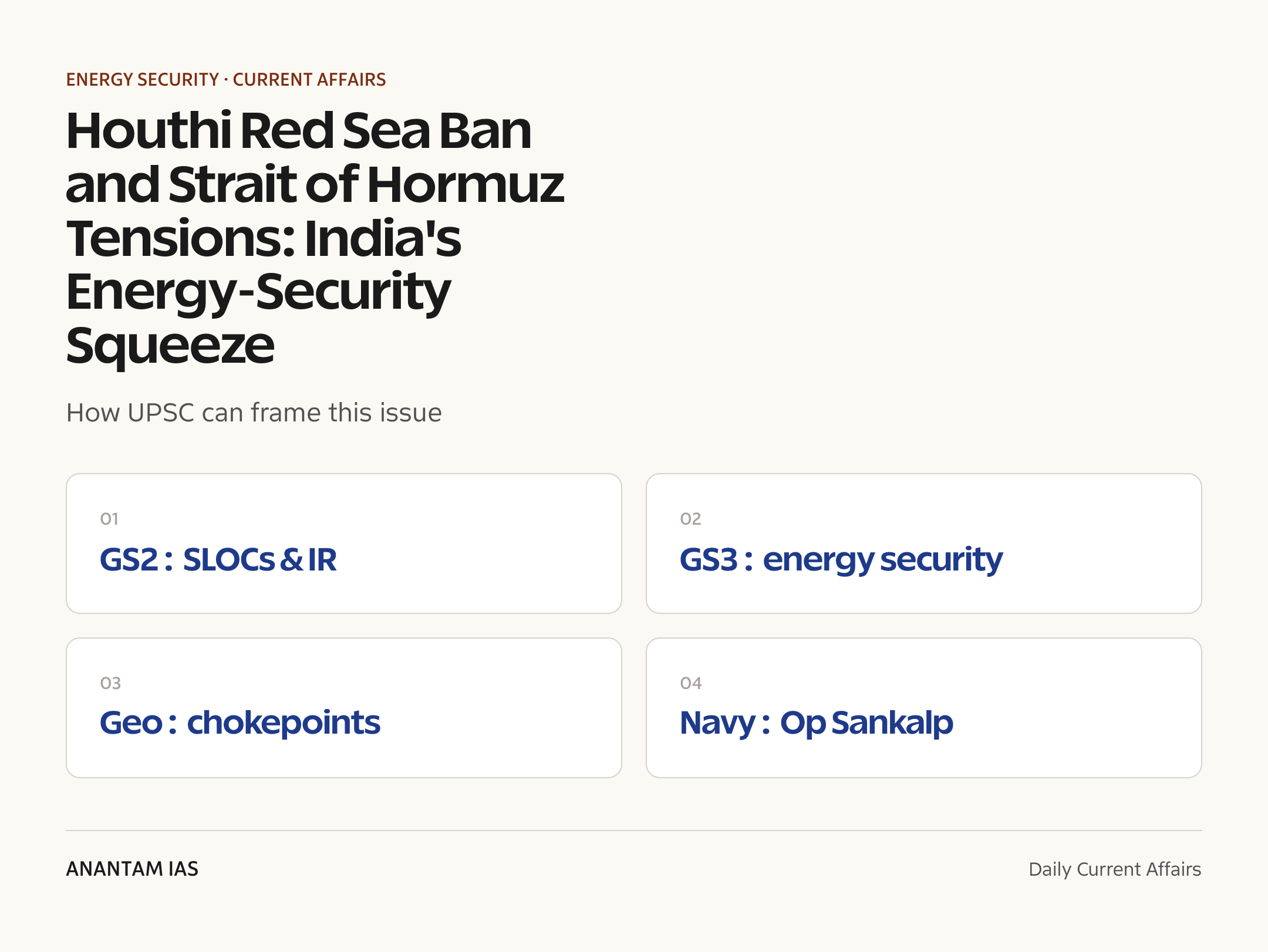
- GS2 IR: how chokepoint conflicts in West Asia test India’s neutrality, energy diplomacy and naval reach in the Indian Ocean Region.
- Links the current Red Sea-Hormuz shock to the durable syllabus on SLOCs, maritime security and India’s crude-import dependence.
- Prelims: locations of Bab-el-Mandeb, Suez Canal, Strait of Hormuz, Gulf of Aden and the Cape of Good Hope route.
- GS3 economy: transmission of an oil-price and freight shock into India’s import bill, current account and retail inflation.
What It Means: Energy Security Lens
A chokepoint shock is a geography problem before it is a war problem. The reason a localised conflict off Yemen can move prices in Mumbai is that the global energy and container system funnels through a handful of narrow straits with no cheap substitute. When Bab-el-Mandeb becomes risky, the only large-scale alternative is the Cape of Good Hope, which lengthens every Asia-Europe voyage by roughly two weeks. That extra time is not free: it ties up ships, raises fuel burn, and shrinks effective shipping capacity, so freight rates and delivery times rise even for cargo that never goes near the Red Sea.
India’s vulnerability is concentrated on the oil side. With import dependence above 85 percent and a heavy Gulf tilt, a Hormuz scare threatens both the volume and the price of India’s crude. The partial cushion is that New Delhi has diversified aggressively, sourcing from around 40 countries and routing close to 70 percent of imports outside Hormuz, with Russian, American and African barrels reducing single-chokepoint risk. The Red Sea side is less about crude and more about merchandise trade and exports, where insurance and freight costs do the damage rather than outright shortage.
The structural answer is redundancy, not reaction. Strategic petroleum reserves buy time during a spike; supplier and route diversification dilute any one chokepoint; and naval presence through Operation Sankalp protects flagged shipping and signals capability. The India-Middle East-Europe Economic Corridor (IMEC), conceived to link India to Europe through the Gulf, Israel and onward rail-and-sea legs, is also relevant here, because its viability depends on the very stability of this region that the current crisis is testing. A corridor designed to be an alternative to Suez only works if its own nodes stay calm.
Challenges and Concerns
- No large-scale bypass exists for Hormuz; pipelines through Saudi Arabia and the UAE carry only a fraction of Gulf export volumes.
- War-risk insurance and freight surcharges raise landed costs even when supply itself is not interrupted.
- Sustained naval deployment far from home stretches the Navy’s ships, crews and logistics over long periods.
- Regional instability undercuts the near-term promise of IMEC as a stable Suez alternative.
- Higher crude and shipping costs squeeze oil-company finances and risk passing through to retail fuel and LPG prices.
Prelims Pointers
- Bab-el-Mandeb connects the Red Sea to the Gulf of Aden and the Indian Ocean; it is about 26 km wide at its narrowest.
- The Suez Canal links the Red Sea to the Mediterranean Sea, completing the short Asia-Europe sea route.
- The Strait of Hormuz links the Persian Gulf to the Gulf of Oman and carries close to one-fifth of seaborne oil and gas.
- The Cape of Good Hope reroute lies at the southern tip of Africa and adds roughly 14 days to Asia-Europe voyages.
- Sea lanes of communication (SLOCs) are the primary maritime routes used for trade and energy supply.
- Operation Sankalp is the Indian Navy’s deployment to secure shipping; first launched in June 2019 near the Strait of Hormuz.
- India imports more than 85 percent of its crude oil, with major suppliers in the Gulf, Russia and the United States.
- Roughly 40 to 50 percent of India’s crude transits Hormuz, while about 70 percent is now sourced via routes outside it.
- The Houthi movement is based in Yemen and controls the country’s Red Sea coast around Hodeidah.
- IMEC, the India-Middle East-Europe Economic Corridor, was announced on the sidelines of the 2023 G20 Summit in New Delhi.
- Brent crude is the international benchmark price commonly used to track West Asian oil-supply shocks.
- The Gulf of Aden lies between Yemen and Somalia and is a focus of India’s anti-piracy escort missions.
Mains Practice Questions
- “India’s energy security is hostage to a handful of maritime chokepoints.” Examine this statement with reference to the Strait of Hormuz and the Bab-el-Mandeb, and outline measures to reduce this vulnerability. (GS2/GS3, 15 marks)
- Discuss how instability in the Red Sea and the Strait of Hormuz affects India’s trade costs, current account and domestic inflation. (GS3, 10 marks)
- Evaluate the role of the Indian Navy, through deployments such as Operation Sankalp, in securing India’s sea lanes of communication in the Indian Ocean Region. (GS2/GS3, 15 marks)
- Assess the strategic significance of the India-Middle East-Europe Economic Corridor (IMEC) as an alternative trade route, and the risks West Asian instability poses to it. (GS2, 10 marks)
Way Forward
Deepen crude-supplier and route diversification so no single chokepoint carries a dominant share of imports, and keep building strategic petroleum reserves as a shock buffer.
Sustain calibrated naval presence and maritime domain awareness in the Indian Ocean Region while using energy diplomacy to keep Gulf supply lines open and IMEC nodes stable.
Frequently Asked Questions
What did the Houthis ban on 8 June 2026?
The Houthi movement declared a complete and total ban on Israeli maritime navigation in the Red Sea, calling Israeli-flagged ships and vessels in Israeli commerce legitimate military targets. The move revived the shipping disruption seen during the earlier Gaza conflict and pushed up oil prices and freight risk across the region.
Why does the Red Sea matter so much for global trade?
The Red Sea links Asia to Europe through Bab-el-Mandeb in the south and the Suez Canal in the north, carrying about 12 percent of global maritime trade and roughly $1 trillion of goods a year. Closing it forces ships around the Cape of Good Hope, the long and costly way around southern Africa.
How dependent is India on the Strait of Hormuz?
India imports more than 85 percent of its crude oil, and roughly 40 to 50 percent of those imports pass through the Strait of Hormuz from Gulf suppliers. New Delhi has diversified so that about 70 percent of crude now arrives via routes outside Hormuz, but the strait remains a single point of acute risk.
What is Operation Sankalp?
Operation Sankalp is the Indian Navy’s mission to protect shipping in the region. It was first launched in June 2019 near the Strait of Hormuz and was re-energised from December 2023 during the Red Sea crisis, with dozens of warships escorting merchant vessels. It is the practical face of India’s maritime-security doctrine.
How does this crisis reach Indian consumers?
Higher crude prices and longer, riskier shipping routes raise India’s import bill and freight and insurance costs. Those costs feed into LPG, diesel, petrol and imported-input prices, and the analysis noted LPG revisions and oil-company under-recoveries soon after the Houthi declaration. A distant strait becomes a kitchen-table price.
How is IMEC relevant to this issue?
The India-Middle East-Europe Economic Corridor is designed to connect India to Europe through the Gulf and onward legs as an alternative to the Suez route. Its promise depends on a stable West Asia, so the current Red Sea and Hormuz tensions are a direct test of whether that alternative can deliver.