Houthis seize key city on Red Sea, advance towards Bab el-Mandeb
Why in News?
Yemen’s Houthi rebels have reportedly captured Mokha port and Zuqar Island in the southern Red Sea, advancing towards Bab al-Mandeb. The militant group has already declared a naval blockade against Saudi Arabia, the world’s largest oil exporter. Houthi dominance over the Bab el-Mandeb waterway would further isolate Gulf oil producers from their main shipping routes.
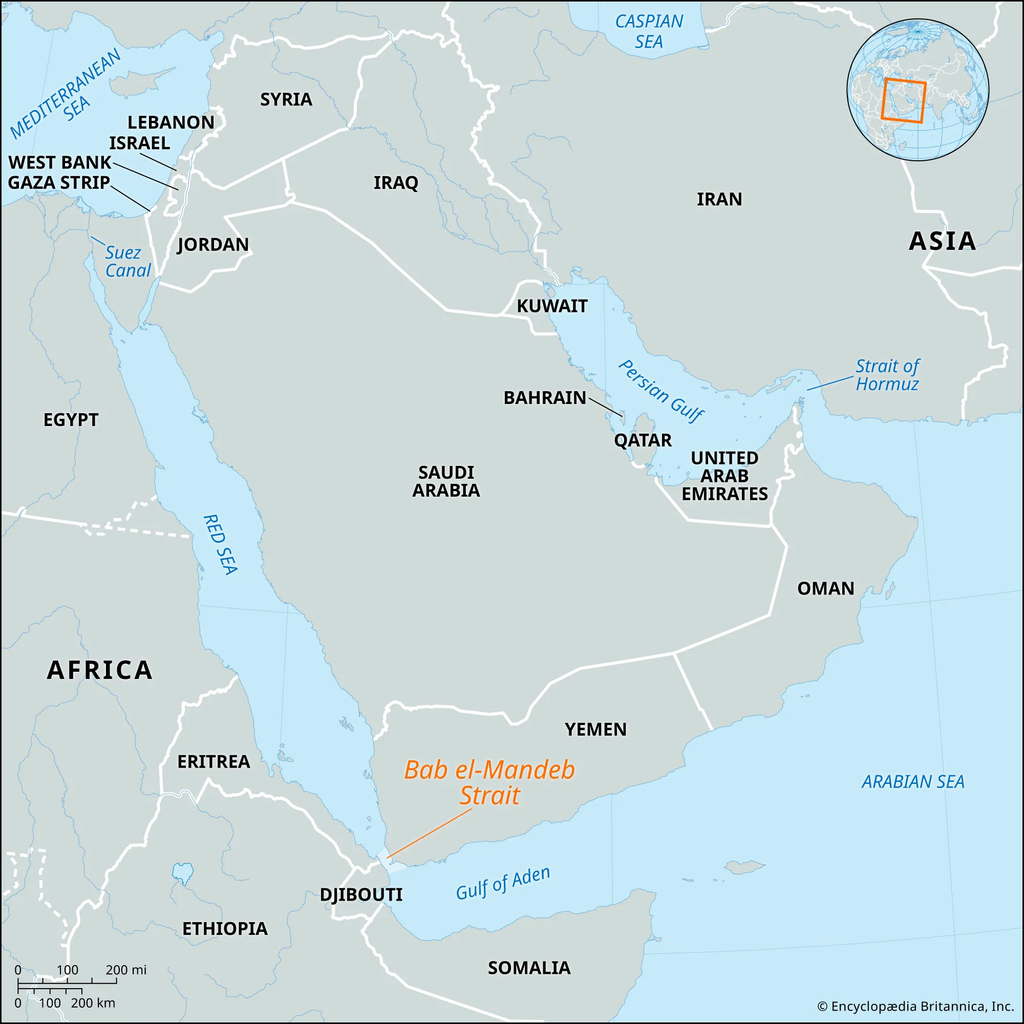
| UPSC Relevance: GS-2 International Relations: West Asia; Locations in News Prelims: Location of Bab-el-Mandeb, Houthis |
About Bab-al-Mandeb:
- Location: A narrow strait at the southern entrance to the Red Sea, between Yemen in Asia and Djibouti and Eritrea in Africa.
- Connects: The Red Sea and the Gulf of Aden, providing access to the Arabian Sea and Indian Ocean.
- Width and island: About 29 km wide at its narrowest point. Yemen’s Perim Island (also called Mayyun) divides it into eastern and western channels.
- Gateway to the Suez Canal: Ships travelling from the Indian Ocean towards Europe enter the Red Sea through Bab-al-Mandeb, then sail north to the Suez Canal and the Mediterranean Sea.
- Meaning: Its Arabic name means “Gate of Tears”, traditionally associated with the dangers of navigating the passage.
- Distinction from Hormuz: Bab-al-Mandeb lies southwest of the Arabian Peninsula; Hormuz lies on its northeastern side, connecting the Persian Gulf with the Gulf of Oman.
Why is it Strategically Important?
- Gateway to the Suez route: It forms the southern entrance to the Red Sea, making it indispensable for the shortest major maritime route between Asia and Europe.
- Energy-security chokepoint: Large volumes of oil and petroleum products pass through it. EIA estimates put oil flows at 8.1 million barrels per day in April-June 2026, compared with 5.4 million in October-December 2025.
- Military and geopolitical leverage: Positions near its narrow approaches enable surveillance and potential attacks using missiles, drones, mines and small boats. Even limited attacks can disrupt commerce without physically closing the strait.
- Costly alternative route: Ships avoiding the Red Sea-Suez corridor must generally sail around Africa’s Cape of Good Hope, increasing travel time, fuel consumption, freight charges and insurance costs.
- Importance during Hormuz disruption: Saudi Arabia can transport oil through its East-West pipeline to Yanbu on the Red Sea. Shipments from Yanbu towards Asian markets must then pass through Bab-al-Mandeb, making simultaneous disruption of both chokepoints particularly serious.
Who are the Houthis?
- Identity: A Yemeni political and armed movement formally known as Ansar Allah.
- Origins: Emerged from a Zaydi Shia revivalist movement in northern Yemen; named after Hussein Badreddin al-Houthi.
- Leadership: Led by Abdul-Malik al-Houthi.
- Territorial base: Captured Sanaa in 2014 and controls substantial parts of northwestern Yemen.
- External support: Backed by Iran and fighting forces aligned with Yemen’s internationally recognised government.
- Maritime relevance: Their missile and drone attacks on shipping since late 2023 have demonstrated how a non-state armed group can disrupt global supply chains.
Significance to India:
- Trade: Disruption affects India’s shipping links with Europe and Mediterranean markets.
- Energy and inflation: Higher oil prices, freight rates and insurance premiums increase import costs.
- Seafarer safety: Attacks endanger Indian crew members and merchant vessels. Under Operation Sankalp, the Indian Navy expanded maritime-security operations from late 2023 across the Gulf of Aden, Arabian Sea and waters off Somalia.
Restoring dependable navigation and preventing further spillover are essential to both regional stability and global economic security.
Practice MCQ:
Q. With reference to the Bab-al-Mandeb Strait, consider the following statements:
1. It connects the Red Sea with the Gulf of Aden.
2. It separates the Arabian Peninsula from the Horn of Africa.
3. Ships travelling from the Indian Ocean to the Mediterranean Sea through the Suez Canal must pass through it.
Which of the statements given above are correct?
(a) 1 and 2 only
(b) 2 and 3 only
(c) 1 and 3 only
(d) 1, 2 and 3
Answer: (d)