How scientists are using ‘DNA maps’ to expose Pangolin Trafficking Hubs?
Why in News?
Recent advances in biotechnology are transforming wildlife crime investigations. A recent study published shows how population genomics and DNA mapping can identify the geographic origin of trafficked pangolins.
| UPSC Relevance: GS-3 Science and Technology: Biology and Biotechnology; GS-3 Environment: Species in News Prelims: Pangolin, Single Nucleotide Polymorphisms (SNP) |
Pangolins are one of the world’s most trafficked mammals, even as their existence is threatened by shrinking habitats. So to protect them, conservationists are keen to know where they are being poached.
Using DNA Maps to Trace Pangolin Trafficking Hubs:
The Challenge:
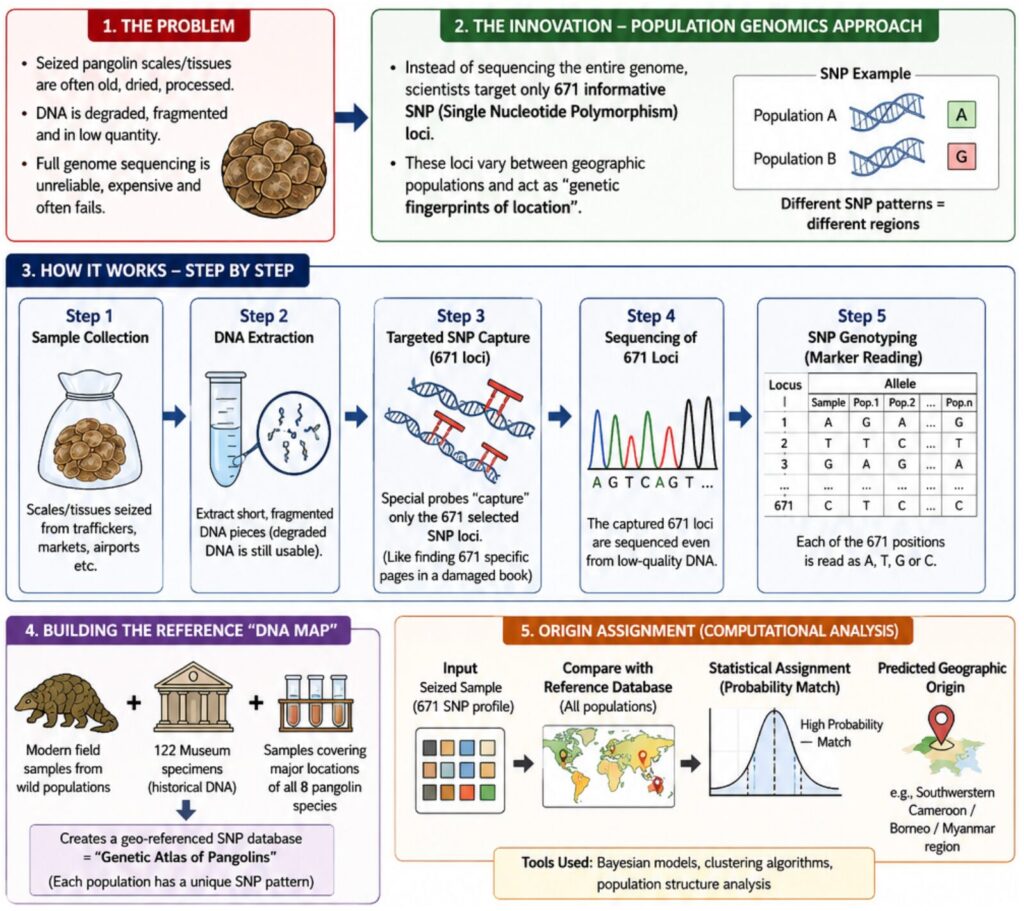
- Pangolin scales seized at airports or markets are often old, dried, and heavily degraded, making traditional DNA sequencing ineffective. Moreover, whole-genome sequencing is costly and impractical for forensic use.
Targeted Population Genomics:
- Researchers adopted a targeted population genomics approach instead of whole-genome sequencing. They focused on 671 highly informative SNP (Single Nucleotide Polymorphism) loci, i.e., 671 specific positions in DNA that vary between populations.
- These SNPs act as genetic markers of geography, enabling scientists to distinguish between pangolin populations across different regions, even from degraded samples. The SNP method is typically useful when the DNA to be analysed is highly degraded.
Methodology:
- DNA from seized scales is extracted and screened only at these 671 loci using targeted sequencing. The resulting SNP profile is then compared with a reference genetic database created using modern field samples, museum specimens and data from multiple pangolin species across Asia and Africa. This creates a “genetic atlas” of pangolin populations.
How is the Origin Determined?
- The SNP pattern from seized samples is matched with reference populations using statistical models. This allows researchers to assign a probable geographic origin, even identifying regional trafficking hubs.
Key Findings:
The study identified major trafficking hotspots such as:
- Southwestern Cameroon (White-bellied pangolin)
- Southwestern Borneo (Sunda pangolin)
- Myanmar region (Chinese pangolin)
It also revealed that domestic and international trafficking networks are interconnected, with overlapping supply zones.
Significance:
This approach enables forensic wildlife tracking even from degraded DNA, strengthens enforcement, and helps target poaching hotspots rather than only intercepting shipments.
About Pangolin:
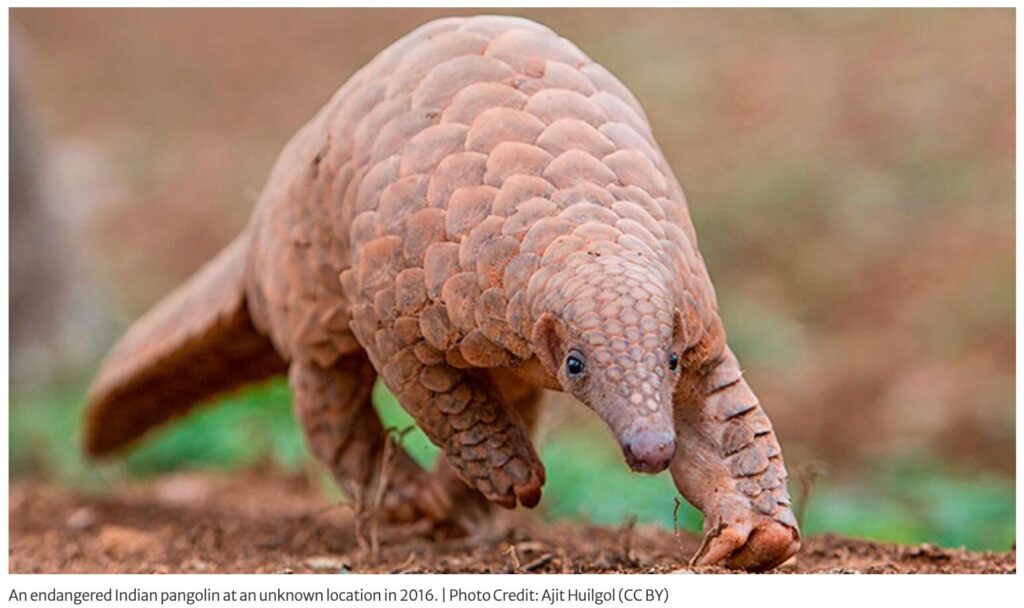
- The pangolin, often called the “scaly anteater,” is the only mammal in the world completely covered in tough, overlapping scales.
- Physical characteristics and behaviour:
- Have large, protective keratin scales covering their skin.
- Lve in hollow trees or burrows.
- Nocturnal and solitary animals; meet only to mate.
- Insectivorous; their diet consists mainly of ants and termites
- Long tongue; does not have teeth; uses the muscular stomach to grind food.
- Nature’s Pest Control: A single adult pangolin can eat up to 70 million insects a year, keeping forest ecosystems healthy and naturally aerating soil through digging.
- India has two species:
- Indian Pangolin
- Chinese Pangolin
- Distribution:
- Indian Pangolin: widespread across central, southern, and northern India
- Chinese Pangolin: Northeast India and Himalayan foothills
- Threats: Poaching (for their meat and scales, which are used in traditional medicine) and heavy deforestation of their natural habitats.
Conservation status of Pangolin:
- CITES: Appendix I
- IUCN status:
- Chinese Pangolin: Critically Endangered
- Sunda Pangolin: Critically Endangered
- Indian Pangolin: Endangered
- Philippine Pangolin: Critically Endangered
- Schedule I of the Wildlife Protection Act, 1972.
UPSC PYQ 2023:
Q. Aerial metagenomics’ best refers to which one of the following situations?
(a) Collecting DNA samples from air in a habitat at one go
(b) Understanding the genetic makeup of avian species of a habitat
(c) Using air-borne devices to collect blood samples from moving animals
(d) Sending drones to inaccessible areas to collect plant and animal samples from land surfaces and water bodies
Answer: (a)
Q. ‘Microsatellite DNA’ is used in the case of which one of the following?
(a) Studying the evolutionary relationships among various species of fauna
(b) Stimulating ‘stem cells’ to transform into diverse functional tissues
(c) Promoting clonal propagation of horticultural plants
(d) Assessing the efficacy of drugs by conducting series of drug trials in a population
Answer: (a)