Human Gene Knockouts and Loss-of-Function Research
Why in News?
A large open-access study published in Nature on 17 June 2026 analysed exomes and whole genomes from 173,303 participants in the Pakistan Genome Resource to study naturally occurring homozygous loss-of-function variants.
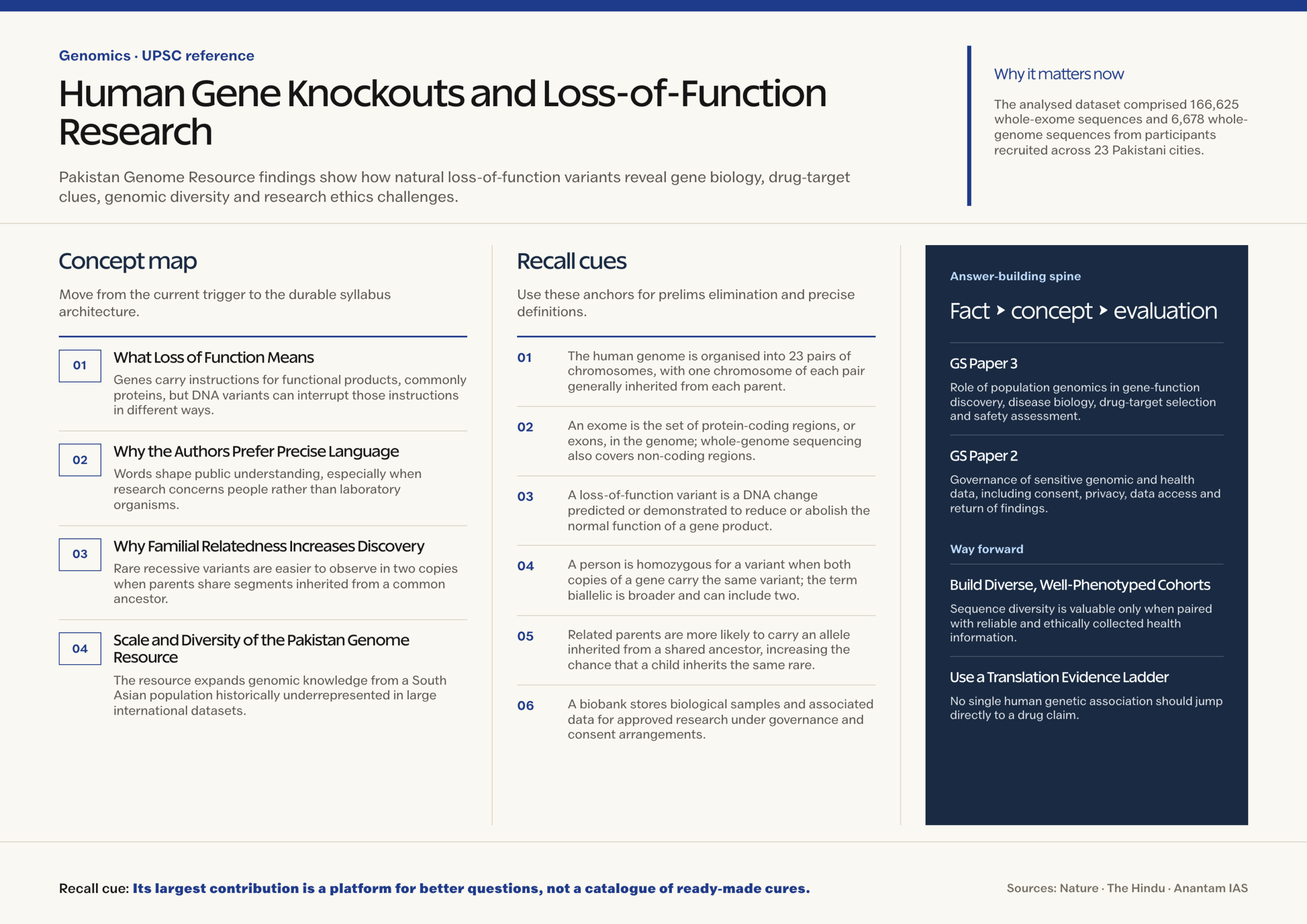
- The analysed dataset comprised 166,625 whole-exome sequences and 6,678 whole-genome sequences from participants recruited across 23 Pakistani cities.
- At least one homozygous loss-of-function gene was identified in 34,364 participants, about 20% of the sequenced cohort.
- For 3,323 of the 6,476 genes, such carriers were unique to the Pakistan resource when compared with 761,616 non-South-Asian individuals in the gnomAD reference used by the researchers.
- The study linked genomic data with medical histories, clinical measures and disease status, and supported recall-by-genotype studies in which consenting participants and relatives could undergo focused follow-up.
- The researchers use the precise term homozygous loss-of-function carriers; “human knockout” is convenient shorthand but can wrongly suggest deliberate gene deletion.
- A naturally occurring loss-of-function variant can act like a long-term biological experiment, showing what may happen when a gene’s normal product is greatly reduced or absent.
- Human evidence can complement cell and animal models, but lifelong genetic loss differs from partial, temporary or adult-onset inhibition by a drug.
- The study demonstrates why ancestry-diverse genomics matters: variants rare or missing in global databases may be informative in populations that have been underrepresented in sequencing research.
UPSC Relevance
Prelims Relevance
- The human genome is organised into 23 pairs of chromosomes, with one chromosome of each pair generally inherited from each parent.
- An exome is the set of protein-coding regions, or exons, in the genome; whole-genome sequencing also covers non-coding regions.
- A loss-of-function variant is a DNA change predicted or demonstrated to reduce or abolish the normal function of a gene product.
- A person is homozygous for a variant when both copies of a gene carry the same variant; the term biallelic is broader and can include two different variants affecting the two copies.
- Related parents are more likely to carry an allele inherited from a shared ancestor, increasing the chance that a child inherits the same rare recessive variant from both sides.
- A biobank stores biological samples and associated data for approved research under governance and consent arrangements.
Mains Relevance
GS Paper 3
- Role of population genomics in gene-function discovery, disease biology, drug-target selection and safety assessment.
- Scientific differences among whole-exome sequencing, whole-genome sequencing, association analysis and recall-by-genotype research.
GS Paper 2
- Governance of sensitive genomic and health data, including consent, privacy, data access and return of findings.
- Protection of communities from stigma, discrimination and extractive research practices.
Essay
- Human diversity is not noise around a scientific average; it is a source of knowledge that can improve both discovery and fairness.
Background and Context
What Loss of Function Means
Genes carry instructions for functional products, commonly proteins, but DNA variants can interrupt those instructions in different ways.
- A predicted loss-of-function variant may introduce a premature stop signal, disrupt a splice site or shift the reading frame, reducing the chance of producing a normal protein.
- Prediction is not certainty. Some apparently disruptive variants may be rescued by alternative splicing, another start site or their position near the end of a transcript.
- The Nature study applied quality-control and annotation filters to reduce false classification of predicted loss-of-function variants.
- When both gene copies carry a genuine disruptive variant and little or no functional product remains, researchers may informally describe the person as a natural human gene knockout.
Why the Authors Prefer Precise Language
Words shape public understanding, especially when research concerns people rather than laboratory organisms.
- In experimental biology, a knockout usually means a gene has been purposefully disabled in a cell or model organism.
- Participants in the Pakistan Genome Resource inherited naturally occurring variants; researchers did not engineer their genomes.
- The phrase “homozygous loss-of-function carrier” states the observed genotype without implying that every gene function is completely absent in every tissue.
- Person-first, non-stigmatising language also avoids reducing participants to biological anomalies or presenting a community as a research instrument.
Why Familial Relatedness Increases Discovery
Rare recessive variants are easier to observe in two copies when parents share segments inherited from a common ancestor.
- Most genes are represented by a maternal and a paternal copy. A single rare loss-of-function copy may be masked by the other functional copy.
- When parents are related, both may carry the same ancestral variant, raising the probability that a child inherits that variant on both copies.
- This population structure helps researchers identify rare homozygous genotypes, but it also increases the risk of some recessive genetic disorders.
- The scientific finding must not be presented as approval of consanguineous marriage or as a judgement about any culture. Public-health responses should emphasise voluntary counselling, informed choice and accessible care.
Scale and Diversity of the Pakistan Genome Resource
The resource expands genomic knowledge from a South Asian population historically underrepresented in large international datasets.
- The study analysed 173,303 participants from 23 cities, combining 166,625 exomes with 6,678 whole genomes.
- Researchers found homozygous loss-of-function variants across 6,476 genes; 2,397 of those genes had only one identified carrier in the resource.
- Nearly half of the variants catalogued by the project were not observed in the comparison databases available to the study, underscoring the incompleteness of existing references.
- The cohort is a nested case-control resource rather than a simple nationally representative survey, so its disease frequencies and knockout prevalence should not be generalised mechanically to Pakistan’s entire population.
Way Forward
Build Diverse, Well-Phenotyped Cohorts
- Expand recruitment across regions and underrepresented groups without treating any community as a convenient source of rare variants.
- Use harmonised clinical measurements and longitudinal follow-up so genotype-phenotype relationships can be replicated.
- Support recall-by-genotype only under explicit consent, with counselling and a clear plan for clinically important findings.
Conclusion
- The Pakistan Genome Resource shows how naturally occurring loss-of-function variation can reveal which human genes tolerate disruption, which pathways may be useful to investigate and where a proposed therapy may need extra safety scrutiny.
- The same research also sets a governance test.
UPSC Practice Questions
Prelims MCQ 1
With reference to human genomics, consider the following statements:
- The exome consists mainly of protein-coding regions of the genome.
- A homozygous loss-of-function genotype means both copies of a gene carry the same loss-of-function variant.
- A naturally occurring human gene knockout necessarily results from laboratory gene editing.
How many of the above statements are correct?
(a) Only one (b) Only two (c) All three (d) None
Answer: (b) Only two
Explanation:
Statements 1 and 2 are correct. Statement 3 is incorrect because the Pakistan Genome Resource studied naturally inherited loss-of-function variants, not laboratory editing of participants’ genomes.
Prelims MCQ 2
Which one of the following best explains why a naturally occurring loss-of-function variant is not automatic proof that a drug blocking the same protein will be safe?
(a) Human genes never produce proteins (b) Drugs cannot affect gene products (c) Lifelong genetic loss may allow compensation, while drug timing, dose and off-target effects differ (d) Whole-genome sequencing measures only environmental exposure
Answer: (c) Lifelong genetic loss may allow compensation, while drug timing, dose and off-target effects differ
Explanation:
Natural loss can prioritise or question a target, but therapeutic translation needs functional validation and clinical testing because genetic loss and pharmacological inhibition differ in timing, degree, tissue distribution and secondary effects.
UPSC Mains Questions
- How can naturally occurring loss-of-function variants improve drug-target discovery while also preventing costly therapeutic failures? Discuss the limits of translating such findings into medicine.
- Population diversity is both a scientific resource and an ethical responsibility in genomics. Examine with reference to consent, privacy, representation and benefit sharing.
Sources: Nature and The Hindu.
Frequently Asked Questions
What is a natural human gene knockout?
It is informal shorthand for a person who inherited disruptive variants affecting both copies of a gene, leaving little or no normal gene function. Researchers prefer terms such as homozygous loss-of-function carrier because “knockout” can wrongly imply that scientists deliberately.
What did the Pakistan Genome Resource study find?
The Nature study analysed 173,303 participants, including 166,625 exomes and 6,678 whole genomes. It found 34,364 participants with at least one homozygous loss-of-function gene and identified such carriers across 6,476 genes, about one-third of human protein-coding genes.
Why does familial relatedness help identify rare variants in two copies?
Related parents are more likely to share a rare allele inherited from a common ancestor. Their child has a higher chance of receiving that allele from both parents. This aids discovery of recessive gene effects but can also raise the.
Can a protective loss-of-function finding directly produce a medicine?
No. It can suggest a target and provide human evidence, but lifelong genetic loss differs from drug treatment in timing, dose, tissue exposure and off-target effects. Researchers still need molecular validation, replication, safety studies and controlled clinical trials before making.
What is recall-by-genotype?
It is a research design in which consenting participants are invited for focused follow-up because their genotype raises a specific question. Specialised measurements and, where separately consented, study of relatives can help connect the variant to a phenotype more directly.