Human trafficking feeds on migration, Supreme Court outs their ‘close link’
Why in News?
The Supreme Court, in a significant judgment delivered on May 29, 2026, highlighted the close relationship between migration and human trafficking, describing trafficking as one of the gravest forms of human exploitation. The Court also raised concerns about the limitations of the Immoral Traffic (Prevention) Act (ITPA), the rights of voluntary adult sex workers, child trafficking, and the growing threat of cyber-enabled trafficking.
UPSC Relevance
Prelims: Human trafficking, Palermo Protocol, Bharatiya Nyaya Sanhita (BNS) Section 143, Immoral Traffic (Prevention) Act (ITPA), Fundamental Rights.
Mains:
GS-I: Social Issues, Migration,
GS-II: Vulnerable Sections, Human Rights, Governance,
GS-III: Cyber Security, Organised Crime,
Essay: Human Dignity, Social Justice.
Background
Human trafficking remains one of the world’s most profitable organised crimes, involving the recruitment, transportation, harbouring, or exploitation of persons through force, deception, coercion, or abuse of vulnerability.
India faces multiple forms of trafficking, including:
- Forced labour, Sexual exploitation, Child trafficking, Domestic servitude, Forced marriages, Organ trafficking.
The Supreme Court’s judgment seeks to address trafficking not merely as a criminal issue but as a social, economic, and human rights challenge.
Understanding the Link Between Migration and Human Trafficking
Why Migration Creates Vulnerability
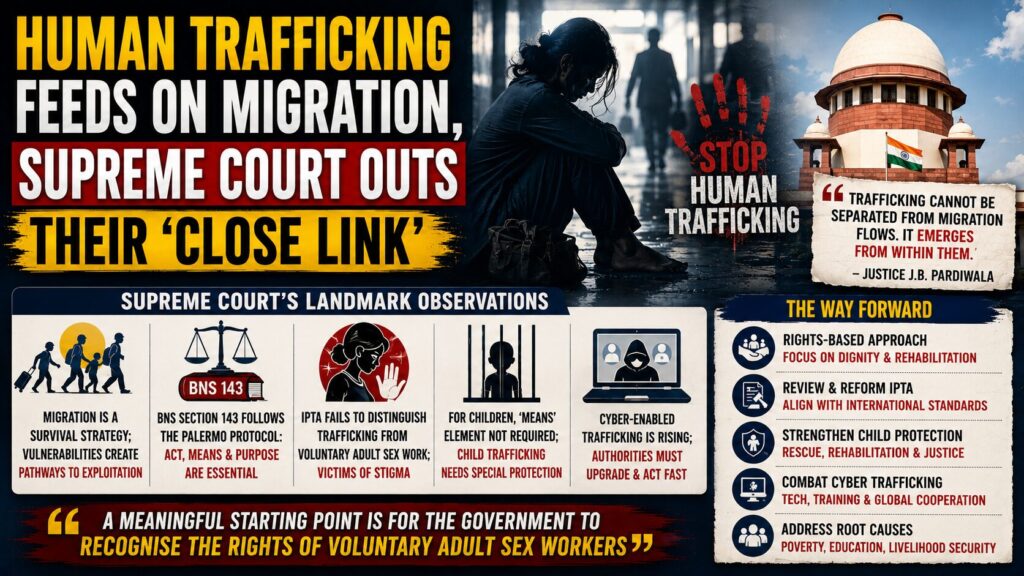
The Court observed that migration is often a survival strategy adopted by people facing poverty, unemployment, social exclusion, environmental distress, or lack of opportunities.
Many migrants leave their homes seeking:
- Better employment opportunities.
- Economic security.
- Education.
- Safer living conditions.
However, these aspirations frequently expose them to exploitative intermediaries, fraudulent recruiters, and organised criminal networks.
The Court’s Key Observation
The Supreme Court clarified that not all migration amounts to trafficking. However, trafficking frequently emerges within migration flows because the same vulnerabilities that compel migration can be exploited by traffickers.
The judgment underlined that systemic inequalities, poverty, lack of information, and weak institutional protections often convert a legitimate search for livelihood into a pathway of exploitation.
Human Trafficking in India: Structural Drivers
Economic Inequality
Persistent poverty and unemployment continue to push vulnerable populations into risky migration pathways.
Families facing severe financial distress may become easy targets for traffickers promising jobs, education, or better living conditions.
Gender-Based Vulnerabilities
Women and girls face heightened risks due to:
- Gender discrimination.
- Limited educational opportunities.
- Wage inequalities.
- Social marginalisation.
These vulnerabilities often intersect with trafficking for sexual exploitation and forced labour.
Child Vulnerability
Children are particularly susceptible because of their dependence and inability to provide informed consent.
Trafficked children may be exploited for:
- Forced labour, Begging, Domestic work, Sexual exploitation, Illegal adoption.
Informal Labour Markets
Large sections of India’s workforce operate within informal sectors where regulation and worker protections remain weak.
This creates opportunities for traffickers to disguise exploitation as employment.
Supreme Court’s Concerns Regarding the Immoral Traffic (Prevention) Act
Conflation of Sex Work and Trafficking
One of the most significant observations of the Court concerns the treatment of sex work under existing law.
The Court noted that the ITPA effectively treats most prostitution involving third parties as trafficking, irrespective of whether coercion, force, fraud, or deception is involved.
This approach differs substantially from modern international anti-trafficking frameworks.
Conflict with Section 143 of Bharatiya Nyaya Sanhita
The Court highlighted that Section 143 of the Bharatiya Nyaya Sanhita adopts the internationally recognised three-tier framework derived from the Palermo Protocol.
Under this framework, trafficking requires:
- Act: Recruitment, transportation, transfer, harbouring, or receipt of persons.
- Means: Force, coercion, deception, fraud, inducement, or abuse of vulnerability.
- Purpose: Exploitation.
The Court observed that the ITPA does not always require proof of these elements, creating inconsistencies within the legal framework.
Rights of Voluntary Adult Sex Workers
A Significant Judicial Observation
The Court recognised that voluntary adult sex workers often face severe social stigma, discrimination, and exclusion.
According to the judgment, the absence of explicit legal protections has contributed to their marginalisation and reduced access to welfare measures and legal safeguards.
Rights Without Recognising a Right to Sex Work
The Court made an important distinction:
Recognition of the rights of sex workers does not automatically imply recognition of a legal right to sex work.
Rather, it emphasises that every individual, irrespective of occupation, is entitled to dignity, safety, healthcare, legal protection, and access to justice.
Child Trafficking Requires a Separate Legal Approach
Why Children Need Special Protection
The Court stressed that children cannot be treated identically to adults in trafficking cases.
International conventions and child-rights frameworks recognise that children possess limited agency and are particularly vulnerable to manipulation and exploitation.
Removal of the “Means” Requirement
In cases involving children, the Court observed that proving coercion, deception, or force should not be mandatory for establishing trafficking.
The mere existence of exploitation should be sufficient because children cannot meaningfully consent to such arrangements.
This approach aligns with global anti-trafficking standards.
Cyber-Enabled Human Trafficking: An Emerging Threat
Digital Transformation of Trafficking Networks
The judgment warned that trafficking networks are increasingly exploiting digital technologies.
Social media platforms, messaging applications, online job portals, and anonymous digital communication tools have expanded the reach of traffickers.
New Forms of Exploitation
Cyber-enabled trafficking may involve:
- Fake employment offers.
- Online grooming of children.
- Recruitment through social media.
- Live-streamed sexual exploitation.
- Online commercial sexual exploitation.
The Court observed that technological advancements have increased both the scale and sophistication of trafficking operations.
Governance Challenge
Law enforcement agencies often struggle to keep pace with rapidly evolving digital platforms, encrypted communications, and transnational criminal networks.
This creates significant challenges for prevention, detection, and prosecution.
International Framework: Palermo Protocol
What is the Palermo Protocol?
The United Nations Protocol to Prevent, Suppress and Punish Trafficking in Persons, Especially Women and Children (2000), commonly called the Palermo Protocol, is the principal international instrument against human trafficking.
Key Principles
The Protocol focuses on:
- Prevention of trafficking, Protection of victims, Prosecution of offenders, International cooperation.
It also provides the globally accepted definition of trafficking based on the “Act-Means-Purpose” framework.
Challenges in India’s Anti-Trafficking Framework
Legal Ambiguities
Differences between older laws and newer trafficking provisions can create uncertainty in enforcement.
Victim-Centred Protection Deficit
Many victims continue to face social stigma, inadequate rehabilitation, and limited access to compensation and support services.
Poor Conviction Rates
Investigations often suffer from:
- Lack of evidence.
- Witness intimidation.
- Cross-border complexities.
- Organised criminal involvement.
Digital Trafficking Networks
Rapid technological change is outpacing regulatory and enforcement capacities.
Way Forward
Adopt a Rights-Based Approach
Anti-trafficking laws should prioritise victim protection, rehabilitation, and reintegration rather than solely focusing on criminalisation.
Reform the ITPA
Legislative reforms should address the distinction between voluntary adult sex work and trafficking while ensuring stronger protections against exploitation.
Strengthen Child Protection Mechanisms
Special procedures for identifying, rescuing, rehabilitating, and prosecuting child trafficking cases should be expanded.
Enhance Cyber Surveillance Capabilities
Law-enforcement agencies require specialised technological capacity to identify and dismantle online trafficking networks.
Address Root Causes of Vulnerability
Reducing poverty, improving employment opportunities, expanding education, and strengthening social security can reduce susceptibility to trafficking.
Conclusion
The Supreme Court’s judgment broadens the understanding of human trafficking by locating it within the larger realities of migration, inequality, and social vulnerability. It highlights the need to move beyond narrow criminal-law responses and adopt a comprehensive framework centred on human dignity, victim protection, child welfare, and digital-age challenges. As migration continues to shape India’s socio-economic landscape, strengthening safeguards against exploitation will remain critical to ensuring that the pursuit of opportunity does not become a pathway to human trafficking.
Practice Questions
Prelims Question 1 (Inference-Based)
Consider the following statements with reference to human trafficking and migration:
I. The Supreme Court observed that migration often arises from socio-economic vulnerabilities that may also create conditions conducive to human trafficking.
II. Human trafficking can occur through deception, coercion, or abuse of vulnerability during migration processes.
III. Eliminating all forms of migration would automatically eliminate human trafficking.
Which of the following relationships among the above statements is/are correct?
- Statement II explains one of the mechanisms through which the vulnerabilities mentioned in Statement I may lead to trafficking.
- Statement III is a logical extension of Statement I.
- Statement III contradicts the understanding reflected in Statements I and II.
(a) 1 only
(b) 1 and 3 only
(c) 2 and 3 only
(d) 1, 2 and 3
Answer: (b)
Explanation:
Statement II validates and explains the linkage identified in Statement I. Statement III is incorrect because the Court specifically stated that not all migration is trafficking. Therefore, eliminating migration would not automatically eliminate trafficking. Statement III contradicts the nuanced relationship described in Statements I and II.
Prelims Question 2 (Assertion-Reason)
Assertion (A): Under international anti-trafficking standards, trafficking involving children does not require proof of coercion, force, or deception.
Reason (R): Children are considered particularly vulnerable and incapable of providing meaningful consent to exploitative arrangements.
(a) Both A and R are true and R is the correct explanation of A.
(b) Both A and R are true but R is not the correct explanation of A.
(c) A is true but R is false.
(d) A is false but R is true.
Answer: (a)
Explanation:
International frameworks such as the Palermo Protocol recognise the special vulnerability of children. Therefore, establishing trafficking involving children does not require proof of force, coercion, or deception because meaningful consent is legally and ethically problematic in such circumstances.
Mains Practice Questions
- Human trafficking is increasingly linked to migration, socio-economic vulnerability, and digital technologies rather than merely organised crime. Discuss.
- Critically examine the challenges in India’s anti-trafficking legal framework with reference to the Supreme Court’s observations on the Immoral Traffic (Prevention) Act and the rights of voluntary adult sex workers.