IBC Significance and Haircut


Context:
A Parliamentary Standing Committee on Finance has expressed serious concerns about high “haircuts” and weak asset valuation practices under the Insolvency and Bankruptcy Code (IBC). The committee examined the IBC (Amendment) Bill, 2025 and identified structural weaknesses in India’s insolvency resolution framework.
UPSC Relevance:
Economy
UPSC PYQ:
Q. Which of the following statements best describes the term ‘Scheme for Sustainable Structuring of Stressed Assets (S4A)’, recently seen in the news? (2017)
(a) It is a procedure for considering ecological costs of developmental schemes formulated by the Government.
(b) It is a scheme of RBI for reworking the financial structure of big corporate entities facing genuine difficulties.
(c) It is a disinvestment plan of the Government regarding Central Public Sector Undertakings.
(d) It is an important provision in ‘The Insolvency and Bankruptcy Code’ recently implemented by the Government.
About Haircut:
A haircut is the difference between the loan amount and the actual value of the asset used as collateral. It reflects the lender’s perception of the risk of fall in the value of assets. But in the context of loan recoveries, it is the difference between the actual dues from a borrower and the amount he settles with the bank.
Example:
If a bank is owed ₹100 crore but recovers only ₹35 crore →
Haircut = 65%
Parliamentary Committee report:
- Average recovery rate: ~32.8%
- Average haircut: ~67%
- In many cases, creditors recovered only a third of their claims
This means that two-thirds of the money is being written off — a major financial risk.
Insolvency & Bankruptcy Code 2016:
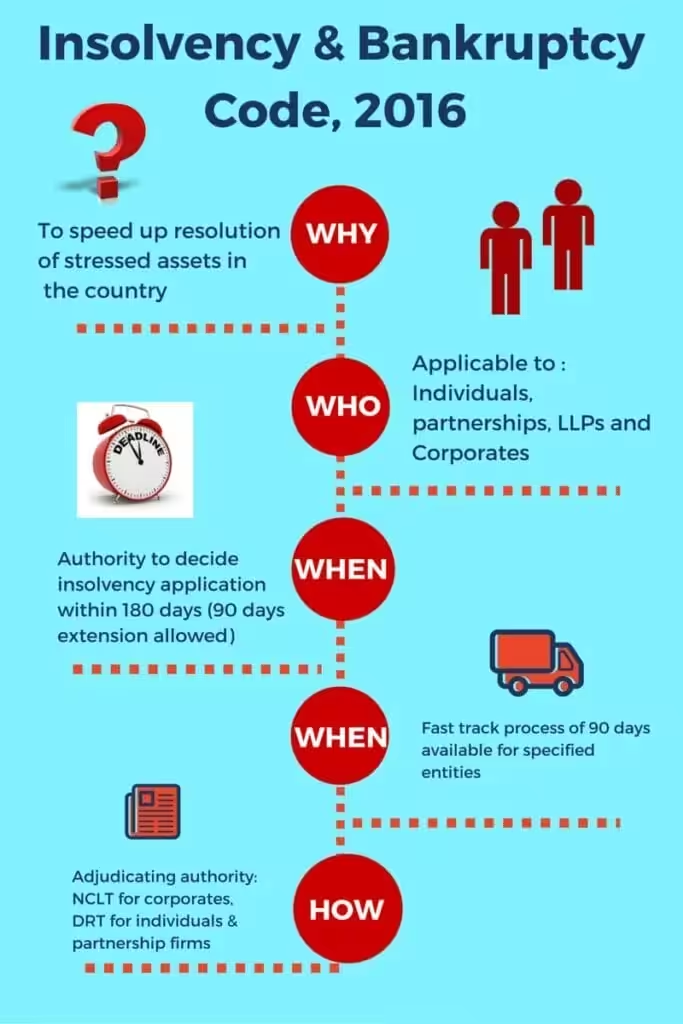
Purpose: To reorganize insolvency resolution process in a time bound manner.
Four pillars of Code:
- Insolvency Professionals (IPs): Manage insolvency, liquidation and bankruptcy process.
- Information Utilities (IUs): Store facts about lenders and terms of lending.
- Adjudicating Authority (AA): NCLT for corporate insolvency and Debt Recovery Tribunal for individual insolvencies.
- Insolvency and Bankruptcy Board of India (IBBI): Responsible for specifying regulations for various processes.
Resolution Process:
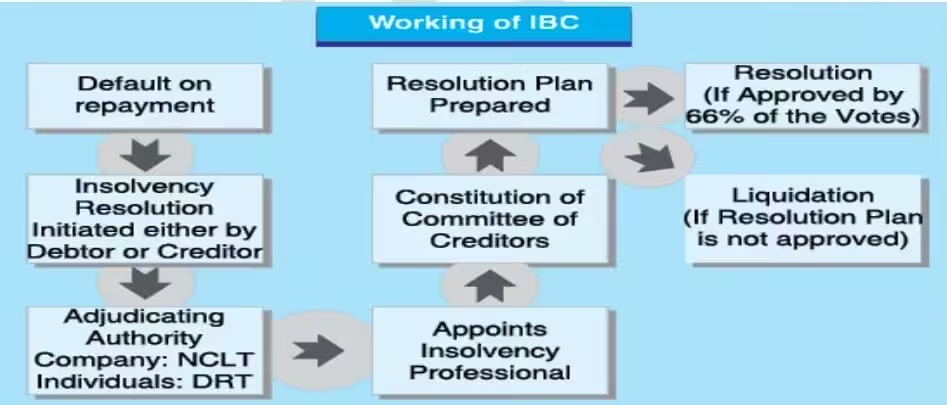
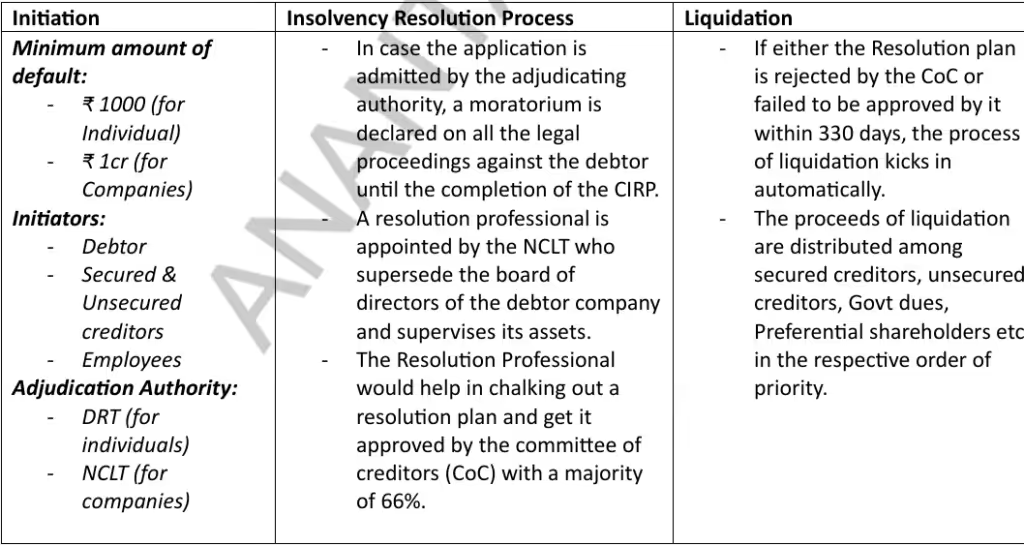
Successful examples:
- Essar Steel, where the creditors managed to recover 92% of ₹49,000 crore of debt outstanding.
- Bhushan Power and Steel in which 41% of ₹47,157 crore debt outstanding was recovered.
- Bhushan Steel in which 64% of ₹56,022 crore outstanding was retrieved, and Binani Cements in whose case all of the ₹6,469 crore outstanding was recovered.
Key Concerns (Parliamentary Committee):
Poor Asset Valuation:
- Assets of bankrupt companies are often undervalued.
- Valuation is:
- inconsistent,
- lacks transparency,
- Varies across resolutions.
- This reduces the final recovery for creditors.
Excessive Haircuts
- Haircuts are too high even for viable firms.
- This creates:
- loss of confidence in banking system,
- weakening of lending discipline,
- moral hazard for borrowers.
Weak Accountability of Resolution Professionals
- Resolution Professionals (RPs) and liquidators:
- face limited monitoring,
- escape responsibility for poor outcomes.
- Committee flagged lack of performance audit and accountability mechanisms.
Judicial Delays
- One of the biggest failures of IBC:
- long delays in NCLT/NCLAT,
- frequent appeals and reversals,
- uncertainty in finality of resolution.
- This destroys asset value over time.
Post-Resolution Challenges
- Even after successful resolution:
- a single-window clearance system for revived firms.
- Firms face:
- Government clearance delays
- Regulatory bottlenecks
- Funding difficulties
- Market stigma of being “defaulted”
- Committee recommended:
- a single-window clearance system for revived firms.
Despite its successes, the IBC faces several structural and operational challenges. As per economic survey(2024-25) IBC resolution plans take 582 days on average, liquidation process takes 499 days.
Committee Recommend?
1. Move to Enterprise-Value-Based Resolution
- Instead of selling assets at scrap value:
- focus on reviving core business value.
- Aim: maximize long-term productive capacity, not just liquidation proceeds.
2. Strengthen Valuation Framework
- Standardised valuation norms
- Dual valuation checks
- Transparent disclosure of assumptions
3. Reduce Haircuts
- Use:
- competitive global bidding,
- better market outreach,
- technology-enabled auctions.
4. Define Roles of Valuers & Liquidators Clearly
- Introduce Standard Operating Procedures (SOPs)
- Improve regulatory supervision of IBBI.
5. Improve Cross-Border Insolvency Framework
- Need faster coordination with foreign courts and creditors.
- Many stressed firms have foreign assets.