India’s ‘Wild’ Weather: IIT-Delhi Study Links Extremes to Human Activity
Why in News?
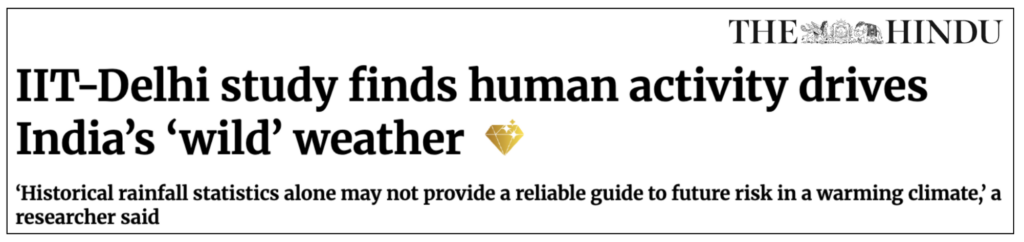
A new study by researchers from IIT-Delhi and KSMDB College, Kollam, published in the journal Environmental Research Letters, finds that human activity — not natural variation — is the primary driver of India’s intensifying extreme rainfall.
Using a statistical technique called fingerprinting, the team analysed rainfall data from 1905 to 2014 and produced what it calls the first dispositive evidence that anthropogenic forcing is reshaping the statistics of India’s extreme rains, most visibly in the core monsoon zone.
- Rainfall observations spanning 1905–2014 compared against multiple climate models.
- Greenhouse gas forcing found to be the dominant driver of intensifying extreme precipitation in West Central India.
- Aerosols (vehicle and factory emissions) currently scatter sunlight and partly suppress rain — a cooling ‘mask’.
- Researchers warn that as air pollution falls, the aerosol cooling effect will vanish and greenhouse warming will be ‘unmasked’.
- Key caution: it may ‘no longer be appropriate to assume stationarity‘ in extreme rainfall.
The development matters in the context of:
- For years, scientists debated whether India’s concentrated rains and violent urban floods were natural variability or climate change; this study supplies attribution evidence.
- Matters for disaster management because urban drainage, dams and infrastructure are designed on historical rainfall baselines that may no longer hold.
- Reinforces the IPCC finding that human influence has intensified heavy precipitation events globally.

UPSC Relevance
Prelims Relevance
- Fingerprinting — a detection-and-attribution method separating human signals from natural climate variability.
- Environmental Research Letters — a peer-reviewed climate-science journal carrying the study.
- Anthropogenic forcing vs natural forcing (solar, volcanic) in climate attribution.
- Greenhouse gases warm the atmosphere; aerosols scatter sunlight and can suppress rainfall.
- Aerosol masking / ‘unmasking’ of greenhouse warming as air cleans up.
- The core monsoon zone and West Central India as monsoon-sensitive regions.
- El Niño — a natural ocean-atmosphere cycle.
- Stationarity assumption — the idea that past climate statistics predict future risk.
- IPCC AR6 attribution of intensified heavy precipitation to human influence.
- Centre for Atmospheric Sciences, IIT Delhi — the lead research body.
Mains Relevance
GS Paper 3
- Attribution science as a tool for climate policy — how ‘fingerprinting’ strengthens the case for mitigation and adaptation.
- Implications of non-stationary rainfall for designing climate-resilient infrastructure and urban flood management.
GS Paper 3 (Disaster Management)
- Rethinking disaster-risk baselines: why historical return periods may understate future extreme-rainfall risk.
GS Paper 2
- Air-quality policy paradox: cleaning aerosols improves health but may ‘unmask’ greenhouse warming — governance trade-offs.
Essay
- Science as humanity’s mirror — attribution evidence and the moral responsibility for a warming planet.
- When the past stops guiding the future: planning under climate uncertainty.
Background and Context
What attribution science is
Attribution science asks not whether the climate is changing, but how much of a given change is caused by humans.
- Detection identifies that a change has occurred beyond natural variability; attribution assigns its cause.
- Fingerprinting compares real-world observations against climate-model simulations run with and without human forcings.
- Like a forensic investigator matching a fingerprint at a crime scene, scientists look for the unique ‘signal’ of human influence in the data.
- Natural cycles such as El Niño are statistically separated out so they are not mistaken for human-caused trends.
- The method underpins IPCC conclusions and a fast-growing field of single-event attribution for floods and heatwaves.
What the IIT-Delhi study did
The team built a long observational record and tested it against models to isolate the human signal.
- Analysed rainfall data from 1905 to 2014 — over a century of observations.
- Used fingerprinting to separate natural weather cycles from changes caused specifically by human activity.
- Found a contest in India’s skies between greenhouse gases (which warm) and aerosols (which scatter sunlight and suppress rain).
- Impact most visible in the core monsoon zone, including West Central India.
- Concluded that greenhouse gas forcing is a dominant driver of intensifying extreme precipitation there.
- As per the study, statistical characteristics of extreme rainfall are changing over time.
Greenhouse gases vs aerosols — the masking effect
Two human emissions pull India’s rainfall in opposite directions, and that balance is about to shift.
- Greenhouse gases (CO2, methane) trap heat and a warmer atmosphere holds more moisture, intensifying downpours.
- Aerosols from vehicle exhaust and factories scatter incoming sunlight, cooling the surface and partly suppressing rainfall.
- This aerosol masking has been hiding part of the true greenhouse warming.
- As India cuts air pollution, the aerosol load drops and the cooling effect vanishes.
- The full force of greenhouse warming is then ‘unmasked’ — risking a surge in extreme-rainfall events now being kept in check.
- This is the governance paradox: cleaner air saves lives but can reveal stronger warming.
India’s extreme-weather trends
The study fits a wider pattern of weather growing more violent and erratic across India.
- Increasingly concentrated rainfall and violent floods have devastated Indian cities and farms.
- More frequent and intense heatwaves, including hotter nights, are recorded across the plains.
- The monsoon is turning erratic — longer dry spells punctuated by short, heavy bursts.
- Cloudbursts and flash floods in the Himalayas and urban centres are rising.
- Urban flooding events (Chennai, Bengaluru, Mumbai) reflect this shift toward sharp, concentrated rain.
- These trends mirror the global picture in the IPCC AR6 report.
Why historical baselines are failing
The most practical warning is that the past may no longer be a reliable guide to the future.
- Engineers design drains, dams and culverts using return periods — e.g. the ‘100-year flood’ from past records.
- The study warns it may ‘no longer be appropriate to assume stationarity‘ in extreme rainfall.
- Stationarity is the assumption that the statistical behaviour of rainfall stays constant over time.
- Where extremes show a clear upward trend, historical statistics alone may understate future risk.
- Chaithra cautions that historical observations remain essential for local vulnerabilities but should not be used blindly.
The disaster-management link
Non-stationary rainfall directly reshapes how India must plan for floods and droughts.
- Climate-resilient infrastructure must be sized for future, not past, extremes.
- Early-warning systems and the India Meteorological Department forecasts gain in importance.
- Aligns with the shift from relief-centric to prevention-centric disaster management under the Disaster Management Act, 2005.
- Supports the Sendai Framework priority of understanding disaster risk through better data.
- Strengthens the case for nature-based solutions — wetlands, urban sponge design — to absorb heavy rain.
Way Forward
Update design standards
- Revise rainfall return-period norms for drainage, dams and urban planning to account for non-stationarity.
- Mandate climate-stress testing of major infrastructure projects.
Invest in science and data
- Expand regional attribution studies and high-resolution climate modelling for India.
- Strengthen dense rain-gauge and radar networks for early warning.
Balance air quality and climate policy
- Plan for the aerosol unmasking effect while pursuing clean-air goals under the National Clean Air Programme.
- Pair pollution cuts with aggressive greenhouse-gas mitigation so the net climate signal is managed.
Mainstream nature-based and ‘sponge city’ solutions in urban master plans so cities can absorb concentrated downpours.
Conclusion
The IIT-Delhi study moves the debate from ‘is the climate changing?’ to ‘humans are changing it, and we can measure how.’ Fingerprinting greenhouse and aerosol signals in a century of rainfall data, it gives India hard attribution evidence for its wilder weather.
Its sharpest lesson is practical: the past is no longer a safe guide. As aerosol cooling fades, planners must design for a future of heavier, more erratic rain — making attribution science a foundation of India’s climate adaptation and disaster preparedness.
UPSC Practice Questions
Prelims MCQ 1
With reference to climate-change attribution and the recent IIT-Delhi rainfall study, consider the following statements:
- ‘Fingerprinting’ separates the human-caused signal in climate data from natural variability.
- Aerosols from vehicle and factory emissions tend to warm the surface and intensify rainfall.
- The study found greenhouse gas forcing to be a dominant driver of extreme precipitation in West Central India.
How many of the above statements are correct?
(a) Only one (b) Only two (c) All three (d) None
Answer: (b) Only two
Explanation:
Statements 1 and 3 are correct. Statement 2 is wrong — aerosols scatter sunlight, cool the surface and tend to suppress rainfall, not intensify it.
Prelims MCQ 2
In climate science, the assumption of ‘stationarity’ that the study questions refer to:
(a) The constant position of the monsoon trough over the year
(b) The assumption that the statistical behaviour of rainfall stays unchanged over time
(c) A fixed ratio between greenhouse gases and aerosols in the atmosphere
(d) The steady-state temperature of the Indian Ocean
Answer: (b) The assumption that the statistical behaviour of rainfall stays unchanged over time
Explanation:
Stationarity assumes that past rainfall statistics (means, extremes, return periods) remain valid for the future. The study warns this can no longer be assumed in a warming climate.
UPSC Mains Questions
- Attribution science is shifting the climate debate from causation to quantification. Discuss how detection-and-attribution methods such as ‘fingerprinting’ can strengthen India’s climate mitigation and adaptation policy.
- ‘Historical rainfall statistics may no longer be a reliable guide to future risk.’ In light of recent research on India’s extreme weather, examine the implications for disaster management and climate-resilient infrastructure.
Sources: The Hindu and Environmental Research Letters.
Frequently Asked Questions
What did the IIT-Delhi study find?
Researchers from IIT-Delhi and KSMDB College, Kollam, found that human activity — not natural variation — is the primary driver of India’s intensifying extreme rainfall. Published in Environmental Research Letters, the study used over a century of rainfall data (1905–2014) and the ‘fingerprinting’ technique to isolate the human signal, with greenhouse gases the dominant force in West Central India.
What is climate ‘fingerprinting’?
Fingerprinting is a detection-and-attribution method. Scientists compare real-world observations with climate models run with and without human forcings, then look for the unique ‘fingerprint’ of human influence — much like matching a fingerprint at a crime scene. It also separates natural cycles such as El Niño from human-caused trends.
How do aerosols affect India’s rainfall?
Aerosols are tiny particles from vehicle exhaust and factories that scatter incoming sunlight. This cools the surface and partly suppresses rainfall, masking some of the true greenhouse warming. As India cuts air pollution, this cooling effect fades and greenhouse warming gets ‘unmasked’, potentially boosting extreme rains.
Why does this matter for disaster management?
Engineers design drains, dams and flood defences using historical rainfall records. The study warns that rainfall is becoming ‘non-stationary’, so past statistics may understate future risk. India must update design standards, strengthen early warning, and build climate-resilient infrastructure sized for heavier, more erratic rain.
What is the ‘stationarity’ assumption?
Stationarity is the assumption that the statistical behaviour of rainfall — its averages, extremes and return periods — stays constant over time. Infrastructure planning relies on it. The study cautions that in a warming climate this assumption may no longer hold where extreme rainfall is clearly rising.
How does this link to the IPCC?
The findings reinforce the IPCC AR6 conclusion that human influence has intensified heavy precipitation events worldwide. By providing India-specific attribution evidence, the study localises the global picture and supports the case for both stronger mitigation of emissions and faster adaptation.