Illegal Loan Apps and India’s Digital Lending Safeguards
Why in News?
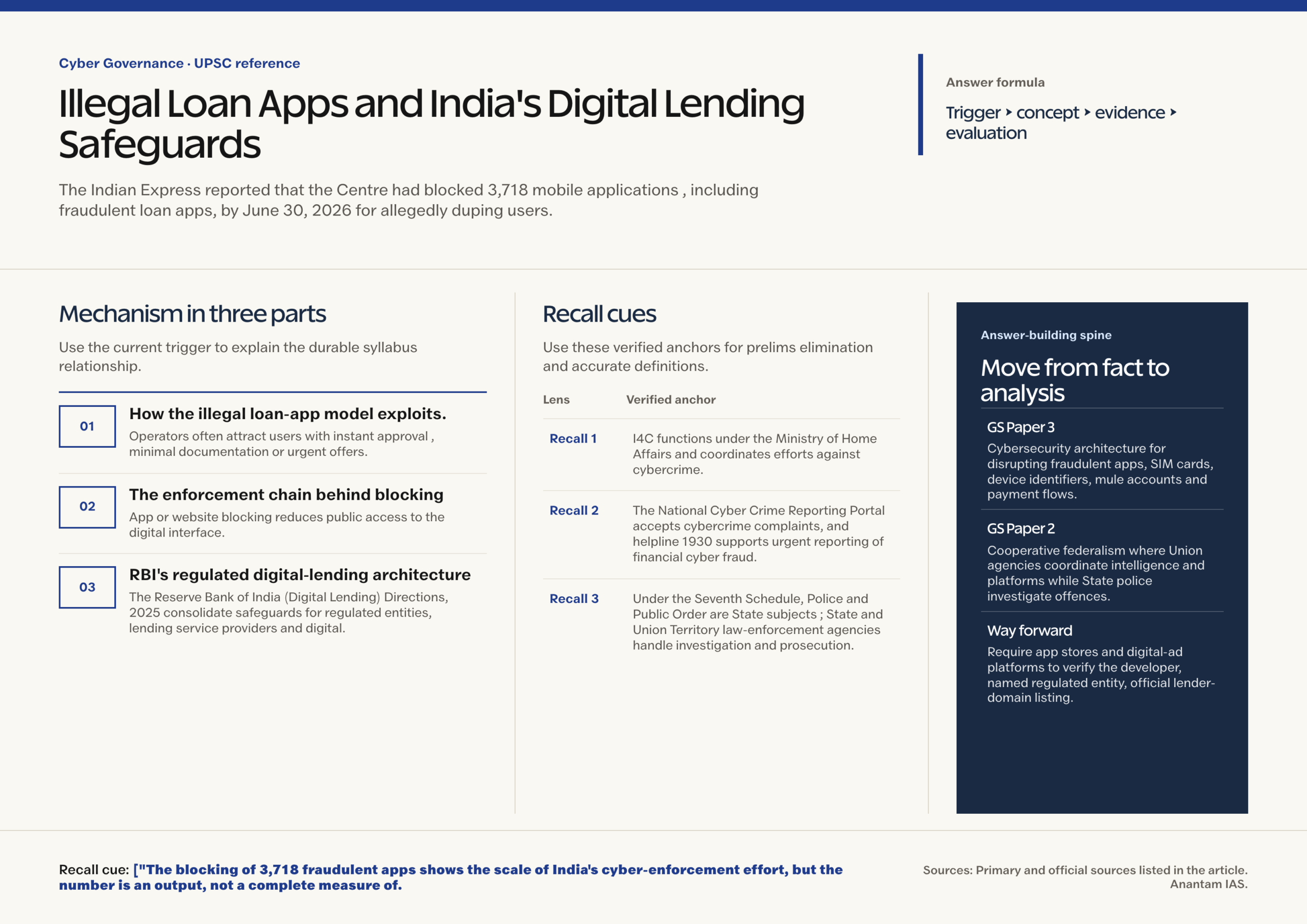
The Indian Express reported that the Centre had blocked 3,718 mobile applications , including fraudulent loan apps, by June 30, 2026 for allegedly duping users.
- In a Lok Sabha reply, the government said the Indian Cyber Crime Coordination Centre (I4C) had acted under Sections 69A and 79(3)(b) of the Information Technology Act, 2000.
- The figure of 3,718 refers to mobile apps blocked for alleged fraud; it includes fraudulent loan apps but should not be read as a count of loan apps alone.
- Police inputs had also led to the blocking of more than 15.75 lakh SIM cards and 5.77 lakh IMEI numbers, targeting communication channels and devices used in cybercrime.
- The I4C-run Citizen Financial Cyber Fraud Reporting and Management System, launched in 2021, had helped save more than Rs 11,158 crore across over 32.80 lakh complaints by June 30, 2026.
- The national cybercrime helpline 1930 and the National Cyber Crime Reporting Portal provide rapid reporting channels, while investigation and prosecution remain primarily with State and Union Territory police.
- An illegal loan app is not merely a consumer-credit problem. It can combine deceptive advertising, unlawful data access, coercive recovery, identity theft, mule accounts and rapid movement of stolen funds.
- Blocking an app can reduce immediate reach, but mirror websites, sideloaded Android packages, renamed apps and new accounts allow operators to reappear. Enforcement must follow the entire fraud chain.
- RBI rules apply to regulated entities such as banks and NBFCs and to the lending service providers they engage. A criminal app falsely claiming an association with a lender may sit outside that regulated chain, requiring.
UPSC Relevance
Prelims Relevance
- I4C functions under the Ministry of Home Affairs and coordinates efforts against cybercrime.
- The National Cyber Crime Reporting Portal accepts cybercrime complaints, and helpline 1930 supports urgent reporting of financial cyber fraud.
- Under the Seventh Schedule, Police and Public Order are State subjects; State and Union Territory law-enforcement agencies handle investigation and prosecution.
- Section 69A of the IT Act empowers the Central Government or an authorised officer to direct blocking of public access to information on specified statutory grounds, subject to prescribed procedure and safeguards.
- Section 79 concerns conditional safe-harbour protection for intermediaries; subsection 79(3)(b) addresses failure to remove or disable access after legally cognisable actual knowledge.
- A Regulated Entity in digital lending may be a bank, cooperative bank, NBFC or housing finance company covered by RBI directions.
Mains Relevance
GS Paper 3
- Cybersecurity architecture for disrupting fraudulent apps, SIM cards, device identifiers, mule accounts and payment flows.
- Financial-sector regulation, consumer protection and the trade-off between digital credit inclusion and predatory lending.
GS Paper 2
- Cooperative federalism where Union agencies coordinate intelligence and platforms while State police investigate offences.
- Due process, transparency and proportionality in online blocking, alongside intermediary responsibility.
Essay
- Technology can widen access to credit, but trust depends on whether institutions can make convenience compatible with dignity, privacy and accountability.
Background and Context
How the illegal loan-app model exploits borrowers
Fraudulent lending applications turn a short loan journey into a combined credit, privacy and coercion risk.
- Operators often attract users with instant approval, minimal documentation or urgent offers. The interface may obscure the actual lender, total cost, tenure, processing deductions or recovery terms.
- Some apps seek intrusive access to contacts, call logs, files, photographs or device functions. Stolen personal data can support harassment, impersonation, identity theft or pressure on a borrower’s family and colleagues.
- A small amount may be disbursed after an upfront deduction, while repayment demands reflect a much larger nominal amount. Repeated refinancing can trap a borrower in a cycle of short-tenure, high-cost debt.
- Collection agents may use threats, manipulated images or mass messages to contacts. Such conduct converts a financial dispute into cyber-enabled extortion and intimidation.
- Illegal apps can be distributed through social-media links or sideloaded APK files, so removal from an official app store does not by itself end access.
The enforcement chain behind blocking
Effective action must disable several layers used by the same criminal network.
- App or website blocking reduces public access to the digital interface. Section 69A requires an authorised decision on specified grounds, reasons recorded in writing, and compliance with the 2009 Blocking Rules.
- Intermediary action under Section 79(3)(b) concerns removal or disabling of unlawful material after legally valid notice or a court order, consistent with the Supreme Court’s reading of actual knowledge in Shreya Singhal v. Union of India.
- Blocking SIM cards and IMEIs targets communication identities and devices used to contact victims, though criminals may replace them. Accurate attribution is essential to avoid harming legitimate users.
- Freezing suspect beneficiary or mule accounts can interrupt the movement of proceeds. Rapid reporting matters because stolen funds may pass through several accounts within minutes.
- Evidence preservation, FIR registration, arrests, charge sheets and prosecution depend mainly on State and Union Territory law-enforcement agencies because Police and Public Order are State subjects.
RBI's regulated digital-lending architecture
RBI focuses on the regulated lender and its agents, while criminal enforcement addresses actors outside that chain.
- The Reserve Bank of India (Digital Lending) Directions, 2025 consolidate safeguards for regulated entities, lending service providers and digital lending apps. A bank or NBFC remains responsible when it outsources customer acquisition, servicing or recovery.
- Loan disbursal should ordinarily move directly into the borrower’s bank account, and repayment should move directly into the regulated entity’s account. Pass-through or pool accounts controlled by unrelated third parties are a warning sign.
- Fees payable to an LSP are to be paid by the regulated entity, not separately collected by the LSP from the borrower. The lender must disclose the all-inclusive APR and provide a standardised Key Fact Statement.
- The Key Fact Statement should identify key costs, recovery mechanism, grievance officer and cooling-off period. A charge omitted from the KFS cannot be imposed later during the loan term.
- Digitally signed documents, including the KFS, sanction letter, terms and account statements, should automatically reach the borrower’s verified email or SMS channel. This creates an evidence trail beyond the app screen.
Data protection and recovery safeguards
A legitimate loan journey should collect only what is needed and should not weaponise a borrower’s phone.
- RBI requires need-based data collection with prior, explicit consent and an audit trail. Borrowers should be able to permit or deny specific uses, restrict third-party disclosure, revoke consent and request deletion where applicable.
- Digital lending apps in the regulated chain must not access phone resources such as contacts, call logs, telephony functions, files or media. One-time access to camera, microphone or location may be taken only when needed for.
- The regulated entity must publish details of its apps, LSPs and the activities assigned to them. Recovery-agent details must be communicated when the loan is sanctioned and when recovery responsibility changes.
- The app or lender should provide a visible grievance channel. If a regulated entity does not resolve a complaint under the applicable timeline, the borrower may use RBI’s Complaint Management System where the complaint falls within.
- These protections help distinguish a compliant digital loan from an illegal app, but a directory entry is a verification aid, not a promise that every loan is affordable or suitable for every borrower.
Way Forward
Build a verified-app and advertising chain
- Require app stores and digital-ad platforms to verify the developer, named regulated entity, official lender-domain listing and grievance contact before permitting a lending app or advertisement.
- Use RBI’s DLA directory as a starting checkpoint and display the limits clearly: the directory records associations reported by regulated entities and is not an approval of individual loan products.
- Create rapid channels for lenders to report impersonating apps, domains and advertisements and for platforms to preserve evidence while restricting access.
Conclusion
- The blocking of 3,718 fraudulent apps shows the scale of India’s cyber-enforcement effort, but the number is an output, not a complete measure of safety.
- A durable response combines precise takedowns, accountable regulated lending, privacy safeguards, financial tracing and fast victim reporting .
UPSC Practice Questions
Prelims MCQ 1
With reference to India’s framework against fraudulent digital lending, consider the following statements:
- The Indian Cyber Crime Coordination Centre functions under the Ministry of Home Affairs.
- Police and Public Order are subjects in the Union List of the Seventh Schedule.
- RBI’s public Digital Lending Apps directory helps users verify an app’s reported association with a regulated entity.
How many of the above statements are correct?
(a) Only one (b) Only two (c) All three (d) None
Answer: (b) Only two
Explanation:
Statements 1 and 3 are correct. I4C is under the Ministry of Home Affairs, and RBI’s DLA directory records associations reported by regulated entities. Police and Public Order are State List subjects, so statement 2 is incorrect.
Prelims MCQ 2
Which one of the following is required under RBI’s digital-lending safeguards for regulated entities?
(a) Repayment through a pool account controlled by any app developer (b) Unrestricted access by lending apps to a borrower’s contact list (c) Upfront disclosure of the Annual Percentage Rate in the Key Fact Statement (d) Automatic increase in a borrower’s credit limit without specific consent
Answer: (c) Upfront disclosure of the Annual Percentage Rate in the Key Fact Statement
Explanation:
RBI requires the all-inclusive APR to be disclosed upfront in the KFS. Repayment ordinarily goes directly to the regulated entity, intrusive phone-resource access is restricted, and credit limits cannot be automatically increased without explicit consent.
UPSC Mains Questions
- Illegal loan apps expose the limits of treating cyber fraud, consumer credit and data protection as separate regulatory problems. Discuss with reference to India’s institutional response.
- App blocking is necessary but insufficient against networked financial cybercrime. Examine the additional telecom, banking, platform and policing measures required for durable deterrence.
Sources: PIB, Ministry of Home Affairs and The Indian Express.
Frequently Asked Questions
Were all 3,718 blocked applications illegal loan apps?
No. The government’s figure covers mobile applications blocked for allegedly duping users and says the set included fraudulent loan apps. The available official statement does not identify all 3,718 as lending applications, so the number should not be presented as.
Does RBI approve individual loan apps?
RBI regulates banks, NBFCs and other covered entities, not an app as a stand-alone lender licence. Its public DLA directory helps users check whether a regulated entity has reported an association with an app. Users should also confirm that association.
What should a borrower check before taking a digital loan?
Identify the bank or NBFC, verify the app’s association, read the Key Fact Statement, compare the APR and total repayment, check the grievance officer and reject unnecessary permissions. Disbursal and repayment should ordinarily occur directly between the borrower and the.
What should a victim do after losing money through a fraudulent loan app?
Call 1930 immediately and file a detailed complaint at cybercrime.gov.in. Keep the transaction ID, bank or wallet details, app link, phone numbers, messages, screenshots and loan documents ready. Notify the bank or regulated lender at the same time so it.
How does Section 69A differ from Section 79 of the IT Act?
Section 69A provides a statutory power to direct blocking of public access on specified grounds, subject to procedure and safeguards. Section 79 provides conditional safe harbour to intermediaries; subsection 79(3)(b) concerns loss of protection when unlawful material is not removed.