IMEC
India-Middle East-Europe Economic Corridor

Context:
The India–Middle East–Europe Economic Corridor (IMEC)—announced during the G20 Summit 2023 in New Delhi—is once again in focus due to geopolitical instability in West Asia, especially after the Hamas–Israel conflict. The recent security crisis and shifting regional alliances have raised concerns about the corridor’s feasibility and future direction.
UPSC Relevance:
International Relation
UPSC PYQ:
Q. What is the importance of developing Chabahar Port by India? (2017)
(a) India’s trade with African countries will enormously increase.
(b) India’s relations with oil-producing Arab countries will be strengthened.
(c) India will not depend on Pakistan for access to Afghanistan and Central Asia.
(d) Pakistan will facilitate and protect the installation of a gas pipeline between Iraq and India.
About IMEC:
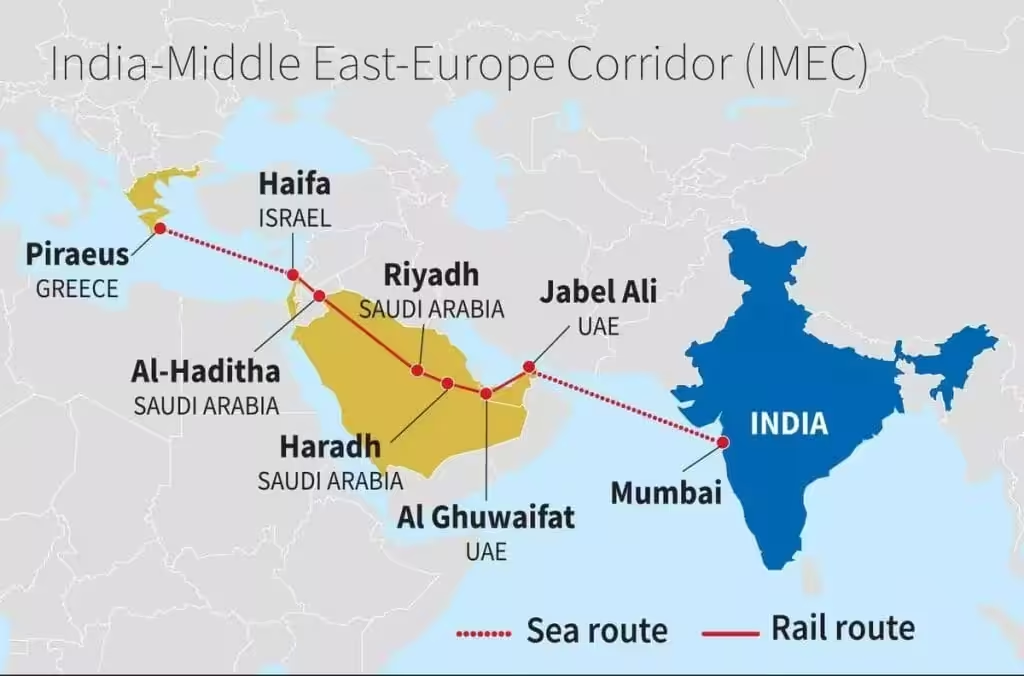
- Launched at the 2023 Group of Twenty (G20) summit in New Delhi, the India-Middle East-Europe Economic Corridor (IMEC) features three pillars that integrate existing and future infrastructure:
- A transportation pillar—the corridor’s backbone—integrating rail and maritime networks
- A energy pillar with interconnected energy and electricity infrastructure across continents
- A digital pillar providing new fiber-optic cables and cross-border digital infrastructure.
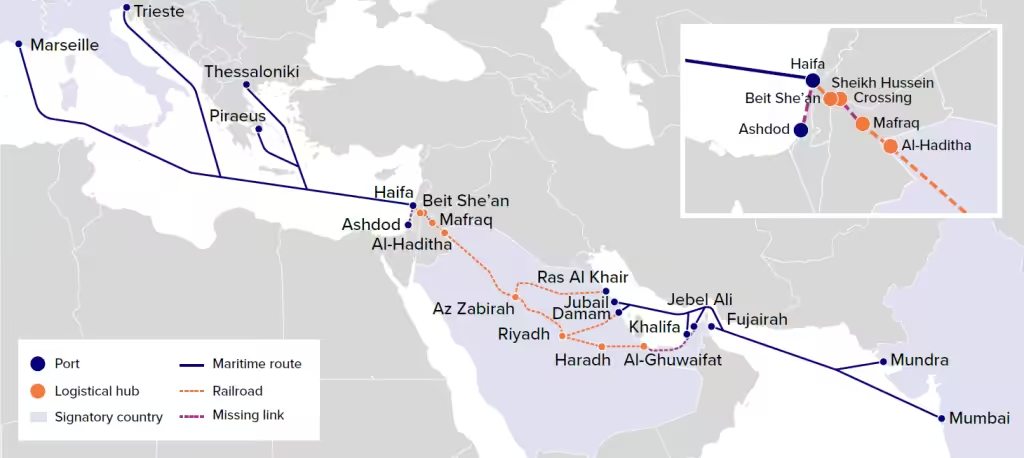
- The corridor is well placed to be a consequential regional integration and infrastructure initiative in the coming decades, reinforcing supply chain security and aligning Eurasian policy around open, rules-based connectivity, supported by market-driven, locally funded investment from a diverse set of countries.
- IMEC also provides an alternative to existing corridors dominated by a single government, particularly the Belt and Road Initiative.
The transportation corridor plan has a financing gap of approximately $5 billion to become minimally operational, linking Gulf ports to Haifa, Israel. Most of the unmet costs are in Jordan, Israel, and logistics hubs likely at Haradh, in the Kingdom of Saudi Arabia (linking KSA-United Arab Emirates); al-Haditha, KSA (KSA-Jordan); Mafraq, the Jordan logistics hub, and near Beit She’an in Israel (Jordan-Israel).
- Transshipment times via the transportation corridor could be reduced by about 40 percent (to twelve-plus days) relative to maritime routes, generating approximately $5.4 billion in annual savings on Asia-Europe trade traveling the route.
Current Challenges:
- Security instability
- Escalating violence in West Asia, particularly between Israel and Hamas, and attacks on Red Sea shipping lanes by the Houthis, threaten IMEC’s viability.
- Changing Geopolitics:
- Countries like Saudi Arabia, Iran, and Egypt are recalibrating their foreign policies. Pakistan, too, may seek to counter India’s growing influence in the region.
- Mediterranean Concerns:
- Disruptions in the Red Sea have increased shipping costs and time for global trade, pushing the world to look for alternative trade routes.
IMEC’s success depends on peace and stability in the Middle East. The corridor must remain adaptive to evolving geopolitical and security dynamics. India and its partners (Saudi Arabia, UAE, Israel, EU) need innovative diplomatic coordination to sustain progress despite regional tensions.