Inclusive Education Summit 2026: CWSN, Accessibility and NEP 2020
The Ministry of Education’s Inclusive Education Summit in January 2026 highlighted the schooling needs of children with disabilities and other disadvantaged learners. The event placed accessibility, assistive technology and teacher capacity in the spotlight.
For UPSC, inclusive education is not charity. It is a constitutional and developmental obligation linked to equality, dignity, human capital and the right to education.
This article explains the summit through the lens of CWSN inclusion, NEP 2020, RPwD Act and school-level implementation gaps.
Quick Facts
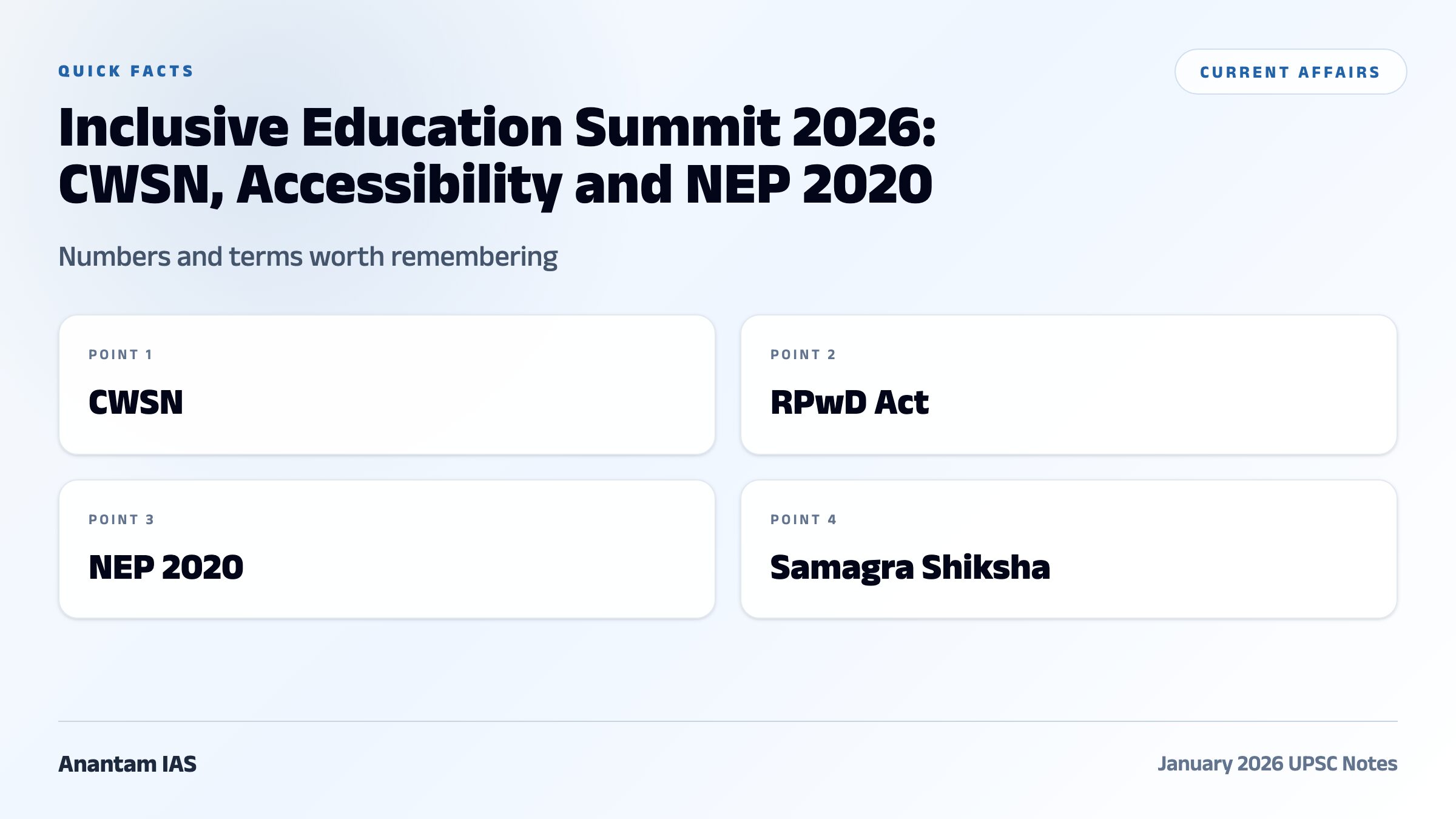
- The summit was held in January 2026 by the Ministry of Education.
- CWSN means Children With Special Needs.
- Inclusive education is linked to NEP 2020 and the Rights of Persons with Disabilities Act, 2016.
- Accessibility includes infrastructure, learning material, assistive devices and teacher support.
- Samagra Shiksha supports inclusive education interventions.
- Official source: PIB Ministry of Education release dated 21 January 2026.
- Official source: PIB, Ministry of Education.
What Just Happened
The summit brought policy attention to inclusive education and the practical barriers faced by children with disabilities.
The event highlighted the need for accessible schools, trained teachers, assistive technology and social acceptance.
For aspirants, this is a strong GS-II topic because it connects rights-based law with everyday delivery in classrooms.
Background and Historical Context
India’s disability-rights framework includes the RPwD Act, 2016, which expanded recognised disabilities and strengthened rights-based language.
The Right to Education Act and Samagra Shiksha provide school-level frameworks, while NEP 2020 emphasises equitable and inclusive education.
The challenge is implementation. A child may be enrolled but excluded if classrooms, transport, toilets, books, pedagogy and attitudes are inaccessible.
Key Features of Inclusive Education
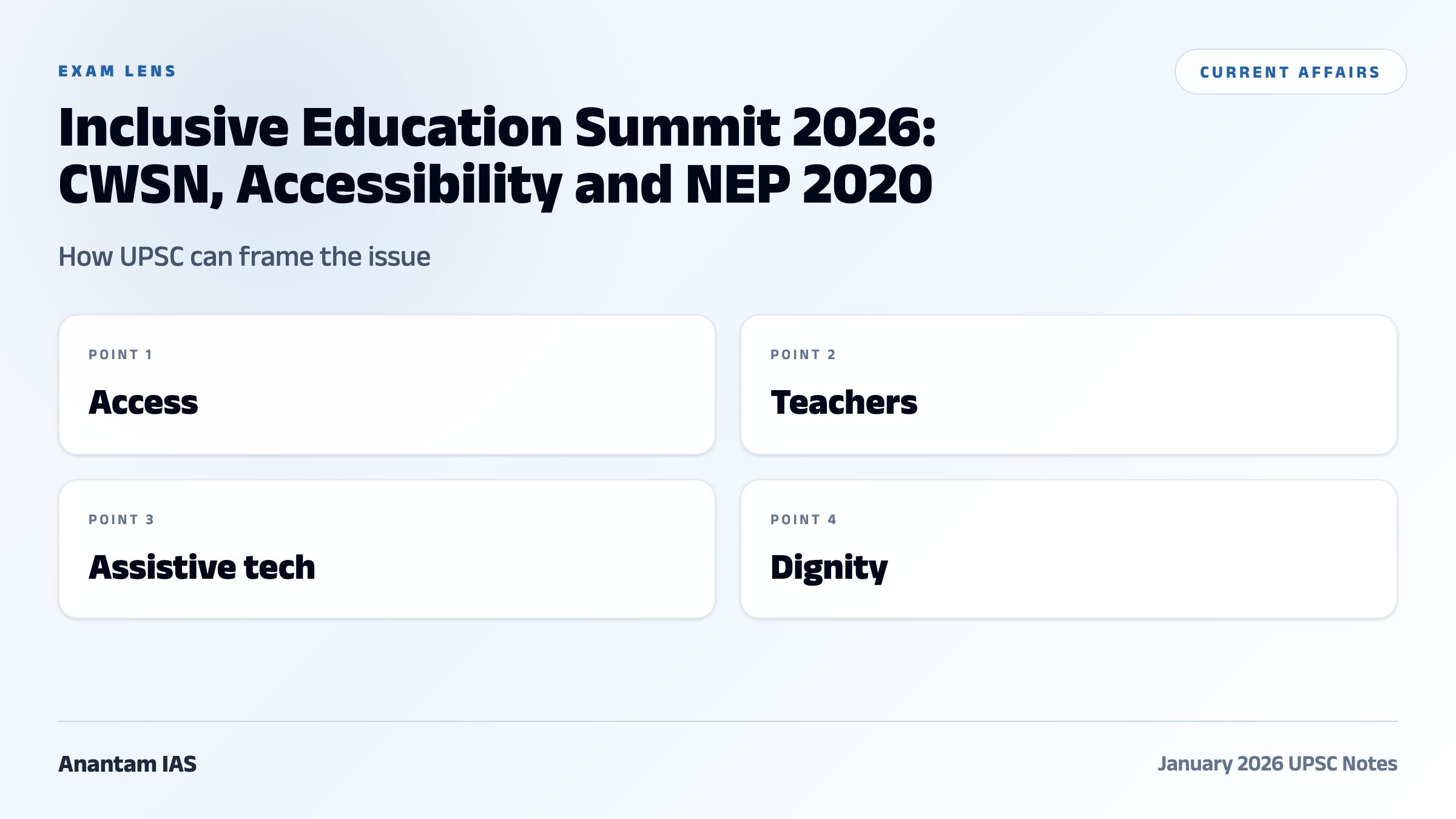
The core policy architecture can be read through these features.
- Accessibility: ramps, toilets, transport, digital content and classroom design matter.
- Assistive technology: devices and software can support learning.
- Teacher capacity: teachers need training in inclusive pedagogy.
- Legal anchor: RPwD Act and RTE create rights-based obligations.
- Social inclusion: stigma and low expectations must be addressed.
- Data need: states need accurate CWSN identification and tracking.
Why It Matters
This is a high-yield UPSC topic because it joins current news with durable syllabus themes.
- It connects a January 2026 event with durable UPSC syllabus themes.
- It gives usable facts for Prelims and analytical hooks for Mains.
- It helps students move from news recall to policy reasoning.
- It can be linked with static concepts in polity, economy, governance, science, environment or society.
Detailed Analysis: Inclusive Education Lens
Enrolment is not inclusion. A child sitting in school but unable to access learning material is still excluded.
Universal design is better than afterthought accommodation. Schools should be built for diverse learners from the start.
Teacher training is the decisive variable. Inclusive education fails when responsibility is pushed only to special educators.
Comparative Perspective
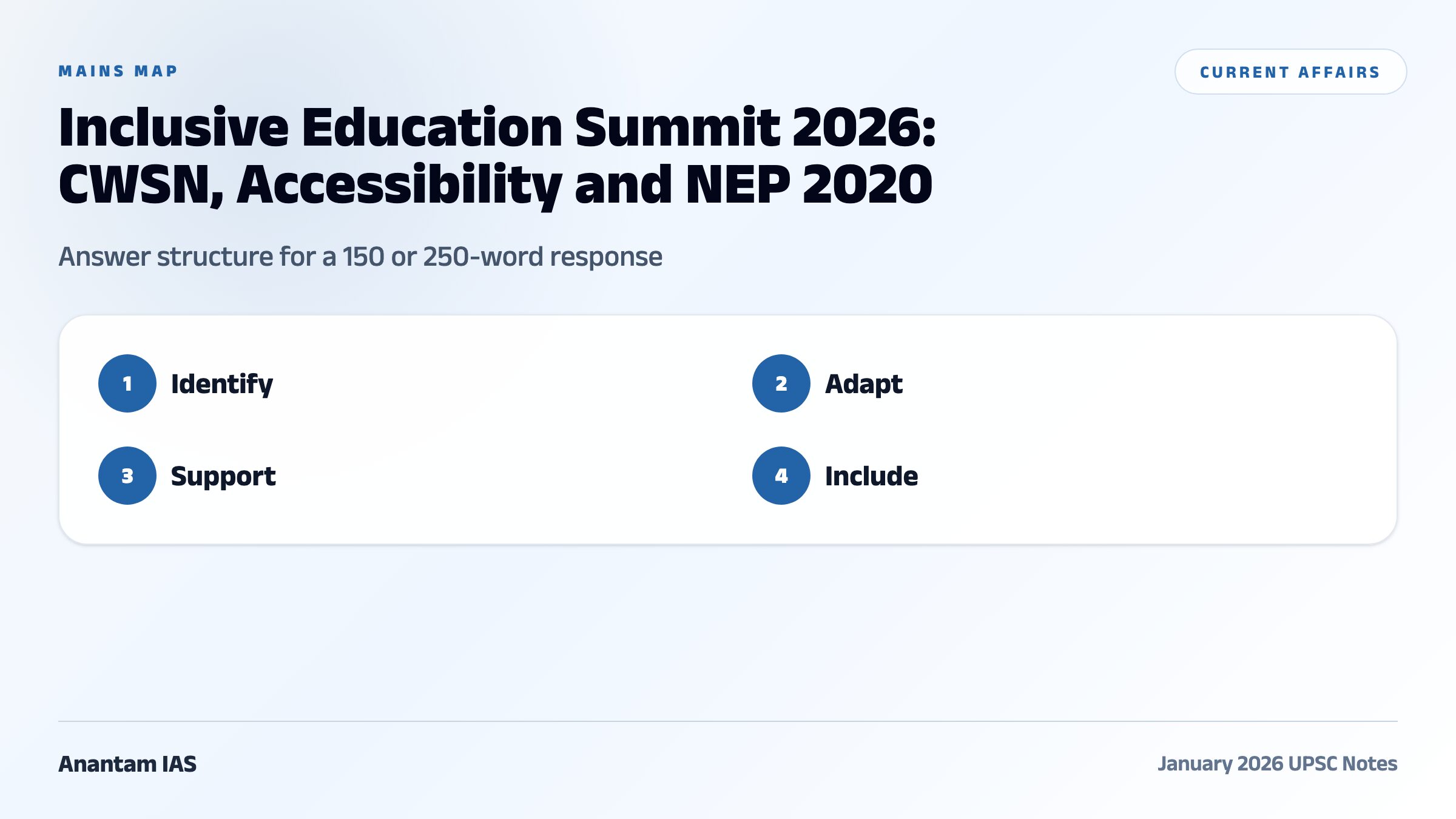
A comparison helps prevent the answer from becoming a one-dimensional news summary.
- Special schools: separate settings for children with specific disabilities.
- Inclusive education: mainstream schools adapt to diverse learners.
- Integrated education: learners enter mainstream settings but support may remain limited.
- Universal design: designs systems usable by the widest range of learners.
Challenges
The policy or institutional promise runs into recurring constraints.
- Schools may lack ramps, accessible toilets and transport.
- Teacher training in inclusive pedagogy is limited.
- Assistive devices are often delayed or poorly maintained.
- Disability data can be incomplete.
- Stigma and low expectations reduce participation.
Prelims Pointers
- RPwD Act, 2016 expanded recognised disabilities.
- CWSN means Children With Special Needs.
- NEP 2020 emphasises equitable and inclusive education.
- Samagra Shiksha supports inclusive education.
- Universal Design for Learning is an approach to accessible pedagogy.
- Reasonable accommodation is a key disability-rights principle.
Mains Questions
- Inclusive education requires system redesign, not only special provisions. Discuss. (GS Paper II, 250 words)
- How does the RPwD Act strengthen the rights-based approach to education? (GS Paper II, 150 words)
- Enrolment without accessibility is not inclusion. Analyse. (GS Paper II, 250 words)
- What reforms are needed to make government schools disability-inclusive? (GS Paper II, 250 words)
Way Forward
States should audit school accessibility, train all teachers in inclusive pedagogy and integrate assistive technology procurement with classroom support.
CWSN data should track attendance, learning and transition, not merely enrolment.
For Mains, connect inclusion with dignity, equality, Article 21A, social justice and human capability.
The examiner is unlikely to reward a bare fact dump here. The better answer connects the January 2026 event to institutional design, implementation capacity and India’s long-term development priorities.
Frequently Asked Questions
What is inclusive education?
It means schools adapt so that children with disabilities and diverse needs can learn with others meaningfully.
What does CWSN mean?
Children With Special Needs.
Which law is important?
The Rights of Persons with Disabilities Act, 2016 is central.
How does NEP 2020 connect?
It emphasises equitable and inclusive education.
What is the main implementation gap?
Accessible infrastructure, trained teachers and assistive support remain uneven.
Why is this relevant for UPSC?
It links education, social justice, rights and governance delivery.