India submits 4th Biennial Update Report to UNFCCC
Why in News?
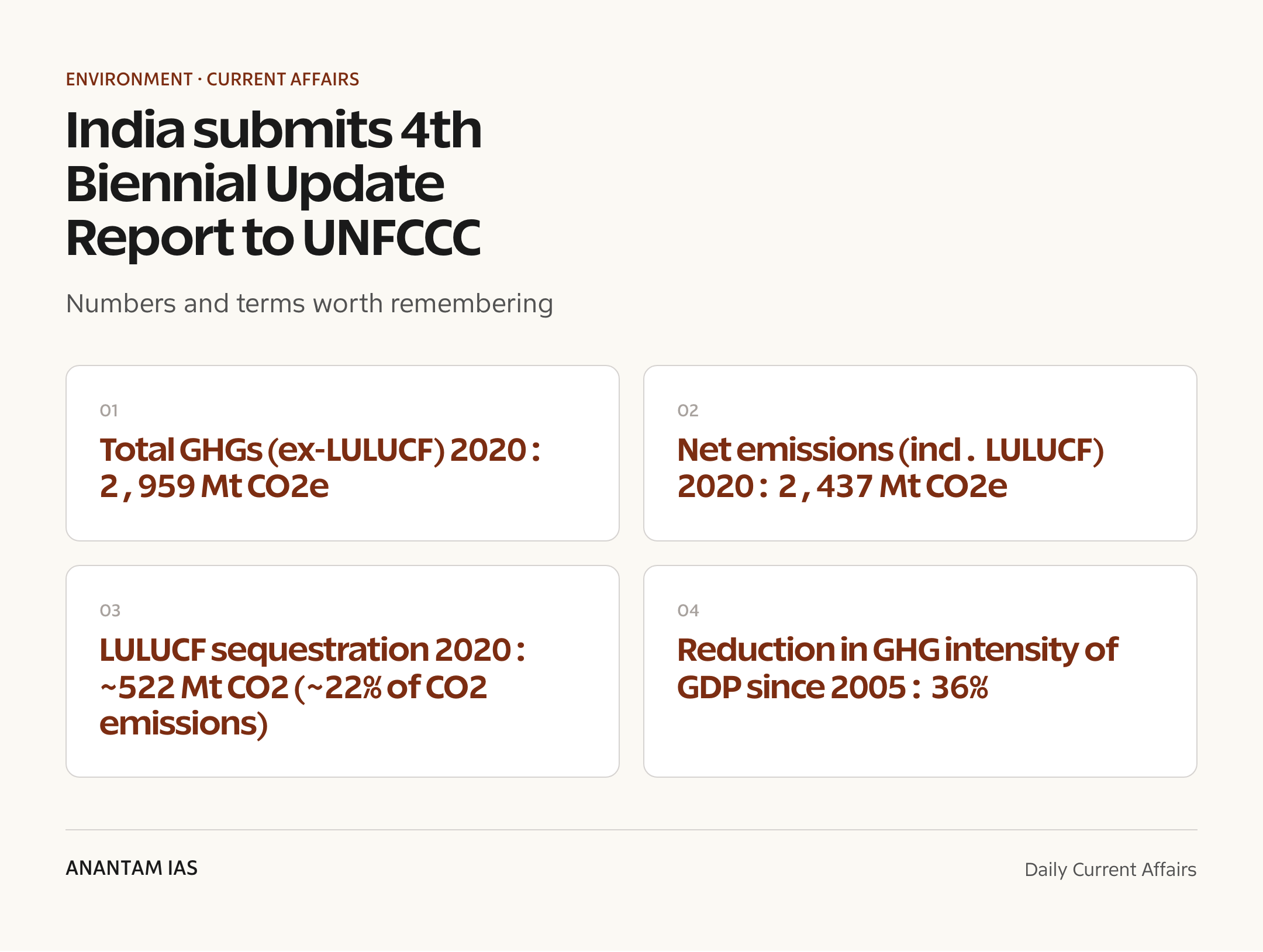
India submitted its 4th Biennial Update Report (BUR-4) to the UNFCCC on 30 December 2024, updating the national GHG inventory for 2020 and reporting progress on mitigation, adaptation and support needs.
- BUR-4 submission updates the Third National Communication and provides a full GHG inventory for 2020 to the UNFCCC secretariat.
- Policy relevance: the report documents mitigation actions, constraints and requirements in finance, technology and capacity building that shape domestic planning and international negotiations.
- Quantitative update: India reports a 7.93% decline in total GHG emissions in 2020 relative to 2019 and a 36% reduction in emissions intensity of GDP since 2005.
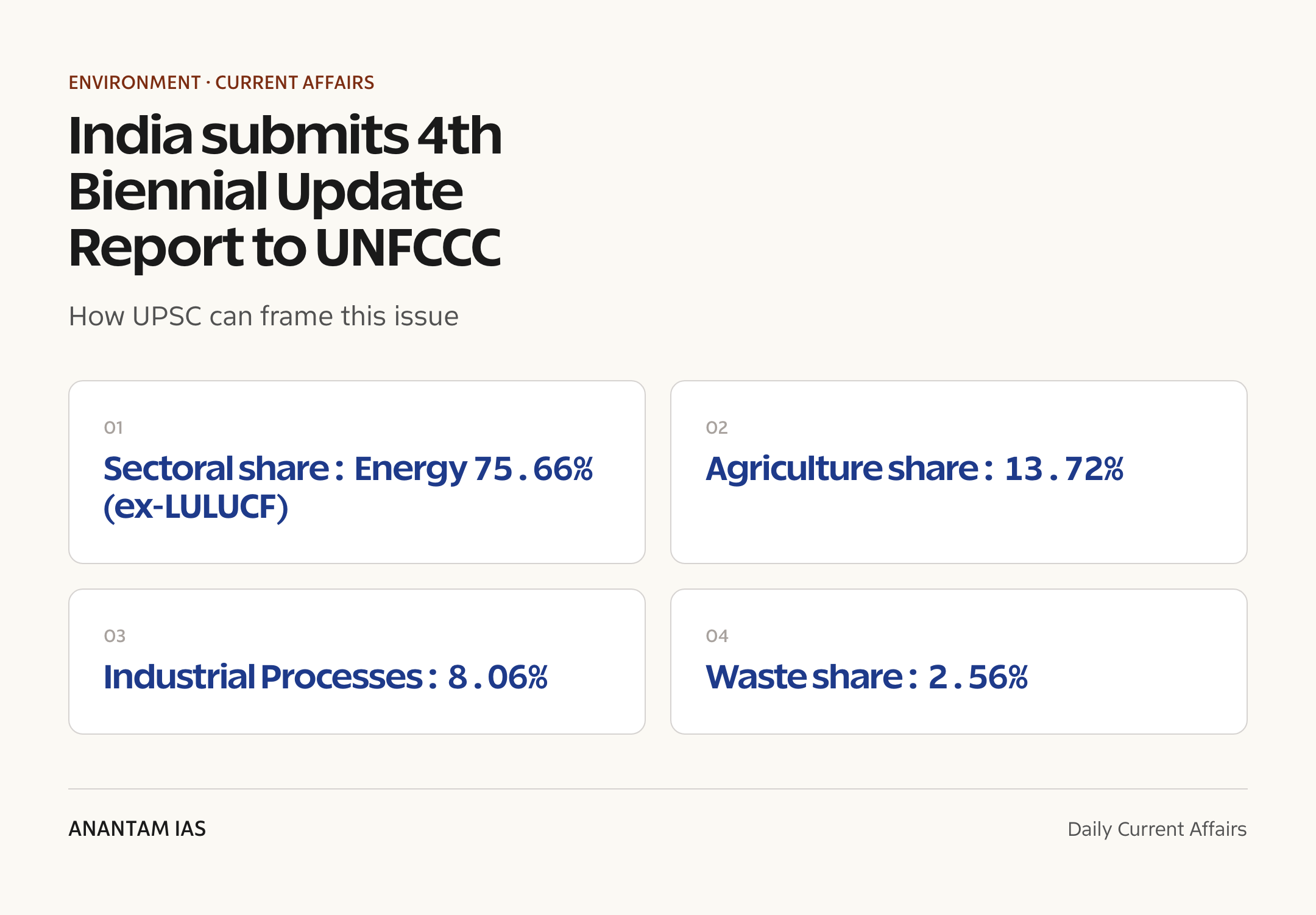
- Sectoral picture: energy contributes 75.66% of emissions (ex-LULUCF), agriculture 13.72%, industrial processes 8.06% and waste 2.56%.
- LULUCF role: forests and other land use sequestered ~522 Mt CO2 in 2020, equal to about 22% of CO2 emissions that year.
The development matters in the context of:
- BUR purpose: Biennial Update Reports are submissions by non-Annex I countries that provide updated GHG inventories, mitigation actions and needs related to finance, technology and capacity building.
- NDC link: BURs complement Nationally Determined Contributions by tracking progress and providing historical inventories that inform future NDC updates and policy choices.
- India’s development context: India frames its climate actions in the principles of equity and common but differentiated responsibilities and respective capabilities (CBDR-RC).
- Global process: UNFCCC uses BURs to aggregate national information, assess global progress and shape discussions on finance and technology transfer under the Paris architecture.
- Data vintage: BUR-4 reports the national inventory for the calendar year 2020, a pandemic-affected year with notable emissions fluctuation.
- Domestic use: the report informs national planning across energy, forestry, agriculture and waste sectors and supports MRV (measurement, reporting, verification) strengthening.
UPSC Relevance
Prelims Relevance
- Definition and purpose of Biennial Update Reports under the UNFCCC.
- Key greenhouse gas inventory figures for India in 2020: total emissions, sectoral shares and LULUCF sequestration.
- India’s stated change in GHG emission intensity of GDP since 2005 (36% by 2020).
Mains Relevance
GS3 Environment
- Assess how India’s BUR-4 reflects the balance between developmental priorities and mitigation commitments.
- Discuss the role of accurate GHG inventories and LULUCF accounting in shaping climate policy and international negotiations.
- Analyse the implications of reported finance, technology and capacity-building needs for India’s climate diplomacy and domestic implementation.
Essay
- Material for essays on sustainable development, climate justice and India’s role in global climate governance.
- Data points to support arguments on low-carbon growth pathways and energy transition in emerging economies.
- Evidence for debates on equity and differentiated responsibilities in international climate action.
Background and Context
What is a Biennial Update Report
Function and scope of BURs submitted by non-Annex I parties to the UNFCCC.
- Purpose: provide updated national GHG inventories, mitigation actions and information on needs in finance, technology and capacity building.
- Reporting cycle: BURs are usually submitted every two years, complementing National Communications and NDC updates.
- Audience: UNFCCC secretariat, other parties, researchers and international funders who use the data for synthesis reports and negotiations.
- MRV role: strengthen transparency through documented methodologies, uncertainty assessment and institutional arrangements for measurement, reporting and verification.
- Comparability limits: methodologies and data availability vary among countries; land-use accounting poses special challenges.
Key findings in India’s BUR-4
Quantitative and sectoral highlights from the 2020 inventory and related notes.
- Total emissions (ex-LULUCF) reported at 2,959 Mt CO2e for 2020; net emissions including LULUCF at 2,437 Mt CO2e.
- 2020 drop: total GHG emissions decreased by 7.93% compared to 2019, influenced by pandemic-related activity changes and structural factors.
- Sectoral shares: energy 75.66%, agriculture 13.72%, industrial processes 8.06%, waste 2.56%.
- LULUCF sequestration: ~522 Mt CO2 sequestered, equivalent to roughly 22% of the country’s CO2 emissions in 2020.
- Intensity gains: GHG emission intensity of GDP reduced by 36% since 2005.
Methodology and inventory issues
How India compiles GHG inventories and challenges specific to national reporting.
- IPCC guidelines: India uses IPCC Tiered approaches for sectors, mixing activity data and emission factors to estimate emissions.
- Data sources: national statistics, energy consumption datasets, industrial production figures and forestry assessments feed the inventory.
- Uncertainty: sectoral uncertainties are documented; LULUCF estimates are sensitive to land-use classification and biomass assessment methods.
- Temporal comparability: national time series depend on methodological consistency; revisions may occur when improved data become available.
- Capacity gaps: need for finer spatial data, national emission factors and improved monitoring for distributed sources like small combustion and agriculture.
India's mitigation actions reported
Overview of policies and programmes cited in BUR-4 as contributing to mitigation.
- Renewable energy expansion: large-scale deployment of solar and wind capacity and supportive policies like RPOs and auctions.
- Energy efficiency: standards and labelling, Perform Achieve and Trade (PAT) scheme and appliance efficiency programmes.
- Electrification and clean cooking: household electrification, Ujjwala LPG connections and efforts to reduce biomass burning.
- Forestry and restoration: national afforestation programmes and landscape restoration contributing to LULUCF sinks.
- Transport shifts: policies promoting public transport, vehicle fuel efficiency and gradual electrification of mobility.
Finance, technology and capacity-building needs
What BUR-4 reports about India’s constraints and support requirements for implementation.
- Finance gaps: need for concessional and climate-focused finance to scale low-carbon infrastructure and adaptation measures.
- Technology needs: access to advanced renewable integration, storage technologies and climate-smart agricultural practices.
- Capacity building: strengthening state-level MRV, sectoral modelling and local institutions for project implementation.
- Private sector role: mobilising domestic capital and blended finance to reduce reliance on external funding alone.
- International cooperation: emphasis on technology transfer, joint R&D and targeted capacity support under UNFCCC mechanisms.
Implications for global climate diplomacy
How the BUR affects India’s positioning in international negotiations and multilateral processes.
- Credibility: a transparent inventory supports India’s negotiating stance that action aligns with development priorities and equity considerations.
- Negotiation leverage: documented needs in finance and technology underpin requests for support and collaboration.
- Comparative signal: data on per capita and intensity trends strengthen arguments about differentiated responsibility.
- Policy narratives: showcasing emissions intensity improvement feeds into narratives of low-carbon development pathways.
Way Forward
Strengthen national MRV systems
- Develop and adopt national emission factors for key sectors to reduce inventory uncertainty.
- Invest in remote sensing and ground measurements for more accurate LULUCF and land-use change monitoring.
- Standardise state-level reporting templates and build capacity at subnational agencies for timely data flows.
- Create a central data platform that integrates energy, industrial and land-use datasets for automated reporting.
Mobilise finance and technology at scale
- Design blended finance instruments to de-risk private investment in renewable energy and storage projects.
- Prioritise international partnerships for transfer of grid integration and battery technologies.
- Structure targeted funds for climate-smart agriculture and livelihood-linked adaptation interventions.
- Use BUR-4 quantified needs to negotiate enhanced grant and concessional flows in UNFCCC forums.
Align domestic policy with inventory findings
- Target sectoral policies where emissions intensity remains high, such as industry and transport decarbonisation.
- Scale up programmes that deliver both development and mitigation co-benefits, including clean cooking and urban public transport.
- Mainstream LULUCF management into land-use planning and incentivise afforestation and agroforestry practices.
- Enhance monitoring of policy outcomes through annual indicator dashboards tied to inventory metrics.
Use BURs for diplomacy and domestic communication
- Present BUR evidence in climate negotiations to secure targeted technology partnerships and finance.
- Communicate inventory achievements to domestic stakeholders to build political and social support for climate measures.
- Leverage BUR data to inform NDC updates and set realistic sectoral trajectories.
- Engage private sector and civil society using transparent data to catalyse bottom-up initiatives and innovation.
Conclusion
BUR-4 is a technical and diplomatic instrument that documents India’s 2020 GHG inventory, sectoral emissions, and LULUCF sequestration while identifying gaps in finance, technology and capacity. The submission strengthens India’s transparency record and provides data to align domestic policy with internationally pledged trajectories. Continued investment in MRV, targeted finance instruments and technology partnerships will be critical to convert reported needs into measurable mitigation and adaptation outcomes.
UPSC Practice Questions
Prelims MCQ 1
Which of the following is a mandatory element of a Biennial Update Report (BUR) submitted by non-Annex I parties to the UNFCCC?
(a) Detailed national adaptation plans with costing (b) A national greenhouse gas inventory (c) A legally binding emissions budget (d) A schedule for fossil fuel phase-out
Answer: (b) A national greenhouse gas inventory
Explanation:
BURs must include updated national greenhouse gas inventories. Adaptation plans, binding budgets and fossil fuel phase-out schedules are not required elements of BURs.
Prelims MCQ 2
According to India’s BUR-4, which sector contributed the largest share of GHG emissions (excluding LULUCF) in 2020?
(a) Agriculture (b) Industrial Processes and Product Use (c) Energy (d) Waste
Answer: (c) Energy
Explanation:
BUR-4 reports the energy sector contributed 75.66% of India’s emissions excluding LULUCF, the largest share among sectors.
UPSC Mains Questions
- {‘question’: ‘Analyse how strengthened national MRV systems can improve the credibility of India’s climate commitments and aid in negotiating international support. Discuss specific institutional and technical measures.’, ‘model_answer’: ‘Start with the link between credible MRV and trust in international negotiations. Explain specific institutional measures: a centralised MRV unit, standardised state reporting templates, legal mandates for data sharing, and dedicated budgets. Discuss technical measures: development of national emission factors, enhanced activity data collection, remote sensing for LULUCF, integrated data platforms, uncertainty quantification and third-party verification. Conclude by showing how improved MRV helps quantify finance and technology needs, enabling targeted support and potentially better concessional terms.’}
- {‘question’: ‘Evaluate the role of LULUCF sequestration in India’s climate strategy as reflected in BUR-4. What are methodological and policy challenges in scaling LULUCF sinks?’, ‘model_answer’: ‘Begin with the contribution reported in BUR-4: ~522 Mt CO2 sequestered in 2020, about 22% of CO2 emissions. Discuss policy relevance: cost-effective mitigation potential, co-benefits for biodiversity and livelihoods. Examine methodological challenges: land classification, carbon stock estimation, permanence, baseline setting and avoiding double counting. Address policy challenges: competing land uses, governance across ministries and states, financing for large-scale restoration, and safeguards for community rights. Offer solutions: integrated land-use planning, improved monitoring, incentives for agroforestry, and landscape-level financing mechanisms.’}
Sources: PIB, Ministry of Environment, Forest and Climate Change and UNFCCC.
Frequently Asked Questions
q
a
q
a
q
a
q
a
q
a
q
a