India and Belgium ramp up Bilateral Defence Cooperation
Why in News?
India and Belgium have significantly expanded their bilateral relationship during Belgian Prime Minister Bart De Wever’s visit to India, with new initiatives covering defence, trade, law enforcement, emerging technologies and maritime security.
The visit signals an attempt to transform a relationship historically centred on diamonds and commerce into a broader strategic and technology partnership anchored in the India-EU ties.
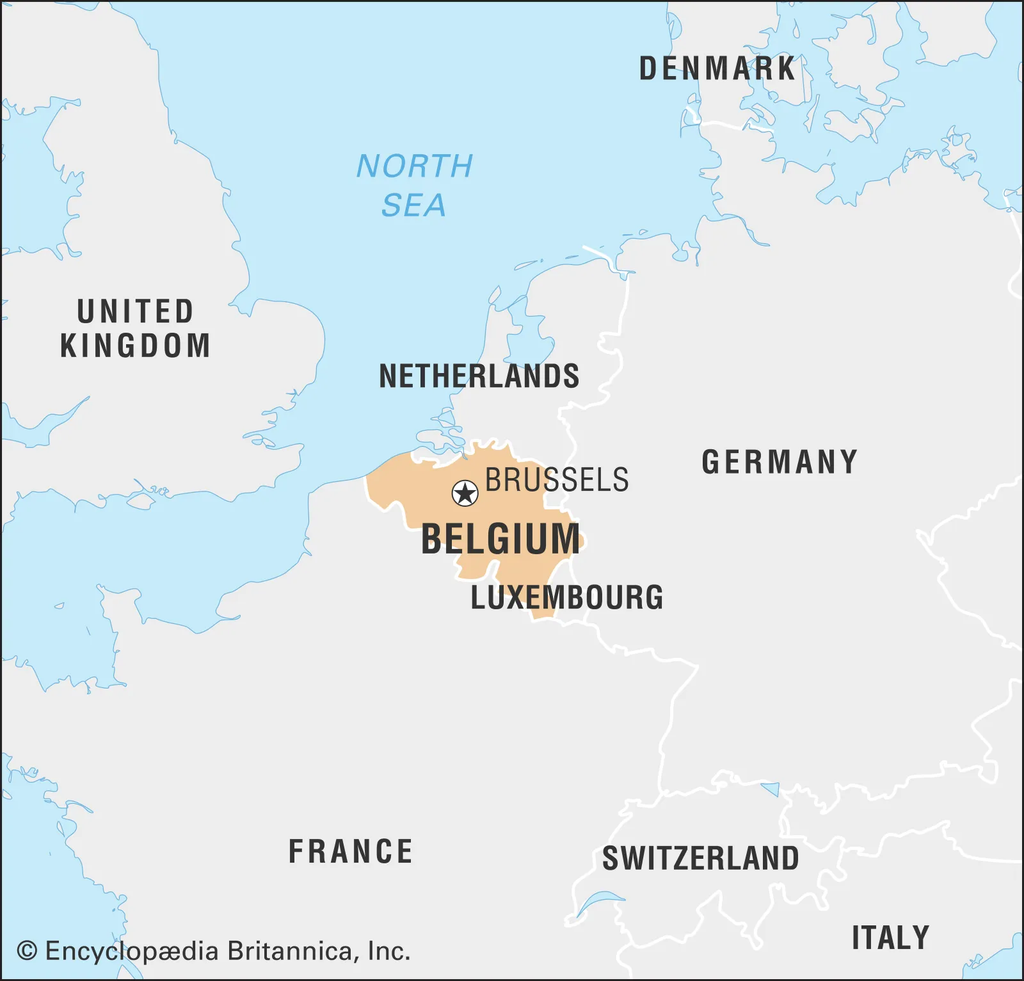
| UPSC Relevance: GS-2 International Relations: Bilateral relations Prelims: Location of Belgium; European Union Mains: India’s engagement with Belgium |
Major Outcomes:
1. Defence and Security:
- The two countries concluded:
- a Letter of Intent between their Defence Ministries, establishing a framework for staff talks, training, research and defence-industrial cooperation;
- an MoU between the Belgian Security and Defence Industry and the Society of Indian Defence Manufacturers; and
- an MoU between India’s CBI and Belgium’s Federal Police to combat cybercrime, transnational organised crime and track fugitives.
- Several business-level partnerships covering defence manufacturing (including the reported production of Belgian rocket systems in India) are also expected. These can support India’s objectives of defence indigenisation, co-production and integration into global supply chains.
- India will appoint a resident Defence Attaché in Brussels, while Belgium has appointed one in New Delhi. Cooperation will also include military education, high-level visits, emerging technologies and maritime security. A Belgian frigate is scheduled to visit India in late 2026.
- Belgium reportedly assured India that it would not extend defence technology or assistance to Pakistan. While politically significant, it is not a formal, legally binding restriction.
2. Trade and investment:
- India and Belgium set a target to double their current $13 billion bilateral trade over the next five years. The proposed collaboration between Belgium’s sovereign investment institution (SFPIM) and India’s NIIF could support an Indo-Belgian investment corridor.
- The two sides launched the India-Belgium Investment Fast-Track Mechanism, an investment-facilitation mechanism. It will help businesses resolve regulatory bottlenecks and facilitate two-way investments.
- The partnership will benefit from the India-EU Free Trade Agreement, whose negotiations were concluded in January 2026. However, early implementation and completion of the Investment Protection and Geographical Indications agreements remain important.
3. Counterterrorism and Global issues:
- Belgium condemned the 2025 Pahalgam terrorist attack and supported India’s campaign against cross-border terrorism. The two countries will explore a Joint Working Group on Counterterrorism, including cooperation through the UN sanctions regime and FATF.
- On Ukraine and West Asia, both sides favoured dialogue and diplomacy, adherence to international law and the UN Charter, and the protection of maritime routes and unimpeded commercial shipping.
Strategic Importance of Belgium for India:
- Gateway to the European Union: Brussels hosts the principal institutions of the European Union and NATO. Stronger relations with Belgium can therefore enhance India’s engagement with Europe on defence, technology, trade and global governance.
- Defence industrial capabilities: Belgium possesses specialised capabilities in ammunition, rockets, aerospace components, maritime systems and advanced manufacturing. Co-production in India can complement Make in India and Atmanirbhar Bharat, while giving Belgian firms access to India’s large defence market.
- Technology and green transition: Belgium is home to IMEC (Interuniversity MicroElectronics Centre), a globally important semiconductor research centre. The two countries intend to connect IMEC with Indian semiconductor firms, universities, C-DAC and the ChipIN Centre. The Cooperation can be extended to cover:
- green hydrogen and energy storage
- offshore wind and renewable energy
- pharmaceuticals and biotechnology
- critical-mineral refining and recycling
- artificial intelligence and start-ups; and
- space and astronomical research.
- Maritime and logistics cooperation: The Port of Antwerp-Bruges is one of Europe’s leading port and logistics hubs. Belgian expertise in ports, dredging and offshore infrastructure can support Sagarmala, port modernisation and India-Europe connectivity.
- Traditional economic links: Antwerp’s diamond industry has deep connections with Mumbai and Surat. The challenge is to preserve these traditional links while diversifying trade into technology-intensive and sustainable sectors.
Historical and Multilateral Dimensions:
- Belgium was among the first European countries to establish diplomatic relations with independent India in 1947. The two countries will mark the 80th anniversary of diplomatic relations in 2027.
- The leaders also honoured more than 9000 Indian soldiers who died in the Flanders Fields during the First World War, reflecting a significant but under-recognised historical connection.
- Belgium reiterated support for India’s permanent membership of a reformed UN Security Council. Both countries also agreed to support each other’s candidature for non-permanent UNSC membership: India for 2028-29 and Belgium for 2037-38.
Challenges:
- Defence announcements must translate into commercially viable technology transfer and production.
- Differences over intellectual property, export controls and localisation may constrain co-development.
- EU sustainability and regulatory requirements could affect Indian exports.
- Diamond-dominated trade needs greater diversification.
- India and Belgium may differ on the framing of the Ukraine conflict and relations with Russia.
- Reported private-sector agreements require clear timelines, procurement commitments and end-use safeguards.
The visit marks the transition of India-Belgium ties from a predominantly commercial relationship to a multi-dimensional strategic partnership. Defence co-production, semiconductors, green technologies, ports and law-enforcement cooperation offer substantial complementarities.
Effective implementation can also make Belgium an important pillar of India’s wider engagement with the European Union and its strategy of diversifying defence and technology partnerships.