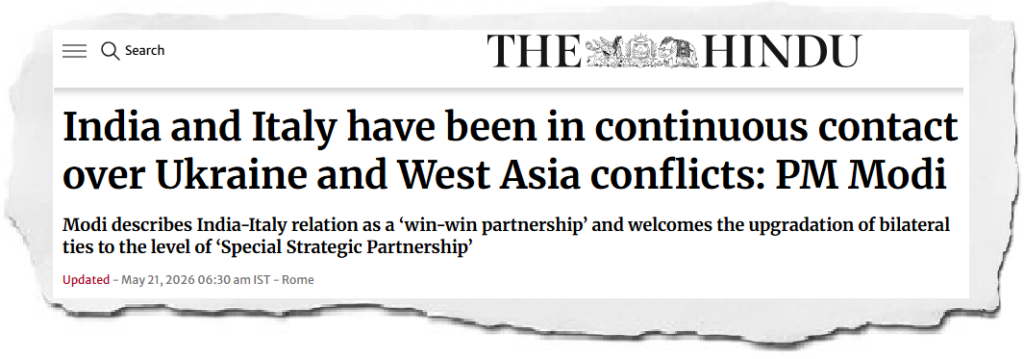
India and Italy have been in continuous contact over Ukraine and West Asia conflicts: PM Modi
Why in News?
Prime Minister Narendra Modi, during his visit to Italy, announced the elevation of India–Italy relations to a Special Strategic Partnership, while highlighting sustained engagement on the conflicts in Ukraine and West Asia. The two countries signed multiple agreements covering defence, critical minerals, agriculture, technology and cooperation in Africa.
UPSC Relevance
Prelims:
India–Italy relations, UNCLOS, FAO, India-EU FTA, Critical Minerals.
Mains:
GS II: Bilateral relations, International institutions;
GS III: Energy security, Critical minerals, Agriculture and technology cooperation.
Background
India and Italy have strengthened bilateral engagement in recent years through increasing trade, strategic cooperation and technology partnerships. The relationship has expanded from traditional economic interactions to broader cooperation in security, mobility, energy and global governance issues.
The recent elevation of ties reflects a growing convergence of interests amid changing geopolitical and economic realities.
Key Outcomes of the Visit
Upgradation to Special Strategic Partnership
India and Italy elevated bilateral relations to a Special Strategic Partnership, aimed at expanding cooperation across strategic sectors.
The partnership seeks to strengthen collaboration in trade, defence, technology, innovation, clean energy and mobility.
Defence cooperation
The two countries signed a Defence Industrial Road Map aimed at expanding cooperation in:
Defence manufacturing: Joint production and industrial partnerships.
Technology collaboration: Sharing technological capabilities and research cooperation.
Strategic security engagement: Enhanced institutional cooperation in defence-related sectors.
Cooperation in critical minerals
India and Italy signed an agreement on critical minerals cooperation.
Critical minerals are increasingly important because they serve as key inputs in renewable energy technologies, batteries, semiconductor industries and strategic sectors.
Agriculture and agricultural research
The two countries signed an agreement to strengthen cooperation between institutions and ministries dealing with:
Agricultural research: Collaborative research activities and knowledge exchange.
Technology transfer: Improving agricultural productivity through modern techniques.
Institutional linkages: Building stronger partnerships between research organisations.
Cooperation in Africa
The two sides agreed to undertake trilateral projects with African partners in sectors such as:
Digital Public Infrastructure (DPI): Promoting digital connectivity and governance systems.
Artificial Intelligence: Supporting technological capacity-building.
Healthcare and education: Expanding developmental cooperation.
Renewable energy and connectivity: Supporting sustainable development initiatives.
Geopolitical Dimensions
Position on Ukraine and West Asia conflicts
India reiterated its long-standing approach of resolving disputes through dialogue and diplomacy.
The emphasis reflects India’s broader foreign policy approach of maintaining strategic autonomy while engaging with multiple stakeholders.
Indo-Pacific cooperation
India and Italy expressed support for a free, open and inclusive Indo-Pacific region in accordance with international law and United Nations Convention on the Law of the Sea (UNCLOS).
Strait of Hormuz concerns
Both countries highlighted the importance of freedom of navigation and uninterrupted global trade flows through the Strait of Hormuz.
The Strait is strategically important because a large proportion of global oil and energy trade passes through it.
Significance for India
Strengthening economic ties: Italian companies operating in India can contribute to industrial growth, investments and technology transfer.
Supply chain diversification: Cooperation in critical minerals and manufacturing can help India reduce supply-chain vulnerabilities.
Energy and strategic security: Partnerships in clean energy and critical sectors strengthen India’s long-term energy security goals.
Enhanced global outreach: Joint projects in Africa expand India’s developmental engagement and Global South partnerships.
Challenges
Geopolitical uncertainties: Ongoing conflicts in Ukraine and West Asia continue to create instability in global markets and supply chains.
Trade barriers: Despite growing engagement, unresolved issues continue to affect progress in India–EU trade negotiations.
Implementation challenges: Converting strategic agreements into practical outcomes requires sustained institutional coordination.
Competition in strategic sectors: Competition among major powers in technology, defence and critical minerals may complicate cooperation frameworks.
Way Forward
Deepening technology partnerships: India and Italy should expand collaboration in emerging sectors such as semiconductors, AI and advanced manufacturing.
Strengthening defence industrial cooperation: Joint production and technology-sharing initiatives should be accelerated.
Expanding developmental partnerships: Trilateral cooperation in Africa can be broadened to additional sectors.
Fast-tracking economic agreements: Progress in India–EU trade negotiations can strengthen broader economic engagement.
Conclusion
The elevation of India–Italy relations to a Special Strategic Partnership reflects the growing strategic importance of bilateral ties in an evolving global environment. Stronger cooperation in technology, trade, security and development can strengthen India’s long-term economic and geopolitical interests.
Practice Questions
1. Consider the following statements regarding India–Italy relations:
- India and Italy recently elevated their ties to a Special Strategic Partnership.
- India and Italy signed agreements related to critical minerals cooperation.
- Italy is a member of the Quad grouping.
Which of the statements given above is/are correct?
(a) 1 and 2 only
(b) 2 and 3 only
(c) 1 and 3 only
(d) 1, 2 and 3
Correct Answer: (a)
Explanation: Italy is not a member of the Quad grouping.
2. With reference to UNCLOS, consider the following statements:
- UNCLOS deals with international maritime law.
- It regulates issues such as navigation rights and maritime zones.
- India is not a party to UNCLOS.
Which of the statements given above is/are correct?
(a) 1 only
(b) 1 and 2 only
(c) 2 and 3 only
(d) 1, 2 and 3
Correct Answer: (b)
Explanation: India is a signatory to UNCLOS.
Mains Questions
- Discuss how cooperation in critical minerals and technology can strengthen India’s strategic and economic interests.
- Examine the significance of India–Italy relations in the context of changing geopolitical and economic dynamics.