India Opens Fresh Anti-Dumping Probes on Chinese Imports
Why in News?
India has initiated a clutch of fresh anti-dumping investigations against imports from China and other countries, following separate complaints by domestic manufacturers, the Commerce Ministry confirmed on 25 June 2026. The probes are run by the Directorate General of Trade Remedies (DGTR), the body that investigates dumping and recommends protective duties.
Four applications cover thermal paper, Biaxially Oriented Polyamide (BOPA) film, certain antioxidants, and a sunset review of decor paper, with a parallel probe into Cold Rolled Grain Oriented (CRGO) electrical steel from China, Japan, Korea and Russia. The wave lands as the India-China trade deficit hit an all-time high, making trade remedies a live exam theme on WTO law, MSME protection and Atmanirbhar Bharat.
- DGTR initiated anti-dumping probes on three products from China: thermal paper, BOPA film and certain antioxidants (other countries involved: Korea, Singapore, U.S., Thailand).
- Applicants include Vinati Organics (antioxidants), JPFL Films (BOPA film), the Indian Association of Thermal Paper Manufacturers (thermal paper) and ITC Ltd (sunset review of decor-paper duty).
- A separate probe targets CRGO electrical steel and amorphous metal from China, Japan, Korea, Russia, on a complaint by JSW JFE Electrical Steel Nashik Pvt Ltd; the inputs are core materials for transformers.
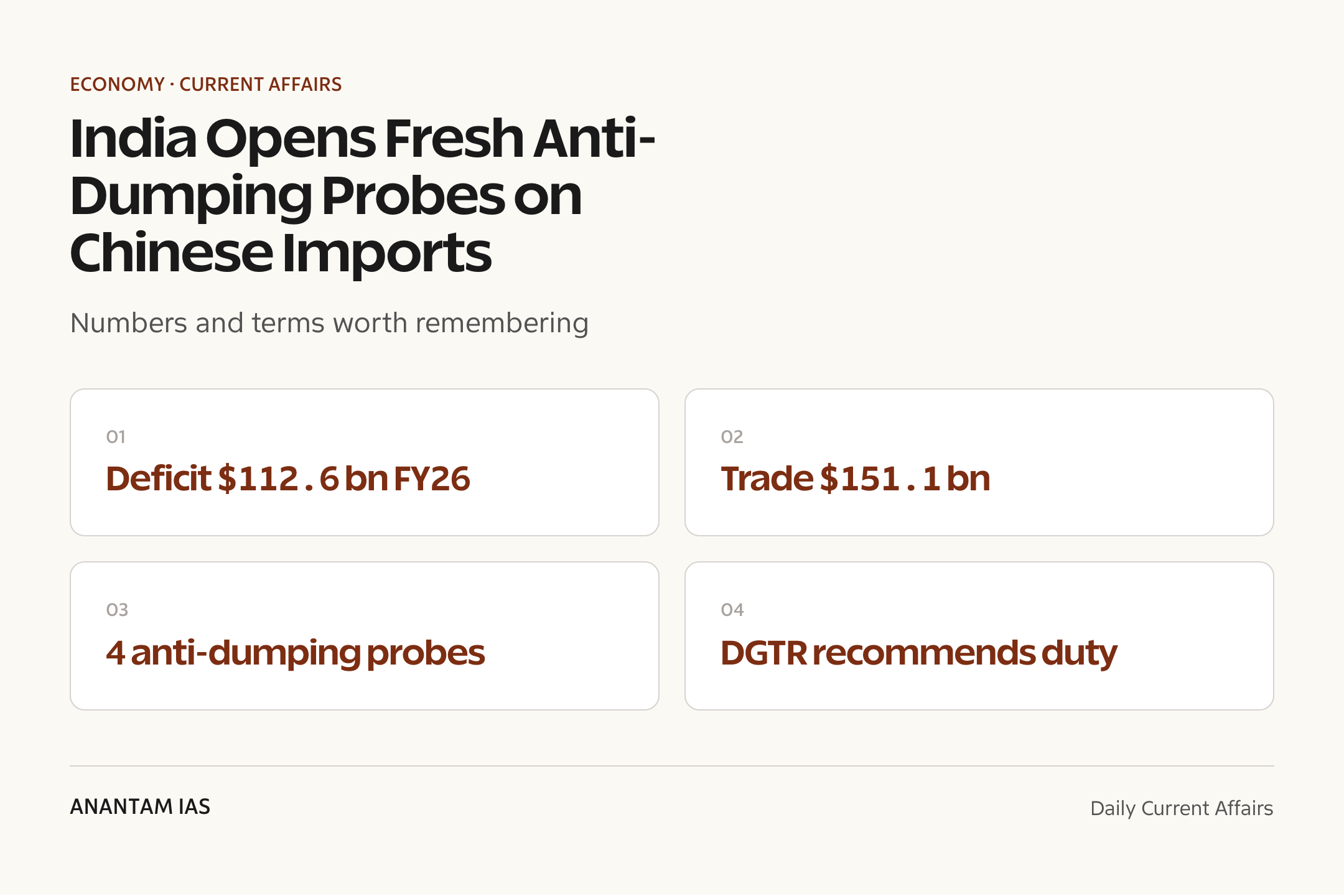
- China is India’s largest trading partner in FY26 with bilateral trade of $151.1 billion; the trade deficit swelled to a record $112.6 billion (vs $99.2 billion in FY25).
- DGTR recommends duties; the Ministry of Finance takes the final decision to impose them.
The development matters in the context of:
- Anti-dumping action is permitted under the WTO framework (Article VI of GATT 1994 and the Anti-Dumping Agreement) and targets goods exported below their normal value.
- For China, treated as a non-market economy, normal value is built from Indian cost of production plus reasonable profit rather than Chinese domestic prices.
- The probes reflect concern over Chinese industrial overcapacity and the risk of cheap goods being diverted to India amid U.S.-China trade tensions.
UPSC Relevance
Prelims Relevance
- DGTR functions under the Department of Commerce, Ministry of Commerce and Industry (not the Finance Ministry).
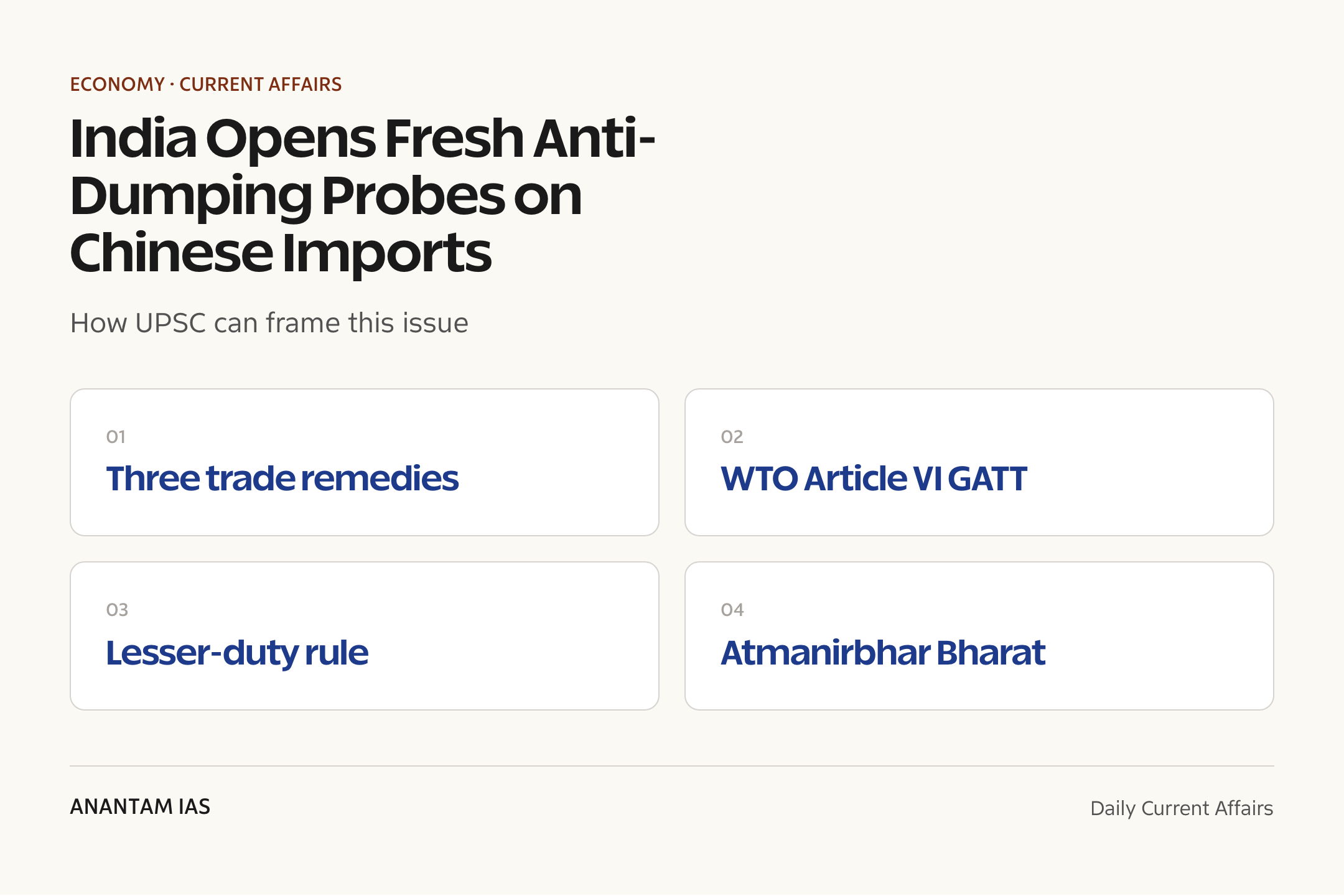
- Three trade remedies: anti-dumping duty, countervailing (anti-subsidy) duty, and safeguard duty.
- Anti-dumping duty counters exporting below normal value; safeguard duty counters import surges and is country-neutral.
- WTO basis: Article VI of GATT 1994 + Anti-Dumping Agreement; subsidies covered by the Agreement on Subsidies and Countervailing Measures (ASCM); surges by the Agreement on Safeguards.
- Dumping margin = normal value minus export price; injury to domestic industry must be established.
- Lesser-duty rule: duty is capped at the level needed to remove injury, even if the dumping margin is higher.
- Sunset review reassesses whether an existing anti-dumping duty should continue beyond its term.
- DGTR recommends, the Ministry of Finance imposes the duty.
- China is a non-market economy for India’s dumping calculations; normal value uses surrogate cost data.
- India-China bilateral trade in FY26 reached $151.1 billion, with a record trade deficit of $112.6 billion.
Mains Relevance
GS Paper 3
- Evaluate trade-remedy instruments (anti-dumping, countervailing, safeguard) as tools to protect domestic industry and MSMEs without breaching WTO commitments.
- Link rising anti-dumping action to Atmanirbhar Bharat, import dependence in chemicals and electrical steel, and value-chain self-reliance.
GS Paper 2
- Assess the India-China economic relationship: a record $112.6 billion deficit, overcapacity-driven dumping, and the policy space WTO rules leave for India.
Essay
- Free trade versus fair trade: protecting domestic industry in an age of overcapacity.
- Self-reliance and globalisation need not be opposites if calibrated by rules-based remedies.
Background and Context
What DGTR Does and the Three Trade Remedies
DGTR is India’s single investigating authority for unfair-trade and import-surge cases.
- DGTR (Directorate General of Trade Remedies) sits in the Department of Commerce under the Ministry of Commerce and Industry; it investigates and recommends, while the Ministry of Finance imposes duties.
- Anti-dumping duty counters dumping, that is, exporting a product below its normal value in the home market.
- Countervailing (anti-subsidy) duty neutralises export subsidies granted by the exporting government.
- Safeguard duty responds to a sudden import surge and is country-neutral, applying to all sources of a product.
- All three require evidence of injury (or serious injury, for safeguards) to the domestic industry.
How a Dumping Case Is Built
Dumping is established by comparing prices, not merely by low cost.
- Normal value is the comparable price of the good in the exporter’s home market (or a constructed cost-plus-profit value).
- Export price is the price at which the good is sold to India.
- Dumping margin = normal value minus export price, usually expressed as a percentage.
- For a non-market economy like China, surrogate or constructed costs replace unreliable domestic prices.
- DGTR must also show a causal link between dumped imports and material injury to domestic producers.
WTO Discipline Behind the Duties
Trade remedies are exceptions allowed within a rules-based order.
- Anti-dumping action is grounded in Article VI of GATT 1994 and the WTO Anti-Dumping Agreement.
- Subsidies and countervailing measures fall under the Agreement on Subsidies and Countervailing Measures (ASCM).
- Import surges are governed by the Agreement on Safeguards.
- India applies the lesser-duty rule: the duty is held to the minimum needed to remove injury.
- A sunset review tests whether dumping and injury would recur if an existing duty lapsed.
- All parties in the current probes, including China, are WTO members, so the action proceeds within the multilateral regime.
Products in the News and Why They Matter
The probes span packaging chemicals, paper and a strategic steel input.
- Thermal paper (from U.S., China, South Korea), BOPA film used in packaging (China, Thailand) and certain antioxidants for the polymer industry (China, Korea, Singapore).
- ITC Ltd sought a sunset review of the existing anti-dumping duty on decor paper from China.
- CRGO electrical steel and amorphous metal (China, Japan, Korea, Russia) are core materials for power and distribution transformers, a strategic energy-infrastructure input.
- Domestic applicants allege the dumped imports cause material injury to local manufacturing and seek protective duties.
The India-China Trade Anxiety
The remedies wave coincides with a record bilateral imbalance.
- China overtook the U.S. as India’s largest trading partner in 2025-26, with bilateral trade of $151.1 billion.
- India’s imports from China rose 16% to $131.63 billion; exports rose 36.66% to $19.47 billion.
- The trade deficit hit an all-time high of $112.6 billion in FY26, up from $99.2 billion in FY25 (figures attributed to The Hindu’s report of the Commerce Ministry data).
- Overcapacity in Chinese industry and U.S.-China tensions raise the risk of cheap-import diversion into India.
- Trade remedies dovetail with Atmanirbhar Bharat and protection of MSMEs in chemicals, paper and steel.
Way Forward
Strengthen the Trade-Remedy Machinery
- Resource DGTR for faster, evidence-rich investigations so injury to domestic industry is addressed in time.
- Apply the lesser-duty rule judiciously to balance producer protection with downstream-user and consumer costs.
Address Structural Import Dependence
- Scale domestic capacity in strategic inputs like CRGO electrical steel through PLI-type support and technology partnerships.
- Diversify import sources and deepen quality controls to reduce reliance on dumped goods.
Stay Within WTO Discipline
- Ensure duties are WTO-consistent to withstand challenge at the Dispute Settlement Body.
- Pair remedies with export competitiveness so protection does not become permanent insulation.
Conclusion
The fresh round of probes shows trade remedies working as intended: a rules-based, evidence-led response to dumping rather than blunt protectionism. With the China trade deficit at a record $112.6 billion, instruments like anti-dumping duties let India shield manufacturing and MSMEs while remaining inside the WTO framework.
The deeper test is structural. Duties buy time, but durable balance needs competitive domestic capacity in chemicals, paper and strategic inputs such as electrical steel. Trade remedies and Atmanirbhar Bharat succeed together only when protection is calibrated, time-bound and paired with genuine industrial upgrading.
UPSC Practice Questions
Prelims MCQ 1
With reference to trade remedies available to India, consider the following statements:
- Anti-dumping duties are recommended by the Directorate General of Trade Remedies but imposed by the Ministry of Finance.
- A safeguard duty is applied against a specific exporting country found to be dumping goods.
- Anti-dumping action by India is permitted under the World Trade Organisation framework.
How many of the above statements are correct?
(a) Only one (b) Only two (c) All three (d) None
Answer: (b) Only two
Explanation:
Statements 1 and 3 are correct. Statement 2 is wrong: a safeguard duty counters an import surge and is country-neutral, not aimed at a single dumping exporter.
Prelims MCQ 2
Which one of the following best distinguishes an anti-dumping duty from a safeguard duty?
(a) An anti-dumping duty targets export subsidies, while a safeguard duty targets dumping. (b) An anti-dumping duty addresses pricing below normal value, while a safeguard duty addresses an import surge and is country-neutral. (c) A safeguard duty is recommended by the RBI, while an anti-dumping duty is recommended by DGTR. (d) An anti-dumping duty is always permanent, while a safeguard duty is reviewed every year.
Answer: (b) An anti-dumping duty addresses pricing below normal value, while a safeguard duty addresses an import surge and is country-neutral.
Explanation:
Anti-dumping duty counters exports below normal value from specific countries; safeguard duty responds to import surges and applies regardless of source.
UPSC Mains Questions
- Trade remedies are exceptions within a rules-based trading order, not departures from it. In light of India’s recent anti-dumping investigations, examine how instruments such as anti-dumping, countervailing and safeguard duties protect domestic industry while remaining WTO-consistent.
- India’s trade deficit with China reached a record high in 2025-26. Discuss the structural drivers of this imbalance and assess whether trade-remedy measures alone can address it, or whether domestic capacity building is indispensable.
Sources: The Hindu and Business Standard.
Frequently Asked Questions
What is dumping in international trade?
Dumping occurs when an exporter sells a product to another country below its normal value, that is, below the comparable price in its own home market or below its cost of production. If these dumped imports cause material injury to the importing country’s domestic industry, that country may impose an anti-dumping duty to restore a level playing field.
Who imposes anti-dumping duties in India?
The Directorate General of Trade Remedies (DGTR), under the Department of Commerce, investigates dumping and recommends a duty. The final decision to impose the duty rests with the Ministry of Finance. So investigation and imposition lie with two different ministries, a frequently tested distinction.
How does an anti-dumping duty differ from a safeguard duty?
An anti-dumping duty targets goods exported below normal value and is applied against specific countries found to be dumping. A safeguard duty responds to a sudden surge in imports of any product and is country-neutral, applying to all sources. Anti-dumping addresses unfair pricing; safeguards address volume shocks.
What is the lesser-duty rule?
Under the lesser-duty rule, the anti-dumping duty is capped at the level needed to remove the injury to domestic industry, even if the calculated dumping margin is higher. India follows this rule, which keeps duties proportionate and limits the cost burden on downstream users and consumers.
Why is China treated as a non-market economy in these probes?
For dumping calculations India treats China as a non-market economy because state influence makes its domestic prices unreliable as a benchmark. Normal value is then built from India’s cost of production plus a reasonable profit, or from surrogate data, rather than from Chinese domestic prices.
How large is India’s trade deficit with China?
Per Commerce Ministry data reported by The Hindu, India’s trade deficit with China reached an all-time high of about $112.6 billion in 2025-26, up from $99.2 billion in 2024-25. Bilateral trade touched $151.1 billion, making China India’s largest trading partner that year.