India-Argentina Trade: Lithium, Pharma and MERCOSUR Pathways
Why in News?
India and Argentina held their fourth Joint Trade Committee meeting in Buenos Aires on 24 August 2026, advancing four distinct trade and investment tracks.
- KABIL completed Phase II drilling in Catamarca, while possible engagement in Argentina’s Salta and Jujuy provinces remains under exploration.
- Technical discussions advanced on SPS measures for Indian onions, dairy products, grapes, potatoes, bananas and pulses, but final market access wasn’t announced.
- Argentina committed to work towards moving India from Annex II to Annex I in its pharmaceutical regulatory framework, not to grant automatic product approvals.
- Both sides reported progress on terms for expanding the India-MERCOSUR PTA and on digital certificates of origin, which can reduce documentary friction.
- The meeting links India’s critical-mineral security with practical barriers faced by agricultural and pharmaceutical exporters in the Argentine market.
- It also shows that economic diplomacy works through separate instruments: exploration contracts, regulatory cooperation, SPS protocols and preferential tariff rules.
UPSC Relevance
Prelims Relevance
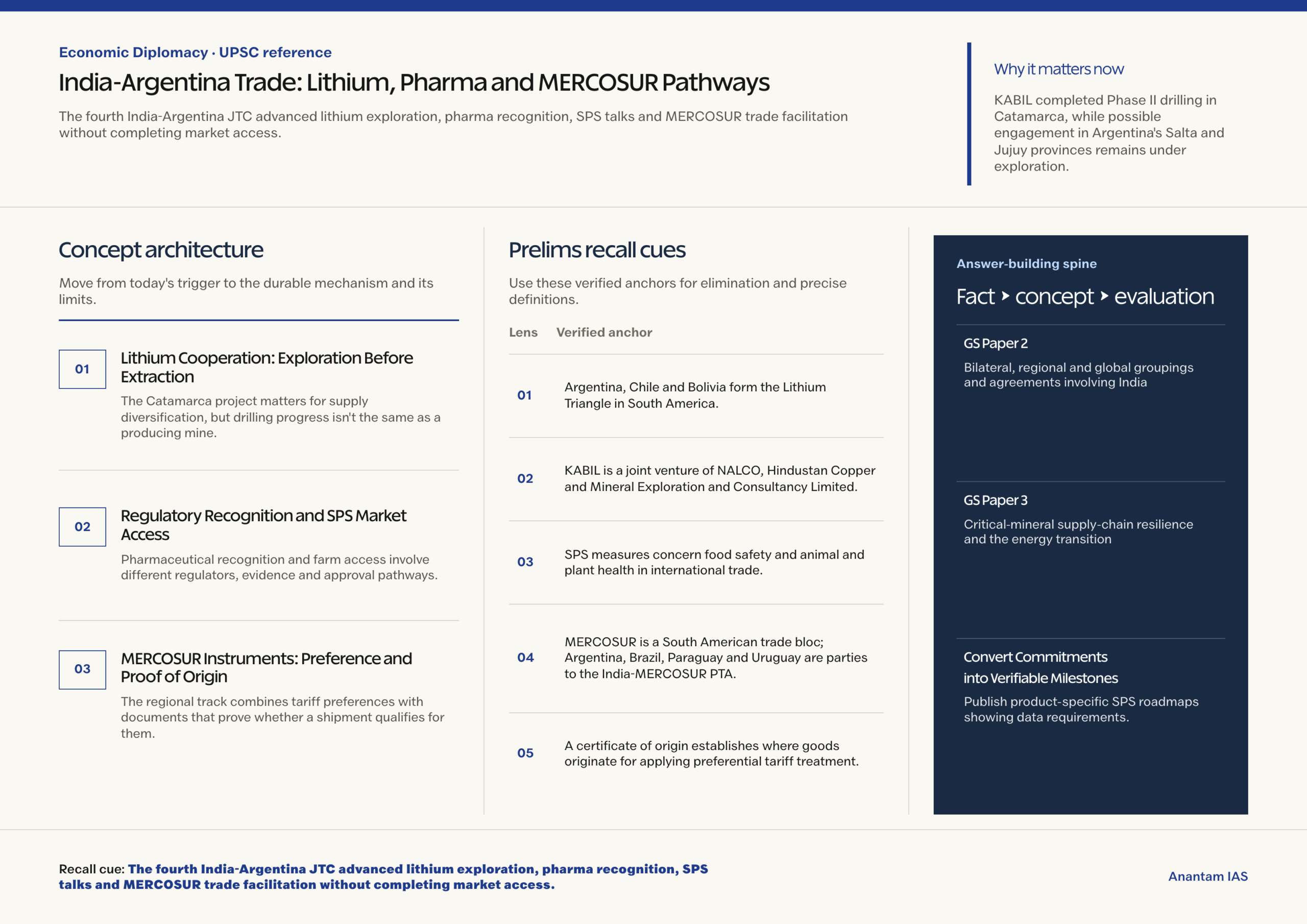
- Argentina, Chile and Bolivia form the Lithium Triangle in South America.
- KABIL is a joint venture of NALCO, Hindustan Copper and Mineral Exploration and Consultancy Limited.
- SPS measures concern food safety and animal and plant health in international trade.
- MERCOSUR is a South American trade bloc; Argentina, Brazil, Paraguay and Uruguay are parties to the India-MERCOSUR PTA.
- A certificate of origin establishes where goods originate for applying preferential tariff treatment.
Mains Relevance
GS Paper 2
- Bilateral, regional and global groupings and agreements involving India
- India’s relations with Latin America through issue-based economic diplomacy
GS Paper 3
- Critical-mineral supply-chain resilience and the energy transition
- Export competitiveness shaped by non-tariff and regulatory barriers
Essay
- Strategic partnerships deepen when diplomatic intent is converted into workable regulatory and commercial pathways.
Background and Context
Lithium Cooperation: Exploration Before Extraction
The Catamarca project matters for supply diversification, but drilling progress isn’t the same as a producing mine. It is a staged risk-reduction process.
- In 2024, KABIL secured exploration and exclusivity rights over five lithium-brine blocks through Catamarca’s state enterprise, CAMYEN. Exploitation rights depend on discovery, assessment and investment decisions, not drilling progress alone.
- Phase II drilling produces geological evidence on a deposit’s continuity and quality. Drill cores and brine samples help map grade, depth and distribution before commercial viability is assessed.
- A project must still pass resource assessment, feasibility, financing, environmental and provincial approvals before commercial extraction. Each stage can change project economics or halt development despite exploration success.
- Overseas exploration can diversify India’s future access to battery minerals, but resilient supply also requires processing capacity, logistics and responsible sourcing. Upstream rights don’t supply refined battery material automatically.
- Discussions concerning Salta and Jujuy are exploratory. The JTC release announced no signed mining projects there, and neither province is covered by the reported Catamarca drilling milestone.
Regulatory Recognition and SPS Market Access
Pharmaceutical recognition and farm access involve different regulators, evidence and approval pathways. Lower friction doesn’t mean removing safety checks.
- Argentina’s promised work on moving India from Annex II to Annex I could reduce regulatory barriers, but the upgrade remains incomplete. Its effect depends on final Argentine rules.
- The 2019 memorandum links Argentina’s ANMAT with India’s CDSCO. Regulator cooperation can improve information exchange and regulatory understanding, but it doesn’t automatically create mutual recognition.
- An Annex-status change wouldn’t itself register every Indian medicine. Companies would still need to meet applicable quality, safety and efficacy requirements through product-specific, evidence-based applications.
- SPS negotiations address food-safety, pest and disease risks through standards, inspection, certification, treatment and quarantine. WTO rules require a scientific basis, necessity and non-discrimination.
- Talks cover onions, dairy products, grapes, potatoes, bananas and pulses. Argentina must still accept product-specific protocols before entry; technical discussion isn’t market authorization.
MERCOSUR Instruments: Preference and Proof of Origin
The regional track combines tariff preferences with documents that prove whether a shipment qualifies for them. Both functions must work for exporters to benefit.
- The India-MERCOSUR Preferential Trade Agreement entered into force in 2009 and grants negotiated tariff preferences on a limited goods schedule, not all bilateral trade. A preference needn’t mean zero duty.
- It is a PTA, not a comprehensive free trade agreement. Wider coverage or deeper preference margins require concluded negotiations and implementation; product schedules determine the commercial value for exporters in practice.
- A certificate of origin verifies that goods meet agreed origin rules and qualify for a preference. It connects eligibility under the PTA with treatment at customs.
- Digital certificates can shorten processing, improve traceability and reduce paper handling. They don’t alter tariffs or replace rules of origin; customs-system compatibility still matters for use.
- Both sides advanced Terms of Reference and set a one-year negotiating objective. The terms organize future talks; they aren’t final concessions or a concluded PTA expansion.
Way Forward
Convert Commitments into Verifiable Milestones
- Publish product-specific SPS roadmaps showing data requirements, competent authorities and pending technical steps for each agricultural export.
- Define the legal steps and timeline for pharmaceutical Annex upgrading while preserving ANMAT’s regulatory safeguards and predictable applications for Indian firms.
- Move lithium blocks through resource assessment and environmental scrutiny before treating exploration progress as supply security.
- Complete MERCOSUR negotiations and make digital origin verification interoperable so tariff preferences become easier for legitimate exporters to claim.
Conclusion
- The JTC’s value lies in four concrete pathways: lithium exploration, pharmaceutical recognition, SPS protocols and MERCOSUR trade facilitation. None is completed market access; formal implementation is the next evidence test.
- In a Mains answer, use the case to show how India-Latin America relations combine resource security with regulatory and regional trade diplomacy, while separating announced commitments from delivered outcomes.
UPSC Practice Questions
Prelims MCQ 1
With reference to KABIL’s engagement in Argentina, consider the following statements:
- KABIL is a joint venture involving NALCO, Hindustan Copper and Mineral Exploration and Consultancy Limited.
- Its Catamarca engagement covers lithium-brine exploration blocks.
- Completion of Phase II drilling means commercial lithium production has begun.
How many of the above statements are correct?
(a) Only one (b) Only two (c) All three (d) None
Answer: (b) Only two
Explanation:
Statements 1 and 2 are correct. Phase II drilling is an exploration milestone; it doesn’t establish that commercial production has started.
Prelims MCQ 2
Which one of the following best describes sanitary and phytosanitary measures in international trade?
(a) Rules dealing with food safety and animal and plant health (b) Tariff preferences granted under a trade agreement (c) Exchange-rate controls applied to import payments (d) Patent rules governing pharmaceutical inventions
Answer: (a) Rules dealing with food safety and animal and plant health
Explanation:
The WTO SPS Agreement covers food-safety measures and measures protecting animal or plant life and health from specified risks.
UPSC Mains Questions
- India’s economic engagement with Latin America increasingly connects critical-mineral security with market-access diplomacy. Discuss with reference to India-Argentina relations.
- Non-tariff measures can matter as much as tariffs in determining actual export access. Examine with reference to SPS protocols, pharmaceutical regulation and certificates of origin.
Sources: PIB, Ministry of Commerce and Industry and Ministry of Foreign Affairs, Argentina.
Frequently Asked Questions
What was decided at the fourth India-Argentina Joint Trade Committee meeting?
The meeting advanced lithium exploration, product-wise SPS talks, work on India’s pharmaceutical regulatory status and MERCOSUR trade-facilitation instruments. It didn’t announce completed access across these tracks.
Has KABIL started commercial lithium mining in Argentina?
No. KABIL completed Phase II drilling in Catamarca. Drilling supports resource assessment, while commercial extraction still depends on feasibility, approvals, financing, infrastructure and further project decisions.
What does Argentina’s proposed pharmaceutical Annex upgrade mean?
Argentina committed to work towards moving India from Annex II to Annex I in its regulatory framework. The change could reduce barriers, but it isn’t complete or automatic product approval.
Why are SPS discussions necessary for agricultural exports?
Importing countries use SPS rules to manage food-safety, pest and disease risks. Product-specific evidence, inspection, treatment, certification or quarantine conditions may be settled before access is granted.
How do digital certificates of origin support India-MERCOSUR trade?
They provide electronic proof that goods meet agreed origin rules for tariff preferences. Digital processing can reduce paperwork and improve traceability without changing tariff concessions by itself.