India-Australia CECA: Bridging the Trade and Trust Barrier
Why in News?
There is growing anticipation that India and Australia may conclude a Comprehensive Economic Cooperation Agreement (CECA), expanding upon the existing India-Australia Economic Cooperation and Trade Agreement (ECTA) signed in 2022.
| UPSC Relevance: GS-2 International Relations: Bilateral Relations; GS-3 Economy: International Trade, Agriculture Prelims: CECA, ECTA, Free Trade Agreement (FTA), Quad, Phytosanitary Standards Mains: India-Australia bilateral relations and trade partnership. |
India-Australia Economic Relations:
- Merchandise Trade: Bilateral merchandise trade increased from US$ 12.2 billion in FY 2020-21 to approximately US$ 24.1 billion in FY 2024-25 after the implementation of ECTA. Australia accounts for nearly two-thirds of bilateral merchandise exports.
- Services Trade: Bilateral services trade has crossed US$ 10 billion. Australia’s higher education sector constitutes nearly 60% of bilateral services trade.
- Investment Relations: The investment relationship presents a contrasting picture:
- Indian investment in Australia ~US$ 32 billion
- Australian FDI in India ~US$ 18 billion.
About the Economic Cooperation and Trade Agreement (ECTA):
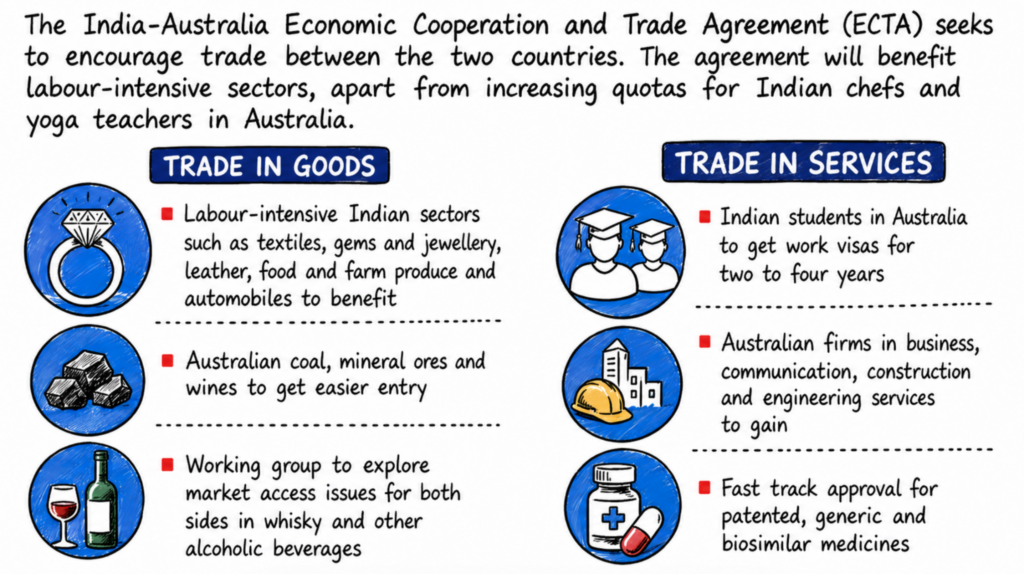
- ECTA is a bilateral trade agreement signed between India and Australia in 2022, and came into force the same year.
- Aim: To enhance the economic ties between India and Australia.
Key aspects of ETCA:
- Tariff Reduction: Australia eliminated 96% tariffs on Indian goods. India offered preferential access to Australia on over 70% of its tariff lines, including primarily raw materials and intermediaries such as coal, mineral ores and wines.
- Enhanced professional mobility: Indian IT and healthcare professionals gain improved access to the Australian market.
- Rule of origin: ECTA includes a rules of origin clause to avoid benefits to any third party.
Comprehensive Economic Cooperation Agreement (CECA):
- A Comprehensive Economic Cooperation Agreement (CECA) is a broader form of Free Trade Agreement that covers:
- Trade in goods and services
- Investments
- Intellectual Property Rights (IPR)
- Digital trade
- Regulatory cooperation
- Mobility of professionals
- The proposed India-Australia CECA seeks to deepen economic integration beyond the tariff reductions already provided under ECTA.
Why is CECA Important for India?
- Diversification of Trade Partnerships: The global trading environment has become increasingly uncertain due to Geopolitical conflicts, Supply-chain disruptions, Protectionist policies, and tariff wars among major economies. A comprehensive trade agreement with Australia can help India reduce dependence on a limited set of export markets.
- Strengthening Indo-Pacific Partnerships: Australia is a key partner in the Quad grouping, Indo-Pacific economic architecture, and critical minerals supply chains. Enhanced economic cooperation complements the growing strategic partnership between the two countries.
- Access to Critical Resources: Australia possesses vast reserves of Lithium, Cobalt, Rare Earth elements and Copper. These minerals are crucial for electric vehicles (EVs), Renewable energy systems, and semiconductor manufacturing.
- Greater Market Access: CECA can facilitate increased exports of pharmaceuticals, IT and digital services, Textiles and apparel, Engineering goods and Agricultural products.
The Agriculture Question: The Biggest Hurdle
Australia’s 2025 Economic Engagement Roadmap identifies four major cooperation superhighways: Clean Energy, Education, Tourism and Agribusiness. Agriculture remains the most sensitive issue in CECA negotiations.
Agriculture is the most structurally and politically sensitive dimension of the India-Australia trade relationship. The asymmetry between the two agricultural economies is stark and fundamental.
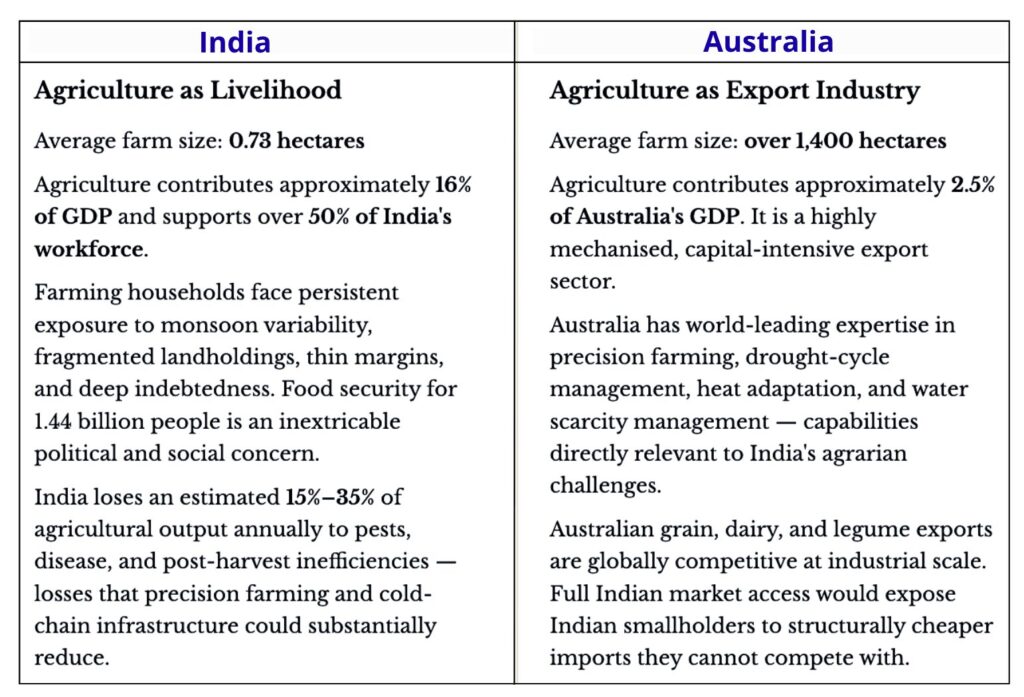
Protecting India’s market from cheap Australian wheat, dairy, and sugar is not a mere negotiating stance; it is a political and social necessity, given the direct livelihood implications for hundreds of millions of farming households.
India has traditionally protected Dairy products, Wheat, Rice, Sugar and Chickpeas. These sectors were largely excluded from ECTA and remain politically sensitive.
Transforming Agriculture from a Challenge into an Opportunity:
Rather than focusing solely on tariff concessions, both countries can cooperate through institutional and technological partnerships.
- Biosecurity and Phytosanitary Cooperation: Both countries can expand cooperation on Digital certification systems, Quarantine protocols, Food safety standards and Mutual recognition arrangements. This would improve access for Indian agricultural exports while ensuring safety standards.
- Agricultural Technology Collaboration: Australia can contribute expertise in Precision farming, Water management, Climate-resilient agriculture, irrigation technologies and Farm mechanisation. Australia’s experience in managing droughts and water scarcity can be particularly useful for India.
- Investment in Agricultural Infrastructure: India loses an estimated 15-35% of agricultural output due to Pest attacks and post-harvest losses, Inadequate storage and Poor logistics. Australian investment can help develop Cold-chain infrastructure, Warehousing, Food processing facilities and Agricultural logistics networks.
- Smart Agriculture Partnerships: The recently launched India-Australia Smart Farm Network Initiative aims to promote Joint research, Climate-smart agriculture, Technology transfer and University-industry collaborations.
India and Australia should move beyond a narrow focus on tariff reductions and pursue a partnership based on complementarity rather than complete symmetry.
A balanced CECA can protect India’s agricultural interests while expanding opportunities in trade, services, education, clean energy, and critical minerals, which can significantly strengthen the bilateral relationship between the nations.