India’s Central Asia Visit: Uzbekistan Agenda and SCO Priorities
Why in News?
The Prime Minister began a 29 August-1 September visit to Uzbekistan and Kyrgyzstan for bilateral talks in Tashkent and the Shanghai Cooperation Organisation Summit in Bishkek.
- The 29-30 August Uzbekistan State Visit is scheduled to include delegation-level talks reviewing the strategic partnership and setting its next agenda.
- The stated bilateral agenda covers trade and investment, defence, digital connectivity, energy, education and people-to-people relations.
- The 31 August-1 September SCO Summit is expected to feature India’s priorities of Security, Connectivity and Opportunity.
- The official releases describe planned talks and expected meetings; they do not establish any concluded agreement, declaration or implementation outcome.
- The itinerary links a focused bilateral partnership with India’s wider Central Asia engagement through a regional organisation.
- For India, the agenda brings together security concerns, trade access, digital links and cultural relations rather than treating them as separate policy tracks.
- The visit also tests how India can support regional connectivity without compromising sovereignty, territorial integrity or strategic autonomy.
UPSC Relevance
Prelims Relevance
- The Shanghai Cooperation Organisation is the regional forum associated with the Bishkek summit in this development.
- India has been a full SCO member since 2017.
- Tashkent is the capital of Uzbekistan; Bishkek is the capital of the Kyrgyz Republic.
- The visit separates a bilateral State Visit in Uzbekistan from participation in a multilateral summit in Kyrgyzstan.
- India’s stated SCO framing is Security, Connectivity and Opportunity.
Mains Relevance
GS Paper 2
- India’s bilateral and multilateral engagement with Central Asia
- Role and limits of the SCO in regional cooperation
- Strategic autonomy while working with diverse regional powers
GS Paper 3
- Regional responses to terrorism, separatism and extremism
- Connectivity and trade access as components of economic security
Essay
- Connectivity creates strategic value only when it combines physical access, political trust and respect for sovereignty.
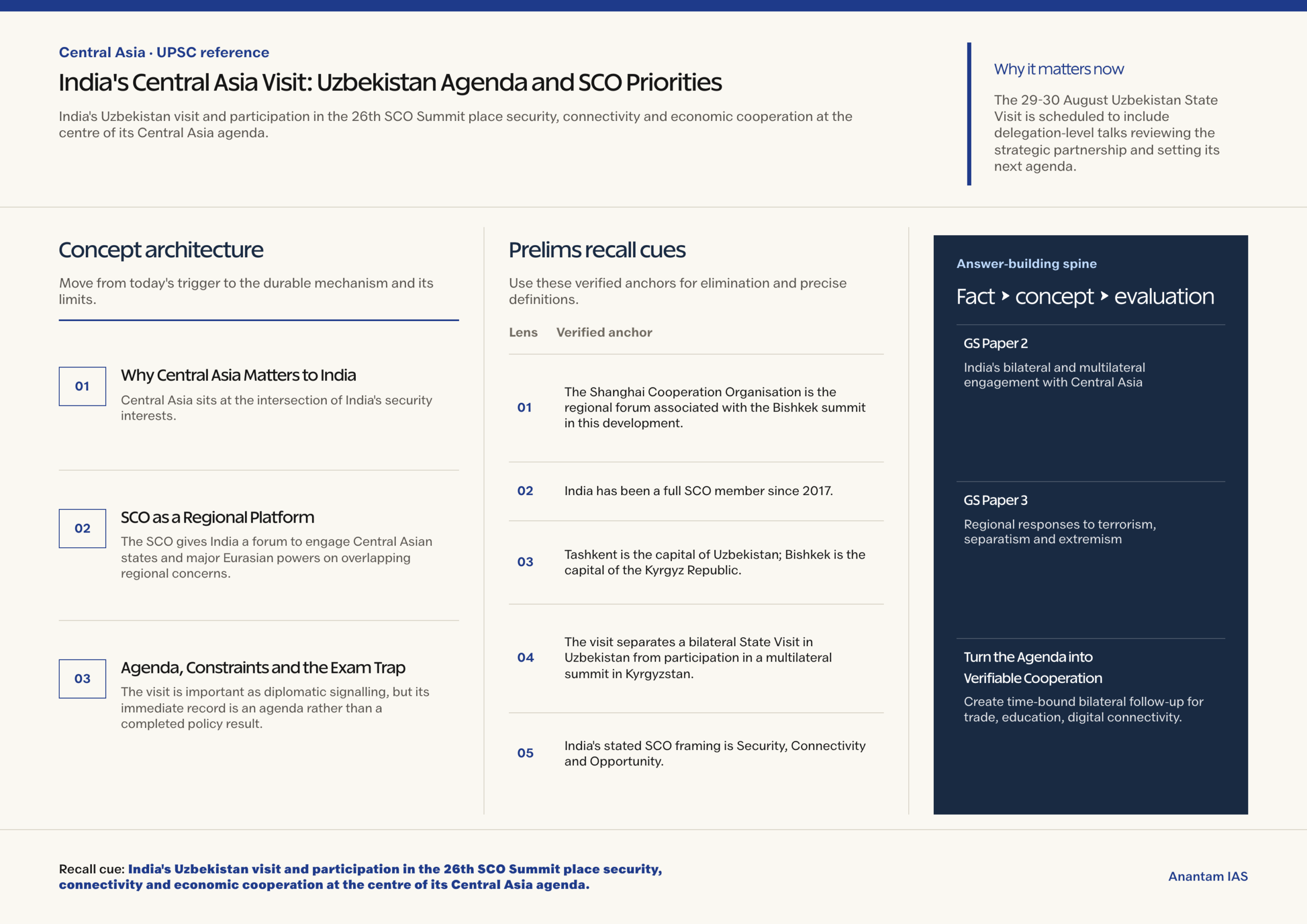
Background and Context
Why Central Asia Matters to India
Central Asia sits at the intersection of India’s security interests, continental trade ambitions and long civilisational engagement.
- The region’s location connects South Asia with Eurasia, making access and transit central to trade, diplomacy, crisis response and route diversification during disruption.
- India has no direct land access to Central Asia, so practical connectivity depends on reliable multimodal routes, cooperation with transit partners and predictable border procedures for commercial users.
- Uzbekistan matters because of its population, central location and ability to support regional cooperation in commerce, education, digital systems and security across the wider region.
- The agenda’s inclusion of energy and defence shows that the partnership is broader than trade and includes resilience, capability and long-term strategic trust.
- Cultural institutions and educational links can strengthen public familiarity, but they should complement measurable economic and institutional cooperation rather than substitute for it.
SCO as a Regional Platform
The SCO gives India a forum to engage Central Asian states and major Eurasian powers on overlapping regional concerns.
- India became a full SCO member in 2017, giving it a seat in discussions that extend beyond purely bilateral relationships.
- The 26th summit marks 25 years of the organisation, making institutional direction and regional relevance part of the political context.
- India’s Security priority addresses terrorism, separatism and extremism, which the departure statement identifies as continuing threats to regional peace and stability.
- The Connectivity priority concerns movement of goods, people and digital services, but credible projects must remain transparent, economically viable and respectful of sovereignty.
- The Opportunity priority can translate dialogue into trade, investment, education, technology and energy partnerships, provided follow-up mechanisms assign responsibilities and convert announced intent into implementable projects.
Agenda, Constraints and the Exam Trap
The visit is important as diplomatic signalling, but its immediate record is an agenda rather than a completed policy result.
- The PIB releases say leaders would review cooperation and set the road ahead; they do not report a signed agreement, adopted declaration or delivered project.
- SCO participation and the Uzbekistan State Visit serve different purposes: one is multilateral agenda-setting, while the other deepens a specific strategic partnership.
- India must pursue continental access while managing route constraints, competing power interests, changing regional conditions and its commitment to strategic autonomy.
- Security cooperation is useful when it supports information exchange and common threat assessment, but India must preserve independent positions on regional disputes.
- A strong answer should evaluate later outcomes against the announced agenda instead of presenting expected meetings as proof that cooperation has already advanced.
Way Forward
Turn the Agenda into Verifiable Cooperation
- Create time-bound bilateral follow-up for trade, education, digital connectivity, energy and defence cooperation after the Uzbekistan talks.
- Prioritise interoperable multimodal corridors with transparent financing, predictable customs procedures and respect for sovereignty.
- Use the SCO for practical counter-terrorism dialogue while retaining India’s independent threat assessment and diplomatic choices.
- Measure progress through completed projects, sustained exchanges and reduced transaction barriers rather than summit language alone.
Conclusion
- India’s Central Asia policy works best when security, connectivity and opportunity reinforce one another: safety enables exchange, access enables commerce, and economic stakes support durable political ties.
- In an answer, distinguish today’s announced agenda from future outcomes, then assess success through implemented connectivity, deeper bilateral cooperation and credible regional security coordination.
UPSC Practice Questions
Prelims MCQ 1
With reference to the 2026 India-Central Asia visit, consider the following statements:
- The bilateral State Visit was scheduled in Uzbekistan.
- The 26th SCO Summit was scheduled in the Kyrgyz Republic.
- India became a full member of the SCO in 2017.
How many of the above statements are correct?
(a) Only one (b) Only two (c) All three (d) None
Answer: (c) All three
Explanation:
The State Visit was scheduled in Tashkent, Uzbekistan; the summit in Bishkek, Kyrgyzstan; and India has been a full SCO member since 2017.
Prelims MCQ 2
Which of the following best describes India’s stated priorities for the 26th SCO Summit?
(a) Security, Connectivity and Opportunity (b) Trade, Tourism and Technology (c) Sovereignty, Sustainability and Solidarity (d) Energy, Education and Environment
Answer: (a) Security, Connectivity and Opportunity
Explanation:
The official departure statement identifies Security, Connectivity and Opportunity as India’s vision for regional engagement at the summit.
UPSC Mains Questions
- India’s engagement with Central Asia must combine bilateral depth with effective multilateralism. Discuss with reference to Uzbekistan and the Shanghai Cooperation Organisation.
- How can India pursue connectivity and counter-terrorism cooperation in Eurasia while protecting sovereignty and strategic autonomy?
Sources: PIB, Prime Minister's Office and PIB, Prime Minister's Office.
Frequently Asked Questions
What was the purpose of India’s Uzbekistan visit?
The scheduled State Visit aimed to review and deepen cooperation in trade, investment, defence, digital connectivity, energy, education and people-to-people relations, while setting a future bilateral agenda.
What were India’s stated priorities at the 26th SCO Summit?
India framed its approach around Security, Connectivity and Opportunity, linking regional stability with practical access, economic cooperation and resistance to terrorism, separatism and extremism.
Did the official releases announce completed agreements?
No. They described scheduled talks, expected meetings and intended priorities. Any agreement, summit declaration or implemented project requires confirmation from subsequent official outcome documents.
Why is connectivity difficult for India in Central Asia?
India lacks direct land access to Central Asia. Effective trade consequently depends on dependable multimodal corridors, transit cooperation, transparent financing, efficient customs systems and respect for sovereignty.
How should UPSC answers evaluate this visit?
Separate the bilateral Uzbekistan agenda from the SCO’s multilateral role, preserve the agenda-versus-outcome distinction, and assess future progress through completed projects and sustained institutional cooperation.