Doval-Wang Yi Talks: India-China Reset Ahead of the SCO Calendar
Why in News?
National Security Adviser Ajit Doval met Chinese Foreign Minister Wang Yi in Beijing, on the sidelines of the Shanghai Cooperation Organisation (SCO) Security Council Secretaries’ meeting, in a fresh round of high-level India-China engagement. Doval is India’s designated Special Representative (SR) on the boundary question and Wang Yi is his Chinese counterpart, so the talks doubled as a stocktaking of the SR boundary mechanism alongside the broader bilateral relationship.
Both sides used the familiar language of respecting each other’s core interests and properly handling sensitive issues so that differences on the boundary do not derail the wider relationship. The meeting matters because it marks the slow, guarded normalisation of ties after the deadly 2020 Galwan clash, the multi-year military standoff along the Line of Actual Control (LAC), and the October 2024 understanding on patrolling that allowed a partial thaw. It also sets the tone as the SCO season and a planned new round of SR talks loom.
- NSA Ajit Doval, India’s Special Representative on the boundary question, met Chinese FM Wang Yi, his SR counterpart.
- The meeting took place on the sidelines of the SCO Security Council Secretaries’ meeting in Beijing.
- Both sides stressed respect for core interests and handling sensitive boundary issues so they do not derail overall ties.
- India flagged the need for mutual sensitivity on matters of concern, and counter-terrorism as a regional priority.
- Talks reaffirmed the Special Representatives (SR) mechanism and pointed toward a further round of SR boundary talks.
- The engagement extends the cautious post-Galwan normalisation that the October 2024 patrolling understanding reopened.
The development matters in the context of:
- The exchange is bilateral and boundary-focused, distinct from the multilateral BRICS and SCO summit tracks where the two countries also interact.
- India has stayed measured on the SCO’s rotating summit calendar, keeping cooperation on counter-terrorism and connectivity separate from its bilateral concerns with both China and Pakistan.
UPSC Relevance
Prelims Relevance
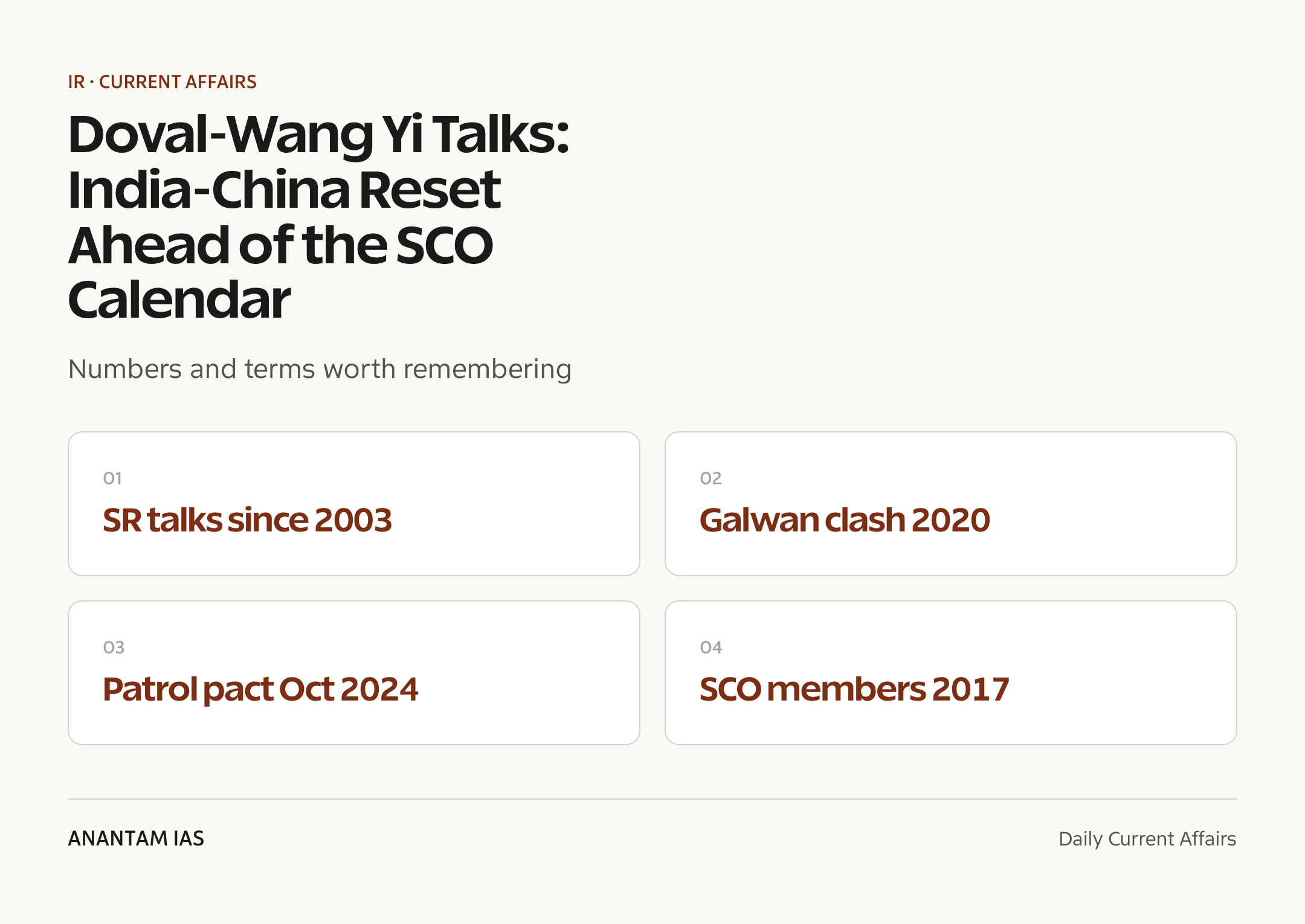
- Special Representatives (SR) mechanism: the India-China dialogue on the boundary question set up in 2003 to seek a political settlement, distinct from military and diplomatic channels.
- Line of Actual Control (LAC): the effective, undemarcated boundary between India and China, divided into Western, Middle and Eastern sectors.
- Galwan Valley: site of the June 2020 clash in eastern Ladakh that triggered the longest India-China military standoff in decades.
- October 2024 patrolling understanding: an arrangement on resumed patrolling at friction points reported to include Depsang and Demchok in eastern Ladakh.
- 2005 political parameters and guiding principles: the agreed framework that is meant to guide a fair, reasonable and mutually acceptable boundary settlement.
- Disengagement, de-escalation, de-induction: the three sequential steps of pulling back troops, lowering force levels and withdrawing build-ups along the LAC.
- Shanghai Cooperation Organisation (SCO): a Eurasian security and economic grouping; India and Pakistan joined as full members in 2017, with Iran admitted later.
- SCO architecture: a rotating chair and annual summit, with bodies such as the Council of Heads of State and the Regional Anti-Terrorist Structure (RATS).
- 1993 and 1996 agreements: pacts on maintaining peace and tranquillity and on confidence-building measures along the LAC that underpin border management.
- WMCC: the Working Mechanism for Consultation and Coordination on India-China border affairs, the diplomatic-military channel that complements the SR talks.
Mains Relevance
GS Paper 2
- India-China bilateral relations: managing a contested boundary while keeping space for trade, multilateral cooperation and crisis stability.
- Border management mechanisms: the role of the Special Representatives track, the WMCC and confidence-building agreements in preventing escalation.
- India’s strategic balancing: engaging China and the SCO without diluting concerns on sovereignty, terrorism and connectivity projects.
GS Paper 3
- Security challenges along borders: lessons from the Galwan standoff for force posture, infrastructure and surveillance on the LAC.
- Linkages between external relations and internal security: how a contested frontier shapes India’s defence preparedness and counter-terrorism stance.
- The interplay of diplomacy and deterrence in securing a long, undemarcated land boundary.
Essay
- Trust and verification: can adversaries build peace through mechanisms while the core dispute remains unresolved?
- The long game of diplomacy: patience, red lines and the management of a contested frontier.
Background and Context
The Special Representatives mechanism on the boundary
The SR talks are the dedicated political channel for the India-China boundary question.
- The Special Representatives dialogue was established in 2003 to seek a political settlement of the boundary question above the technical and military levels.
- It produced the 2005 agreement on political parameters and guiding principles, the agreed basis for a fair and mutually acceptable solution.
- On the Indian side the SR is the National Security Adviser; on the Chinese side it has been a senior leader, currently Foreign Minister Wang Yi.
- The mechanism runs in rounds and works alongside the diplomatic-military WMCC channel on day-to-day border affairs.
The LAC and the sectors of the dispute
The boundary remains undemarcated, which is the root of recurring friction.
- The Line of Actual Control (LAC) separates the two armies but is not a settled, mapped boundary.
- It is conventionally divided into the Western sector (Ladakh), the Middle sector and the Eastern sector (Arunachal Pradesh).
- Differing perceptions of where the LAC lies lead to face-offs, particularly in the Western sector.
- Peace had been managed through the 1993 and 1996 agreements until the 2020 standoff exposed their limits.
Galwan 2020 and the long standoff
The 2020 clash reset the relationship and froze normal engagement.
- The June 2020 Galwan clash in eastern Ladakh caused casualties on both sides, the first combat deaths on the boundary in decades.
- It triggered a prolonged military standoff with heavy force build-ups at multiple friction points.
- India linked the overall relationship to peace and tranquillity on the border, freezing business as usual.
- Rounds of military commander-level talks achieved disengagement at several points over the following years.
The October 2024 patrolling understanding
A 2024 arrangement reopened space for political engagement.
- In October 2024 the two sides announced an understanding on resumed patrolling at remaining friction points.
- It was reported to cover Depsang and Demchok in eastern Ladakh, among the most contested areas.
- The understanding enabled a higher-level meeting between the two countries’ leaders on the margins of a multilateral summit.
- It restarted the SR talks and other dialogue channels that had been largely dormant since 2020.
The SCO and India's role
The grouping is a key venue where India engages both China and the wider region.
- The Shanghai Cooperation Organisation is a Eurasian grouping focused on security, counter-terrorism and economic cooperation.
- India and Pakistan became full members in 2017; the chair and annual summit rotate among members.
- The grouping hosts a Security Council Secretaries’ meeting, the forum on whose sidelines the Doval-Wang Yi talks took place.
- India has used the SCO to press counter-terrorism and connectivity sovereignty while keeping its bilateral disputes on a separate track.
Core interests and India's balancing act
The diplomatic vocabulary signals both engagement and limits.
- The phrase respect for core interests is shorthand for not crossing each other’s sovereignty and security red lines.
- India has paired this with calls for mutual sensitivity, signalling that concessions must run both ways.
- Normalisation is being sequenced cautiously: dialogue and limited steps without abandoning border vigilance or strategic hedging.
- India continues to balance China engagement with its partnerships in the Indo-Pacific and its concerns on terrorism.
Way Forward
Move from disengagement to de-escalation
- Convert patrolling understandings into verifiable de-escalation and de-induction so that force levels along the LAC actually fall.
- Keep the SR and WMCC channels active to lock in gains and prevent fresh face-offs at unresolved points.
Anchor talks in agreed principles
- Use the 2005 political parameters as the reference point for any boundary progress rather than ad hoc, point-by-point bargains.
- Insist on reciprocity, so that respect for core interests and mutual sensitivity translate into concrete, two-way restraint.
Engage without lowering guard
- Sustain border infrastructure, surveillance and military readiness even as diplomacy resumes.
- Keep cooperation in multilateral forums like the SCO distinct from bilateral red lines on sovereignty and terrorism.
Conclusion
The Doval-Wang Yi meeting is best read not as a breakthrough but as evidence of a managed, step-by-step normalisation after Galwan. The Special Representatives mechanism, the LAC agreements and the October 2024 patrolling understanding together form the scaffolding that lets the two sides talk while the underlying boundary dispute stays unresolved. The shared language of core interests and mutual sensitivity captures both the appetite for stability and the caution on each side.
For aspirants, this is a compact case in how India manages a difficult neighbour: keep dedicated channels open, anchor talks in agreed principles, sequence trust-building carefully, and never decouple engagement from border preparedness. The test ahead is whether resumed patrolling can mature into genuine de-escalation, and whether the SR track can move from crisis management toward a durable settlement.
UPSC Practice Questions
Prelims MCQ 1
With reference to the Special Representatives (SR) mechanism between India and China, consider the following statements:
- It was established in 2003 to address the India-China boundary question at the political level.
- On the Indian side, the National Security Adviser serves as the Special Representative.
- It produced the 2005 agreement on political parameters and guiding principles for a boundary settlement.
How many of the above statements are correct?
Only one Only two All three None
Answer: All three
Explanation:
The SR mechanism was set up in 2003 as the political channel on the boundary question, the NSA is India’s SR, and the track produced the 2005 agreement on political parameters and guiding principles.
Prelims MCQ 2
With reference to the Shanghai Cooperation Organisation (SCO), consider the following statements:
- India and Pakistan became full members of the SCO in 2017.
- The SCO has a rotating chair and an annual summit of heads of state.
- It includes a security cooperation body focused on counter-terrorism.
How many of the above statements are correct?
Only one Only two All three None
Answer: All three
Explanation:
India and Pakistan joined as full members in 2017, the chair and summit rotate among members, and the SCO runs a Regional Anti-Terrorist Structure focused on counter-terrorism cooperation.
UPSC Mains Questions
- The Special Representatives mechanism has been the central political channel on the India-China boundary question since 2003. Examine its role in managing the relationship after the 2020 standoff and the limits it still faces. (GS2)
- India’s engagement with China combines dialogue with deterrence. Critically analyse how India balances normalisation along the Line of Actual Control with its wider strategic and security interests. (GS2)
- A contested land frontier links external relations with internal security. Discuss the lessons of the post-Galwan period for India’s border management and preparedness. (GS3)
Sources: Indian Express and Ministry of External Affairs.
Frequently Asked Questions
Who are the Special Representatives in India-China talks?
On the Indian side the Special Representative on the boundary question is the National Security Adviser, currently Ajit Doval. On the Chinese side the role is held by a senior leader, currently Foreign Minister Wang Yi. The two meet in rounds to seek a political settlement of the boundary above the military and diplomatic levels.
What is the Special Representatives mechanism?
It is a dedicated India-China dialogue created in 2003 to address the boundary question at the political level. It works alongside the diplomatic-military channel known as the WMCC and produced the 2005 agreement on political parameters and guiding principles, which remains the agreed basis for any boundary solution.
What was the October 2024 patrolling understanding?
It was an arrangement announced in October 2024 on resumed patrolling at remaining friction points along the Line of Actual Control, reported to cover areas such as Depsang and Demchok in eastern Ladakh. It reopened space for high-level engagement and helped restart the Special Representatives talks that had been largely frozen since 2020.
Why does Galwan still matter for India-China ties?
The June 2020 Galwan clash in eastern Ladakh was the first combat death on the boundary in decades and triggered a long military standoff. India tied the overall relationship to peace and tranquillity on the border, so normalisation since then has been slow and conditional on disengagement and de-escalation along the LAC.
What is the SCO and what is India’s role in it?
The Shanghai Cooperation Organisation is a Eurasian grouping focused on security, counter-terrorism and economic cooperation. India and Pakistan became full members in 2017, and the chair and summit rotate among members. India uses the forum to press counter-terrorism and connectivity concerns while keeping its bilateral disputes on a separate track.
What do ‘core interests’ and ‘mutual sensitivity’ mean here?
Respect for core interests is diplomatic shorthand for not crossing each other’s sovereignty and security red lines. India has paired this with calls for mutual sensitivity, signalling that restraint must run both ways. The terms capture a relationship that wants stability while leaving the underlying boundary dispute unresolved.