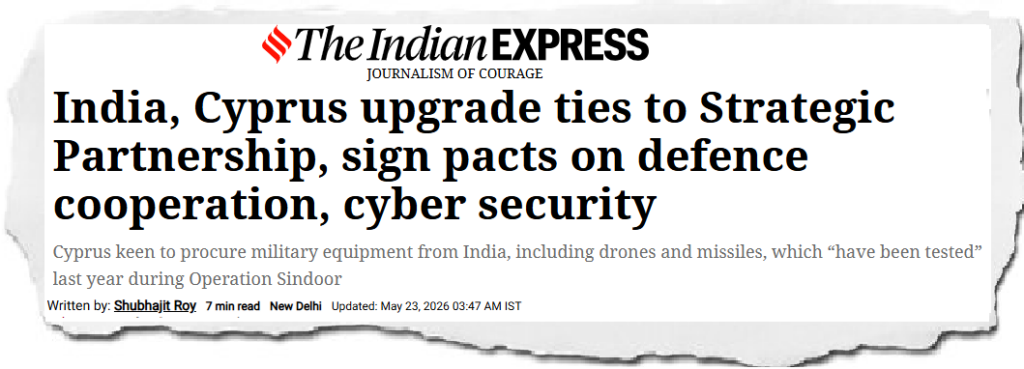
India, Cyprus upgrade ties to Strategic Partnership, sign pacts on defence cooperation, cyber security
Why in News?
India and Cyprus have elevated their bilateral relationship to the level of a Strategic Partnership during the visit of Cyprus President Nikos Christodoulides to India. Both countries signed multiple agreements covering defence, cyber security, maritime cooperation, innovation, higher education and counter-terrorism while also expressing commitment to broader initiatives such as the India–Middle East–Europe Economic Corridor (IMEEC).
UPSC Relevance
Prelims: India–Cyprus relations, IMEEC, GIFT City, strategic partnerships, Mediterranean region.
Mains: GSII:
India and its neighbourhood and international relations; bilateral and regional groupings; India-EU relations.
Background/Context
India and Cyprus have traditionally maintained cordial relations based on shared support for sovereignty, territorial integrity and multilateralism. Cyprus has consistently supported India’s position on several international issues, including India’s candidature in global institutions.
The latest elevation of ties assumes significance because Cyprus currently holds the Presidency of the Council of the European Union and occupies a strategically important location at the crossroads of Europe, Asia and Africa.
The partnership also reflects India’s broader strategy of deepening engagement with Europe, enhancing connectivity initiatives and strengthening its role in emerging geopolitical frameworks.
Evolution of India–Cyprus Relations
India established diplomatic relations with Cyprus soon after Cyprus gained independence in 1960.
Relations have been marked by several important areas of cooperation:
Political cooperation
Cyprus has supported India on issues concerning territorial integrity and multilateral reforms. India has similarly supported the sovereignty and reunification efforts of Cyprus.
Economic and investment relations
Cyprus has emerged as one of the important sources of Foreign Direct Investment (FDI) into India and remains among India’s top investment partners.
Over the last decade, investment flows from Cyprus into India have nearly doubled.
People-to-people linkages
Indian students, professionals and businesses in Cyprus have strengthened social and cultural engagement.
Major Outcomes of the Visit
Elevation to Strategic Partnership
The two countries agreed to formally upgrade bilateral ties to a Strategic Partnership.
Strategic partnerships generally involve long-term cooperation across political, economic, security and technological sectors beyond ordinary diplomatic engagement.
Defence cooperation roadmap (2026–2031)
India and Cyprus unveiled a five-year roadmap to strengthen defence cooperation.
The roadmap is expected to include:
- Expansion of military exchanges and training programmes between defence personnel.
- Cooperation in defence production and procurement.
- Enhanced maritime security collaboration.
- Increased strategic dialogue on regional security concerns.
Cyber security cooperation
The two countries agreed to establish a structured cyber security dialogue.
Growing cyber threats, cybercrime and digital vulnerabilities have made cybersecurity an important dimension of modern diplomacy.
Potential areas of cooperation include information sharing, cyber resilience and digital infrastructure protection.
Counter-terrorism cooperation
An MoU was signed for establishing a Joint Working Group on Counter-Terrorism.
The agreement aims to strengthen:
- Intelligence sharing.
- Capacity building and training.
- Cooperation against terror financing and organised crime.
Cooperation in innovation and education
Agreements were signed to strengthen:
- Higher education and research collaboration.
- Technology and innovation partnerships.
- Cultural cooperation for the period 2026–2030.
Educational partnerships can support knowledge exchange and human resource development.
Maritime cooperation and Search and Rescue (SAR)
Given Cyprus’s strategic location in the Mediterranean Sea and India’s growing maritime outreach, cooperation in maritime transport and Search and Rescue operations assumes importance.
Strategic Significance of Cyprus for India
Gateway to Europe
Cyprus can act as a bridge connecting India with European markets and institutions.
Its Presidency of the Council of the European Union further enhances its strategic value.
Support for India–EU relations
Cyprus has expressed support for early conclusion of the India–European Union Free Trade Agreement (FTA).
Stronger India-Cyprus relations may facilitate broader India-EU engagement.
Maritime and connectivity significance
Cyprus occupies a critical location connecting Europe, West Asia and the Mediterranean.
This position aligns with India’s wider connectivity initiatives.
Geopolitical relevance
The Mediterranean region is increasingly becoming important due to:
- Energy security concerns.
- Trade routes and shipping networks.
- Security challenges in West Asia.
- Emerging strategic competition among global powers.
India–Middle East–Europe Economic Corridor (IMEEC)
India–Middle East–Europe Economic Corridor was announced during the 2023 G20 Summit.
The project aims to establish a transport and economic network connecting India with Europe through West Asia.
Major objectives include:
Enhancing trade connectivity: The corridor aims to reduce transportation costs and improve logistics efficiency.
Energy and digital connectivity: It proposes energy pipelines and digital infrastructure networks across participating countries.
Strategic diversification: The initiative seeks to diversify supply chains and reduce dependence on traditional routes. Cyprus’s location strengthens its potential role in this initiative.
Link with India’s Wider Foreign Policy Objectives
Act West Policy
India’s engagement with Cyprus aligns with its increasing outreach towards West Asia and Europe.
Indo-Pacific and maritime strategy
Maritime cooperation reflects India’s growing focus on secure sea lanes and global maritime governance.
Economic diplomacy
Partnerships in investment, innovation and infrastructure support India’s objective of becoming a major global economic actor.
Reform of global institutions
Both countries emphasized reforming international institutions to make them more representative and effective.
Challenges in India–Cyprus Relations
Limited trade volume: Despite political goodwill, trade relations remain below potential.
Regional geopolitical complexities: Cyprus has complex relations with Turkey, which may occasionally create diplomatic sensitivities.
Need for greater institutional connectivity: Strategic partnerships require sustained implementation mechanisms to convert agreements into outcomes.
Global uncertainties: Conflicts in West Asia and Europe may affect connectivity and investment initiatives.
Way Forward
Strengthen economic engagement
Greater focus should be placed on investment partnerships, digital economy cooperation and infrastructure development.
Enhance defence industrial cooperation
India’s expanding defence manufacturing ecosystem offers opportunities for exports and joint production.
Accelerate connectivity initiatives
Projects like IMEEC should be implemented through coordinated efforts involving all participating countries.
Promote academic and innovation ecosystems
Joint research programmes and technology partnerships can generate long-term strategic benefits.
Expand maritime cooperation
Joint exercises, maritime security dialogue and port connectivity initiatives can strengthen regional engagement.
Conclusion
The elevation of India-Cyprus relations into a Strategic Partnership marks an important step in India’s expanding engagement with Europe and the Mediterranean region. The partnership goes beyond traditional diplomacy and encompasses security, connectivity, technology and economic cooperation. For India, Cyprus can serve not merely as a bilateral partner but also as an important bridge connecting India with Europe and wider global strategic initiatives.
Practice Questions
Prelims Question 1
With reference to the India–Middle East–Europe Economic Corridor (IMEEC), consider the following statements:
- It was announced during the G20 Summit.
- It aims to improve trade and connectivity between India and Europe.
- It includes only maritime connectivity.
Which of the statements given above is/are correct?
(a) 1 only
(b) 1 and 2 only
(c) 2 and 3 only
(d) 1, 2 and 3
Correct Answer: (b)
Explanation: IMEEC was announced during the G20 Summit and seeks to strengthen connectivity through railways, ports, digital and energy networks. It is not limited only to maritime connectivity.
Prelims Question 2
Cyprus occupies strategic significance primarily because of its location in:
(a) South China Sea
(b) Mediterranean region
(c) Arctic region
(d) Pacific Ocean
Correct Answer: (b)
Explanation: Cyprus is located in the Eastern Mediterranean and acts as a bridge between Europe, Asia and Africa.
Mains Questions
- Discuss the strategic significance of Cyprus in India’s evolving engagement with Europe and the Mediterranean region.
- Connectivity initiatives such as IMEEC are increasingly becoming instruments of geopolitics and economic diplomacy. Examine.