India’s Defence Production: An All-Time High of Rs 1.78 Lakh Crore

Why in News?
The Ministry of Defence announced on 18 June 2026 that India’s annual defence production touched an all-time high of Rs 1.78 lakh crore in the financial year 2025-26, a 15.6% rise over the previous year’s Rs 1.54 lakh crore. Defence Minister Rajnath Singh credited sustained policy support and rising private-sector participation under the Atmanirbhar Bharat push.
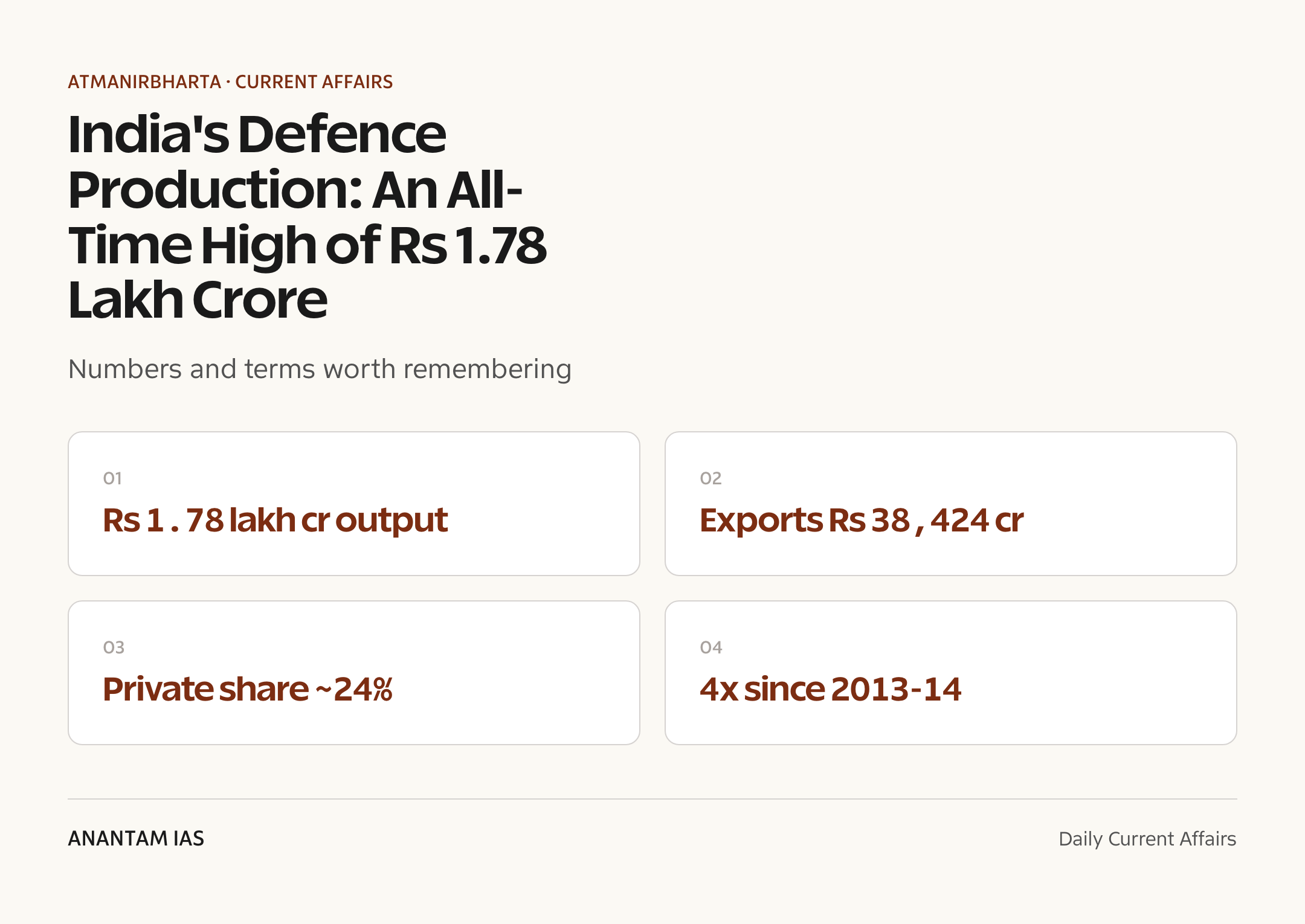
The same year recorded the highest-ever defence exports of Rs 38,424 crore, with the private sector’s contribution alone touching roughly Rs 42,000 crore of output. India’s indigenous defence production has grown almost fourfold since 2013-14 (Rs 43,746 crore).
- Production: Rs 1.78 lakh crore in 2025-26, up 15.6% over 2024-25 (Rs 1.54 lakh crore) and 110% over 2020-21 (Rs 84,643 crore).
- Exports at a record Rs 38,424 crore, with India now exporting to over 100 nations, including the United States, France and Armenia.
- DPSUs and other PSUs made up about 76% of production; the private sector contributed about 24% (~Rs 42,000 crore), an all-time high share.
- Indigenous production has grown nearly fourfold since 2013-14 (Rs 43,746 crore).
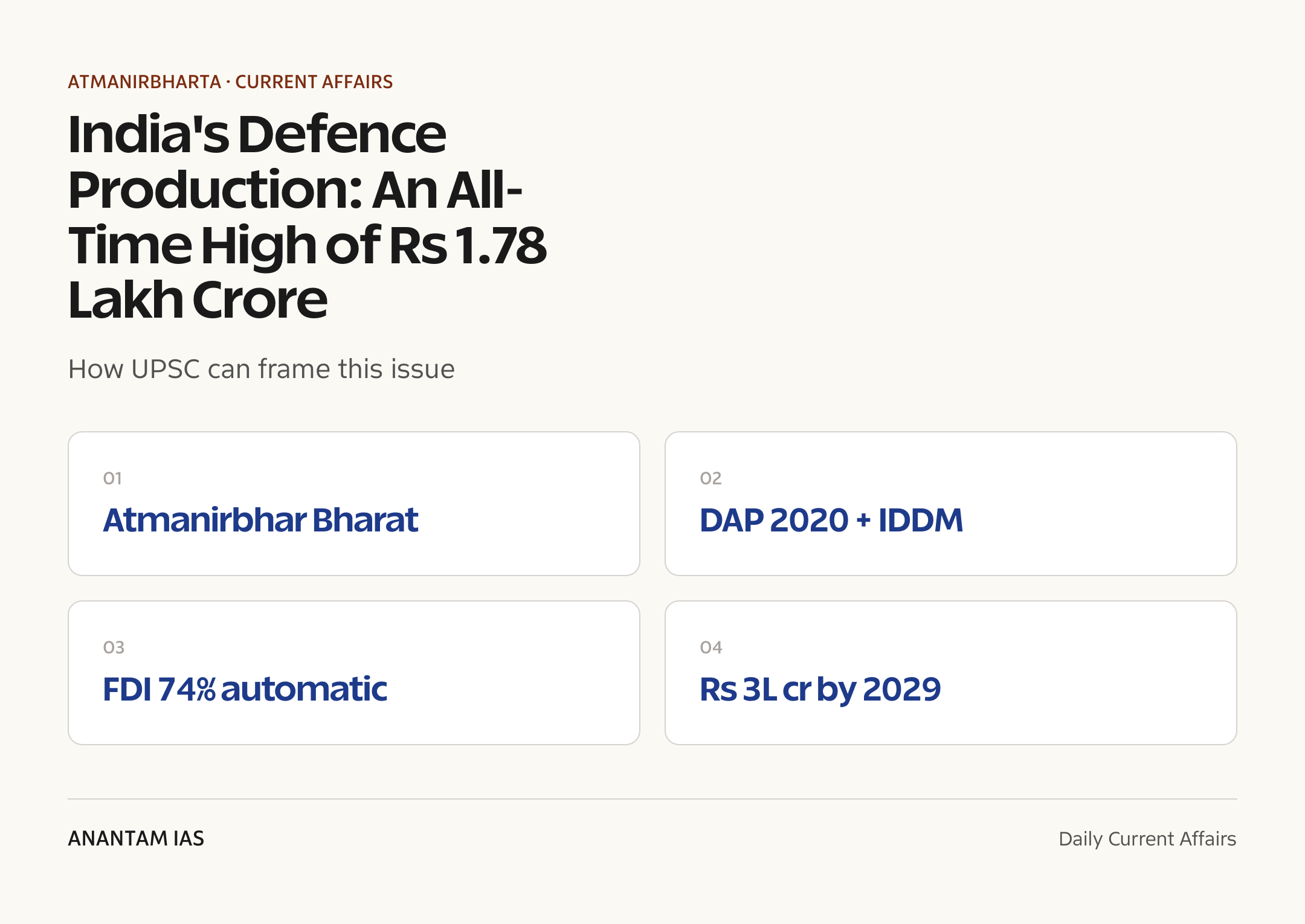
- Government target: Rs 3 lakh crore production and Rs 50,000 crore exports by 2029.
The development matters in the context of:
- Anchors the durable syllabus theme of self-reliance in defence — moving India from the world’s largest arms importer toward a net exporter.
- Showcases the policy architecture (DAP 2020, Positive Indigenisation Lists, FDI liberalisation, iDEX) that examiners test under indigenisation of technology.
- Links defence manufacturing to Make in India, MSME growth, jobs and the wider economy.
UPSC Relevance
Prelims Relevance
- Atmanirbhar Bharat in defence — self-reliance vision
- Defence Acquisition Procedure (DAP) 2020 and its ‘Buy {Indian-IDDM}’ top-priority category
- Positive Indigenisation Lists (PILs) — items barred from import after set timelines
- FDI in defence: up to 74% via automatic route, up to 100% via government route
- iDEX (Innovations for Defence Excellence) and the Defence Innovation Organisation
- Defence Production & Export Promotion Policy (DPEPP) — draft roadmap
- RDI Scheme — Rs 1 lakh crore Research, Development and Innovation corpus
- DPSUs (e.g. HAL, BEL, BDL) and the corporatised Ordnance Factory Board (now 7 DPSUs)
- SRIJAN portal for indigenisation; Defence Industrial Corridors in UP and Tamil Nadu
Mains Relevance
GS Paper 3
- Assess India’s progress toward self-reliance in defence manufacturing and the role of the private sector and MSMEs.
- Examine how policy reforms (DAP 2020, indigenisation lists, FDI norms) have reshaped India’s defence industrial base and exports.
GS Paper 2
- Defence exports as an instrument of foreign policy and strategic partnerships.
Essay
- Self-reliance is the foundation of national security.
- From importer to exporter: India’s quest for strategic autonomy.
Background and Context
The headline numbers
The 2025-26 data marks a step-change in scale across production and exports.
- Total production: Rs 1.78 lakh crore (2025-26), against Rs 1.54 lakh crore (2024-25) — a 15.6% jump.
- Growth of 110% over 2020-21 (Rs 84,643 crore) and nearly 4x over 2013-14 (Rs 43,746 crore).
- Exports at Rs 38,424 crore, up from less than Rs 1,000 crore a decade ago, reaching 100+ nations.
- Defence budget rose from Rs 2.53 lakh crore (2013-14) to Rs 6.81 lakh crore (2025-26).

What changed: from importer to producer
India long ranked among the world’s largest arms importers, exposing it to costly delays and supply shocks.
- Earlier procurement was slow, with critical capability gaps and heavy import dependence straining forex reserves.
- Private participation was limited by restrictive policy, DPSU dominance and poor technology access.
- Exports in 2013-14 were just Rs 686 crore — India was a buyer, not a builder.
- A decade of reform under the Atmanirbhar Bharat banner reversed the trajectory; 2025 was declared the ‘Year of Reforms’.
The policy architecture
A cluster of reforms — not a single scheme — drives the indigenisation push.
- DAP 2020: makes ‘Buy {Indian-IDDM}’ (Indigenously Designed, Developed and Manufactured) the top-priority procurement category.
- Positive Indigenisation Lists: notified items that must be sourced domestically after fixed deadlines, run by the DMA and Department of Defence Production.
- FDI liberalised to 74% via the automatic route and up to 100% through the government route.
- RDI Scheme (Rs 1 lakh crore) funds R&D across DPSUs, private firms, MSMEs and startups; iDEX backs defence startups.
- Defence Industrial Corridors in Uttar Pradesh and Tamil Nadu, plus the SRIJAN indigenisation portal.
Who is producing — public vs private
The structure of the industrial base is shifting toward private players.
- DPSUs and other PSUs accounted for about 76% of 2025-26 output; the private sector contributed about 24% (~Rs 42,000 crore).
- The Ordnance Factory Board was corporatised into 7 new DPSUs in 2021 to improve accountability.
- Roughly 16,000 MSMEs now feed the supply chain as ‘game-changers’.
- Over 788 industrial licences have been issued to about 462 companies.
What India now exports
Exports span platforms, sub-systems and components, not just spares.
- Items include bulletproof jackets, Dornier aircraft, Chetak helicopters, fast interceptor boats and lightweight torpedoes.
- Buyers include the United States, France and Armenia, alongside many smaller states.
- Exports give Indian firms scale, hard-currency earnings and a foothold in global supply chains.
- They also serve as an instrument of defence diplomacy, and strategic partnership-building.
Why it matters strategically
Self-reliance in arms is both a security and an economic objective.
- Reduces vulnerability during global disruptions and sanctions, supporting strategic autonomy.
- Builds a deep-tech industrial base spilling over into aerospace, electronics and materials.
- Creates skilled jobs and links to the wider Make in India manufacturing agenda.
- Signals India’s ambition to be a global defence manufacturing hub.
The gaps that remain
Records on value mask continuing dependence in high-end systems.
- India still imports critical aero-engines, advanced sensors and some sub-systems.
- Much ‘indigenous’ output relies on licensed/transferred technology rather than home-grown design.
- R&D spend as a share of the defence budget stays modest versus leading producers.
- Export figures remain small against the Rs 50,000 crore by 2029 target, and global majors dominate the market.
Way Forward
Deepen genuine indigenisation
- Prioritise IDDM projects and home-grown design IP, not just assembly under licence.
- Crack the hardest dependencies — aero-engines, advanced sensors and propulsion.
Strengthen the ecosystem
- Scale iDEX and the RDI Scheme to fund startups, MSMEs and academia.
- Use the Defence Industrial Corridors and predictable orders to anchor private investment.
Build durable export markets
- Pair exports with credit lines, lifecycle support and defence diplomacy.
- Move up the value chain from components toward complete platforms and systems.
Conclusion
The Rs 1.78 lakh crore record confirms that India’s decade-long bet on Atmanirbharta in defence is producing measurable results — rising output, a stronger private base and exports to over 100 countries.
The next test is qualitative: turning value records into genuine technological self-reliance in high-end systems and meeting the Rs 3 lakh crore production and Rs 50,000 crore export targets by 2029.
UPSC Practice Questions
Prelims MCQ 1
With reference to India’s defence-manufacturing policy, consider the following statements:
- Under the Defence Acquisition Procedure (DAP) 2020, ‘Buy {Indian-IDDM}’ is the highest-priority procurement category.
- Foreign Direct Investment in defence is allowed up to 74% through the automatic route.
- Positive Indigenisation Lists permit the import of listed items only after a fixed timeline.
How many of the above statements are correct?
(a) Only one (b) Only two (c) All three (d) None
Answer: (b) Only two
Explanation:
Statements 1 and 2 are correct. Statement 3 is reversed — Positive Indigenisation Lists BAR the import of listed items after a fixed timeline (forcing domestic sourcing), they do not permit import only after a deadline.
Prelims MCQ 2
India’s annual indigenous defence production in the financial year 2025-26 was approximately:
(a) Rs 46,429 crore (b) Rs 84,643 crore (c) Rs 1.54 lakh crore (d) Rs 1.78 lakh crore
Answer: (d) Rs 1.78 lakh crore
Explanation:
Production hit a record Rs 1.78 lakh crore in 2025-26, up 15.6% over 2024-25 (Rs 1.54 lakh crore). Rs 46,429 crore was the 2014-15 figure and Rs 84,643 crore the 2020-21 figure.
UPSC Mains Questions
- India’s defence production has touched a record high even as the country remains dependent on imports for high-end systems. Critically examine the progress and the gaps in India’s drive for self-reliance in defence manufacturing. (250 words)
- Discuss how policy reforms over the past decade — including DAP 2020, indigenisation lists and FDI liberalisation — have reshaped India’s defence industrial base and its export profile. (250 words)
Sources: PIB, Ministry of Defence and The Indian Express.
Frequently Asked Questions
What was India’s defence production in 2025-26?
India’s indigenous defence production reached an all-time high of about Rs 1.78 lakh crore in financial year 2025-26, a 15.6% increase over the previous year’s Rs 1.54 lakh crore. This was almost four times the 2013-14 figure of Rs 43,746 crore, reflecting a decade of Atmanirbhar Bharat reforms.
How much were India’s defence exports in 2025-26?
Defence exports touched a record Rs 38,424 crore in 2025-26, up from less than Rs 1,000 crore a decade earlier. India now exports to over 100 nations, including the United States, France and Armenia, supplying items such as bulletproof jackets, Dornier aircraft and Chetak helicopters.
What is Atmanirbhar Bharat in defence?
It is the policy push to make India self-reliant in arms manufacturing, cutting import dependence by promoting indigenous design, development and production. Its tools include Positive Indigenisation Lists, the ‘Buy {Indian-IDDM}’ procurement priority, liberalised FDI, and funding schemes such as iDEX and the RDI Scheme.
What is the Defence Acquisition Procedure (DAP) 2020?
DAP 2020 is the framework governing defence capital acquisitions. It gives top priority to the ‘Buy {Indian-IDDM}’ category — systems indigenously designed, developed and manufactured — and aims to speed up procurement, improve transparency and build a globally competitive domestic defence industry.
What is a Positive Indigenisation List?
It is a list of defence items, notified by the Ministry of Defence, that can no longer be imported after a fixed deadline and must be sourced from Indian industry. Such lists guarantee domestic firms a captive market and steadily reduce reliance on foreign suppliers.
What are India’s defence-manufacturing targets for 2029?
The government aims to raise annual defence production to about Rs 3 lakh crore and defence exports to Rs 50,000 crore by 2029, reinforcing India’s ambition to become a global defence manufacturing hub while supporting jobs and economic growth.