India–EFTA TEPA: New Openings for the Seafood Sector
Why in News?
PIB confirmed that the Department of Commerce organised a Chintan Shivir on “Opportunities for the Seafood Sector under the India–EFTA Trade and Economic Partnership Agreement (TEPA)” on 3 July 2026 at the Chennai Trade Centre, on the sidelines of Seafood Expo Bharat 2026.
The brainstorming session brought exporters face-to-face with officials from the Department of Commerce, Invest India, DGFT, the Export Inspection Council and FIEO to work out how the pact’s tariff concessions and its USD 100 billion investment ambition can be converted into concrete gains for India’s fishermen and seafood businesses.
- The Chintan Shivir was held on 3 July 2026 at the Chennai Trade Centre, alongside Seafood Expo Bharat 2026; Joint Secretary Mohit Yadav of the Department of Commerce addressed the participants.
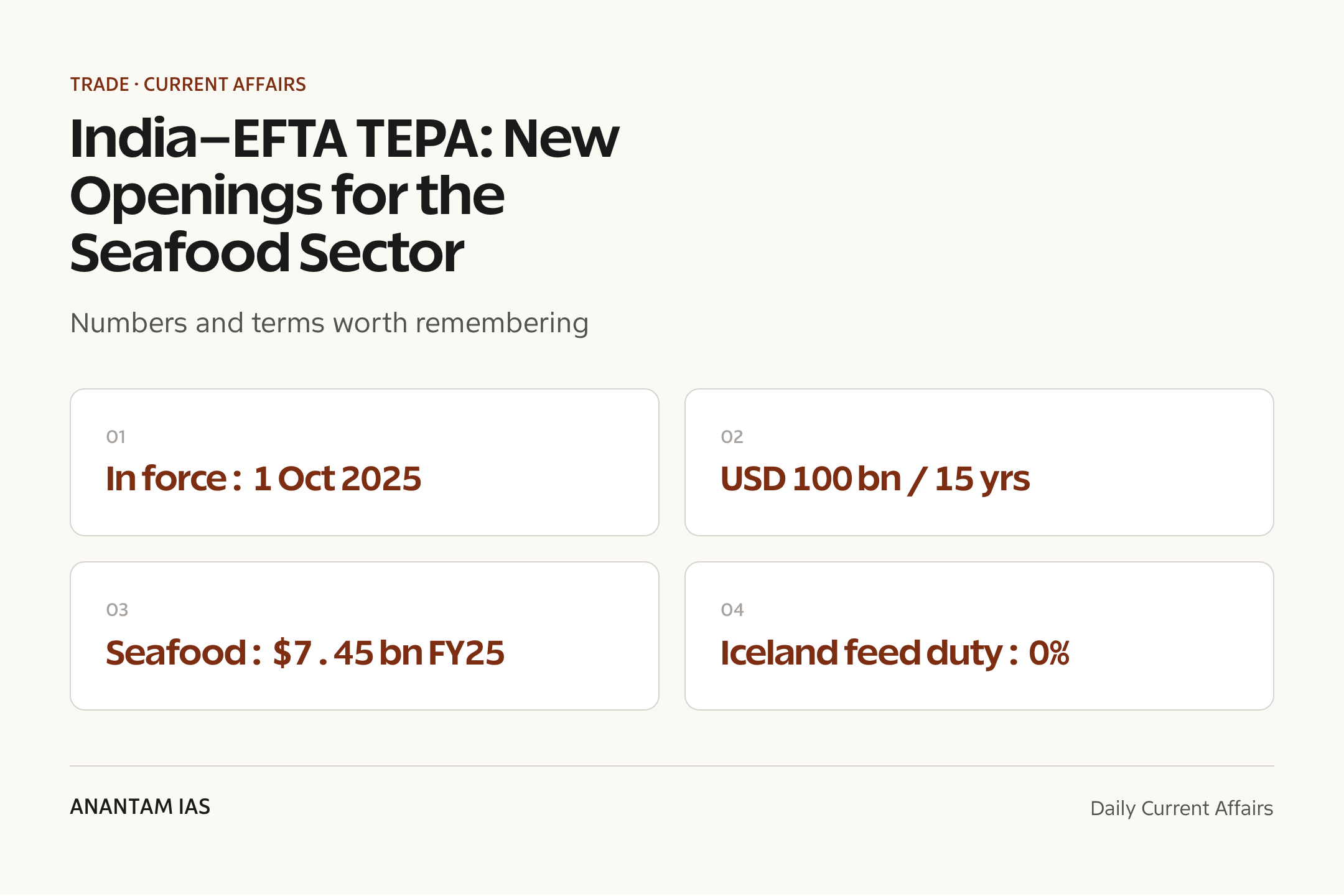
- Under TEPA, Iceland has eliminated its 55 per cent import duty on feed, including fish feed.
- Switzerland has cut the import duty on fats and oils of fish (other than liver oil) from 18.05 per cent to zero; Norway has scrapped its 13.16 per cent duty on fish and shrimp feed.
- An open-house session let exporters raise market access, regulatory compliance and quality-standard issues directly with policymakers.
- PIB noted TEPA also opens avenues for technology transfer and joint ventures with niche EFTA firms, with coastal states such as Tamil Nadu among the biggest potential gainers.
The development matters in the context of:
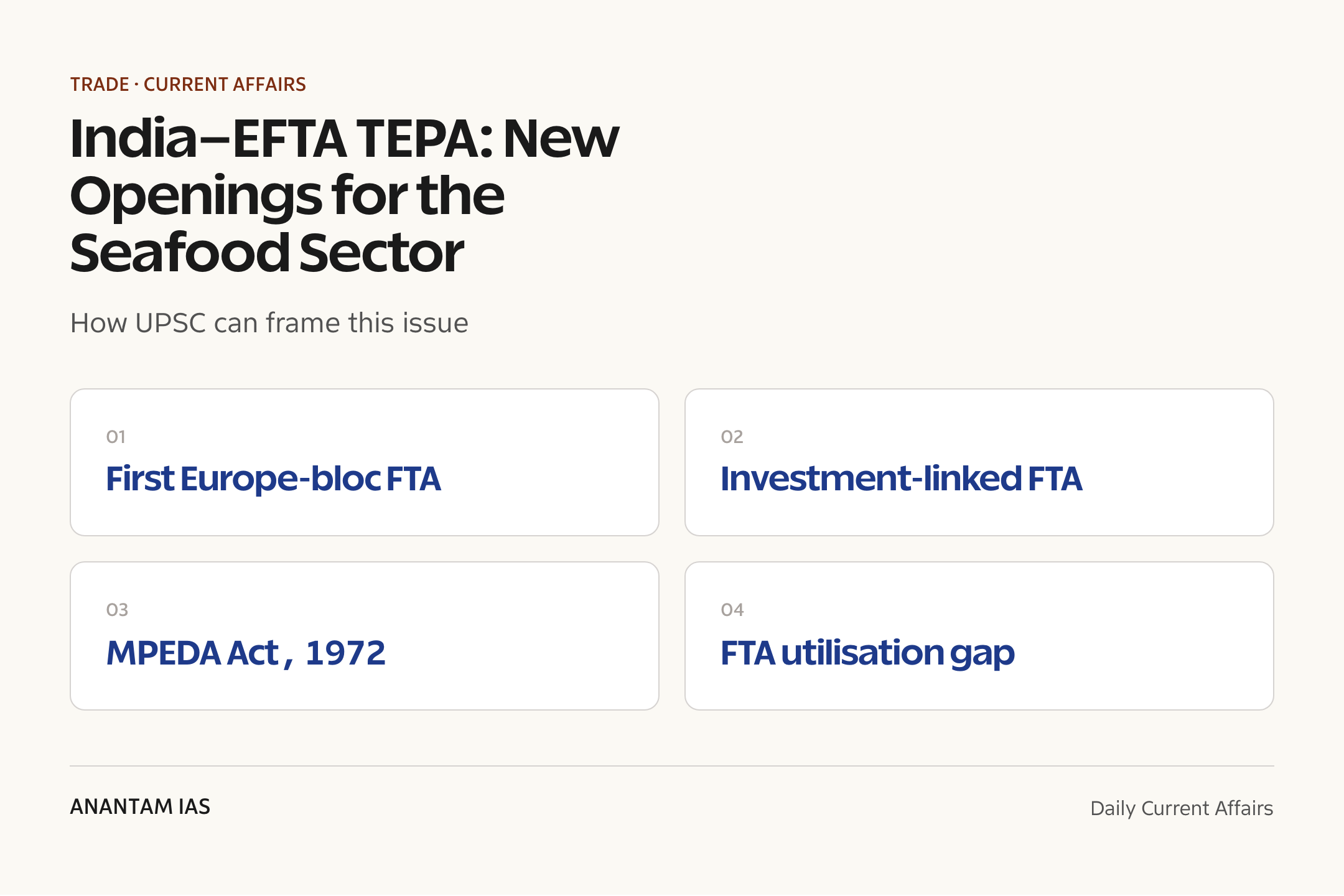
- TEPA is India’s first trade agreement with a European bloc and the first Indian FTA with a binding, investment-linked commitment — USD 100 billion over 15 years and one million direct jobs.
- India’s seafood exports stood at USD 7.45 billion (16.98 lakh tonnes) in 2024-25 as per MPEDA — the Chennai exercise is about widening this basket into high-value EFTA markets.
- The event illustrates the FTA utilisation problem: signing a pact is only the start; sector-level outreach turns paper concessions into orders and investment.
UPSC Relevance
Prelims Relevance
- TEPA — Trade and Economic Partnership Agreement between India and EFTA; signed on 10 March 2024, entered into force on 1 October 2025.
- EFTA members: Iceland, Liechtenstein, Norway and Switzerland — none of them is a member of the European Union.
- EFTA economies have a combined GDP of about USD 1.79 trillion (PIB).
- TEPA’s investment chapter: USD 100 billion of investment into India over 15 years plus one million direct jobs — a first in any Indian FTA.
- Seafood-relevant tariff cuts: Iceland’s 55% feed duty, Norway’s 13.16% fish/shrimp-feed duty and Switzerland’s 18.05% duty on fish fats and oils all brought to zero.
- MPEDA — statutory body under the MPEDA Act, 1972; headquarters Kochi; works under the Department of Commerce.
- Export Inspection Council (EIC) — statutory body under the Export (Quality Control and Inspection) Act, 1963; certifies export quality.
- India’s seafood exports 2024-25: USD 7.45 billion / 16,98,170 tonnes; frozen shrimp is the largest item and the USA the largest market (MPEDA).
Mains Relevance
GS Paper 3
- FTAs as instruments of export-led growth — how tariff concessions translate (or fail to) into sector-level gains.
- TEPA’s investment-linked design as a new template for Indian trade agreements.
- Fisheries and the Blue Economy: value addition, quality compliance and market diversification in seafood exports.
- Non-tariff barriers — SPS standards, traceability, certification — as the real frontier of market access.
GS Paper 2
- India’s layered engagement with Europe: EFTA (TEPA), the ongoing India–EU FTA negotiations and the India–UK agreement.
- Institutional coordination — Commerce Department, DGFT, EIC, MPEDA, FIEO, Invest India — in implementing international agreements domestically.
Essay
- Trade agreements are signed in capitals but succeed in coastal villages — the last mile of globalisation.
- From protection to promotion: how open trade can serve, not sink, small producers.
Background and Context
TEPA in Brief: India's First European Trade Pact
TEPA is India’s first operational trade agreement with a European economic bloc, negotiated intermittently over nearly 16 years.
- The pact was signed on 10 March 2024 in New Delhi and, as PIB announced, entered into force on 1 October 2025 after ratification by all five parties.
- It has 14 chapters covering trade in goods, rules of origin, services, investment promotion, intellectual property, government procurement, trade and sustainable development, and dispute settlement.
- EFTA — the European Free Trade Association — groups Iceland, Liechtenstein, Norway and Switzerland: developed, high-income economies that sit outside the EU but are deeply integrated with the European market.
- EFTA states will eliminate or reduce tariffs covering about 99.6 per cent of India’s export value to the bloc, giving Indian goods near-comprehensive duty-free access.
- India has kept sensitive sectors — dairy, soya and coal among them — protected, and the effective duty on gold is unchanged.
- TEPA complements India’s other Europe tracks: the ongoing India–EU FTA negotiations and the trade agreement concluded with the United Kingdom.
The Investment-Linked Novelty: Why TEPA Is a Template
TEPA is the first Indian trade agreement in which tariff concessions are tied to a binding investment commitment.
- EFTA states have committed to facilitate USD 100 billion of investment into India over 15 years — USD 50 billion in the first ten years and another USD 50 billion in the following five.
- The commitment is paired with a target of creating one million direct jobs in India through this investment.
- A built-in review mechanism gives the commitment teeth: if the targets are not met after consultations and a grace period, India can proportionately rebalance its tariff concessions.
- This inverts the usual FTA logic — instead of trading market access for market access alone, India traded access for capital, technology and jobs.
- For sectors like seafood, the investment channel matters as much as tariffs: Norway is a world leader in cold-water aquaculture, fish-feed technology and cold-chain logistics, all of which India’s fisheries value chain needs.
What TEPA Puts on the Table for Seafood
The pact combines direct tariff relief on inputs and products with openings for joint ventures across the fisheries value chain.
- Iceland has eliminated its steep 55 per cent import duty on feed, including fish feed — one of the sharpest single cuts in the agreement.
- Switzerland has reduced the duty on fats and oils of fish (other than liver oil) from 18.05 per cent to zero, helping marine-ingredient exporters.
- Norway has removed its 13.16 per cent duty on feed, including fish and shrimp feed, widening access for Indian feed manufacturers.
- PIB highlighted openings for technology transfer and collaboration with niche EFTA firms — from hatchery genetics to processing equipment.
- Coastal states, particularly Tamil Nadu, stand to gain through demand for fishermen’s catch, processing jobs and port-linked logistics — the reason the Chintan Shivir was held in Chennai.
India's Seafood Economy: The MPEDA Picture
Seafood is one of India’s most successful agri-allied export stories, but the basket remains concentrated in one product and a few markets.
- MPEDA data show India exported 16,98,170 tonnes of seafood worth ₹62,408 crore (USD 7.45 billion) in 2024-25 — see our note on India’s record seafood exports.
- Frozen shrimp dominates: about 7.42 lakh tonnes worth roughly USD 5.18 billion, close to 70 per cent of total export value.
- The USA is the largest frozen-shrimp market, followed by China, the EU, South-East Asia, Japan and the Middle East — concentration that exposes exporters to shocks in one or two markets.
- MPEDA (Marine Products Export Development Authority), set up under the MPEDA Act, 1972 with headquarters in Kochi, promotes exports and runs quality programmes such as SHAPHARI certification for aquaculture.
- The wider fisheries sector supports around 3 crore fishers and fish farmers; India is the world’s second-largest fish producer with roughly 8 per cent of global output.
- Flagship schemes back the sector: PMMSY (Pradhan Mantri Matsya Sampada Yojana, ₹20,050-crore outlay) and the FIDF (Fisheries and Aquaculture Infrastructure Development Fund).
Institutions in the Room: Who Does What
The Chintan Shivir doubled as a map of India’s export-promotion machinery — worth knowing institution by institution.
- Department of Commerce — negotiates trade agreements and steers their implementation; convened the Chintan Shivir.
- Invest India — the national investment promotion agency; presented investment opportunities across the seafood value chain.
- DGFT (Directorate General of Foreign Trade) — administers the Foreign Trade Policy; its Chennai Regional Office briefed exporters on facilitation schemes.
- Export Inspection Council (EIC) — statutory body under the Export (Quality Control and Inspection) Act, 1963; certifies that consignments meet importing-country standards.
- FIEO (Federation of Indian Export Organisations) — the apex export-promotion body; shared strategies for using TEPA benefits.
- Together these bodies span negotiation, investment facilitation, licensing, certification and outreach — a ready GS2 example of institutional coordination in implementing international agreements.
The Real Test: From Signed FTA to Utilised FTA
India’s older FTAs were often under-used by exporters — the Chintan Shivir model is designed to close that gap.
- Studies and parliamentary reviews have repeatedly flagged low utilisation of India’s earlier FTAs — rules-of-origin paperwork, certification costs and information gaps often outweighed tariff savings; see our explainer on India’s experience with FTAs.
- For seafood, tariffs are half the battle: SPS (sanitary and phytosanitary) standards, antibiotic-residue limits, traceability and catch certification decide whether consignments clear European borders.
- TEPA sits in a new generation of Indian pacts — the UAE CEPA (2022), the Australia ECTA (2022) and the agreement with the UK — where signing is paired with sector-specific outreach.
- The open-house format lets policymakers hear compliance bottlenecks directly from exporters, feeding into scheme design rather than leaving concessions unused on paper.
- The Chennai session closed with a shared government–industry commitment to maximise TEPA benefits and expand seafood exports to EFTA markets.
Way Forward
Convert concessions into orders
- Run EFTA-specific exporter handholding — market intelligence, buyer matchmaking and rules-of-origin help — through MPEDA and Export Promotion Councils.
- Push value-added products (ready-to-eat, marinated, retail-pack seafood) rather than bulk frozen commodity, since high-income EFTA consumers pay for processing done in India.
Use the investment channel deliberately
- Court Norwegian and Icelandic aquaculture, feed-technology and cold-chain firms for joint ventures in coastal states, converging with PMMSY infrastructure spending.
- Track the USD 100-billion commitment transparently so the review mechanism remains credible and sectors can plan around incoming capital.
Fix the compliance frontier
- Scale residue-monitoring, traceability and SHAPHARI-type certification so Indian consignments meet European SPS norms by default, not exception.
- Institutionalise the Chintan Shivir format — periodic, sector-wise, port-city consultations for every operational FTA.
Conclusion
The Chennai Chintan Shivir is a small event with a large signal: India’s trade policy is moving past the signing ceremony. TEPA’s seafood concessions — Iceland’s 55 per cent feed duty gone, Swiss and Norwegian lines at zero — are real, but they earn nothing until exporters in Tamil Nadu, Andhra Pradesh and Kerala can navigate certification, standards and buyers.
For aspirants, TEPA is the reference case for a new FTA architecture — investment-linked, enforceable and paired with domestic outreach. Whether India’s USD 7.45-billion seafood trade diversifies beyond frozen shrimp and the American market will be an early, measurable test of that design.
UPSC Practice Questions
Prelims MCQ 1
With reference to the India–EFTA Trade and Economic Partnership Agreement (TEPA), consider the following statements:
- TEPA is India’s first operational trade agreement with a European economic bloc.
- All four EFTA members — Iceland, Liechtenstein, Norway and Switzerland — are also members of the European Union.
- The agreement includes a commitment to facilitate USD 100 billion of investment into India over 15 years.
How many of the above statements are correct?
(a) Only one (b) Only two (c) All three (d) None
Answer: (b) Only two
Explanation:
Statements 1 and 3 are correct: TEPA, in force since 1 October 2025, is India’s first trade pact with a European bloc and carries a binding USD 100-billion, 15-year investment commitment with a one-million-jobs target. Statement 2 is incorrect — EFTA states are NOT members of the European Union; EFTA is a separate grouping.
Prelims MCQ 2
The Marine Products Export Development Authority (MPEDA), often seen in the news, functions under which of the following?
(a) Ministry of Fisheries, Animal Husbandry and Dairying (b) Department of Commerce, Ministry of Commerce and Industry (c) Ministry of Food Processing Industries (d) NITI Aayog
Answer: (b) Department of Commerce, Ministry of Commerce and Industry
Explanation:
MPEDA is a statutory body established under the MPEDA Act, 1972, headquartered in Kochi. It promotes marine-product exports and works under the Department of Commerce — not the Fisheries Ministry, which handles production-side schemes like PMMSY.
UPSC Mains Questions
- “India’s recent trade agreements mark a shift from tariff-centric pacts to investment-linked partnerships.” Discuss this statement with reference to the India–EFTA Trade and Economic Partnership Agreement, highlighting how its design differs from India’s earlier FTAs.
- Despite being the world’s second-largest fish producer, India’s seafood exports remain concentrated in frozen shrimp and a handful of markets. Examine the structural constraints behind this concentration and evaluate how agreements like TEPA can aid diversification.
- “Signing a free trade agreement is only the beginning; utilisation is the real test.” In the light of India’s FTA experience, discuss the institutional and compliance measures needed to convert negotiated market access into actual export gains.
Sources: PIB, Ministry of Commerce & Industry and MPEDA (seafood export data 2024-25).
Frequently Asked Questions
What is the India–EFTA TEPA?
The Trade and Economic Partnership Agreement (TEPA) is a free trade pact between India and the four-member European Free Trade Association. Signed on 10 March 2024 and in force since 1 October 2025, it is India’s first operational trade agreement with a European economic bloc, covering goods, services, investment promotion and sustainable development across 14 chapters.
Which countries are members of EFTA?
EFTA comprises Iceland, Liechtenstein, Norway and Switzerland. These are developed European economies with a combined GDP of about USD 1.79 trillion, but none of them belongs to the European Union — a distinction Prelims frequently tests. TEPA with EFTA is separate from India’s ongoing FTA negotiations with the EU.
What makes TEPA different from India’s earlier FTAs?
TEPA is the first Indian trade agreement with a binding, investment-linked commitment: EFTA states are to facilitate USD 100 billion of investment into India over 15 years and support one million direct jobs. If targets are missed after consultations, India can proportionately rebalance its tariff concessions — giving the promise enforceable teeth.
What does TEPA offer India’s seafood sector?
Iceland has eliminated its 55 per cent import duty on feed including fish feed, Norway has scrapped its 13.16 per cent duty on fish and shrimp feed, and Switzerland has cut the 18.05 per cent duty on fish fats and oils to zero. The pact also opens technology-transfer and joint-venture routes with EFTA’s aquaculture and cold-chain firms.
What is MPEDA and what does it do?
The Marine Products Export Development Authority is a statutory body created under the MPEDA Act, 1972, headquartered in Kochi and working under the Department of Commerce. It promotes seafood exports, sets quality and traceability programmes such as SHAPHARI certification, and publishes India’s official seafood export statistics.
How large are India’s seafood exports?
As per MPEDA, India exported 16,98,170 tonnes of seafood worth ₹62,408 crore (USD 7.45 billion) in 2024-25. Frozen shrimp was the largest item at roughly USD 5.18 billion — close to 70 per cent of export value — with the USA as the biggest market, followed by China and the European Union.