India’s Emerging Technology Ecosystem: GII Rank 38, Quantum Mission and the Semiconductor Push
Why in News?
A recent feature from the Ministry of Electronics & IT (MeitY) and the Department of Science & Technology (DST) maps India’s transition from a technology consumer to a technology producer. The story rests on three pillars: a sharp rise in the Global Innovation Index (GII), a fully funded National Quantum Mission, and the rapid scaling of the Semicon India Programme for chip manufacturing.
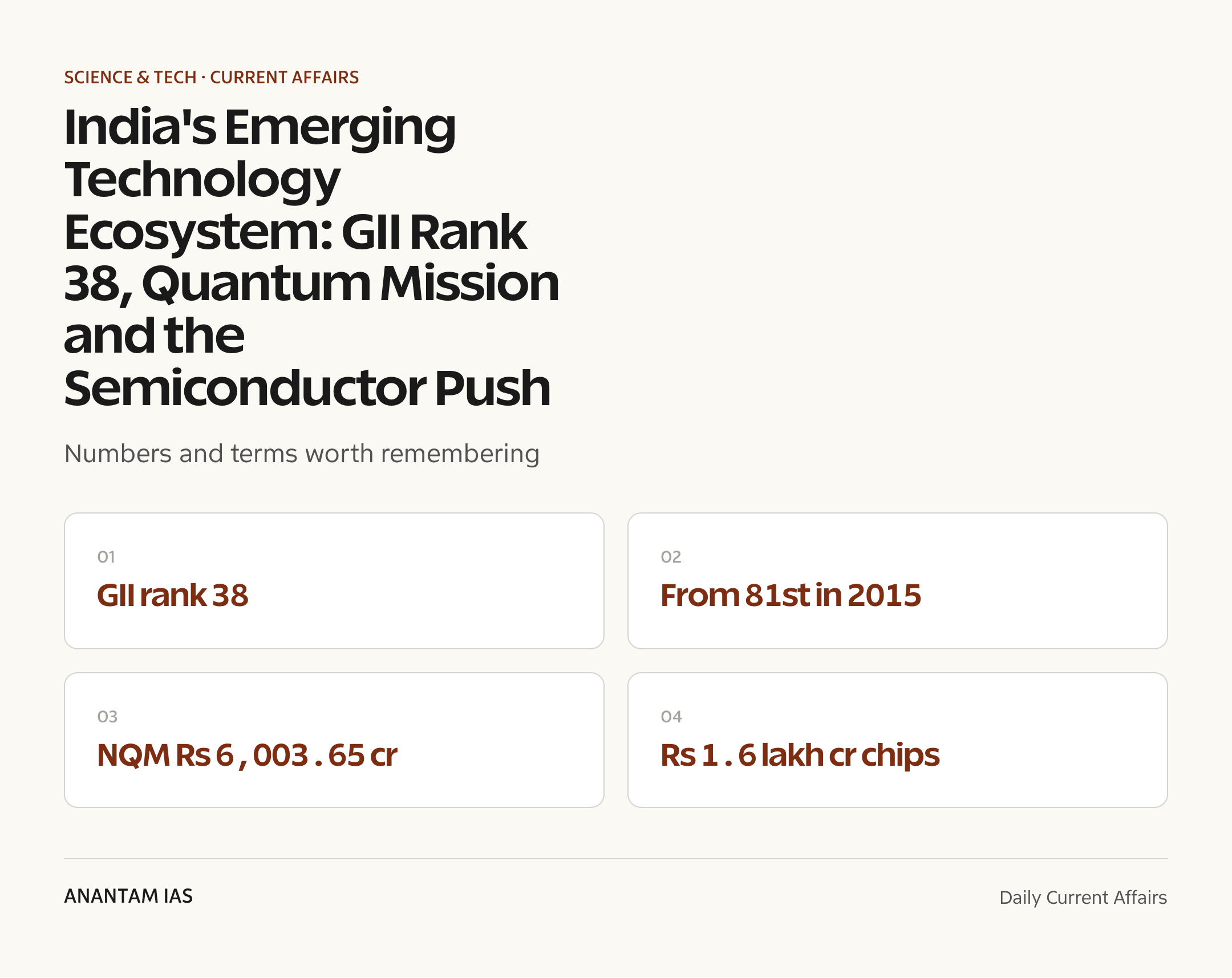
On the World Intellectual Property Organization (WIPO) GII 2025, India ranks 38th — up from 81st in 2015 — and remains an innovation overperformer for the 15th year running. Alongside, the National Quantum Mission carries a Rs 6,003.65 crore outlay and semiconductor investment commitments have crossed Rs 1.6 lakh crore, anchoring the longer-horizon goal of Viksit Bharat 2047.
- India ranks 38th on the WIPO Global Innovation Index 2025, up from 81st in 2015.
- The National Quantum Mission has a Rs 6,003.65 crore outlay for 2023-24 to 2030-31.
- Under Semicon India, investment commitments of about Rs 1.6 lakh crore have been received in three years.
- 10 semiconductor units are approved, including 2 fabs and 8 ATMPs/OSATs; one has begun commercial production.
- Union Budget 2026-27 announced India Semiconductor Mission 2.0 for equipment, materials, design and supply chains.
- DST is funding deep-tech research through the ANRF (Rs 50,000 crore) and a Rs 1 lakh crore RDI Fund.
The development matters in the context of:
- The Global Innovation Index is published annually by WIPO and ranks ~130 economies on innovation inputs and outputs across seven pillars.
- A semiconductor fab manufactures chips; ATMP/OSAT units handle assembly, testing, marking and packaging — the back-end of the chip value chain.
- Quantum technology uses the principles of quantum mechanics for computing, secure communication, sensing and new materials.
- These efforts sit within Atmanirbhar Bharat and the vision of a developed India — Viksit Bharat 2047.
UPSC Relevance
Prelims Relevance
- India ranks 38th in the WIPO Global Innovation Index 2025, a rise from 81st in 2015.
- India tops Central and Southern Asia in the GII and ranks 1st globally in ICT services exports.
- Bengaluru (21st) and Delhi (26th) feature among the world’s top innovation clusters in GII 2025.
- The National Quantum Mission was approved in 2023 with a Rs 6,003.65 crore outlay for 2023-31.
- NQM will set up four Thematic Hubs (T-Hubs) in Quantum Computing, Communication, Sensing & Metrology, and Materials & Devices.
- The Semicon India Programme has attracted about Rs 1.6 lakh crore in investment commitments.
- 10 units are approved under Semicon India — 2 fabs and 8 ATMPs/OSATs.
- The Design Linked Incentive (DLI) Scheme supports design of ICs, chipsets and SoCs.
- India hosts about 7% of the world’s GCCs in the semiconductor domain and ~20% of the global chip-design workforce.
- The Anusandhan National Research Foundation (ANRF) has an outlay of Rs 50,000 crore over five years.
Mains Relevance
GS Paper 3
- How a coordinated innovation policy stack — GII benchmarking, mission-mode programmes and incentives — moves an economy up the technology value chain.
- Semiconductor self-reliance as a strategic objective: fabs, ATMP/OSAT, design (DLI) and talent, and the risks of import dependence.
- The role of quantum technology in computing, secure communication and sensing, and India’s National Quantum Mission as a deep-tech bet.
- Building a research-to-commercialisation pipeline through the ANRF and the RDI Fund for critical technologies.
GS Paper 2
- Government schemes for technology development and the institutional architecture (MeitY, DST, ANRF) behind Viksit Bharat 2047.
- Leveraging global benchmarks such as the GII to shape policy priorities and attract investment.
Essay
- From consumer to producer: India’s climb up the technology ladder
- Innovation as the engine of a developed India by 2047
Background and Context
The Global Innovation Index — India's steady climb
The GII is the most cited global yardstick of innovation capacity, and India’s trajectory on it is striking.
- Published by WIPO, the Global Innovation Index ranks economies on seven pillars spanning innovation inputs and outputs.
- India ranks 38th in GII 2025, a long rise from 81st in 2015.
- India is an innovation overperformer for the 15th consecutive year, beating its income-group peers across all seven pillars.
- It ranks 1st in ICT services exports, performs strongly on late-stage VC deals and intangible-asset intensity, and leads Central and Southern Asia.
- Bengaluru (21st) and Delhi (26th) rank among the world’s top innovation clusters, with Mumbai also in the top 50.
- India still does better on innovation outputs than inputs, pointing to weak domestic R&D spending as the gap to close.
National Quantum Mission — a deep-tech bet
Quantum technology is the next computing frontier, and India has committed serious money to it.
- The National Quantum Mission was approved by the Union Cabinet in 2023 with an outlay of Rs 6,003.65 crore for 2023-24 to 2030-31.
- It will establish four Thematic Hubs (T-Hubs) in leading institutions, each a not-for-profit Section-8 company.
- The four verticals are Quantum Computing, Quantum Communication, Quantum Sensing & Metrology, and Quantum Materials & Devices.
- The mission aims to seed and scale industrial and scientific R&D, develop quantum computers, secure satellite-based communication and high-sensitivity sensors, and build a domestic quantum ecosystem.
- It is implemented by the Department of Science & Technology (DST), placing India among a small group of nations with a dedicated, funded quantum programme.
Semicon India — building the chip ecosystem
The Semicon India Programme is the centrepiece of India’s push to make, not just import, semiconductors.
- Investment commitments of about Rs 1.6 lakh crore have come in within three years of launch.
- 10 units are approved — 2 fabs and 8 ATMPs/OSATs — with one in commercial production and three in pilot production.
- The Design Linked Incentive (DLI) Scheme supports design of ICs, chipsets, SoCs and IP cores; 24 design projects are approved.
- 7 chips have been fabricated from 16 designs taped out, including a 12 nm node at TSMC; Indian engineers now design up to 2 nm chips.
- Union Budget 2026-27 launched India Semiconductor Mission 2.0 for equipment, materials, a design full stack and resilient supply chains.
Talent, GCCs and the design advantage
India’s biggest semiconductor strength today is brains, not fabs.
- India hosts about 7% of the world’s Global Capability Centres (GCCs) in the semiconductor domain.
- It employs nearly 20% of the global semiconductor chip-design workforce.
- 105 fabless chip-design companies have been supported with advanced design infrastructure.
- 315 universities are getting access to advanced EDA tools, and SCL has fabricated and packaged 94 student-designed chips.
- Indian-origin engineers in GCCs contribute to design, verification and development of cutting-edge nodes.
Funding the research-to-market pipeline
Two DST-backed funds are designed to carry ideas from the lab to the market.
- The Anusandhan National Research Foundation (ANRF) has an outlay of Rs 50,000 crore over five years for academic, industry and translational research.
- The Research, Development and Innovation (RDI) Fund carries an allocation of Rs 1 lakh crore for late-stage technology and commercialisation.
- Priority areas include AI, quantum computing, deep tech, robotics, biotechnology, climate and advanced materials.
- Together they target the full innovation pipeline, from knowledge creation to industrial deployment.
- MeitY also funds projects such as the GaN ecosystem initiative (~Rs 334 crore, IISc) and next-generation AMOLED displays (~Rs 42 crore, IIT Madras).
The Viksit Bharat 2047 framing
Each of these programmes feeds a single long-term goal — a technologically self-reliant, developed India.
- The strategy draws on Atmanirbhar Bharat and the slogan Make in India, Make for the World.
- Rising GII rank, a funded quantum mission and a growing chip industry signal a shift from consumer to producer.
- Critical technologies — semiconductors, quantum, AI — are treated as strategic assets, not just commercial ones, with national security and economic resilience in view.
- Sustained R&D funding through ANRF and the RDI Fund aims to reduce import dependence and build resilient domestic supply chains for chips, equipment and materials.
- The cumulative effect is meant to anchor economic ambition for Viksit Bharat 2047.
Way Forward
Deepen the chip value chain
- Move beyond assembly toward front-end fabrication at advanced nodes, materials and equipment under ISM 2.0.
- Convert design strength and GCC talent into Indian IP and domestic product companies.
Sustain research funding and talent
- Ensure ANRF and the RDI Fund deliver timely, predictable support across the lab-to-market pipeline.
- Expand specialised STEM talent in quantum, chip design and AI through university and industry partnerships.
Build resilience and translate rank into outcomes
- Strengthen supply-chain security for critical minerals, equipment and chemicals.
- Use the rising GII position to attract investment while improving weak innovation inputs such as R&D spend.
Conclusion
India’s technology story in 2026 is no longer only about consumption. A 38th-place GII rank, a fully funded National Quantum Mission and over Rs 1.6 lakh crore of semiconductor commitments mark a deliberate shift toward becoming a producer of frontier technology.
The harder task is execution — turning approved fabs into running lines, design talent into Indian IP, and research funds into commercial products. If those gaps close, the building blocks now in place could make deep-tech a genuine engine of Viksit Bharat 2047.
UPSC Practice Questions
Prelims MCQ 1
With reference to India’s emerging technology ecosystem, consider the following statements:
- India ranks 38th in the WIPO Global Innovation Index 2025.
- The National Quantum Mission has an outlay of Rs 6,003.65 crore for the period 2023-31.
- The National Quantum Mission proposes to set up four Thematic Hubs.
How many of the above statements are correct?
Only one Only two All three None
Answer: All three
Explanation:
All three are correct. India ranks 38th in GII 2025 (up from 81st in 2015); the National Quantum Mission, approved in 2023, has a Rs 6,003.65 crore outlay for 2023-24 to 2030-31; and it will establish four Thematic Hubs in Quantum Computing, Communication, Sensing & Metrology, and Materials & Devices.
Prelims MCQ 2
Under India’s Semicon India Programme, the abbreviation ‘ATMP/OSAT’ refers to which stage of the semiconductor value chain?
Front-end wafer fabrication Assembly, testing, marking and packaging Chip design and IP cores Raw silicon and materials supply
Answer: Assembly, testing, marking and packaging
Explanation:
ATMP (Assembly, Testing, Marking and Packaging) and OSAT (Outsourced Semiconductor Assembly and Test) units handle the back-end of the chip value chain — packaging and testing finished wafers — as distinct from front-end fabrication (fabs) and chip design (supported under the DLI Scheme).
UPSC Mains Questions
- India’s recent rise in the Global Innovation Index reflects a coordinated policy effort rather than a single reform. Examine the roles of the National Quantum Mission, the Semicon India Programme and dedicated research funds in this transition. (250 words)
- Semiconductor self-reliance is now a strategic, not merely commercial, objective for India. Discuss the strengths and gaps in India’s chip ecosystem across fabrication, design and talent. (250 words)
- How can India convert its rising innovation rankings and deep-tech missions into tangible economic outcomes for Viksit Bharat 2047? Suggest a way forward. (150 words)
Sources: PIB (Ministry of Electronics & IT) and WIPO Global Innovation Index 2025.
Frequently Asked Questions
What is India’s rank in the Global Innovation Index 2025?
India ranks 38th in the WIPO Global Innovation Index 2025, a sharp rise from 81st in 2015. It is an innovation overperformer for the 15th consecutive year, leads Central and Southern Asia, and ranks 1st globally in ICT services exports, with Bengaluru and Delhi among the world’s top innovation clusters.
What is the National Quantum Mission and its outlay?
The National Quantum Mission, approved in 2023, is India’s mission-mode programme for quantum technology with an outlay of Rs 6,003.65 crore for 2023-24 to 2030-31. It will set up four Thematic Hubs covering Quantum Computing, Quantum Communication, Quantum Sensing & Metrology, and Quantum Materials & Devices, and is implemented by the Department of Science & Technology.
How much investment has the Semicon India Programme attracted?
Within three years, the Semicon India Programme has drawn investment commitments of about Rs 1.6 lakh crore. Ten units are approved — two fabs and eight ATMPs/OSATs — with one in commercial production and three in pilot production. The Design Linked Incentive Scheme additionally supports chip design.
What is the difference between a fab and an ATMP/OSAT unit?
A fab (fabrication plant) manufactures the actual semiconductor chips on silicon wafers — the front-end and most capital-intensive stage. ATMP (Assembly, Testing, Marking and Packaging) and OSAT (Outsourced Semiconductor Assembly and Test) units handle the back-end: packaging and testing finished chips for use in devices.
What are the ANRF and the RDI Fund?
The Anusandhan National Research Foundation (ANRF) supports academic, industry and translational research with an outlay of Rs 50,000 crore over five years. The Research, Development and Innovation (RDI) Fund, with an allocation of Rs 1 lakh crore, backs late-stage technology development and commercialisation in critical areas such as AI, quantum computing and biotechnology.
How does this ecosystem connect to Viksit Bharat 2047?
Rising innovation rankings, a funded quantum mission and a growing semiconductor industry mark India’s shift from technology consumer to producer. Built on Atmanirbhar Bharat and Make in India, these efforts treat critical technologies as strategic assets and aim to reduce import dependence, anchoring the long-term goal of a developed India by 2047.