India-EU FTA: envoy signals signing by end-2026, entry into force in early 2027
Why in News?
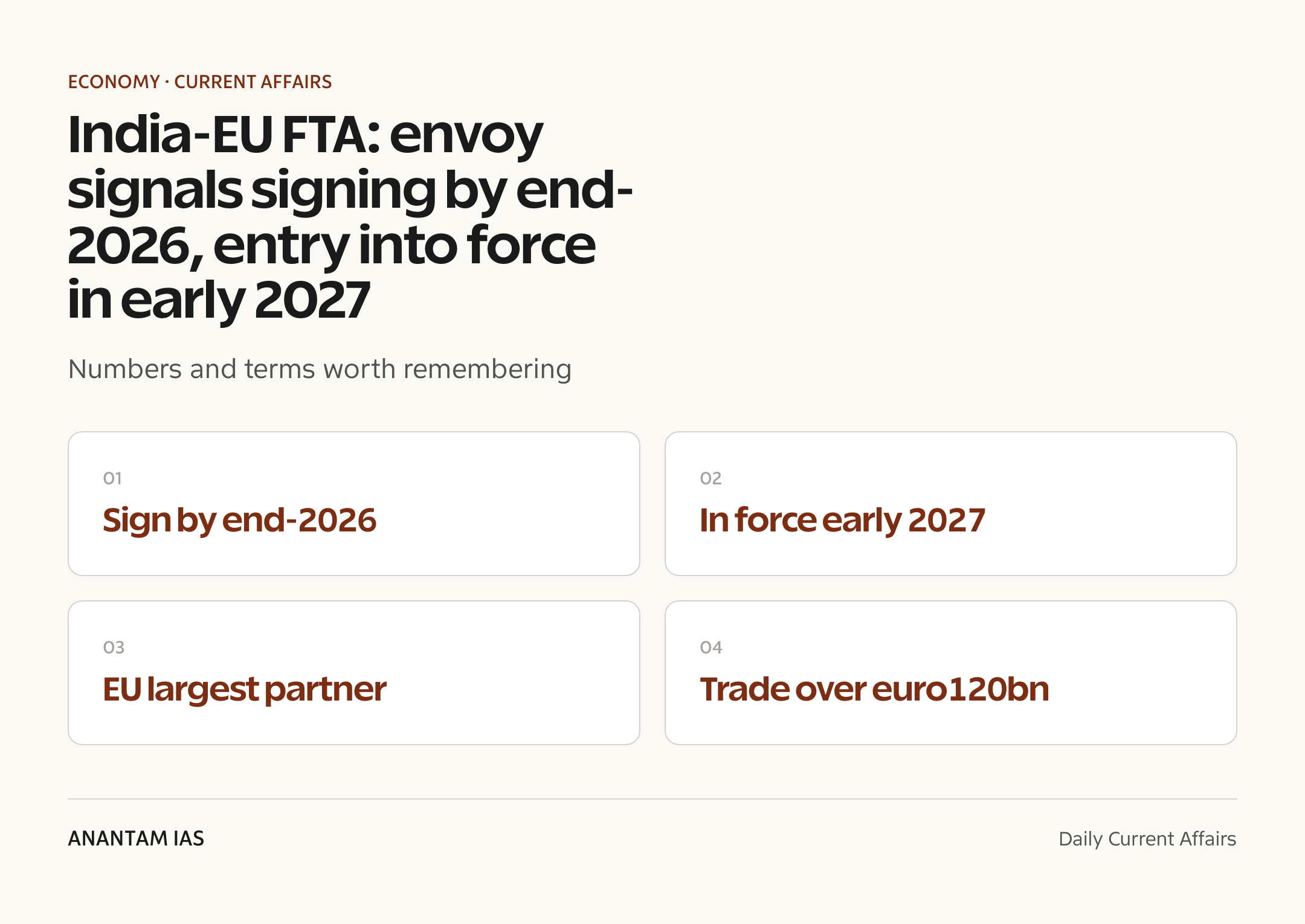
In an interview reported by the Indian Express and ThePrint in early July 2026, the European Union‘s Ambassador to India, Herve Delphin, said New Delhi and Brussels aim to sign the India-EU Free Trade Agreement (FTA) by the end of 2026 and bring it into force in early 2027, likely the first quarter.
Delphin framed the pact as a joint choice of openness over protectionism at a time of tariff wars and fractured supply chains, with the Carbon Border Adjustment Mechanism (CBAM), investment liberalisation and professional mobility flagged as the live threads still being settled before signature.
- Negotiations on the India-EU FTA were formally concluded in late January 2026; the text is now in legal scrubbing (legal vetting) and translation into EU languages before signing.
- Target sequence: signature by end-2026, then ratification, then entry into force in Q1 2027.
- The EU is India’s largest trading partner, with bilateral goods trade of over euro 120 billion in 2024 that both sides want to roughly double.
- The EU is set to liberalise nearly all (about 99.5%) of its tariff lines for Indian goods; India opens about 96.6% of its tariff lines to EU goods, phased over years.
- Delphin said any future changes to CBAM would be applied ‘in the context of India as well’, and pointed to a euro 500 million EU package to support India’s decarbonisation.
The development matters in the context of:
- This is India’s largest pending trade pact by combined GDP and population, and its most demanding on regulatory standards.
- It lands amid a broader Indian FTA push — the India-UK CETA, India-EFTA TEPA and an interim India-US framework — signalling a shift from India’s older protectionist reflex toward calibrated openness.
UPSC Relevance
Prelims Relevance
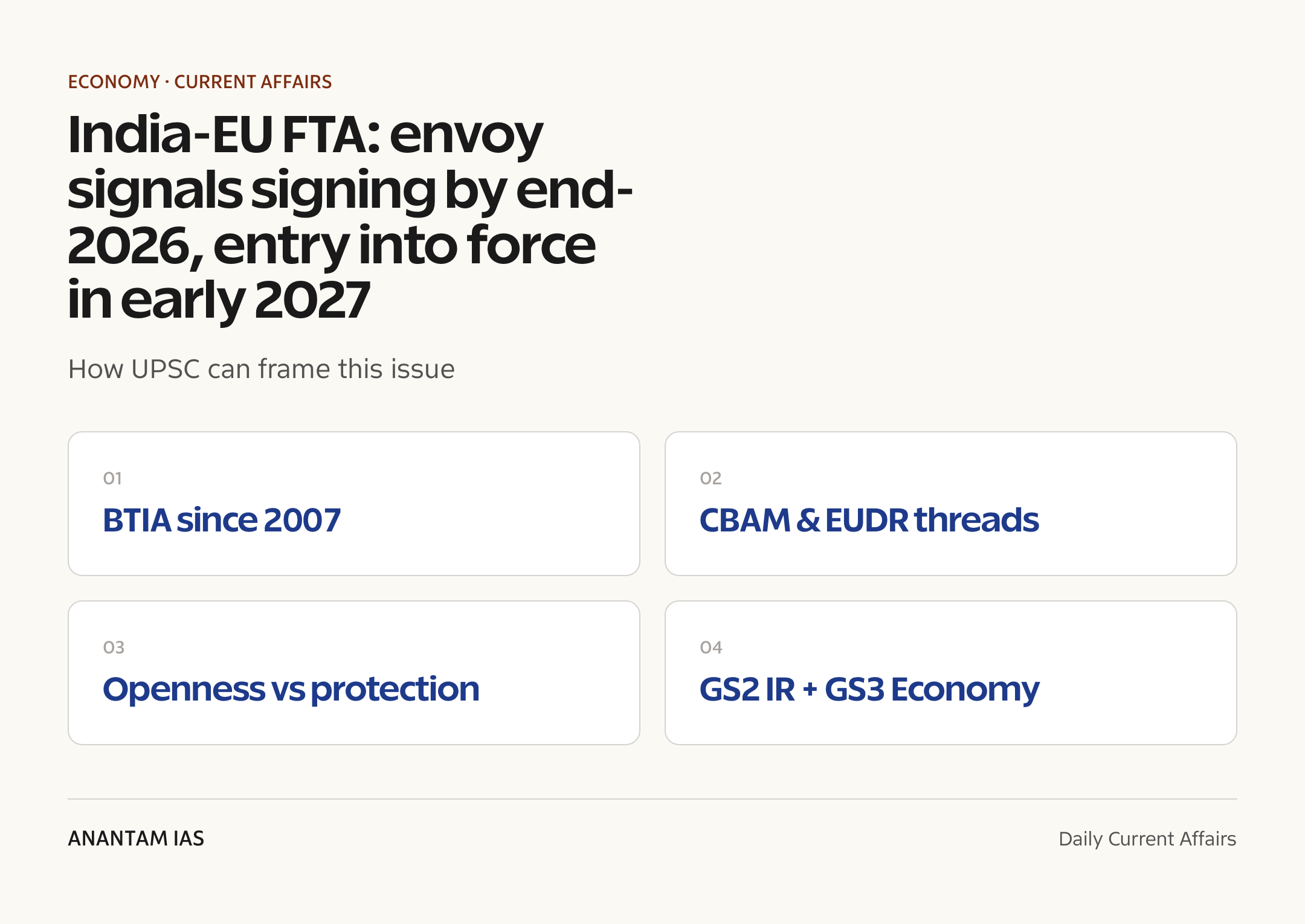
- India-EU FTA negotiations concluded January 2026; began as the BTIA (Broad-based Trade and Investment Agreement) in 2007.
- BTIA launched 2007, stalled 2013, relaunched June 2022 on three tracks: a trade FTA, a separate Investment Protection Agreement (IPA), and a Geographical Indications (GI) agreement.
- The EU is India’s largest trading partner; a customs union and single market of 27 member states.
- CBAM — Carbon Border Adjustment Mechanism — enters its definitive regime from 2026; covers cement, iron and steel, aluminium, fertilisers, electricity and hydrogen.
- EUDR — EU Deforestation Regulation — a non-tariff measure; enforcement pushed to 30 December 2026 (large/medium) and 30 June 2027 (small/micro).
- Mode 4 of trade in services covers movement of natural persons — the basis of professional mobility commitments.
- ‘Legal scrubbing‘ is the legal-linguistic review of an agreed treaty text before signature.
- EU Ambassador to India: Herve Delphin.
Mains Relevance
GS Paper 2
- India and the developed world: features and challenges of the India-EU strategic and trade partnership.
- Bilateral and regional groupings involving India and their impact on India’s interests.
GS Paper 3
- Effects of liberalisation on the economy; impact of a high-standard FTA on Indian industry, MSMEs and agriculture.
- CBAM and green trade barriers as challenges to India’s exports and its decarbonisation pathway.
Essay
- Openness versus protectionism: rules-based trade in an age of tariff walls.
- Trade and the climate: when a carbon border tax reshapes development.
Background and Context
From BTIA to breakthrough: a two-decade road
The FTA is the long-delayed successor to talks first launched almost twenty years ago.
- Negotiations began in 2007 in Brussels as the Broad-based Trade and Investment Agreement (BTIA), covering goods, services, investment and intellectual property.
- Talks stalled in 2013 over autos and wines-and-spirits tariffs, services access, data and agriculture, and stayed frozen for nearly a decade.
- Leaders agreed to relaunch in 2021, and negotiations formally resumed in June 2022 on three parallel tracks — a trade FTA, a separate Investment Protection Agreement, and a Geographical Indications pact.
- Negotiations were concluded in late January 2026, a landmark our note on the India-EU FTA conclusion covers in detail.
What Delphin actually signalled
The envoy’s message was about sequencing and intent, not fresh concessions.
- Ambassador Herve Delphin said the two sides can ‘confidently look at early 2027’ for entry into force, with signing targeted by end-2026.
- Between conclusion and signature the text goes through legal scrubbing and translation into all EU official languages, then ratification.
- He cast the deal as India and the EU having ‘chosen openness over protectionism‘, an implicit contrast with rising unilateral tariffs elsewhere.
- On the sticking points, he stressed dialogue: future CBAM tweaks would be weighed ‘in the context of India as well’, not imposed in isolation.
Scale and stakes: India's biggest pact
The economics explain why this is called the mother of all trade deals.
- The EU is India’s largest trading partner; bilateral goods trade topped euro 120 billion in 2024, with large services and investment flows on top.
- The EU is set to remove duties on nearly all — about 99.5% — of tariff lines for Indian goods; India liberalises roughly 96.6% of its lines for EU goods, phased in over years.
- India has opened over 100 services subsectors to EU firms across finance, telecom and maritime, alongside a structured professional mobility framework for Indian workers.
- Gains are expected in textiles, pharma, leather, engineering goods and IT/ITeS; sensitivities remain in dairy, autos and wines-and-spirits.
The live threads: CBAM, EUDR and non-tariff barriers
The hardest issues are the EU’s green rules, which sit outside the tariff schedule.
- The Carbon Border Adjustment Mechanism (CBAM) enters its definitive regime from 2026, forcing importers to surrender certificates for the embedded carbon in steel, aluminium, cement, fertilisers, electricity and hydrogen.
- India — the largest supplier of iron and steel to the EU — sees CBAM as a unilateral non-tariff barrier that could erode the very tariff gains the FTA delivers; our explainer on the Carbon Border Adjustment Mechanism details the design.
- Delphin pointed to a euro 500 million EU programme to help India decarbonise hard-to-abate sectors — steel, cement, renewables, grids, storage and green hydrogen.
- The EU Deforestation Regulation (EUDR) is a second green hurdle for coffee, leather and agri exports; its enforcement has been delayed to 30 December 2026 for larger firms and 30 June 2027 for small operators.
Investment, mobility and data
Several threads sit alongside the FTA rather than inside it.
- A separate Investment Protection Agreement (IPA) is still being negotiated; the main FTA does not carry comprehensive investor protection.
- Investment liberalisation and a predictable dispute-settlement mechanism are what EU investors most want before committing at scale.
- Mobility — easier movement of Indian professionals and mutual recognition of qualifications — is a headline Indian ask under services Mode 4.
- Data adequacy (whether the EU recognises India’s data-protection regime under the DPDP Act, 2023) shapes how freely digital and services trade can flow.
Strategic context: de-risking and diversification
The pact is as much geopolitics as commerce.
- For the EU, the deal is part of de-risking from China and building resilient supply chains under a ‘China-plus-one’ logic.
- For India, it locks in market access and standards partners amid US tariff turbulence and a wider FTA drive.
- It sits in a run of Indian deals — the India-UK CETA, the India-EFTA TEPA (a separate bloc of Switzerland, Norway, Iceland and Liechtenstein — not the EU), and an interim India-US framework.
- A concluded EU pact would give India a rules-based anchor with a market of about 450 million high-income consumers.
Way Forward
Close the green-trade gap
- Push for CBAM equivalence — recognition of India’s carbon-pricing and reporting so Indian exporters are not double-charged — and deploy the euro 500 million package to cut real emissions in steel and cement.
- Build domestic MRV (measurement, reporting, verification) capacity so MSME exporters can comply with CBAM and EUDR without being priced out.
Lock in investment and mobility
- Conclude the parallel Investment Protection Agreement quickly to convert market access into actual factory-and-jobs investment.
- Secure firm Mode 4 mobility and qualification-recognition commitments, and pursue an EU data-adequacy decision for India.
Protect the sensitive downside: phase in tariff cuts on dairy, autos and wines-and-spirits with adequate transition periods, and pair the FTA with domestic competitiveness reforms so Indian MSMEs and farmers gain rather than lose from openness.
Conclusion
The India-EU FTA has moved from a two-decade negotiating saga to a concrete calendar: sign by end-2026, in force by early 2027. Ambassador Delphin’s framing — openness over protectionism — captures why both sides want it closed while the global trading order is fraying.
The real test is not the tariff schedule but the fine print — CBAM, EUDR, investment protection, mobility and data. Handled well, the pact anchors India to a high-standard, rules-based market and speeds up its own reform and decarbonisation. Handled poorly, green non-tariff barriers could quietly claw back the gains the tariff cuts promise.
UPSC Practice Questions
Prelims MCQ 1
With reference to the India-EU Free Trade Agreement, consider the following statements:
- Negotiations for it began in 2007 as the Broad-based Trade and Investment Agreement (BTIA).
- It was formally concluded in January 2026 and awaits legal scrubbing and signature.
- The European Union is India’s largest trading partner.
How many of the above statements are correct?
(a) Only one (b) Only two (c) All three (d) None
Answer: (c) All three
Explanation:
BTIA talks began in 2007, stalled in 2013 and were relaunched in 2022; negotiations concluded in January 2026 and the text is in legal scrubbing. The EU is India’s largest trading partner. All three statements are correct.
Prelims MCQ 2
The Carbon Border Adjustment Mechanism (CBAM), relevant to India-EU trade, is best described as:
(a) A domestic carbon tax levied by India on its imports (b) An EU levy on the embedded carbon of certain imported goods such as steel and cement (c) A World Trade Organization subsidy for green exporters (d) A United Nations fund for climate adaptation
Answer: (b) An EU levy on the embedded carbon of certain imported goods such as steel and cement
Explanation:
CBAM requires EU importers to surrender certificates matching the embedded emissions of covered goods (iron and steel, aluminium, cement, fertilisers, electricity, hydrogen), so India, a top steel supplier to the EU, treats it as a non-tariff barrier.
UPSC Mains Questions
- The India-EU FTA is described as India’s most demanding trade pact yet. Discuss the opportunities it offers and the challenges posed by non-tariff barriers such as CBAM and the EU Deforestation Regulation. (250 words)
- ‘India has chosen calibrated openness over protectionism.’ Examine this shift in the light of India’s recent free trade agreements and its implications for domestic industry and workers. (250 words)
Sources: Indian Express (interview with EU Ambassador Herve Delphin) and ThePrint.
Frequently Asked Questions
When will the India-EU FTA come into force?
EU Ambassador Herve Delphin said in July 2026 that both sides aim to sign the agreement by the end of 2026, after which it goes through ratification. He expects it to enter into force in early 2027, most likely the first quarter, once legal scrubbing and translation are complete.
How is the India-EU FTA different from the India-EFTA TEPA?
They involve different blocs. The FTA is with the 27-member European Union. The TEPA (Trade and Economic Partnership Agreement) is with EFTA — Switzerland, Norway, Iceland and Liechtenstein, which are not EU members. TEPA is already signed and carries a distinct 15-year, 100-billion-dollar investment pledge.
What is CBAM and why does India object to it?
The Carbon Border Adjustment Mechanism is an EU levy on the embedded carbon of imports like steel, aluminium and cement, entering its definitive phase from 2026. India, the EU’s largest steel supplier, sees it as a unilateral non-tariff barrier that could offset the tariff cuts the FTA offers.
What does ‘openness over protectionism’ mean here?
It is Delphin’s framing that India and the EU have chosen to deepen rules-based, negotiated trade integration at a time when many economies are raising tariffs and turning inward. It signals India’s move from an older protectionist stance toward calibrated, high-standard liberalisation.
Is investment protection part of the FTA?
Not directly. The main FTA covers trade in goods and services and market access. A separate Investment Protection Agreement is still being negotiated to give EU and Indian investors stronger protections and a dispute-settlement mechanism.
How big is India-EU trade?
The EU is India’s largest trading partner. Bilateral goods trade crossed about 120 billion euro in 2024, alongside substantial services and investment flows, and both sides want to roughly double goods trade over the coming years.