Floating Solar: India’s First National Assessment Maps 102 GW Potential
Why in News?
The Ministry for New and Renewable Energy recently released the report ‘Solar PV Potential of India (Floating Solar)’ — the first comprehensive national assessment of floating-solar potential, prepared by the National Institute of Solar Energy (NISE), an autonomous body under the Ministry of New and Renewable Energy (MNRE).
The 121-page assessment estimates India’s reservoirs can host about 102.18 GWp of floating-solar capacity, framing water-mounted panels as a way around the sector’s most intractable obstacle — land.
- NISE screened 11,197 inland waterbodies and found 682 technically feasible, covering 1,946 sq km of usable surface.
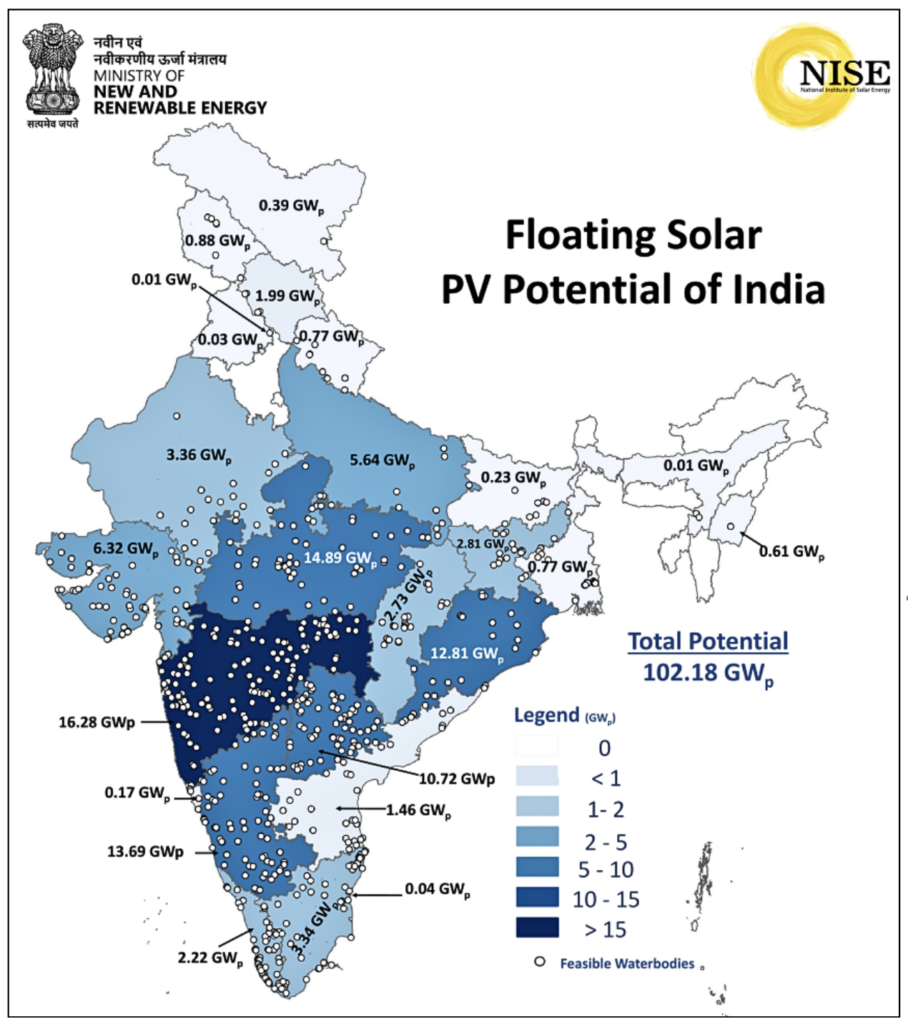
- Maharashtra leads with 16.28 GW, followed by Madhya Pradesh (14.89 GW), Karnataka (13.69 GW), Odisha (12.81 GW) and Telangana (10.72 GW).
- Added to last year’s land-based estimate of 3,343 GWp, India’s total assessed solar potential now stands at 3,445 GWp.
- MNRE said it is working on a dedicated programme to promote floating-solar deployment nationwide.
- Secretary Santosh Kumar Sarangi said MNRE is in talks with the Finance Ministry to promote floating solar and agri-photovoltaics.
The development matters in the context of:
- Floating solar matters because land acquisition — costly, slow and conflict-prone — is a chokepoint for India’s target of 500 GW non-fossil capacity by 2030.
- It supports India’s Panchamrit commitments and the goal of net-zero by 2070 announced at COP26.
- Ground-mounted solar needs three to four times more area per megawatt than the panels themselves occupy; floating solar is ‘land neutral’.
UPSC Relevance
Prelims Relevance
- NISE — National Institute of Solar Energy, an autonomous body under MNRE, is the nodal agency for solar potential assessment.
- Report title: ‘Solar PV Potential of India (Floating Solar)’; released in June 2026.
- Floating-solar potential: 102.18 GWp; total assessed solar potential: 3,445 GWp.
- Six geospatial filters: waterbodies >10 ha; water for >=11 months/year; depth 3-30 m; irradiance >4.5 kWh/m2/day; within 10 km of roads and substations.
- Self-imposed cap of 20% of any reservoir’s surface area.
- Largest plant: Omkareshwar floating solar park on the Narmada (Khandwa, Madhya Pradesh), 278 MW, scaling to 600 MW.
- India’s non-fossil target: 500 GW by 2030; net-zero by 2070.
- Global floating solar reached about 9.6 GW by 2024, nearly 90% of it in Asia; China leads.
Mains Relevance
GS Paper 3
- Land-saving renewable technologies and the land-acquisition chokepoint in India’s clean-energy transition.
- Energy security, the 500 GW non-fossil target, and the role of geospatial assessments in resource mapping.
GS Paper 3
- Environmental trade-offs of floating solar — evaporation reduction versus aquatic-ecosystem and reservoir-use impacts.
GS Paper 2
- Centre-state coordination and dedicated schemes for deploying clean-energy infrastructure on shared water resources.
Essay
- Innovation and the energy transition — turning constraints (scarce land) into opportunity.
- Development versus environment: harnessing water surfaces without harming ecosystems.
Background and Context
What floating solar is and why it matters
Floating photovoltaic (FPV) systems mount solar panels on pontoons over reservoirs and lakes instead of on land.
- Panels float on buoyant structures anchored to the reservoir bed or banks, with cabling routed to onshore substations.
- Chief advantage is being ‘land neutral’ — no land acquisition, sidestepping a slow, costly process prone to conflict with agriculture and habitation.
- Co-benefits include reduced evaporation from covered water surfaces and a cooling effect that can lift panel efficiency.
- It also unlocks idle assets — dam reservoirs, irrigation tanks and quarry lakes — for clean-energy generation near existing grid infrastructure.
How NISE arrived at 102 GWp
NISE passed India’s inland waterbodies through six geospatial filters to isolate feasible sites.
- Filters: lakes/reservoirs larger than 10 hectares; water present for at least 11 months a year; depths between 3 and 30 metres.
- Solar irradiance above 4.5 kWh/m2/day; located within 10 km of both roads and substations.
- A self-imposed cap of 20% of any reservoir’s surface to limit ecological and usage conflict.
- Method demonstrated on Odisha’s Hirakud reservoir, where 499 sq km of water was whittled to 99.5 sq km of usable surface.
- Applied nationwide, the filters yielded 1,946 sq km of feasible area across 682 of 11,197 waterbodies, translating to 102.18 GW.
Where the potential lies
Five states account for the bulk of the assessed capacity.
- Maharashtra — 16.28 GW (highest);
- Madhya Pradesh — 14.89 GW.
- Karnataka — 13.69 GW;
- Odisha — 12.81 GW;
- Telangana — 10.72 GW.
- Combined with the 2025 land-based estimate of 3,343 GWp, India’s total assessed solar potential is now 3,445 GWp.
- Mercom India reported MNRE is preparing a dedicated floating-solar programme and discussing fiscal support with the Finance Ministry.
Where it fits in India’s energy goals
Floating solar is positioned to relieve the land bottleneck in India’s renewable push.
- Ground-mounted solar dominates India’s roughly 100 GW of installed solar, but it needs three to four times more area per megawatt than the panels occupy.
- Land acquisition remains a chokepoint as India pursues 500 GW non-fossil capacity by 2030.
- Non-fossil capacity has risen from 81 GW in 2014 to about 288 GW, with solar growing from 2.8 GW to roughly 155 GW (per MNRE figures cited by Mercom).
- Floating solar dovetails with agri-photovoltaics, the other land-saving model MNRE is promoting.
The catch — cost, durability and ecology
The assessment flags real-world hurdles that temper the headline number.
- The 121-page report contains no cost estimate for realising the potential; its only reference is a 2021 US NREL benchmark that floating plants cost about 25% more upfront than ground-mounted ones (floats, anchoring, waterproofing).
- Field observations at the flagship Omkareshwar park (278 MW on the Narmada, Khandwa, MP) recorded loosening float joints, misaligned platforms, uneven buoyancy and broken electric cables.
- Covering reservoir surfaces raises questions on aquatic ecosystems, oxygen exchange, fisheries and competing water uses — so the 20% cap.
- Anchoring in variable-depth reservoirs and long-term durability in monsoon conditions remain engineering challenges.
Global picture
India’s move follows a fast-maturing but still small global market.
- Global floating solar reached about 9.6 GW by 2024, nearly 90% of it in Asia.
- China leads, including a 120 MW plant on a fish farm at Poyang Lake.
- Singapore’s 1 MW Tengeh reservoir testbed has supplied much of the field’s performance data.
- The Netherlands accounts for roughly three-fourths of Europe’s capacity, built largely on quarry lakes.
Way Forward
Build a costed scheme
- Pair the dedicated floating-solar programme with viability-gap funding and a clear cost-benefit framework, given the ~25% upfront premium.
- Standardise floats, anchoring and cabling specifications to prevent the failures seen at Omkareshwar.
Safeguard ecosystems
- Retain the 20% surface cap and mandate environmental and social impact assessments for fisheries, irrigation and biodiversity.
- Run long-term monitoring of water quality and aquatic life on pilot reservoirs.
Strengthen domestic capacity
- Leverage India’s expanding module manufacturing to localise FPV components and reduce import dependence.
- Train local technicians and developers for water-based O&M, which differs from ground-mount maintenance.
Integrate floating solar with hybrid hydro-solar plants at dam reservoirs to use shared evacuation infrastructure and balance variable generation.
Conclusion
The NISE assessment converts a long-discussed idea into a mapped, quantified resource — 102 GWp that needs no farmland — and gives planners a credible basis for a national programme.
Whether it scales depends on closing the cost, durability and ecological gaps the report itself acknowledges. With states like Maharashtra and Madhya Pradesh holding the bulk of the potential, the next test is turning geospatial promise into bankable, well-engineered projects.
UPSC Practice Questions
Prelims MCQ 1
With reference to the 2026 NISE assessment of India’s floating-solar potential, consider the following statements:
- It was prepared by the National Institute of Solar Energy, an autonomous body under the Ministry of New and Renewable Energy.
- It estimated India’s floating-solar potential at over 100 GWp.
- Maharashtra was assessed to have the highest floating-solar potential among states.
How many of the above statements are correct?
(a) Only one (b) Only two (c) All three (d) None
Answer: (c) All three
Explanation:
NISE (under MNRE) prepared ‘Solar PV Potential of India (Floating Solar)’, estimating about 102.18 GWp, with Maharashtra leading at 16.28 GW. All three statements are correct.
Prelims MCQ 2
Which of the following was NOT one of the geospatial filters NISE used to identify feasible floating-solar sites?
(a) Waterbodies larger than 10 hectares
(b) Water present for at least 11 months a year
(c) Water depth between 3 and 30 metres
(d) Location within 50 km of a major airport
Answer: (d) Location within 50 km of a major airport
Explanation:
NISE’s filters were area (>10 ha), water availability (>=11 months), depth (3-30 m), irradiance (>4.5 kWh/m2/day) and proximity within 10 km of roads and substations. Airport proximity was not a criterion.
UPSC Mains Questions
- Land acquisition has become a key chokepoint in India’s renewable-energy expansion. Examine how floating solar and agri-photovoltaics can ease this constraint, and discuss the cost, durability and ecological challenges they face. (250 words)
- Geospatial assessments are reshaping how India maps its natural resources. With reference to the first national floating-solar assessment, discuss the value and limitations of such resource-potential studies in clean-energy planning. (150 words)
Sources: The Hindu and Mercom India.
Frequently Asked Questions
What is floating solar?
Floating solar, or floating photovoltaics (FPV), mounts solar panels on buoyant structures over reservoirs, lakes and other waterbodies instead of on land. The panels are anchored to the bed or banks, and power is routed to onshore substations. It avoids land acquisition and can reduce water evaporation while cooling the panels.
How much floating-solar potential did NISE estimate?
The National Institute of Solar Energy’s first national assessment, released on 10 June 2026, estimated about 102.18 GWp of floating-solar potential. It screened 11,197 inland waterbodies and found 682 feasible, covering 1,946 sq km of usable surface.
Which state has the highest floating-solar potential?
Maharashtra leads with 16.28 GW, followed by Madhya Pradesh (14.89 GW), Karnataka (13.69 GW), Odisha (12.81 GW) and Telangana (10.72 GW). Together these five states account for most of the assessed national potential.
What filters did NISE use to identify feasible sites?
NISE used six geospatial filters: waterbodies larger than 10 hectares, water present for at least 11 months a year, depths of 3-30 metres, solar irradiance above 4.5 kWh/m2/day, and locations within 10 km of both roads and substations. It also capped use at 20% of any reservoir’s surface.
Why is floating solar important for India?
Ground-mounted solar needs three to four times more area per megawatt than the panels occupy, and land acquisition is slow, costly and conflict-prone. Floating solar is ‘land neutral’, helping India pursue its target of 500 GW of non-fossil capacity by 2030 without competing for farmland.
What are the main challenges of floating solar?
Floating plants cost about 25% more upfront than ground-mounted ones owing to floats, anchoring and waterproofing. Field observations at the 278 MW Omkareshwar park recorded loosening float joints, misaligned platforms and broken cables. Covering reservoirs also raises ecological and competing water-use concerns.