India-France Strategic Partnership: What Underpins the Ties as PM Visits Paris
Why in News?
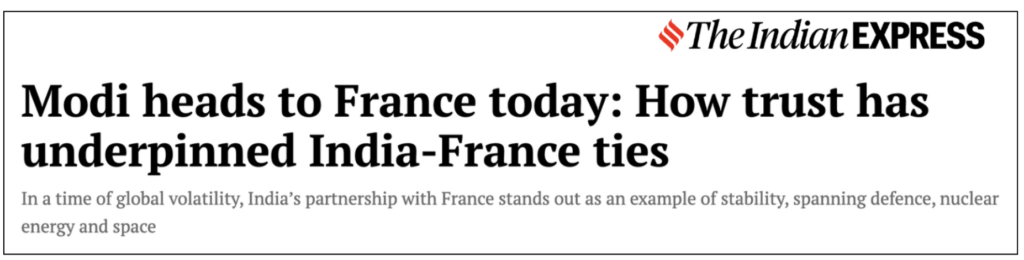
The Prime Minister travelled to Paris for a fresh bilateral summit with the French leadership, refreshing one of India’s oldest and most trusted strategic relationships and reviewing progress across its full spectrum of cooperation.
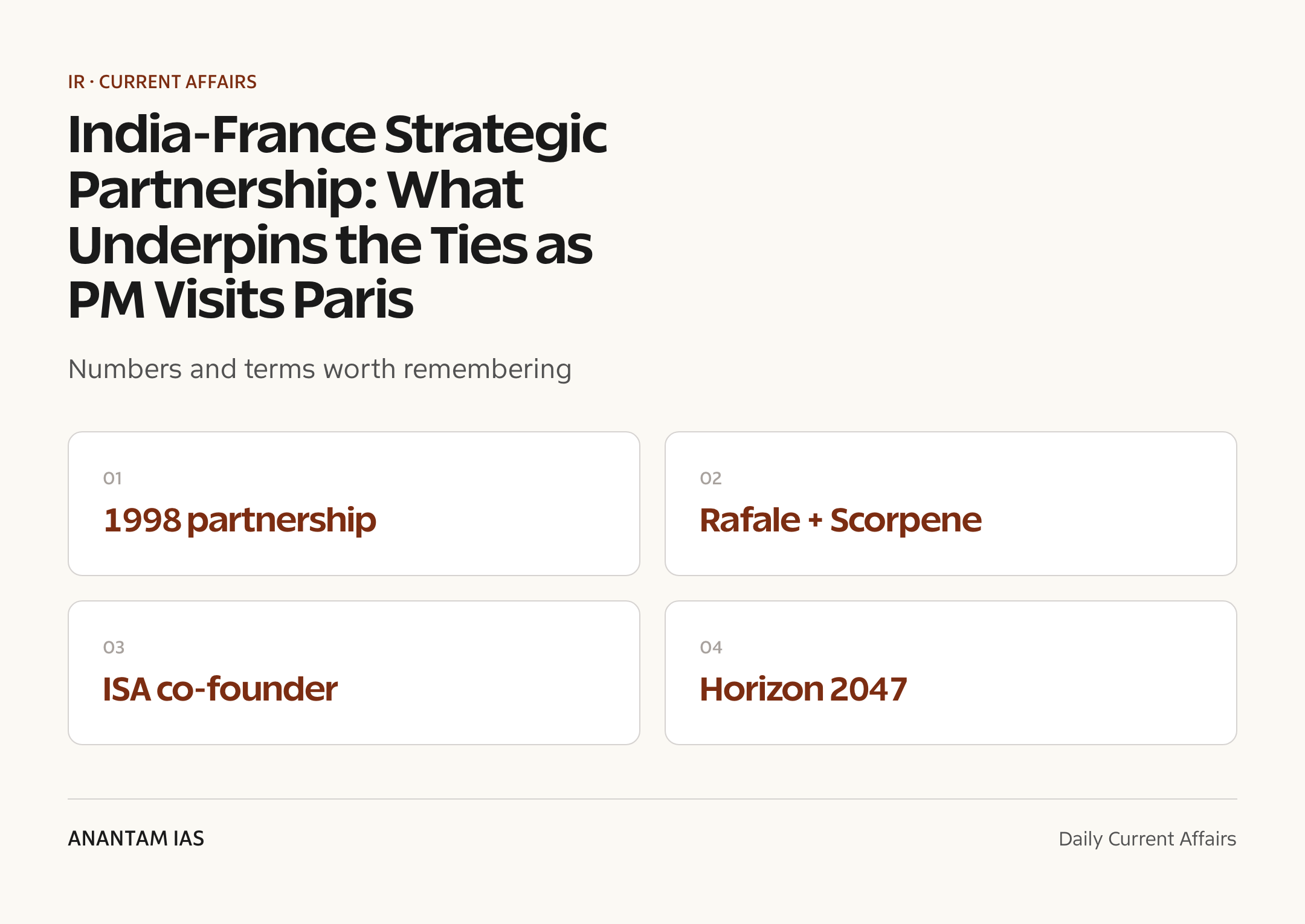
France was the first country with which India signed a Strategic Partnership agreement in 1998, soon after the Pokhran-II nuclear tests, when Paris broke from the Western consensus and chose engagement over sanctions.
- The relationship rests on a long-term roadmap, Horizon 2047, adopted in 2023 to mark a century of partnership leading up to India’s centenary of independence.
- France is among India’s top arms suppliers, having sold the Rafale fighter, Scorpene submarines and earlier Mirage 2000 jets.
- Both countries are co-founders of the International Solar Alliance (ISA), launched at the 2015 Paris climate conference.
- France has consistently backed India’s bid for permanent membership of a reformed UN Security Council and entry into export-control regimes.
The development matters in the context of:
- France is a resident power in the Indo-Pacific, with island territories such as Reunion and a large exclusive economic zone, making it a natural maritime partner for India.
- Unlike many Western capitals, Paris has rarely linked defence and technology cooperation with India to political conditions, building durable strategic trust.
UPSC Relevance
Prelims Relevance
- India-France Strategic Partnership signed in 1998 — India’s first such partnership.
- Horizon 2047 roadmap (adopted 2023) — long-term India-France cooperation framework.
- International Solar Alliance — co-launched by India and France in 2015; headquartered at Gurugram.
- Rafale (Dassault), Scorpene submarines (Naval Group, Project-75), Mirage 2000 — French-origin platforms in Indian service.
- CNES is France’s space agency; it partners with ISRO on missions like Megha-Tropiques, SARAL/AltiKa and TRISHNA.
- Varuna (navy), Garuda (air force) and Shakti (army) are the three India-France bilateral military exercises.
- France is a P5 member of the UN Security Council and supports India’s permanent seat.
- France backed India’s entry into the MTCR, Wassenaar Arrangement and Australia Group, and supports NSG membership.
Mains Relevance
GS Paper 2
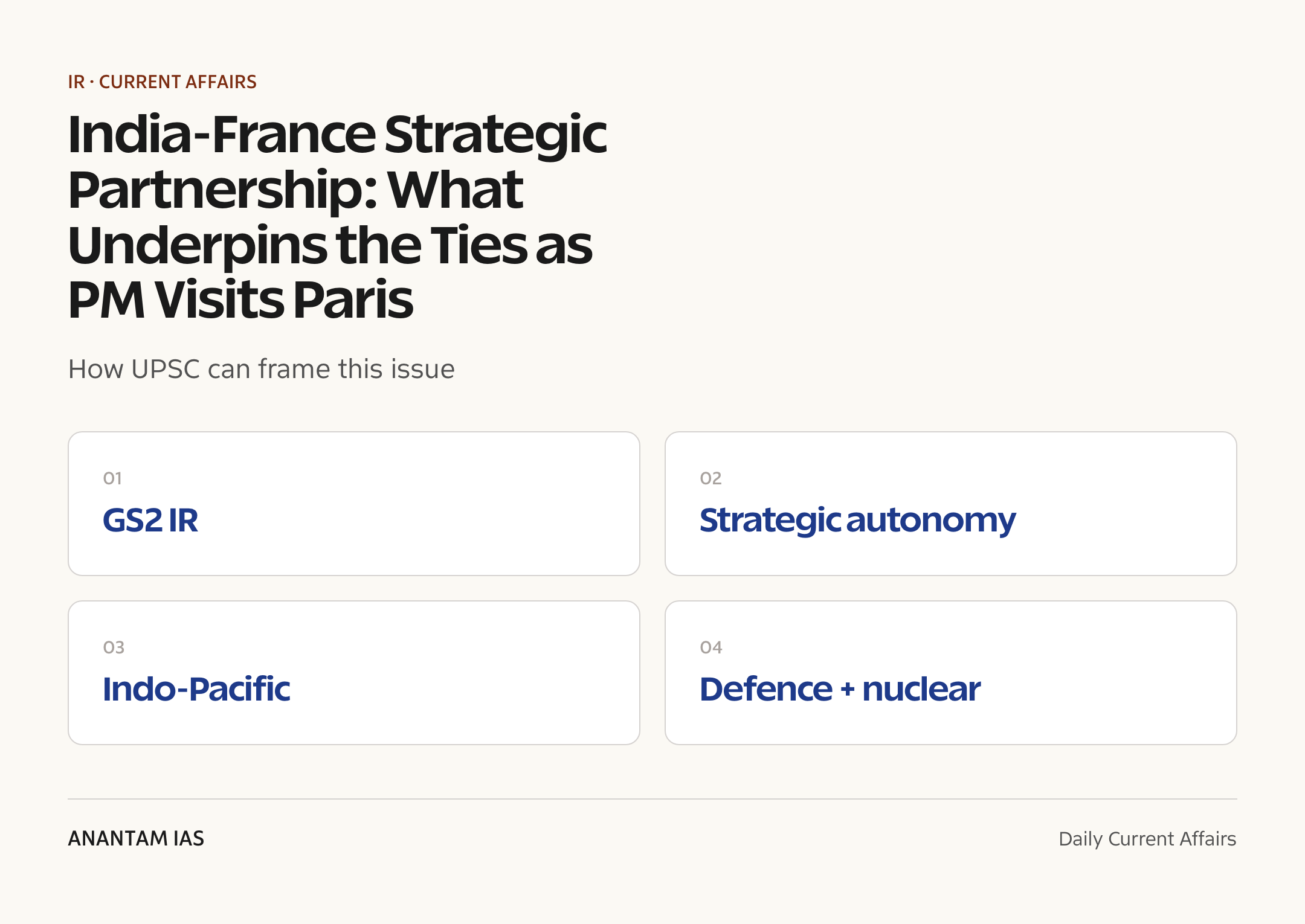
- India-France ties are a model of a strategic autonomy-friendly partnership in a multipolar world.
- Significance of France in India’s Indo-Pacific strategy and defence indigenisation push.
GS Paper 3
- Defence cooperation and ‘Make in India’ technology transfer through French platforms.
- Civil nuclear and space cooperation as drivers of high-technology self-reliance.
Essay
- Trust as the currency of durable international partnerships in a multipolar world.
Background and Context
Why France is a trusted partner
The relationship is built on convergence and a consistent refusal by Paris to apply external pressure on Delhi.
- France did not impose sanctions after the Pokhran-II tests in 1998 and instead pushed for dialogue, unlike the United States and several others.
- It became the first Western power to sign a formal Strategic Partnership with India in the same year.
- Both are strategically autonomous democracies wary of a single dominant pole, which aligns their worldviews.
- France has rarely conditioned defence or nuclear cooperation on India’s internal politics, a key source of strategic trust.
The defence pillar
Defence is the most visible strand, spanning aircraft, submarines and a growing ‘Make in India’ agenda.
- Dassault Rafale jets serve in the Indian Air Force, with a follow-on order of Rafale-Marine for the Navy’s carriers.
- Scorpene-class submarines are built at Mazagon Dock under Project-75 with France’s Naval Group, with additional units agreed.
- Earlier inductions include the Mirage 2000 fighter and the Jaguar engines, embedding French technology in India’s fleet.
- The two armed forces hold three bilateral exercises — Varuna (naval), Garuda (air) and Shakti (army).
- Co-development and technology transfer — including aero-engine and submarine-tech talks — anchor India’s defence indigenisation drive.
Civil nuclear and space
High-technology cooperation extends from atomic energy to Earth observation and human spaceflight.
- France’s EDF is the technology partner for the proposed Jaitapur nuclear plant in Maharashtra — envisaged among the world’s largest, with six EPR reactors.
- ISRO and France’s space agency CNES have a decades-long partnership, including the Megha-Tropiques and SARAL/AltiKa satellites.
- The upcoming TRISHNA mission will study land-surface temperature and the water cycle for climate research.
- France has supported India’s Gaganyaan human-spaceflight programme, including flight-physiology and mission-support cooperation.
Indo-Pacific and maritime convergence
France is a resident Indo-Pacific power, giving the partnership a strong maritime and strategic dimension.
- French island territories such as Reunion and New Caledonia give Paris a permanent presence and a vast exclusive economic zone in the region.
- India and France run a trilateral with the UAE and have explored maritime coordination with Australia.
- Shared goals include freedom of navigation, a rules-based order and keeping sea lanes open against coercion.
- Logistics and information-sharing arrangements let the two navies operate together across the Indian Ocean Region.
Trade, climate and diaspora
Beyond hard security, the relationship spans clean energy, mobility and people-to-people links.
- India and France co-founded the International Solar Alliance at the 2015 Paris climate summit to scale up solar deployment.
- France is a significant European source of foreign direct investment into India across infrastructure, energy and aerospace.
- A migration and mobility partnership eases the movement of students and skilled professionals, including post-study work pathways.
- Counter-terrorism cooperation is institutionalised, with shared concern over cross-border terrorism and intelligence exchange.
The Horizon 2047 roadmap
A long-term blueprint adopted in 2023 sets the agenda toward India’s centenary of independence.
- Horizon 2047 organises cooperation around security and sovereignty, the planet, and people-to-people ties.
- It targets deeper defence co-production, expanded space links and joint work on clean energy and critical technologies.
- Companion frameworks cover the Indo-Pacific and a ‘roadmap on cyber security and digital technology’.
- The roadmap frames France as a durable partner in India’s pursuit of strategic autonomy in a multipolar order.
Way Forward
Deepen co-production
- Convert platform purchases into genuine technology transfer and joint manufacturing under ‘Make in India’, especially in aero-engines and submarines.
- Sustain a stable industrial pipeline so Indian firms can absorb high-end defence technology.
Operationalise the Indo-Pacific
- Move trilaterals with the UAE and partners from declarations to regular joint patrols, exercises and capacity-building for smaller states.
- Coordinate on maritime-domain awareness across the Indian Ocean.
Close the gap between ambition and delivery on the Jaitapur nuclear project and large trade flows, so that the strategic warmth translates into commercial and energy outcomes commensurate with the partnership’s depth.
Conclusion
The India-France relationship shows how shared belief in strategic autonomy and a multipolar world can sustain trust across changing governments and global shocks.
A fresh summit refreshes a high-yield bilateral whose real test now is execution — turning the Horizon 2047 vision into delivered platforms, plants and patrols rather than headline agreements.
UPSC Practice Questions
Prelims MCQ 1
With reference to India-France defence and technology cooperation, consider the following statements:
- France was the first country with which India signed a Strategic Partnership agreement.
- Scorpene-class submarines are built in India in cooperation with France’s Naval Group.
- CNES is the French agency that partners with ISRO on space missions.
How many of the above statements are correct?
(a) Only one (b) Only two (c) All three (d) None
Answer: (c) All three
Explanation:
India signed its first Strategic Partnership with France in 1998. Scorpene submarines are built at Mazagon Dock with Naval Group under Project-75. CNES is France’s space agency and a long-standing ISRO partner.
Prelims MCQ 2
The International Solar Alliance, co-founded by India and France, was launched on the sidelines of which event?
(a) The 2015 Paris Climate Conference (COP21)
(b) The 2002 Johannesburg Earth Summit
(c) The 2009 Copenhagen Climate Conference
(d) The 1992 Rio Earth Summit
Answer: (a) The 2015 Paris Climate Conference (COP21)
Explanation:
The ISA was launched by India and France at COP21 in Paris in 2015 to promote solar energy deployment; it is headquartered in Gurugram, India.
UPSC Mains Questions
- The India-France partnership is often described as one founded on strategic trust. Examine the factors that have made France a durable strategic partner for India, and assess the main pillars of this cooperation. (250 words)
- Discuss how the India-France relationship advances India’s goals of strategic autonomy, defence indigenisation and a stable Indo-Pacific. What challenges constrain the realisation of its full potential? (250 words)
- How do long-term roadmaps such as Horizon 2047 shape the trajectory of India’s strategic partnerships? Illustrate with the India-France example. (150 words)
Sources: Indian Express Explained and Ministry of External Affairs.
Frequently Asked Questions
When did India and France become strategic partners?
India and France signed a Strategic Partnership in 1998, India’s first such agreement with any country. It came soon after the Pokhran-II nuclear tests, when France chose engagement over sanctions, setting the tone for a relationship built on strategic trust and a shared belief in a multipolar world.
What is the Horizon 2047 roadmap?
Horizon 2047 is a long-term India-France cooperation roadmap adopted in 2023, looking ahead to India’s centenary of independence in 2047. It organises the partnership around security and sovereignty, the planet, and people-to-people ties, with deeper defence co-production, expanded space links and joint work on clean energy and critical technologies.
Which French defence platforms does India operate?
India operates the Dassault Rafale fighter (with Rafale-Marine for the Navy), Scorpene-class submarines built under Project-75 with Naval Group, and earlier inductions such as the Mirage 2000 jet. Defence ties increasingly emphasise technology transfer and co-production under Make in India rather than outright purchases.
How do India and France cooperate in space?
ISRO and France’s space agency CNES have a decades-long partnership covering joint satellites such as Megha-Tropiques and SARAL/AltiKa, the upcoming TRISHNA climate-observation mission, and support for India’s Gaganyaan human-spaceflight programme. Space is one of the highest-technology strands of the relationship.
Why is France important to India’s Indo-Pacific strategy?
France is a resident Indo-Pacific power, with island territories such as Reunion and a vast exclusive economic zone in the region. This makes it a natural maritime partner for India in upholding freedom of navigation, a rules-based order and open sea lanes, including through trilaterals with partners like the UAE.
What are the three India-France military exercises?
The two countries hold three bilateral military exercises: Varuna between their navies, Garuda between their air forces, and Shakti between their armies. These exercises build interoperability and reinforce the defence dimension of the strategic partnership.