India-Germany Joint Statement 2026: Defence, Semiconductors and Green Hydrogen
Germany’s Chancellor Friedrich Merz visited India in January 2026, and the joint statement that followed was unusually dense. Defence industrial cooperation, semiconductors, critical minerals, telecom, green hydrogen, green ammonia, bioeconomy and skilled migration all appeared in one diplomatic package.
For UPSC, this is not a routine bilateral visit. It shows how India is building partnerships with middle powers and major industrial economies at a time when supply chains, climate technology and defence manufacturing are becoming strategic rather than purely commercial questions.
This article decodes the India-Germany 2026 outcomes through a GS-II international relations lens and a GS-III technology-security lens.
Quick Facts
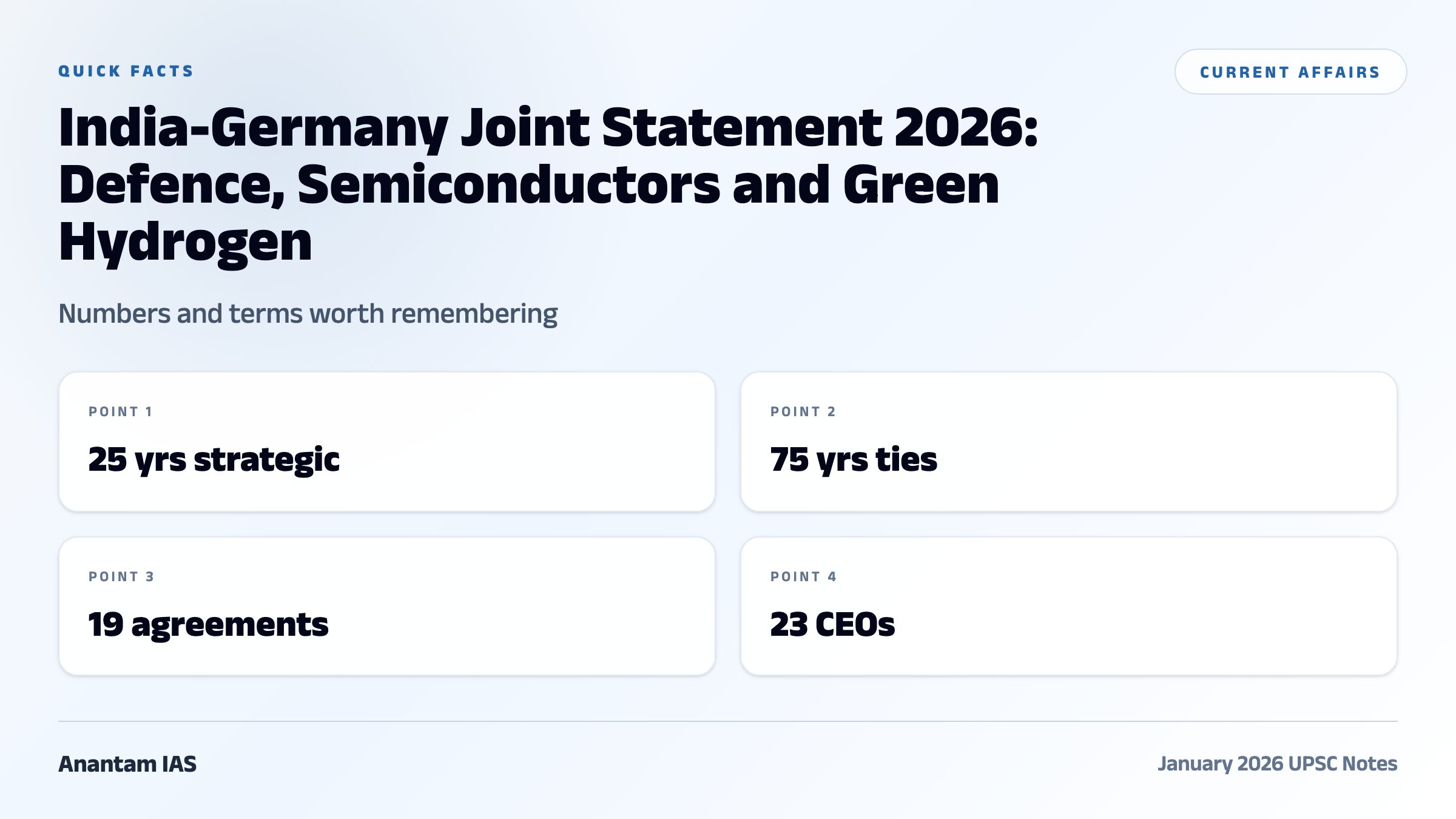
- The visit marked the 25th anniversary of the India-Germany Strategic Partnership and 75 years of diplomatic relations.
- A 23-member German CEO delegation accompanied the Chancellor.
- The joint statement listed 19 formal agreements and eight major announcements.
- Priority areas included defence, semiconductors, critical minerals, telecom, quantum, AI, green hydrogen and green ammonia.
- Germany announced visa-free transit facility for Indian nationals.
- Germany’s Global Shield against Climate Risks was linked with climate-resilience cooperation.
- Official source: PIB joint statement.
What Just Happened
The two sides adopted a wide-ranging joint statement after Chancellor Merz’s India visit. The outcomes covered security, industrial cooperation, climate action, migration, education, innovation and Indo-Pacific coordination.
The important shift is from values-only diplomacy to production-linked diplomacy. Defence platforms, semiconductor supply chains, critical minerals, AI and green hydrogen are now treated as strategic infrastructure.
India and Germany also used the visit to signal a shared interest in a rules-based Indo-Pacific, secure sea lanes and resilient technology supply chains. That gives the relationship relevance beyond trade.
Background and Historical Context
India and Germany established diplomatic relations in 1951. The Strategic Partnership was launched in 2000, and the Inter-Governmental Consultations mechanism later gave the relationship a Cabinet-level review format.
Germany is Europe’s largest economy and a major manufacturing, technology and climate-finance actor. India is a large market, a skilled-labour source, an Indo-Pacific power and a diversification option for European companies.
The relationship has often underperformed its potential because German industry moved slowly in India, and India did not always align regulatory systems with European manufacturing expectations. Supply-chain stress after COVID-19 and geopolitical uncertainty have changed the incentive structure.
Key Features of the 2026 Joint Statement
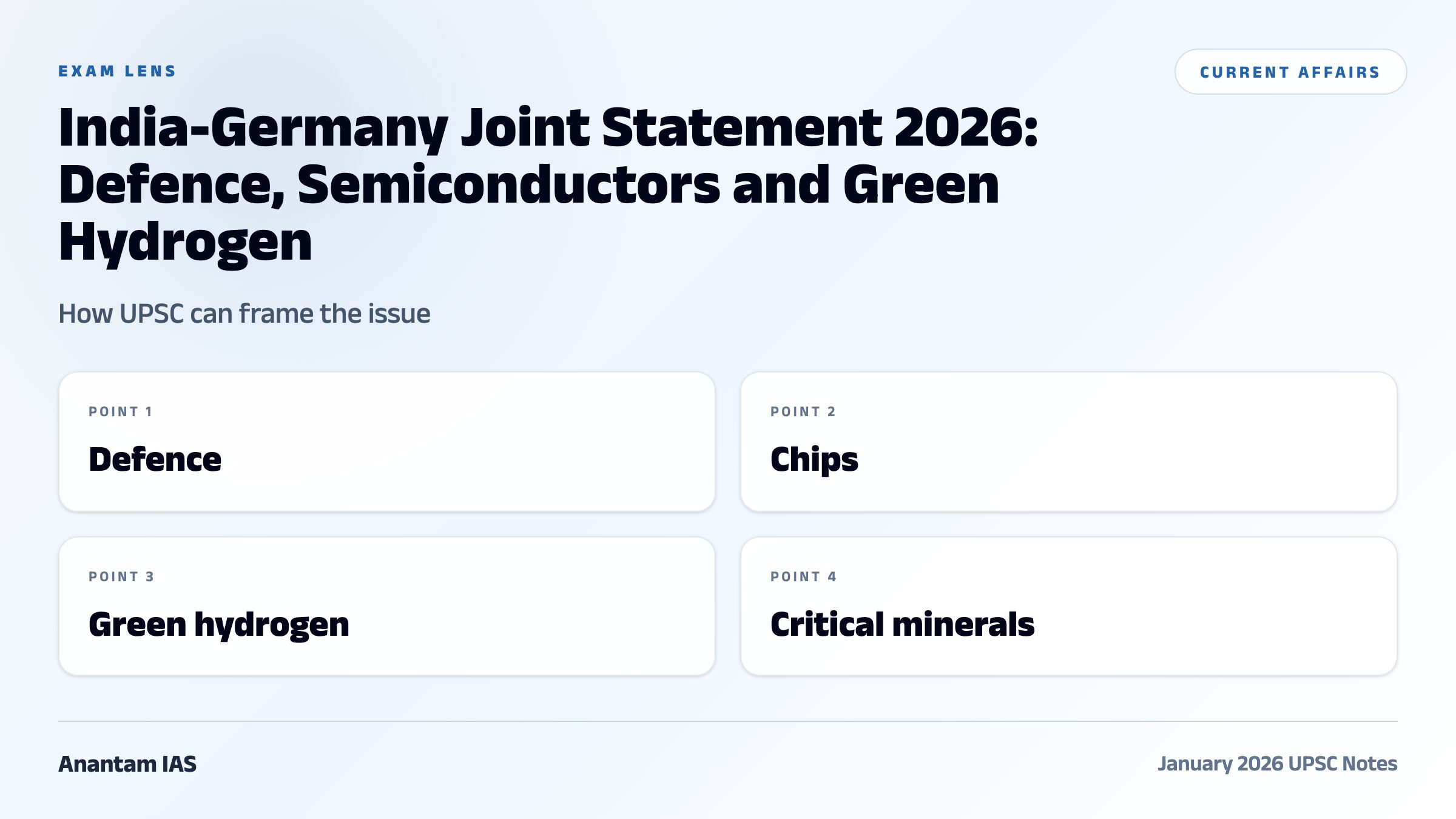
The core policy architecture can be read through these features.
- Defence industry: cooperation moved toward co-development, co-production and technology partnerships.
- Semiconductors: the statement placed chip design, manufacturing ecosystems and talent cooperation in the bilateral frame.
- Critical minerals: both sides linked green transition with secure mineral supply chains.
- Green hydrogen: hydrogen and green ammonia were treated as trade, climate and industrial-policy priorities.
- Mobility: skilled migration and visa facilitation supported labour-market complementarity.
- Indo-Pacific: maritime security and rules-based order appeared as strategic anchors.
Why It Matters
This is a high-yield UPSC topic because it joins current news with durable syllabus themes.
- It gives GS-II content on India’s relations with Europe beyond the India-EU framework.
- It connects IR with GS-III themes: semiconductors, defence manufacturing, energy transition and supply-chain security.
- It shows how diplomacy now includes CEOs, technology standards, migration and climate finance.
- It provides Essay material on a multipolar world and strategic autonomy.
Detailed Analysis: International Relations Lens
The relationship is moving from market access to strategic production. Germany wants supply-chain diversification. India wants technology, investment and manufacturing depth. The overlap is real, but it needs execution.
Green hydrogen is the bridge sector. Germany will need imported green molecules. India wants to become a low-cost producer. If standards, finance and offtake contracts align, this can become one of the most concrete India-Germany partnerships.
Defence cooperation remains promising but difficult. Germany has advanced platforms and engineering capacity, while India seeks indigenisation. Export controls, cost, intellectual property and long procurement cycles will test the ambition.
Comparative Perspective
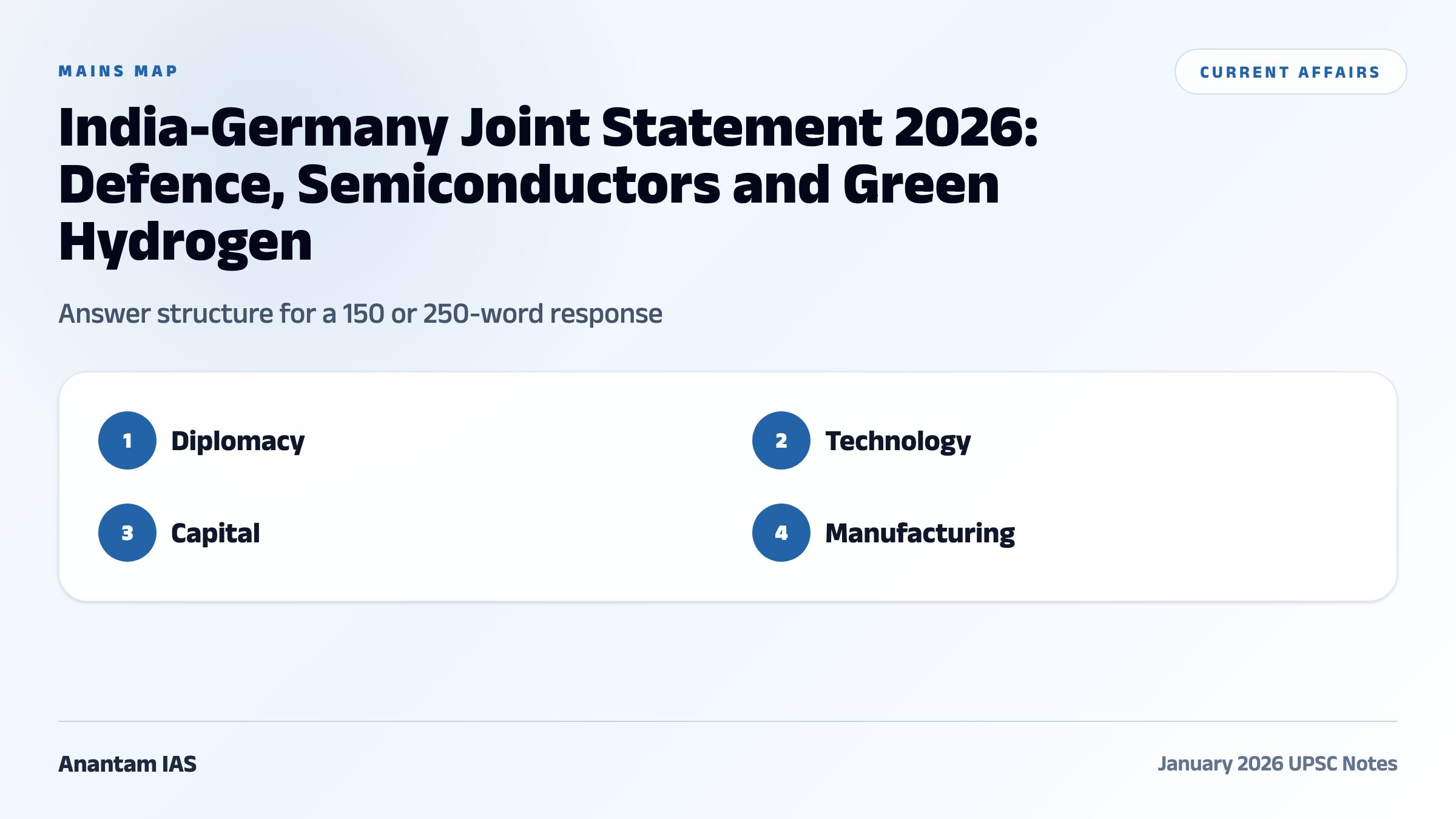
A comparison helps prevent the answer from becoming a one-dimensional news summary.
- India-France: defence and space cooperation are deeper and more operationally mature.
- India-Germany: manufacturing, green technology, skills and industrial supply chains are the stronger pillars.
- India-UK: services, education, finance and diaspora dominate the relationship.
- India-EU: the wider framework covers trade, standards and climate, but Germany remains the industrial heavyweight inside Europe.
Challenges
The policy or institutional promise runs into recurring constraints.
- German companies often find India’s regulatory and compliance environment difficult.
- India needs deeper supplier ecosystems before it can absorb high-end manufacturing at scale.
- Technology transfer in defence and semiconductors will remain sensitive.
- Green hydrogen trade requires common standards, certification and long-term offtake certainty.
- Europe’s internal politics can slow external industrial and trade decisions.
Prelims Pointers
- India-Germany Strategic Partnership began in 2000.
- Inter-Governmental Consultations are a high-level bilateral review mechanism.
- Green hydrogen is produced using renewable electricity through electrolysis.
- Critical minerals are essential for batteries, clean energy, electronics and defence systems.
- Semiconductors are central to electronics, AI, defence, automobiles and telecom.
- Germany is a member of the G7, EU and NATO.
Mains Questions
- India-Germany relations are shifting from trade diplomacy to technology and supply-chain diplomacy. Discuss. (GS Paper II, 250 words)
- How can green hydrogen become a strategic pillar of India-Europe relations? (GS Paper III, 150 words)
- Evaluate the role of middle powers and industrial democracies in India’s strategic autonomy. (GS Paper II, 250 words)
- What constraints limit defence industrial cooperation between India and Germany? Suggest reforms. (GS Paper III, 250 words)
Way Forward
India should convert the joint statement into sector-specific roadmaps: one for defence platforms, one for green hydrogen offtake, one for semiconductor talent and one for critical minerals.
Regulatory predictability will matter more than diplomatic warmth. German firms will invest at scale only if land, taxation, customs, standards and dispute-resolution systems are dependable.
The best India-Germany partnership will not be measured by communiques. It will be measured by factories, research labs, skilling pipelines, co-developed technologies and clean-energy contracts.
The examiner is unlikely to reward a bare fact dump here. The better answer connects the January 2026 event to institutional design, implementation capacity and India’s long-term development priorities.
Frequently Asked Questions
Why was the 2026 India-Germany visit important?
It marked key anniversaries in the relationship and produced outcomes across defence, semiconductors, critical minerals, green hydrogen, AI, migration and the Indo-Pacific.
What is the India-Germany Strategic Partnership?
It is the bilateral framework launched in 2000 to deepen cooperation across political, economic, technological and security domains.
Why does Germany matter to India?
Germany is Europe’s largest economy, a manufacturing powerhouse and a major source of technology, skills cooperation and climate finance.
Why does India matter to Germany?
India offers market scale, skilled talent, Indo-Pacific relevance and supply-chain diversification opportunities.
What are the UPSC themes here?
GS-II international relations, GS-III technology, defence manufacturing, green hydrogen, critical minerals and supply-chain security.
What is the main challenge?
Implementation. The relationship has strong intent, but regulatory friction, technology transfer limits and slow procurement can weaken outcomes.