India and Ghana: Vaccine Hub and a Comprehensive Partnership
Why in News?
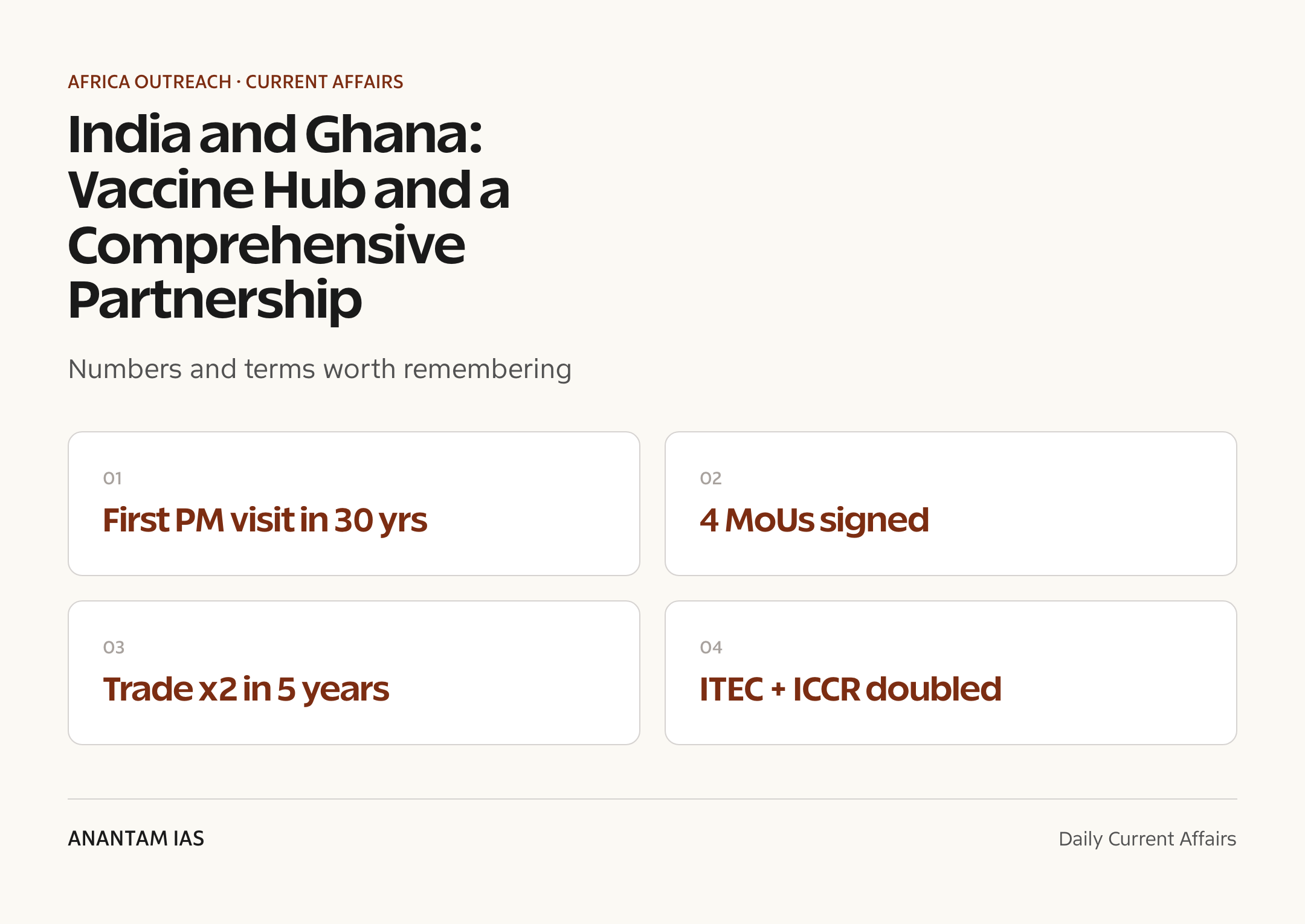
During the first visit by an Indian Prime Minister to Ghana in over 30 years (2-3 July 2025), India and Ghana agreed to elevate their ties to a Comprehensive Partnership and exchanged four MoUs. DD News and the Ministry of External Affairs confirmed the leaders met at Jubilee House, the seat of Ghana’s presidency, with President John Dramani Mahama.
The headline deliverables were support for a regional vaccine hub in Ghana, a doubling of ITEC and ICCR scholarships, and a target to double bilateral trade within five years — a template for India’s wider Africa outreach built on capacity-building and health cooperation.
- First Indian PM visit to Ghana in over 30 years; ties raised to a Comprehensive Partnership.
- Four MoUs signed: culture, standards cooperation, Ayurveda and traditional medicine, and a Joint Commission Mechanism.
- India offered to help build a vaccine hub in Ghana for the West African region.
- Commitment to double ITEC and ICCR scholarships for Ghanaian students.
- Target to double bilateral trade within the next five years.
- PM conferred Ghana’s top civilian honour, Officer of the Order of the Star of Ghana.
The development matters in the context of:
- Africa is central to India’s claim to lead the Global South, reinforced after the African Union joined the G20 under India’s 2023 presidency.
- Vaccine diplomacy revives the Vaccine Maitri model and answers Africa’s push for local manufacturing after COVID-era supply shocks.

UPSC Relevance
Prelims Relevance
- Comprehensive Partnership — the upgraded level of India-Ghana ties.
- ITEC — Indian Technical and Economic Cooperation programme (MEA, since 1964).
- ICCR — Indian Council for Cultural Relations scholarships.
- Officer of the Order of the Star of Ghana — Ghana’s top civilian honour conferred on the PM.
- Jubilee House — seat of Ghana’s presidency, Accra.
- Vaccine Maitri — India’s COVID-era vaccine supply initiative.
- Feed Ghana programme — Ghana’s food-security initiative India backed.
- Ghana’s location — West Africa, on the Gulf of Guinea; capital Accra.
- UPI / Bharat UPI — digital payments expertise offered to Ghana.
Mains Relevance
GS Paper 2
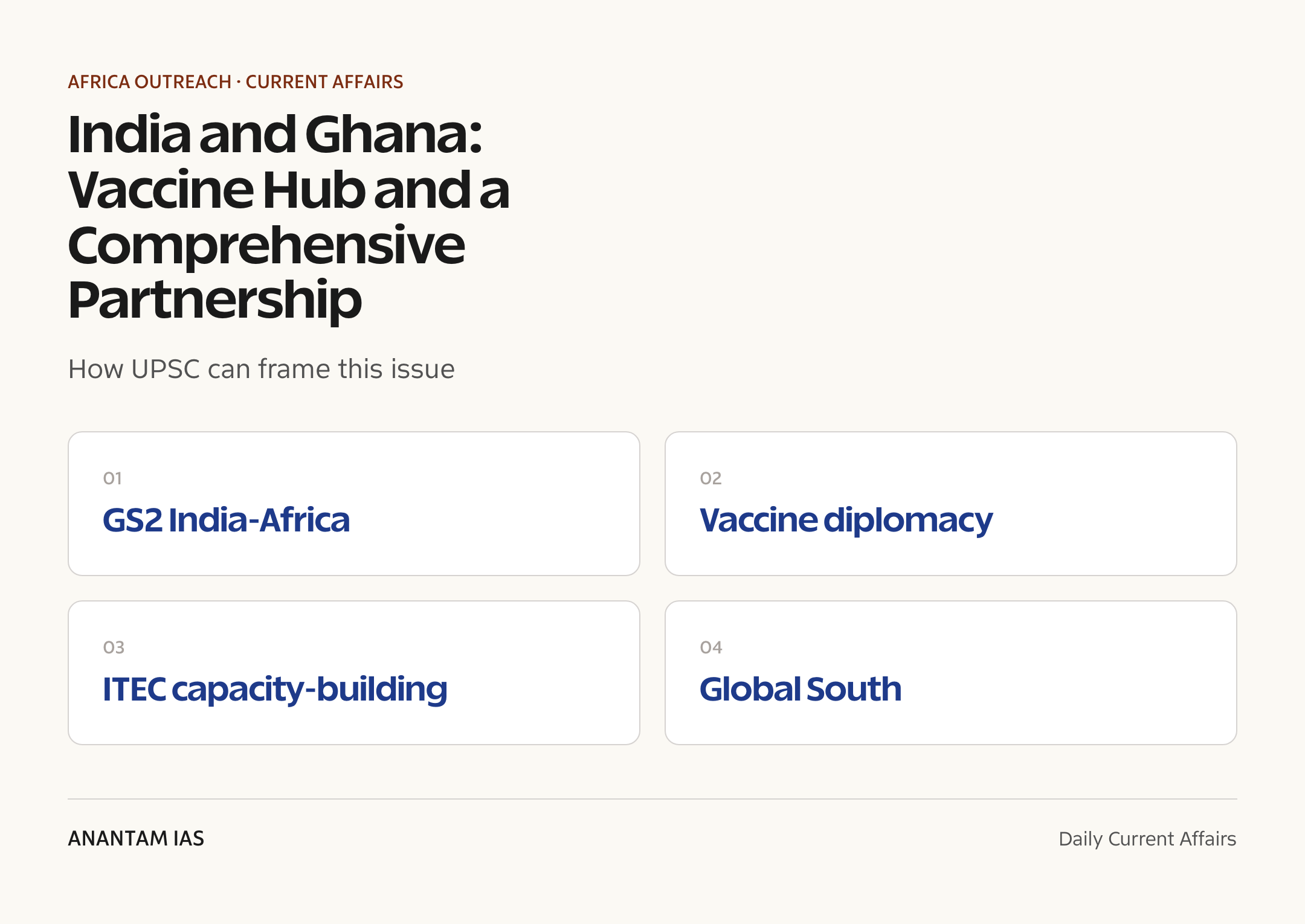
- India-Africa relations: bilateral agreements affecting India’s interests and the Global South agenda.
- Effect of soft-power tools — ITEC capacity-building, vaccine and health diplomacy — on India’s foreign policy.
GS Paper 3
- Health and pharmaceutical cooperation: India as ‘pharmacy of the world’ and regional vaccine manufacturing.
- Critical minerals and energy security as drivers of India’s Africa engagement.
Essay
- India and the Global South: partnership, not patronage.
- Health is wealth — vaccine diplomacy as twenty-first-century statecraft.
Background and Context
The visit and the four MoUs
The visit, the first leg of a five-nation tour, anchored several durable instruments.
- President John Dramani Mahama received the PM at Jubilee House, Accra; a State Banquet followed.
- Four MoUs exchanged: on culture; standards cooperation (bureau-to-bureau on conformity assessment); Ayurveda and traditional medicine; and a Joint Commission Mechanism linking the two foreign ministries for regular review.
- Ties were elevated from a working relationship to a formal Comprehensive Partnership.
- The PM was conferred the Officer of the Order of the Star of Ghana, the country’s highest civilian honour.
Vaccine hub and health diplomacy
Health was the standout pillar, building on India’s pandemic-era credentials.
- India offered to help develop a vaccine hub in Ghana to serve the West African region, supporting local manufacturing capacity.
- Jan Aushadhi Kendras were proposed to supply affordable generic medicines.
- The Ayurveda MoU and talk of health tourism extend India’s traditional-medicine footprint.
- The model echoes Vaccine Maitri, India’s supply of COVID-19 vaccines to dozens of countries during 2021.
Capacity-building: ITEC, ICCR and skills
Human-resource development is India’s signature soft-power instrument in Africa.
- India committed to double ITEC and ICCR scholarships for Ghanaian students and trainees.
- ITEC (1964) funds short civilian and defence training courses; ICCR awards university scholarships and runs cultural diplomacy.
- A Skill Development Centre for youth vocational training was announced.
- India offered support for Ghana’s Feed Ghana food-security programme.
Trade, digital payments and minerals
Economic substance backs the political upgrade.
- Target to double bilateral trade with Ghana within five years.
- India offered to share Bharat UPI expertise for Ghana’s digital-payments ecosystem.
- Critical minerals, energy and digital public infrastructure flagged as growth areas — Ghana is a major gold and bauxite producer.
- Defence, maritime security and cyber cooperation were also identified for deepening.
Why Africa, why now
The visit fits a larger strategic frame for India’s outreach to the continent.
- India is positioning itself as a voice of the Global South; the African Union became a permanent G20 member under India’s 2023 presidency.
- Engagement is offered as a partnership of equals — capacity, technology and trade rather than resource extraction or debt-heavy lending.
- It is also a quiet counter to the deepening Chinese economic and infrastructure presence across West Africa.
- Diaspora ties and shared anti-colonial history — Ghana’s Kwame Nkrumah and India’s Nehru were founders of the Non-Aligned Movement — add ballast to the relationship.
- The visit fits India’s stated approach of demand-driven cooperation, where partner countries set the priorities rather than receiving externally designed projects.
Way Forward
Deliver on the vaccine hub
- Translate the offer into a concrete project with technology transfer and regulatory support so Ghana can manufacture for the region.
- Link it to African Union and continental procurement frameworks for scale.
Close the implementation gap
- India’s Africa pledges often lag in execution; create timelines and a review role for the new Joint Commission Mechanism.
- Use the doubled ITEC and ICCR slots to build a durable cohort of India-trained Ghanaian professionals.
Convert the five-year trade target into sector roadmaps — pharma, critical minerals, digital payments — so the Comprehensive Partnership rests on commercial depth, not just summit announcements.
Conclusion
The Ghana visit shows India deploying its distinctive toolkit — capacity-building, health cooperation and digital public goods — to deepen ties across Africa as a partner of the Global South rather than a donor.
The test now is delivery: a functioning vaccine hub, scholarships filled, and trade that doubles on schedule would turn a historic visit into a durable Comprehensive Partnership.
UPSC Practice Questions
Prelims MCQ 1
With reference to the India-Ghana engagement of July 2025, consider the following statements:
- India and Ghana elevated their relationship to a Comprehensive Partnership.
- India offered to help establish a regional vaccine hub in Ghana.
- An MoU on Ayurveda and traditional medicine was among those signed.
How many of the above statements are correct?
(a) Only one (b) Only two (c) All three (d) None
Answer: (c) All three
Explanation:
All three are correct: ties were raised to a Comprehensive Partnership, India backed a West African vaccine hub, and an Ayurveda/traditional-medicine MoU was one of the four signed.
Prelims MCQ 2
ITEC, often cited in India’s development partnership with Africa, is administered by which ministry?
(a) Ministry of Commerce and Industry (b) Ministry of External Affairs (c) Ministry of Education (d) Ministry of Health and Family Welfare
Answer: (b) Ministry of External Affairs
Explanation:
The Indian Technical and Economic Cooperation (ITEC) programme, launched in 1964, is run by the Ministry of External Affairs and funds training for partner countries.
UPSC Mains Questions
- India’s engagement with Africa increasingly relies on capacity-building and health cooperation rather than aid. Examine this shift in the light of the 2025 India-Ghana Comprehensive Partnership.
- “Vaccine diplomacy has become a central instrument of India’s soft power.” Discuss with reference to India’s offer of a regional vaccine hub in Ghana and earlier initiatives.
Sources: DD News, Ministry of External Affairs and News On Air (Prasar Bharati).
Frequently Asked Questions
What is the India-Ghana Comprehensive Partnership?
It is the upgraded level of bilateral ties agreed during the Indian Prime Minister’s July 2025 visit to Ghana. It formalises closer cooperation across trade, health, capacity-building, defence and culture, replacing the earlier working relationship with a structured, regularly reviewed partnership.
Why was the Ghana visit significant?
It was the first visit by an Indian Prime Minister to Ghana in over 30 years. Beyond symbolism, it produced four MoUs, a vaccine-hub offer, doubled scholarships and a five-year trade target, signalling India’s intent to deepen its Africa outreach as a partner of the Global South.
What is the vaccine hub India offered Ghana?
India offered to help Ghana develop a vaccine manufacturing hub serving the West African region. It would build local production capacity through cooperation and technology support, reducing the region’s dependence on imported vaccines and echoing India’s earlier Vaccine Maitri initiative.
What are ITEC and ICCR?
ITEC (Indian Technical and Economic Cooperation), run by the Ministry of External Affairs since 1964, funds short training courses for partner countries. ICCR (Indian Council for Cultural Relations) awards university scholarships and handles cultural diplomacy. India committed to doubling both for Ghanaian students.
Which four MoUs did India and Ghana sign?
The four MoUs covered culture, standards cooperation, Ayurveda and traditional medicine, and a Joint Commission Mechanism. The last links the two foreign ministries for regular, structured review of the relationship.
How does Ghana fit India’s Africa strategy?
Ghana is a stable West African democracy and a major gold and mineral producer. The partnership advances India’s Global South leadership, offers a capacity-and-trade model distinct from resource-extraction approaches, and provides a counterweight to growing external economic influence in the region.