India’s Gig Work: Full-Time Labour Without Full Protection
Why in News?
A nationwide Janpahal survey reported on 4 September found that platform work is often long-term, while workers face long hours, unsafe conditions and weak social protection.
- The survey covered 1,000 workers across ten cities in delivery, ride-hailing, e-commerce and household or personal-care services.
- Nearly 57% reported working more than 49 hours weekly, while almost 23% worked beyond 70 hours.
- More than 72% had stayed on platforms for over one year, challenging the idea that gig work is only temporary or supplementary.
- The report linked road danger, heat and pollution exposure, harassment, fatigue and limited access to water, toilets and rest areas.
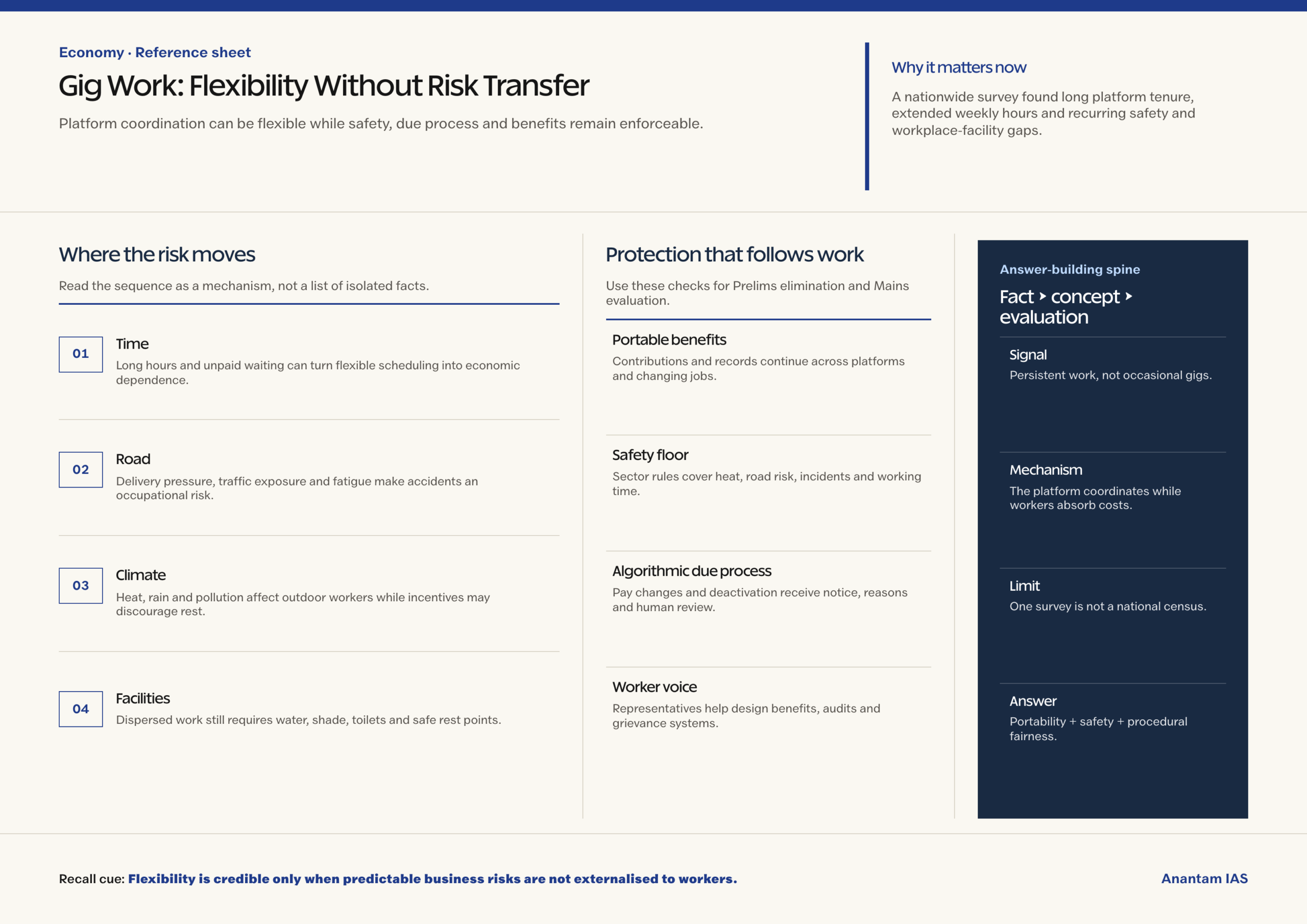
- Platform firms organise work through apps, ratings, pricing and task allocation, but workers often carry vehicle, fuel, waiting-time and accident risks.
- Policy must distinguish flexible scheduling from absence of enforceable safety, grievance and income-protection standards.
UPSC Relevance
Prelims Relevance
- Gig work is task-based work outside a traditional long-term employer-employee arrangement.
- Platform work is mediated through an online system that matches workers, clients or customers.
- The Code on Social Security, 2020 recognises gig workers and platform workers as distinct statutory categories.
- Occupational safety includes road risk, heat stress, sanitation, rest, protective equipment and work-related health.
- Portable benefits follow a worker across platforms and changing work arrangements.
Mains Relevance
GS Paper 3
- Employment quality and risk allocation in the platform economy
- Data-driven management and labour-market formalisation
GS Paper 2
- Social protection, occupational health and grievance redress for non-standard workers
Essay
- Flexibility is meaningful only when workers can exercise it without absorbing every economic and physical risk.
Background and Context
When Gig Work Becomes a Main Job
The survey matters because duration and hours show economic dependence, not occasional use of an app for spare income.
- More than seven in ten respondents had remained on platforms beyond one year, showing that platform work can become a persistent labour-market position.
- Long weekly hours weaken the claim that all workers freely choose short, supplementary shifts around another secure occupation.
- Workers may switch between platforms, yet ratings, incentive windows and demand peaks can still shape when and how long they remain online.
- Employment classification matters because access to minimum standards, injury support and collective voice often depends on whether law recognises a work relationship.
- Dependence can also be measured through income share, hours, duration and the platform’s influence over pricing, allocation, ratings and continued access to work.
Risk Is Shifted to the Worker
The app coordinates demand, but many costs and hazards remain individual even when the platform influences pace, routes and performance.
- Workers commonly supply vehicles and phones, purchase fuel and data, and absorb unpaid waiting time between tasks or during weak demand.
- Road accidents and near misses become occupational hazards when delivery targets, traffic exposure and long hours combine with income pressure.
- Heat, air pollution and rain affect outdoor workers directly, while algorithmic incentives may discourage rest during the busiest and most hazardous periods.
- Limited toilets, drinking water, shade and rest areas show that basic workplace protections can disappear when work has no fixed physical establishment.
- Women and care-service workers may face distinct harassment, sanitation and personal-security risks, so one uniform safety checklist cannot capture every platform occupation.
Protection Must Be Portable
A durable response should attach minimum protection to the work and worker rather than to one permanent employer or platform.
- Registration can identify eligible workers, but a database alone does not guarantee contributions, timely benefits or accessible claims and appeals.
- Portable social insurance can pool contributions across platforms and periods of work while protecting continuity when a worker changes apps.
- Safety standards should cover realistic delivery times, heat protocols, accident reporting, protective equipment and access to sanitation and rest facilities.
- Algorithmic accountability requires notice of pay changes, understandable ratings, human review of suspensions and protection against retaliatory deactivation.
- Financing can combine public support, platform contributions and worker contributions, but the formula should reflect unequal bargaining power and avoid reducing already volatile take-home income.
Evidence Limits and Policy Use
The survey reveals serious risks but should guide investigation and standards rather than be treated as a complete census of every platform worker.
- Its urban sample identifies patterns across several occupations, while national estimates still require representative official data and transparent platform records.
- Self-reported hours and injuries are valuable worker evidence, but administrative accident, earnings and deactivation data would strengthen causal assessment.
- Periodic surveys should track income after costs, multiple-platform use, unpaid waiting and benefit access across gender, city size and occupation.
Way Forward
Build a Worker-Centred Floor
Regulation should preserve genuine flexibility while preventing business models from externalising predictable costs and hazards.
- Create interoperable registration and contribution systems with simple claims, worker access to records and time-bound grievance appeals.
- Set sector-specific safety standards for road exposure, heat, working time, sanitation and incident reporting.
- Require transparent pay calculations, deactivation reasons and human review where automated systems affect livelihood.
- Include worker organisations in benefit design, safety audits and periodic evaluation of platform compliance.
Conclusion
- The survey’s durable lesson is that platform flexibility and labour protection are not opposites; protection must match economic dependence and actual control.
- A strong answer should trace how algorithmic coordination shifts risk, then connect portable benefits, safety standards and procedural fairness to decent work.
UPSC Practice Questions
Prelims MCQ 1
With reference to gig and platform work, consider the following statements:
- All gig work must be mediated by an online platform.
- Platform work uses an online system to connect workers with demand.
- Portable benefits can continue when workers move across platforms.
How many of the above statements are correct?
(a) Only one (b) Only two (c) All three (d) None
Answer: (b) Only two
Explanation:
Statements 2 and 3 are correct. Gig work is broader than platform-mediated work and can exist without an online matching platform.
Prelims MCQ 2
Which policy most directly addresses algorithmic livelihood decisions?
(a) A general advertising code (b) Human review of deactivation and transparent pay rules (c) A fixed platform market share (d) Removal of worker ratings from all services
Answer: (b) Human review of deactivation and transparent pay rules
Explanation:
These measures create notice, explanation and appeal when automated systems affect access to work or earnings.
UPSC Mains Questions
- Platform work combines labour-market flexibility with a systematic transfer of economic and occupational risk to workers. Discuss.
- Design a portable social-protection framework for gig workers without assuming a single permanent employer.
Source: The Hindu.
Frequently Asked Questions
What did the new gig-work survey find?
It found long platform tenure, extended weekly hours and recurring safety, health and workplace-facility gaps among surveyed workers across ten Indian cities.
Are gig work and platform work identical?
No. Gig work is the broader task-based category; platform work is organised through an online intermediary that matches workers with clients or customers.
Why are rest areas and toilets labour issues?
A dispersed workplace does not remove occupational needs. Long outdoor shifts without water, shade, sanitation or rest increase health risk and undermine dignified work.
What are portable benefits?
They are protections linked to the worker and accumulated across platforms or jobs, reducing benefit loss when work arrangements change.
Does regulation necessarily remove flexibility?
No. Minimum safety, contribution, transparency and appeal rules can protect workers while allowing genuine choice over schedules and platforms.