India’s 2026 Heatwave: The Heat Dome, El Nino Risk and the Monsoon
Why in News?
India is facing an unusually early and extreme heatwave in 2026, with peak temperatures arriving weeks ahead of historical norms. Weather agencies describe a persistent heat dome trapping hot air over the Indo-Gangetic plains and eastern India, even as the India Meteorological Department (IMD) flags above-normal heatwave days across east, central and northwest India.
The episode has become a talking point because it links three exam themes at once: climate change and disaster management, the threat of a developing El Nino to the southwest monsoon, and the agricultural and public-health stress that follows. Analyses by Vision IAS and Drishti IAS connect the heat to weakened western disturbances and a possible El Nino developing later in the year.
- The IMD forecasts above-normal heatwave days over east, central and northwest India for the 2026 summer.
- A heat dome — a high-pressure ridge that traps warm air near the surface — has settled over the Indo-Gangetic plains and eastern India.
- Weakened and infrequent western disturbances have reduced the cooling spells that normally interrupt the pre-monsoon heat.
- Forecasters warn an El Nino could develop later in the year, with some commentary citing a ‘super El Nino’ risk to the monsoon.
- Heat stress is straining outdoor labour, the elderly, children and the urban poor, with peak temperatures arriving early.
The development matters in the context of:
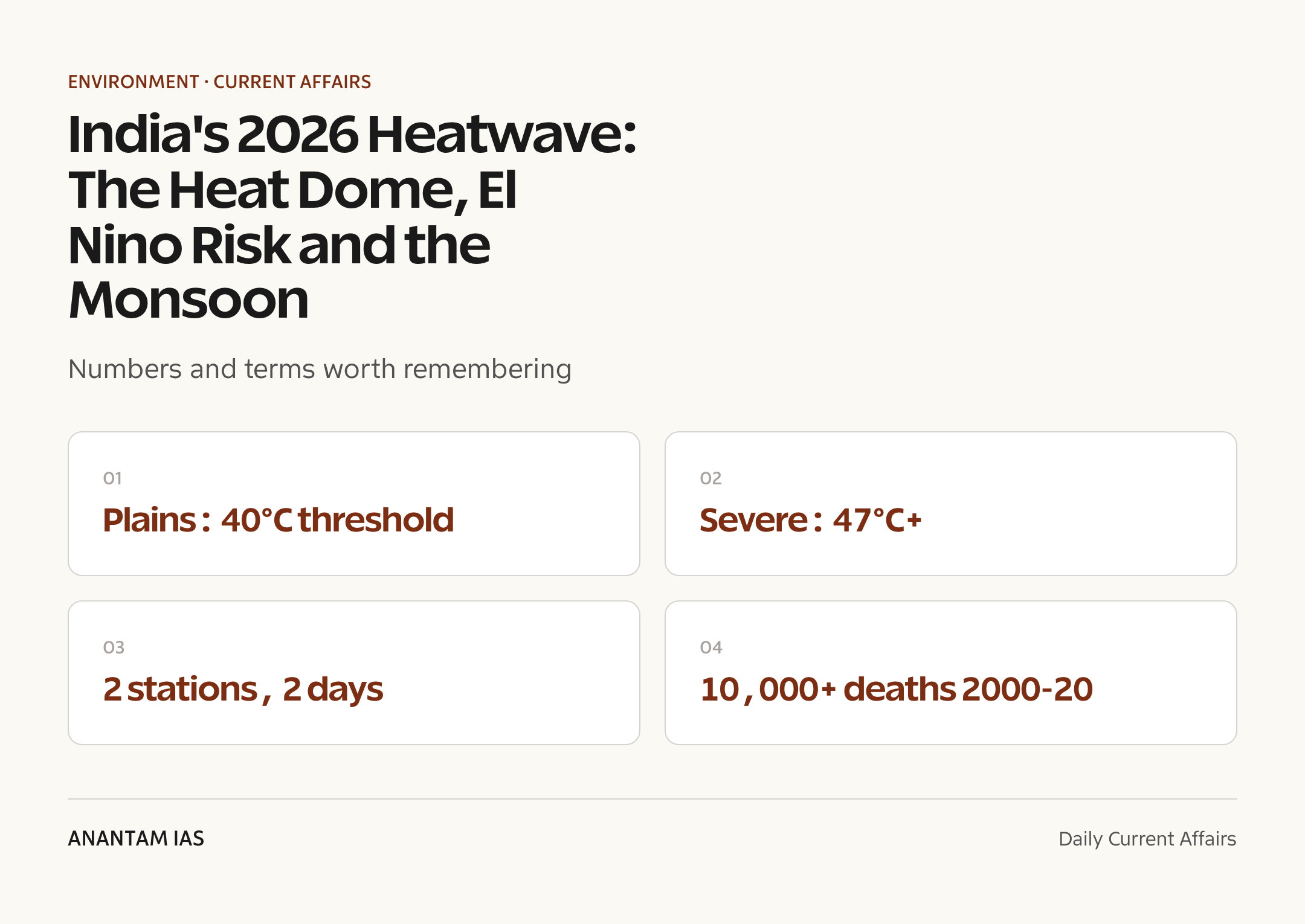
- A heatwave is declared only when temperatures cross set thresholds at a minimum of 2 stations in a meteorological subdivision for at least 2 consecutive days.
- Heat-related deaths and lost working hours make heatwaves a recognised disaster-management and climate-adaptation challenge in India.
UPSC Relevance
Prelims Relevance
- IMD heatwave criteria: declared in plains when the maximum temperature is 40°C or more, in hilly regions at 30°C or more, and at coastal stations when the departure is 4.5°C or more and the maximum is 37°C or above.
- Departure-based classes: Heat Wave = departure of 4.5°C to 6.4°C; Severe Heat Wave = departure above 6.4°C from normal.
- Temperature-based classes: Heat Wave when the actual maximum reaches 45°C; Severe Heat Wave at 47°C or more.
- Declaration rule: thresholds must be met at a minimum of 2 stations in a subdivision for at least 2 consecutive days.
- Heat dome: a strong high-pressure ridge that caps the atmosphere and traps hot air near the ground, intensifying surface heat.
- El Nino / ENSO: the warm phase of the El Nino-Southern Oscillation; warmer central-Pacific waters are generally linked with a weaker Indian southwest monsoon.
- IOD (Indian Ocean Dipole): a positive IOD (warmer western Indian Ocean) tends to support the monsoon and can offset an El Nino’s drying effect.
- Wet-bulb temperature: the temperature combining heat and humidity; a sustained wet-bulb reading near 35°C is considered the survivability limit for humans.
- Urban Heat Island (UHI): cities run hotter than surroundings due to concrete, asphalt and reduced green cover.
- NDMA issues National Guidelines on Heat Wave Management; the colour-coded alerts run Green, Yellow, Orange, Red.
Mains Relevance
GS Paper 3
- Heatwaves as a climate-change-amplified disaster: rising frequency and intensity, attribution to global warming, and the case for treating heat as a notified disaster for relief funding.
- Disaster-management response: Heat Action Plans, early-warning colour codes, cooling infrastructure and the gap between plan design and on-ground implementation.
GS Paper 1
- Physical geography of the event: high-pressure ridges, the heat-dome mechanism, the role of western disturbances and how El Nino-ENSO dynamics shape the monsoon.
- Geographical vulnerability: why the Indo-Gangetic plains and peninsular interiors face the sharpest pre-monsoon heat.
Essay
- Climate change has turned the weather into a development problem: heat, harvests and the human cost.
- Adapting to a warming India: from disaster relief to climate resilience.
Background and Context
What counts as a heatwave in India
The IMD uses fixed thresholds, not loose impressions, before it declares a heatwave.
- In the plains, a heatwave needs a maximum temperature of 40°C or more; in hilly regions the bar is 30°C or more.
- At coastal stations, it is declared when the departure from normal is 4.5°C or more and the actual maximum is 37°C or above.
- By departure, a Heat Wave is a 4.5°C to 6.4°C rise over normal; a Severe Heat Wave exceeds 6.4°C.
- By absolute value, a Heat Wave is flagged at 45°C and a Severe Heat Wave at 47°C.
- The condition must hold at a minimum of 2 stations in a subdivision for at least 2 consecutive days.
The heat dome over the plains
A heat dome is the mechanism driving 2026’s early, stubborn heat.
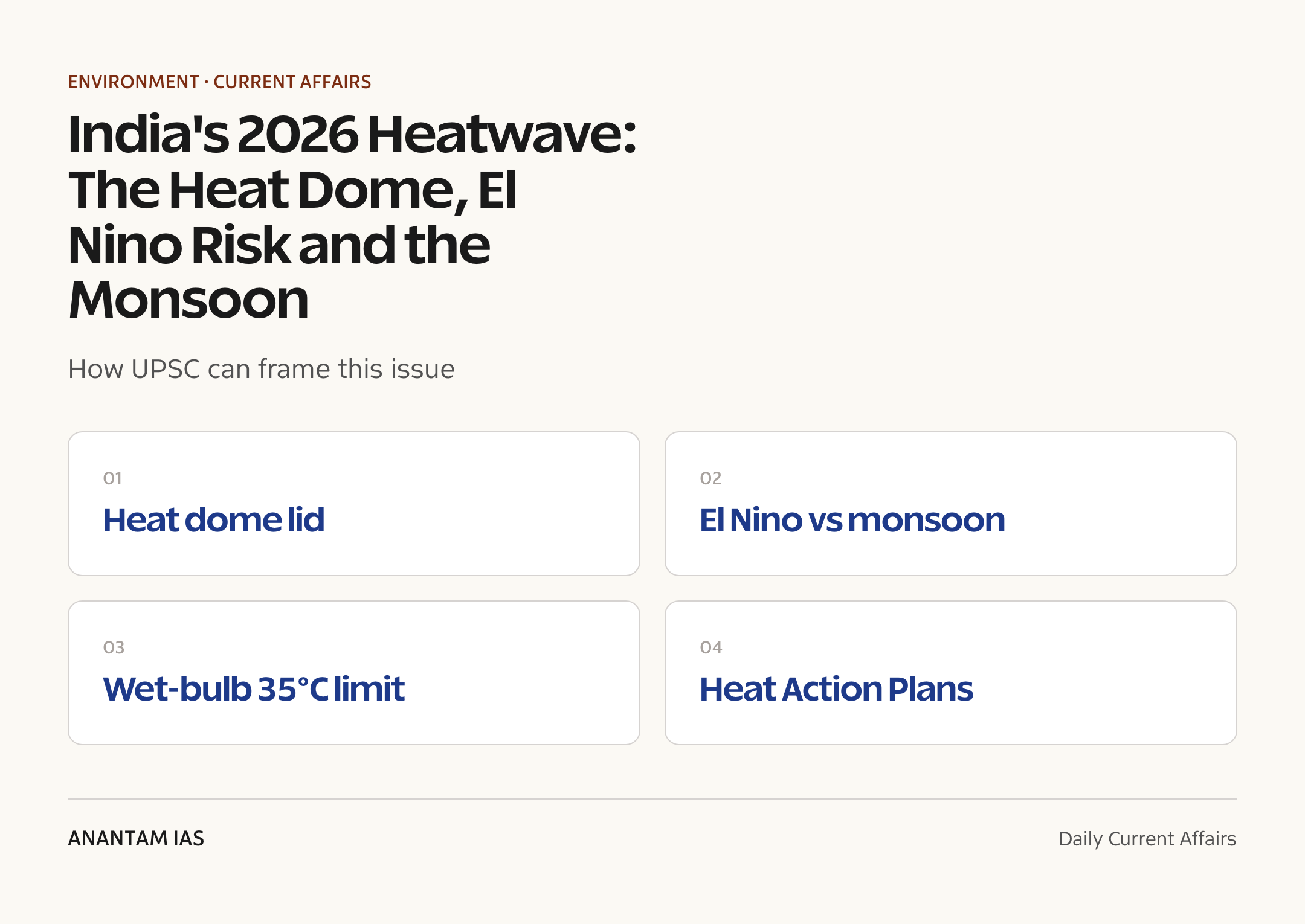
- A heat dome is a strong, persistent high-pressure ridge in the upper atmosphere that acts like a lid, forcing air to sink, warm and stay trapped near the surface.
- Vision IAS notes the dome has settled over the Indo-Gangetic plains and eastern India, holding hot air in place.
- Supporting conditions cited include the absence of cloud cover, low wind speeds and high-pressure systems that concentrate heat at ground level.
- Western disturbances — the rain-bearing systems that usually bring cooling spells — have been weakened and infrequent this year.
- The early onset means peak temperatures have arrived weeks ahead of the usual calendar.
El Nino, ENSO and the monsoon link
The bigger worry is what a developing El Nino could do to the southwest monsoon.
- El Nino is the warm phase of the El Nino-Southern Oscillation (ENSO), marked by unusual warming of the central and eastern Pacific Ocean.
- El Nino years are broadly associated with a weaker, more erratic Indian southwest monsoon and a higher chance of deficient rainfall.
- Drishti IAS notes the likelihood of an El Nino developing by July, while some commentary flags a ‘super El Nino’ risk.
- A positive Indian Ocean Dipole (IOD) — warmer western Indian Ocean — can partly counter El Nino and support monsoon rains.
- The monsoon delivers the bulk of India’s annual rainfall, so any threat to it touches farm output, reservoirs, power and the rural economy.
Why the heat hurts: health, work and harvests
Extreme heat is a public-health and livelihood emergency, not just a comfort issue.
- Drishti IAS cites 733 heatstroke deaths reported across 17 states between March and June in the 2024 season.
- Vision IAS notes over 10,000 deaths were attributed to heatwaves between 2000 and 2020.
- The most exposed groups are outdoor labourers, the elderly, children and the urban poor without access to cooling.
- India is projected to lose about 5.8% of daily working hours by 2030 to rising heat, hitting agriculture and construction hardest.
- Heat speeds soil-moisture loss, can scorch standing crops, and raises wildfire and dust-storm risk that worsens air quality.
Wet-bulb temperature and the urban heat island
Humidity and city design decide how dangerous a given temperature really is.
- Wet-bulb temperature combines heat and humidity; the body cannot cool by sweating once it climbs too high.
- A sustained wet-bulb reading near 35°C is widely treated as the survivability limit for a healthy human, even in shade.
- The Urban Heat Island (UHI) effect makes cities several degrees hotter than their rural surroundings.
- Concrete, asphalt, dense construction, vehicle and air-conditioner exhaust, and shrinking green cover all trap and re-radiate heat.
- Loss of wetlands, tree cover and other natural buffers has weakened India’s defences against heat, as Vision IAS notes.
India's institutional response
A multi-layered framework already exists; the test is implementation.
- NDMA issues National Guidelines on Heat Wave Management that states and cities adapt locally.
- State Heat Action Plans (HAPs) are in place across heat-prone states, built around vulnerability mapping and a coordinated response.
- The IMD runs a colour-coded warning system: Green (no action), Yellow (stay updated), Orange (be prepared) and Red (take immediate action).
- The Ministry of Health and Family Welfare’s National Action Plan on Heat-Related Illnesses (2021) guides the health-system response.
- Heatwave is not yet a notified disaster under central relief rules, which limits dedicated funding for many states.
Way Forward
Strengthen and fund Heat Action Plans
- Move HAPs from paper to practice with clear ward-level triggers, named responsible agencies and pre-monsoon drills.
- Examine notifying heatwave as a disaster so states can draw on dedicated relief funding.
Build cooling and heat-resilient cities
- Expand public cooling: shaded shelters, drinking-water points and adjusted work hours for outdoor labour.
- Mainstream cool roofs, reflective materials, more tree cover and water bodies in urban planning to blunt the heat-island effect.
Protect the monsoon-dependent economy
- Use IMD and ENSO forecasts for contingency cropping plans, heat-tolerant varieties and assured irrigation in deficit-risk districts.
- Strengthen crop insurance, fodder banks and reservoir management ahead of any El Nino-driven rainfall shortfall.
Restore natural buffers and early warning
- Reforest, conserve wetlands and revive green cover to rebuild the landscape’s natural cooling.
- Sharpen district-level early warnings and link them directly to health-system readiness for heatstroke.
Conclusion
The 2026 heatwave is a preview of a warming India, where an early heat dome, weakened western disturbances and a possible El Nino can stack climate, agriculture and public health into a single crisis. The IMD’s thresholds and the NDMA’s guidelines give the country the tools to recognise and respond to it.
The decisive gap is no longer awareness but delivery — turning Heat Action Plans into funded, ward-level action, hardening cities against heat, and shielding the monsoon-dependent rural economy. Treating heat as a serious, recurring disaster rather than a seasonal inconvenience is the shift that 2026 demands.
UPSC Practice Questions
Prelims MCQ 1
With reference to the IMD’s criteria for declaring a heatwave in India, consider the following statements:
- In the plains, a heatwave is declared when the maximum temperature is 40°C or more.
- A Severe Heat Wave is declared when the temperature departure from normal exceeds 6.4°C.
- The criteria must be met at a single station for at least one day.
How many of the above statements are correct?
(a) Only one (b) Only two (c) All three (d) None
Answer: (b) Only two
Explanation:
Statements 1 and 2 match IMD criteria (plains threshold 40°C; severe heat wave departure above 6.4°C). Statement 3 is wrong: the condition must hold at a minimum of two stations in a subdivision for at least two consecutive days.
Prelims MCQ 2
With reference to El Nino and the Indian monsoon, which one of the following statements is most accurate?
(a) El Nino refers to abnormal cooling of the central Pacific and usually strengthens the Indian monsoon. (b) El Nino is the warm phase of ENSO and is broadly associated with a weaker Indian southwest monsoon. (c) A positive Indian Ocean Dipole always worsens the drying effect of El Nino. (d) El Nino has no established link with Indian monsoon rainfall.
Answer: (b) El Nino is the warm phase of ENSO and is broadly associated with a weaker Indian southwest monsoon.
Explanation:
El Nino is the warm phase of the El Nino-Southern Oscillation, linked with a weaker, erratic monsoon. A positive IOD tends to support the monsoon and can offset El Nino, so (a), (c) and (d) are incorrect.
UPSC Mains Questions
- Heatwaves are increasingly a climate-change-amplified disaster rather than a routine seasonal event. Examine the institutional framework India has built to manage them and the gaps in its implementation. (GS Paper 3)
- Explain the heat-dome mechanism and the El Nino-ENSO link to the Indian southwest monsoon. How do these phenomena together threaten India’s agriculture and water security? (GS Paper 1 / GS Paper 3)
Sources: India Meteorological Department (IMD) and National Disaster Management Authority (NDMA).
Frequently Asked Questions
What is a heat dome?
A heat dome is a strong, persistent zone of high pressure in the upper atmosphere that acts like a lid over a region. It forces air to sink, compress and warm, while blocking clouds and rain. The result is trapped, intensifying surface heat that can last for days, as seen over the Indo-Gangetic plains in 2026.
When does the IMD declare a heatwave?
In the plains the maximum must reach 40°C, in hilly areas 30°C, and at coastal stations the departure must be 4.5°C or more with the maximum at 37°C or above. By absolute value, 45°C marks a heat wave and 47°C a severe heat wave. The threshold must be met at two stations for two consecutive days.
How does El Nino affect the Indian monsoon?
El Nino is the warm phase of the El Nino-Southern Oscillation, when the central and eastern Pacific Ocean warms unusually. El Nino years are broadly linked with a weaker and more erratic southwest monsoon and a higher chance of deficient rainfall, though a positive Indian Ocean Dipole can partly offset this effect.
What is wet-bulb temperature and why does it matter?
Wet-bulb temperature combines heat and humidity into one reading. When it climbs too high, sweat cannot evaporate and the body loses its ability to cool itself. A sustained wet-bulb temperature near 35°C is widely treated as the survivability limit for a healthy person, even resting in the shade.
What is the urban heat island effect?
The urban heat island effect describes how cities stay several degrees hotter than surrounding rural areas. Concrete, asphalt, dense buildings, vehicle and air-conditioner exhaust, and reduced green cover absorb and re-radiate heat. Loss of wetlands and tree cover removes the natural cooling that would otherwise temper city temperatures.
What is a Heat Action Plan?
A Heat Action Plan is a state or city-level strategy, guided by NDMA and the IMD, to reduce heatwave harm. It maps vulnerable groups, sets early-warning triggers using colour codes, and coordinates response measures such as cooling shelters, adjusted work hours, drinking water and health-system readiness for heatstroke.