India-Israel Bilateral Investment Treaty Comes Into Force
Why in News?
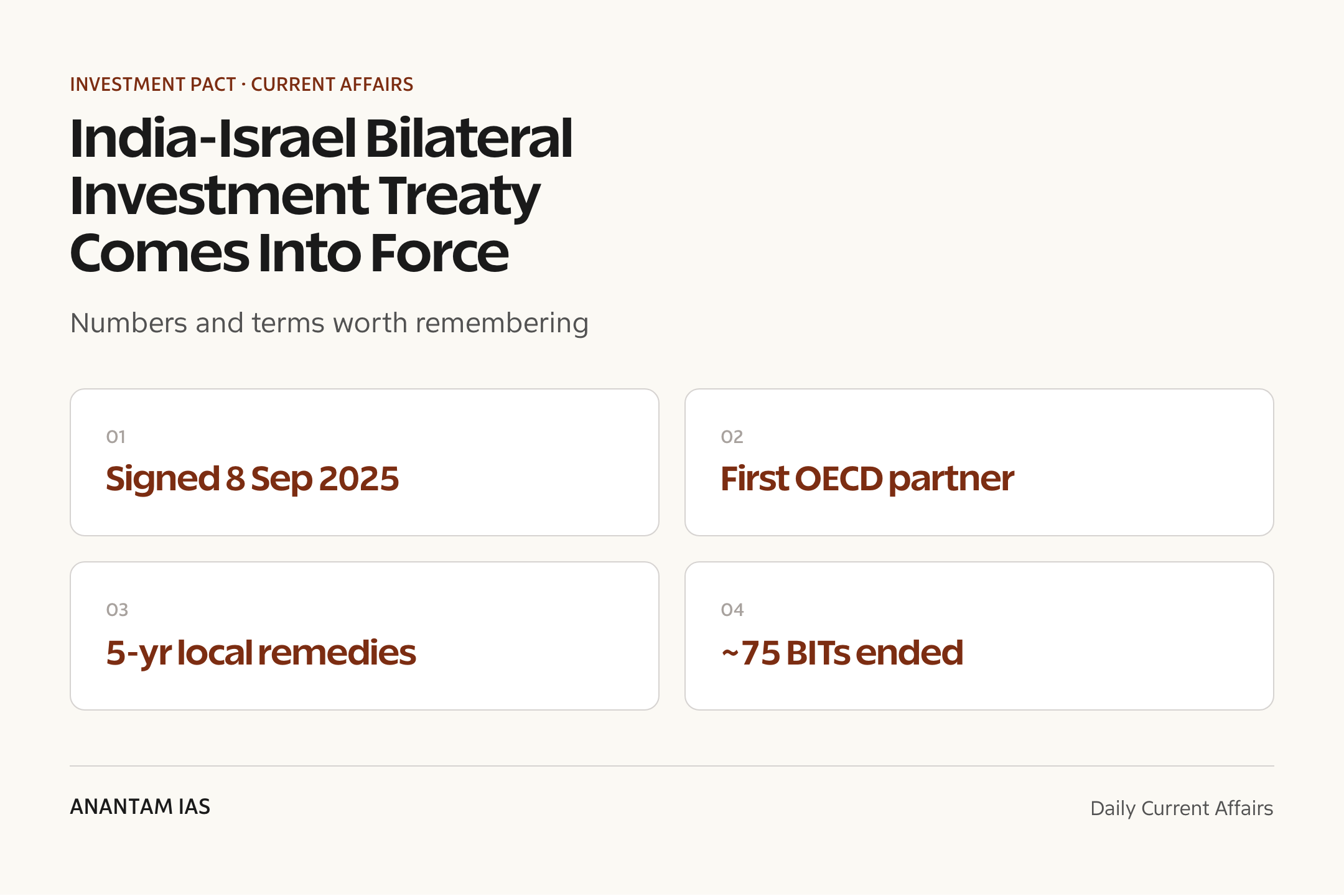
The India-Israel Bilateral Investment Treaty (BIT) has entered into force, the Department of Economic Affairs (DEA) under the Ministry of Finance confirmed. Signed in New Delhi on 8 September 2025 by Finance Minister Nirmala Sitharaman and Israel’s Finance Minister Bezalel Smotrich, it is the first Indian investment treaty to take effect built on the revised Model BIT template with a partner from the developed world.
The headline point: Israel is the first OECD member to accept India’s post-2016 investment-treaty architecture, including Investor-State Dispute Settlement (ISDS) only after five years of exhausting local remedies, and broad carve-outs for taxation and national security.
- Signed in New Delhi on 8 September 2025; now in force after both sides completed internal ratification.
- Replaces the earlier 1996 India-Israel BIT, which India had terminated in 2017.
- Israel becomes the first OECD country to sign onto India’s post-2016 treaty design.
- Investors must exhaust local remedies for five years before invoking ISDS arbitration.
- Carve-outs shield taxation, national security, government procurement, subsidies and compulsory licences.
- India-Israel bilateral trade stands near USD 4 billion (about Rs 35,212 crore) a year, per DEA figures.
- Positioned by DEA as a template for future BIT talks with the UK, EU and OECD economies.
The development matters in the context of:
- Follows India’s 2016-17 mass termination of nearly 75 old-style BITs after adverse arbitral awards.
- Signals India can win developed-economy buy-in for its more state-protective treaty model.
- Feeds the wider India-Israel economic track alongside defence, agriculture and I2U2.
UPSC Relevance
Prelims Relevance
- Bilateral Investment Treaty (BIT): a pact protecting cross-border investors against unfair treatment and expropriation.
- Model BIT 2016: India’s template treaty adopted after adverse ISDS awards.
- ISDS (Investor-State Dispute Settlement): arbitration allowing an investor to sue a host state.
- Exhaustion of local remedies: pursuing domestic courts for five years before international arbitration.
- Department of Economic Affairs (DEA) under the Ministry of Finance is the nodal body for BITs.
- India terminated around 75 BITs from 2016-17 onward.
- The old 1996 India-Israel BIT was terminated in 2017.
- OECD: Organisation for Economic Co-operation and Development; Israel is a member.
- The Model BIT 2016 drops the MFN clause and uses an enterprise-based investment definition.
- I2U2: India, Israel, UAE and the US grouping.
- National treatment and expropriation are core BIT protections.
Mains Relevance
GS Paper 2
- India-Israel bilateral ties and the significance of a developed-economy partner adopting India’s treaty model.
- How investment treaties shape India’s engagement with groupings and agreements affecting its interests.
GS Paper 3
- Investment climate, FDI framework and the trade-off between investor confidence and regulatory sovereignty.
- ISDS reform, the 2016 Model BIT and lessons from adverse arbitral awards for India.
Essay
- Sovereignty and openness: can a state protect its policy space while courting foreign capital?
Background and Context
What a Bilateral Investment Treaty does
A BIT is a reciprocal pact that gives investors from one country legal protections when they invest in the other.
- Core guarantees usually cover fair and equitable treatment, protection against expropriation without adequate compensation, and free transfer of funds.
- Many treaties add national treatment (treating a foreign investor no worse than a domestic one) and, in older models, a most-favoured-nation (MFN) clause extending better terms granted to third countries.
- The signature enforcement tool is ISDS — an investor can take a host government to international arbitration rather than relying only on domestic courts.
- BITs aim to de-risk cross-border capital, lowering the perceived political risk of investing in a partner economy and, in theory, drawing more long-term FDI.
- The flip side is regulatory chill — governments worry that broad protections expose legitimate public-policy measures to costly arbitration claims.
ISDS explained — the core of the debate
Investor-State Dispute Settlement is the mechanism that turns a treaty promise into an enforceable claim, and it is where most of the controversy sits.
- Under classic ISDS, a foreign investor can bypass a host country’s courts and sue the state directly before an international arbitral tribunal.
- Awards can run into hundreds of millions of dollars and are difficult to appeal, which critics say tilts the field toward large investors.
- Broadly worded clauses on fair and equitable treatment (FET) and expropriation have historically been read expansively by tribunals, catching routine regulation.
- The Model BIT 2016 tries to tame this by narrowing FET, tightening the expropriation test, and inserting the five-year local-remedies gate before ISDS can begin.
Why India rewrote its treaty model
India’s shift to a state-protective template grew directly out of arbitration losses in the early-to-mid 2010s.
- The White Industries award of 2011 — where a tribunal held India liable, partly for delays in its own courts — was the trigger that exposed weaknesses in India’s old treaties.
- Later high-profile tax disputes, including the Vodafone and Cairn cases, deepened India’s exposure to large ISDS claims under investor-friendly BITs.
- In response India adopted the Model BIT 2016, a markedly more restrictive template drafted around India’s regulatory interests and its right to regulate.
- From 2016-17 India issued termination notices for close to 75 existing BITs, seeking to renegotiate them on the new terms; the old 1996 India-Israel BIT was among those wound down, terminated in 2017.
- The result: for years India had almost no live investment treaties with major partners, and negotiations to sign fresh ones on the tougher template made slow progress.
Defining features of the Model BIT 2016
The 2016 template is deliberately narrower than the treaties it replaced, tilting the balance toward the host state’s regulatory autonomy.
- ISDS after local remedies: an investor must first pursue Indian courts and tribunals for at least five years before triggering international arbitration.
- Enterprise-based investment: protection is limited to investments made as a genuine business enterprise complying with Indian law, filtering out speculative or shell holdings.
- No MFN clause: the model drops most-favoured-nation treatment to stop investors ‘treaty-shopping’ for better terms from India’s other pacts.
- Narrowed FET: instead of an open-ended fair-and-equitable-treatment guarantee, it lists a closed set of protections such as denial of justice and manifestly abusive treatment.
- Carve-outs: taxation, national security, government procurement, subsidies and compulsory licences sit outside the treaty’s obligations.
- The design preserves the state’s right to regulate for public welfare — health, environment and safety — without those measures automatically counting as expropriation.
Why the OECD-member angle matters
The politically significant fact is not the bilateral flow itself but who agreed to the terms.
- Israel is a member of the OECD, the club of largely high-income economies, and is the first such member to accept India’s post-2016 template.
- Developed-economy investors and their governments have often resisted India’s model as too restrictive on ISDS and too generous to state defences.
- Israel’s acceptance gives India a working precedent to point to in stalled talks with the United Kingdom, the European Union and other OECD partners.
- The DEA frames the pact as a reusable template, signalling India will not dilute its core red lines to close future deals.
The wider India-Israel economic and strategic track
The BIT slots into a relationship that has broadened well beyond defence, with the numbers still modest but rising.
- Annual bilateral trade sits near USD 4 billion (about Rs 35,212 crore); India’s cumulative overseas direct investment in Israel is around USD 443 million and Israeli FDI into India about USD 334 million, per DEA data.
- Defence remains the anchor, with Israel a major supplier of missiles, drones and radar systems to India.
- Agriculture and water cooperation runs through Centres of Excellence and drip-irrigation and precision-farming know-how.
- Both are partners in I2U2 (India, Israel, UAE, US), linking them to food-security and clean-energy projects.
- A settled investment-protection regime is meant to draw private capital into technology, water, agri-tech and manufacturing tie-ups.
Where the BIT sits in India's FDI framework
A BIT is a protection layer that sits on top of, not in place of, India’s domestic FDI rules.
- Entry of foreign capital is still governed by India’s FDI policy and the FEMA regime administered by the RBI and the government.
- The BIT chiefly governs the post-establishment treatment of an investment already made under those rules — how the state may or may not act once the money is in.
- It complements, rather than substitutes for, the wider trade and economic agreements India is negotiating, whose investment chapters often mirror the same red lines.
- A predictable treaty is intended to reinforce India’s pitch as a stable destination amid global supply-chain shifts and China-plus-one relocation.
A template for the pacts still on the table
The Israel treaty matters most as a proof of concept for the far larger deals India is chasing.
- India is negotiating or firming up investment terms with the EFTA bloc, the European Union and the United Kingdom, where investment protection has been a sticking point.
- Each of these carries an investment chapter or a linked BIT, and partners have pushed back on the five-year local-remedies rule and the dropped MFN and FET protections.
- With an OECD economy now inside the tent, India can argue the model is workable, not a deal-breaker, and hold its line in the tougher talks.
- The pattern also fits India’s broader pivot to free-trade and economic-partnership agreements that bundle goods, services and investment in one package.
The criticism and the open debate
Not everyone reads a state-protective treaty as an unqualified win; the design has trade-offs.
- Critics argue the five-year local-remedies gate, given the backlog in Indian courts, can make ISDS a near-dead letter and blunt the treaty’s appeal to cautious investors.
- Dropping the MFN clause and narrowing FET removes protections that developed-economy investors are used to, which some fear could deter capital at the margin.
- Supporters counter that a treaty India can defend is better than a generous one that keeps exposing the exchequer to nine-figure awards.
- The honest verdict is not yet in: whether the restrictive model attracts or quietly discourages FDI will only show up in investment flows over several years, not in the signing ceremony.
Way Forward
Use it as a template
- Leverage the Israel precedent in ongoing BIT and trade talks with the UK, EU, EFTA and other OECD economies, pointing to a live, workable deal.
- Publish the treaty text promptly so investors and arbitration counsel can price the new terms with certainty rather than guessing at the carve-outs.
Balance protection with openness
- Pair the state-protective model with faster, more credible domestic dispute resolution so the five-year local-remedies rule is not seen as a dead end.
- Strengthen commercial courts and arbitration infrastructure so the local-remedies clause reflects a genuine forum, not a delay.
- Track investor sentiment and FDI data to ensure the restrictive design does not quietly deter capital India wants to attract.
Build negotiating and defence capacity
- Deepen institutional capacity within the DEA and the law ministry to defend and negotiate treaties, so India argues from strength rather than reacting to claims.
- Keep the Model BIT under periodic review so it stays credible to partners without surrendering the regulatory space India fought to protect.
Conclusion
The India-Israel BIT coming into force is a modest number on paper but a notable marker of policy: a developed, OECD-member economy has signed up to the treaty model India rebuilt after its arbitration setbacks of the 2010s.
It validates India’s bet that it can protect regulatory space and still find willing partners, and hands negotiators a concrete precedent to wave in the harder rooms.
The real test lies ahead — whether the same terms can unlock the larger, long-stalled deals with the UK, the EU and EFTA, and whether a deliberately tougher treaty ends up attracting the capital it was designed to reassure or quietly holding some of it back.
UPSC Practice Questions
Prelims MCQ 1
With reference to the India-Israel Bilateral Investment Treaty that has come into force, consider the following statements:
- It requires an investor to exhaust local remedies for five years before invoking international arbitration.
- Israel is the first OECD member country to accept India’s post-2016 treaty model.
- It removes taxation and national security matters from carve-outs, bringing them under treaty obligations.
How many of the above statements are correct?
(a) Only one (b) Only two (c) All three (d) None
Answer: (b) Only two
Explanation:
Statements 1 and 2 are correct. Statement 3 is wrong: taxation and national security are carved OUT of the treaty’s obligations, not brought under them.
Prelims MCQ 2
The Model BIT 2016 and the mass termination of India’s older bilateral investment treaties are best explained by which of the following?
(a) India’s exit from the World Trade Organization (b) Adverse Investor-State Dispute Settlement (ISDS) arbitration awards against India (c) A Supreme Court ruling banning foreign investment (d) India joining the OECD as a full member
Answer: (b) Adverse Investor-State Dispute Settlement (ISDS) arbitration awards against India
Explanation:
Losses and exposure in ISDS cases such as White Industries (2011) pushed India to adopt the restrictive Model BIT 2016 and terminate around 75 old-style treaties from 2016-17.
UPSC Mains Questions
- India’s post-2016 investment-treaty model prioritises the state’s right to regulate over expansive investor protections. Examine the trade-offs this creates for attracting foreign capital, using the India-Israel BIT as a reference point.
- Explain how adverse arbitration outcomes reshaped India’s approach to bilateral investment treaties. What lessons does the India-Israel treaty offer for India’s negotiations with OECD economies?
Source: PIB, Department of Economic Affairs, Ministry of Finance.
Frequently Asked Questions
What is the India-Israel Bilateral Investment Treaty?
It is a reciprocal pact protecting investors from each country in the other, covering fair treatment and protection against arbitrary expropriation. Signed in New Delhi on 8 September 2025, it has now entered into force, replacing the earlier 1996 treaty that India terminated in 2017.
Why is Israel being the first OECD country significant?
Developed economies often resisted India’s post-2016 treaty model as too restrictive. Israel, an OECD member, accepting these terms gives India a working precedent it can cite in stalled negotiations with the United Kingdom, the European Union and other high-income partners.
What is ISDS and how does this treaty limit it?
ISDS, or Investor-State Dispute Settlement, lets an investor take a host government to international arbitration. Under this treaty an investor must first exhaust local remedies in Indian courts for at least five years before invoking ISDS arbitration.
What are the treaty’s carve-outs?
Certain areas sit outside the treaty’s obligations. These include taxation and national security, along with government procurement, subsidies and compulsory licences, preserving the government’s policy space in sensitive domains.
Why did India terminate its older BITs?
After adverse ISDS awards, notably the 2011 White Industries case, exposed India to large claims, India adopted the more state-protective Model BIT 2016 and issued termination notices for close to 75 older, investor-friendly treaties from 2016-17, aiming to renegotiate them.
Does the BIT replace India’s FDI rules?
No. Foreign investment entry is still governed by India’s FDI policy and the FEMA regime. The BIT mainly protects the post-establishment treatment of investments already made under those domestic rules, adding a protection layer rather than replacing them.