India-Japan 16th Annual Summit: Joint statements on AI, energy and Indo-Pacific
Why in News?
Prime Minister of Japan Takaichi Sanae paid her first official visit to India from 1-3 July 2026 for the 16th India-Japan Annual Summit with Prime Minister Narendra Modi in New Delhi. PIB released the summit joint statement — ‘Advancing a Partnership of Strategic Convergence and Trust for Shared Growth, Prosperity and Resilience’ — along with a list of 16 outcome documents on 2 July 2026.
The headline deliverables are the India-Japan Joint Declaration on Economic Security, a first-of-its-kind Joint Statement on Cooperation in Artificial Intelligence that elevates the two countries to strategic AI research and development partners, and a Joint Statement on Energy Resilience covering strategic petroleum stockpiling. Both sides will celebrate 2027, the 75th anniversary of diplomatic relations, as the India-Japan Year of Shared Horizons.
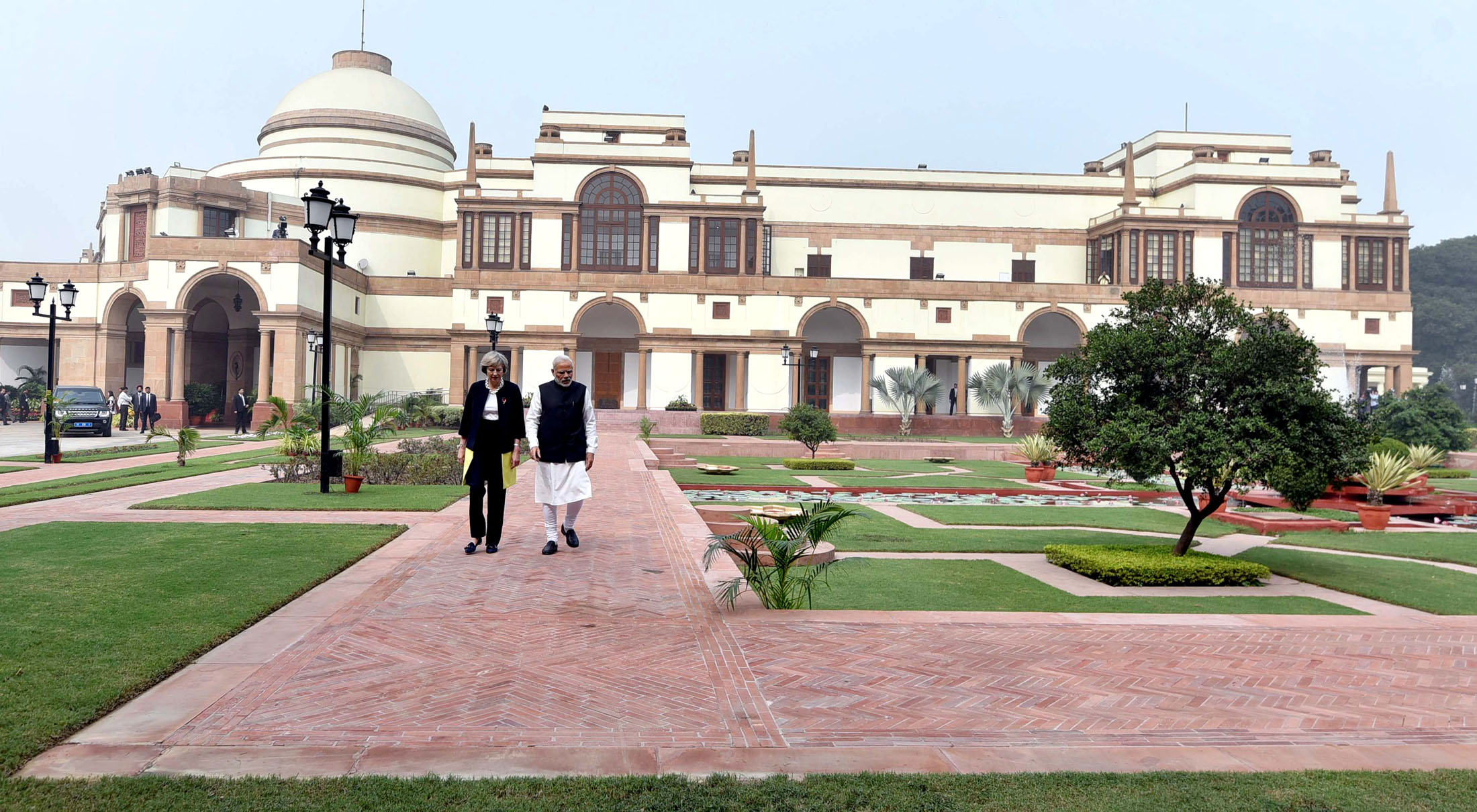
- 16 outcomes announced: 1 joint declaration, 2 joint statements, 6 Memoranda of Cooperation, 5 MoUs, 1 exchange of letters and a 75th-anniversary plan.
- The AI pact builds on the Japan-India AI Cooperation Initiative (JAI) and the first India-Japan AI Strategic Dialogue of April 2026.
- The energy statement was signed between India’s Ministry of Petroleum and Natural Gas (MoPNG) and Japan’s Ministry of Economy, Trade and Industry (METI).
- PM Takaichi affirmed Japan’s support for India’s membership of the International Energy Agency (IEA).
- The fourth 2+2 Ministerial Meeting will be held in Tokyo by end-2026; progress on the 10 trillion yen investment target was reviewed.
The development matters in the context of:
- Japan is one of only a handful of countries with which India holds leader-level Annual Summits, a mechanism running since 2006.
- The visit came amid supply-chain weaponisation, West Asia instability around the Strait of Hormuz, and intensifying technology competition — making economic security the new axis of the partnership.
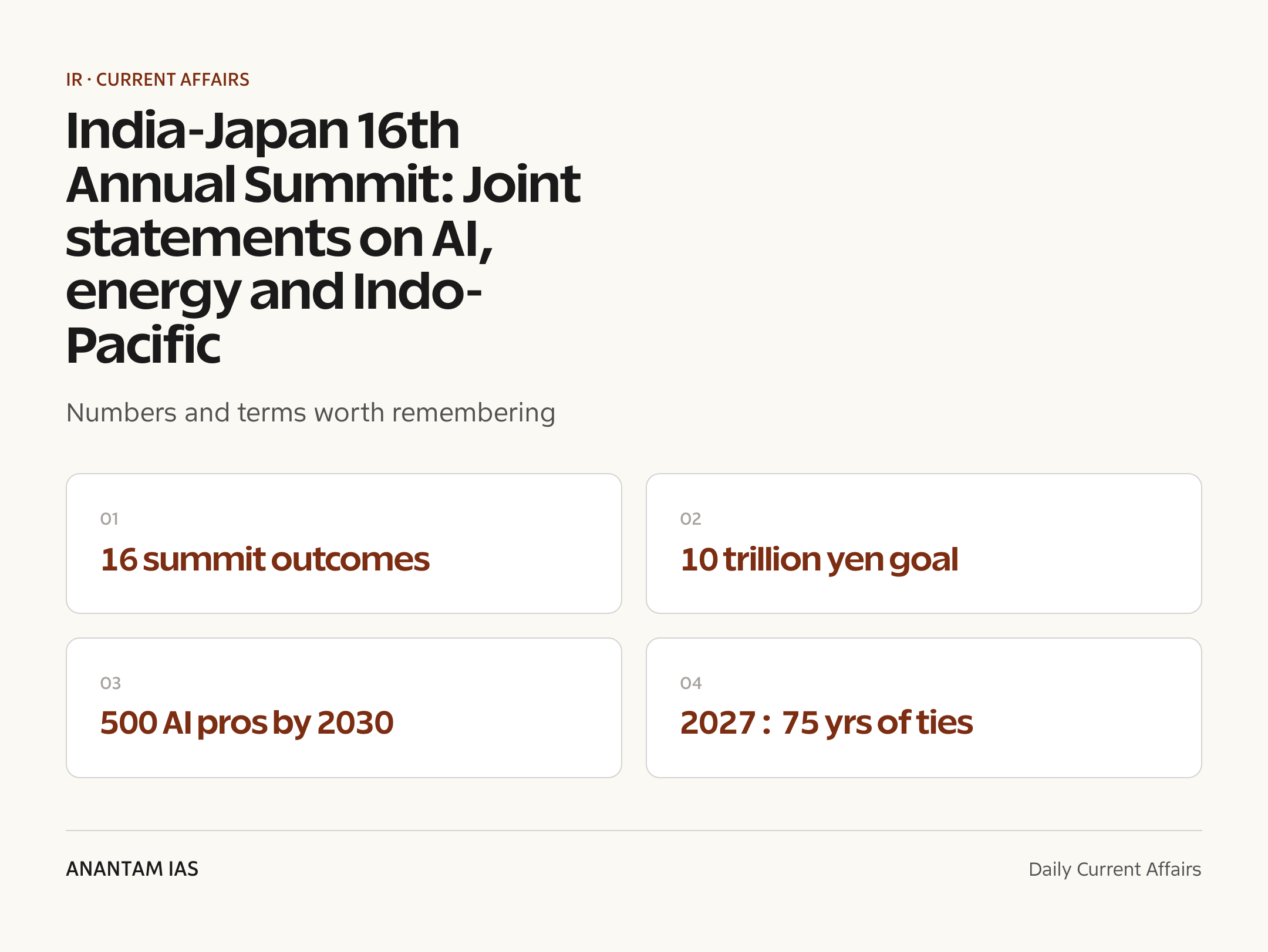
- For GS2, the summit is a ready case study of how a ‘Special Strategic and Global Partnership’ operationalises Indo-Pacific convergence — track it alongside the daily current affairs digests.
UPSC Relevance
Prelims Relevance
- 16th India-Japan Annual Summit — New Delhi, 1-3 July 2026; PM Takaichi Sanae’s first official visit to India.
- Special Strategic and Global Partnership — the label of India-Japan ties since 2014.
- Joint Declaration on Economic Security — semiconductors, critical minerals, ICT/AI, clean energy, pharmaceuticals.
- Joint Statement on AI Cooperation — strategic R&D partnership across the AI technology stack; anchored in the Hiroshima AI Process.
- Joint Statement on Energy Resilience — MoPNG-METI pact on strategic stockpiling of crude oil and petroleum products.
- UNICORN (Unified Complex Radio Antenna) — stealth naval antenna; agreement in principle reached.
- CBG Initiative — Cooperative Biogas for Growth: 1,000 biogas and organic fertilizer plants via dairy cooperatives.
- India-Japan Year of Shared Horizons — 2027, 75 years of diplomatic relations (established 1952).
Mains Relevance
GS Paper 2
- India-Japan ties as a template of issue-based strategic convergence — defence, economic security, technology and people-to-people pillars.
- Indo-Pacific architecture: Japan’s updated FOIP aligned with India’s IPOI and MAHASAGAR; Quad, ASEAN centrality, and a proposed India-Japan-Philippines trilateral dialogue.
- G4 push for UNSC reform; mutual support for permanent seats and non-permanent terms in 2028-29 and 2033-34.
- Counter-terrorism convergence: condemnation of cross-border terrorism from Pakistan, the Pahalgam attack and UN-listed groups like LeT and JeM.
GS Paper 3
- Economic security as doctrine — de-risking semiconductor, critical mineral and pharma supply chains against economic coercion.
- Energy security levers: strategic petroleum reserves, Strait of Hormuz sea-lanes, clean ammonia and biogas cooperation.
- AI and frontier tech: sovereign LLM development, compute infrastructure and AI-talent mobility as technology diplomacy.
Essay
- Middle powers and minilateralism: how like-minded partnerships, not blocs, are rebuilding the world order.
- Technology is the new territory: AI, chips and supply chains as the currency of 21st-century diplomacy.
Background and Context
How India-Japan ties became a Special Strategic and Global Partnership
The relationship has climbed a deliberate ladder of upgrades over seven decades, and the 2026 summit builds directly on that scaffolding.
- Diplomatic relations were established in 1952 through a separate India-Japan peace treaty — 2027 marks the 75th anniversary.
- The Global Partnership (2000) became a Strategic and Global Partnership in 2006, when the Annual Summit mechanism was institutionalised; 2014 brought the elevation to the Special Strategic and Global Partnership.
- The Comprehensive Economic Partnership Agreement (CEPA), in force since 2011, remains the trade backbone; both PMs agreed to accelerate its review to make it ‘more forward-looking’.
- The 15th Annual Summit (August 2025) produced the Joint Declaration on Security Cooperation, the Economic Security Initiative and the 10 trillion yen investment target — all reviewed and extended now.
- The 2+2 Ministerial dialogue, running since 2019, holds its fourth round in Tokyo by end-2026.
What the 16th Summit delivered: the 16 outcomes
PIB’s List of Outcomes groups the deliverables into strategic declarations, ministry-level pacts and institution-to-institution agreements.
- Joint Declaration on Economic Security — project-based collaboration in semiconductors, critical minerals, ICT including AI, clean energy and pharmaceuticals, tracked via Fact Sheet 2.0.
- Joint Statement on AI Cooperation — a roadmap across the AI technology stack; Joint Statement on Energy Resilience — stockpiling and maritime energy transport.
- Six MoCs: the CBG biogas initiative, batteries, pharmaceuticals and medical devices (APIs and Key Starting Materials), geology and mineral exploration, IndiaAI Mission-METI (GENIAC), and the NGMP.
- Research MoUs: C-CAMP-RIKEN and NCBS-TIFR-RIKEN (life sciences and neuroscience), IIT Bombay-BharatGen-NII Japan (LLMs for scientific reasoning), SarvamAI-Preferred Networks (full AI stack).
- Digital and financial plumbing: NIXI-JPNIC MoU on IPv6 and internet governance; an IFSCA-JFSA exchange of letters on FinTech and RegTech supervision.
The AI pact: a first-of-its-kind strategic R&D partnership
The AI joint statement treats AI as an ‘era-defining general-purpose technology’ and organises cooperation into three priority areas.
- Priority I — governance, safety and cybersecurity: coordination in the G20, OECD, GPAI and UN; commitment to the Hiroshima AI Process; AI model evaluation via the Trusted AI Commons platform from the India AI Impact Summit.
- Priority II — infrastructure, models and talent: data centres, GPU compute and semiconductors; the FOIP Digital Corridor Initiative; multilingual, open-source models for native languages.
- A concrete talent goal: inviting 500 highly skilled AI professionals from India to Japan by 2030, set at the Foreign Ministers’ Strategic Dialogue in January 2026.
- Priority III — AI for All: capacity building for the Global South under the New Delhi Declaration; Japan announced it will host the next AI Summit.
- The IndiaAI Mission pairs with Japan’s GENIAC initiative through B2B matchmaking and shared computing resources; child safety in AI and AI-enabled cybersecurity for critical infrastructure get explicit mention.
Energy resilience and economic security: de-risking in a coercive world
Both economies import heavily and sit exposed to chokepoints, so the summit paired energy security with a broader economic security doctrine.
- The two PMs voiced ‘grave concerns’ over economic coercion, arbitrary export restrictions and price manipulation in critical minerals — language aimed at supply-chain weaponisation without naming any country.
- The energy statement institutionalises cooperation on strategic petroleum reserves — best practices and technical collaboration on the stockpiling ecosystem — plus joint investments in maritime energy transport.
- Both sides stressed free navigation through the Strait of Hormuz; regional platforms cited include Japan’s POWERR Asia and the Quad Initiative on Indo-Pacific Energy Security.
- Japan backed India’s membership of the International Energy Agency — significant since India is currently only an IEA Association country.
- Clean energy workstreams: the clean ammonia project in Odisha, green hydrogen, solar PV, and the CBG goal of 1,000 biogas plants riding on dairy cooperatives; batteries and pharma MoCs extend the de-risking logic.
Defence and Indo-Pacific security convergence
Security cooperation moved from dialogue to hardware and interoperability, framed by a shared reading of the region.
- PM Modi welcomed Japan’s review of its Three Principles on Transfer of Defence Equipment and Technology — a loosening of post-war export restraints.
- Agreement in principle on the UNICORN stealth naval antenna — among Japan’s first major defence-technology transfers to India, under ‘Make in India’.
- Navies conducted JAIMEX 25; Japan joined the International Fleet Review 2026 at Visakhapatnam; cooperation extends to satellite-based maritime domain awareness and naval MRO.
- Serious concern over the East and South China Seas; disputes to be settled per UNCLOS; Quad cooperation reaffirmed, with an inaugural India-Japan-Philippines trilateral dialogue in preparation.
- Strongest condemnation of cross-border terrorism from Pakistan, the Pahalgam attack of 22 April 2025 and the Delhi blast of 10 November 2025.
Economy, investment and mobility: from yen target to bullet trains
The economic agenda ties Japanese capital and technology to India’s Viksit Bharat goal and its manufacturing ambitions.
- Progress reviewed on the 10 trillion yen private-investment target set at the 15th Summit; the India-Japan Industrial Competitiveness Partnership fast-track eases investor entry.
- On the Mumbai-Ahmedabad High Speed Rail, Japan noted India’s target of commercial operations on priority sections in 2027 and the plan to introduce the next-generation E10 Shinkansen.
- Future corridors will be explored toward India’s vision of a 7,000 km national high-speed rail network, with Japanese companies invited in.
- The NGMP MoC drives private-sector cooperation across rail, automotive, aviation, shipbuilding, ports and logistics — a ‘Make in India for the World’ export play.
- People-to-people: two-way visitors crossed 540,000 in 2025; Japanese-language education grows via the Nihongo Partners programme.
Regional and global issues: North East, Africa, UNSC reform
The joint statement reads as a map of where Indian and Japanese regional strategies interlock beyond the bilateral.
- Japan’s FOIP and India’s Act East Policy converge on the North Eastern Region — connectivity, semiconductors and biofuels — with value chains linking the NER to the Bay of Bengal and BIMSTEC.
- Africa cooperation is being structured by synthesising India’s IAFS mechanism and Japan’s TICAD process.
- As G4 members, both back urgent UNSC expansion, each other’s permanent candidature and non-permanent terms in 2028-29 and 2033-34.
- Japan supports India hosting the 4th UN World Conference on Disaster Risk Reduction in 2030 under the Sendai Framework.
- Science ties deepen via the ISRO-JAXA LUPEX lunar polar mission and a DST-Cabinet Office Letter of Intent on quantum technologies.
Way Forward
Convert frameworks into projects
- Fix timelines and financing for the flagship pacts — UNICORN, the Odisha clean ammonia plant and the first NGMP projects — so the 17th Summit reviews delivery, not intent.
- Use the CEPA review to address India’s persistent trade deficit with Japan and the low uptake of CEPA benefits by Indian exporters.
Build the AI corridor with safeguards
- Hold the AI Strategic Dialogue annually and track the 500-professionals mobility goal with transparent visa and credential pathways.
- Pair compute and LLM cooperation with interoperable AI safety standards so the partnership shapes, rather than follows, global AI governance.
Deepen the Indo-Pacific web
- Move early on the India-Japan-Philippines trilateral and the next Quad Leaders’ Summit to lock in regional momentum.
- Scale North East connectivity under the Act East Forum as the land bridge to BIMSTEC and Southeast Asia.
Conclusion
The 16th Annual Summit shows the India-Japan relationship maturing from a values-based friendship into an interests-based operating system — one that now spans stealth antennas, petroleum stockpiles, foundation models and bullet trains. The economic security and AI documents mark the first time New Delhi has co-written technology-governance roadmaps of this depth with any partner.
For aspirants, the summit is a compact case study in how India practises strategic autonomy through layered partnerships — bilateral summitry, minilaterals like the Quad, and G4-led multilateral reform — all pointing toward a free, open and rules-based Indo-Pacific. Revise it with the monthly current affairs compilations before Prelims and Mains.
UPSC Practice Questions
Prelims MCQ 1
With reference to the 16th India-Japan Annual Summit (2026), consider the following statements:
- The two countries adopted a first-of-its-kind Joint Statement on Artificial Intelligence, elevating the relationship to a strategic research and development partnership in AI.
- The Joint Statement on Energy Resilience covers cooperation in strategic stockpiling of crude oil and petroleum products.
- Japan announced its support for India’s full membership of the Organisation for Economic Co-operation and Development (OECD).
How many of the above statements are correct?
(a) Only one (b) Only two (c) All three (d) None
Answer: (b) Only two
Explanation:
Statements 1 and 2 are correct per the PIB outcome documents. Statement 3 is wrong: PM Takaichi affirmed support for India’s membership of the International Energy Agency (IEA), not the OECD.
Prelims MCQ 2
The ‘UNICORN’ project, recently seen in the news in the context of India-Japan cooperation, relates to:
(a) A joint lunar polar exploration mission (b) A unified complex radio antenna for naval warships (c) A cross-border digital payments corridor (d) A high-speed rail signalling system
Answer: (b) A unified complex radio antenna for naval warships
Explanation:
UNICORN (Unified Complex Radio Antenna) is a Japanese stealth naval-mast technology. The 16th Summit recorded agreement in principle on the remaining technical details — set to be among Japan’s first major defence-technology transfers to India. The lunar mission is LUPEX (ISRO-JAXA).
UPSC Mains Questions
- “India and Japan are natural and indispensable partners in the Indo-Pacific.” In light of the outcomes of the 16th India-Japan Annual Summit, examine how the Special Strategic and Global Partnership has moved from declaratory convergence to concrete cooperation. (250 words)
- Economic security has emerged as the organising principle of India-Japan relations. Discuss how the 2026 summit outcomes on semiconductors, critical minerals, energy resilience and artificial intelligence address India’s supply-chain vulnerabilities. (250 words)
- Technology partnerships are becoming instruments of foreign policy. With reference to the India-Japan Joint Statement on AI cooperation, analyse the opportunities and risks of aligning India’s AI ecosystem with a strategic partner. (150 words)
Sources: PIB, Prime Minister's Office (List of Outcomes) and PIB, Prime Minister's Office (Joint Statement).
Frequently Asked Questions
What is the 16th India-Japan Annual Summit?
It is the leader-level summit held in New Delhi from 1-3 July 2026 between PM Narendra Modi and Japan’s PM Takaichi Sanae — her first official visit to India. It produced 16 outcome documents, including joint statements on economic security, artificial intelligence and energy resilience.
What is the India-Japan Special Strategic and Global Partnership?
It is the formal designation of India-Japan relations since 2014, built on the Global Partnership of 2000 and the Strategic and Global Partnership of 2006. It rests on three pillars reaffirmed in 2026: defence and security, economic partnership including economic security and technology, and people-to-people exchanges.
What does the India-Japan AI joint statement provide?
It elevates the two countries to strategic R&D partners in AI, with cooperation across governance and safety, compute infrastructure and model development, and ‘AI for All’ capacity building. It includes a goal of inviting 500 highly skilled Indian AI professionals to Japan by 2030.
What is the Joint Statement on Energy Resilience?
Signed between India’s Ministry of Petroleum and Natural Gas and Japan’s METI, it strengthens cooperation in strategic stockpiling and reserve mechanisms for crude oil and petroleum products, and promotes joint investments across the maritime energy transport value chain. Japan also backed India’s IEA membership.
What is the UNICORN project between India and Japan?
UNICORN, or Unified Complex Radio Antenna, is a Japanese stealth mast that integrates a warship’s communication antennas into a single structure. At the 2026 summit both sides reached agreement in principle on remaining technical details, paving the way for a rare Japanese defence-technology transfer to India.
Why is 2027 significant for India-Japan ties?
2027 marks the 75th anniversary of the establishment of diplomatic relations between India and Japan in 1952. The two Prime Ministers decided to celebrate it as the India-Japan Year of Shared Horizons, with year-long commemorative programmes across both countries.