India and Japan review defence ties, prepare ground for 2+2 dialogue
Why in News?
India and Japan held the 8th India-Japan Defence Policy Dialogue in Tokyo on Monday, reviewing the full range of their expanding defence cooperation and agreeing to deepen collaboration in defence industry, cyber security, space and advanced technologies. The dialogue was led by Defence Secretary Rajesh Kumar Singh and Japan’s Vice Minister of Defence for International Affairs, Kano Koji.
According to the Ministry of Defence, both sides assessed progress since the last round, reaffirmed the Special Strategic and Global Partnership, and reviewed military-to-military exchanges, joint-headquarters cooperation, maritime cooperation and joint exercises, particularly in the maritime domain.
As The Hindu reported, the talks were held ahead of the next 2+2 Foreign and Defence Ministers’ Dialogue scheduled later in 2026, with both sides discussing likely outcomes and reaffirming their shared vision of a free, open and rules-based Indo-Pacific. During the visit, Mr. Singh also called on Japan’s Defence Minister Shinjiro Koizumi and invited him to visit India.
- Dialogue led by Defence Secretary Rajesh Kumar Singh and Japan’s Vice Minister of Defence for International Affairs, Kano Koji.
- Both sides assessed progress since the last round and reaffirmed the India-Japan Special Strategic and Global Partnership.
- Agreed to deepen cooperation in defence-industrial collaboration, cyber security, space and advanced technologies.
- Reviewed military-to-military exchanges, joint-headquarters cooperation, maritime cooperation and bilateral and multilateral exercises.
- Discussed preparations for the upcoming 2+2 ministerial dialogue later in 2026.
- Defence Secretary called on Japan’s Defence Minister Shinjiro Koizumi and invited him to visit India.
The development matters in the context of:
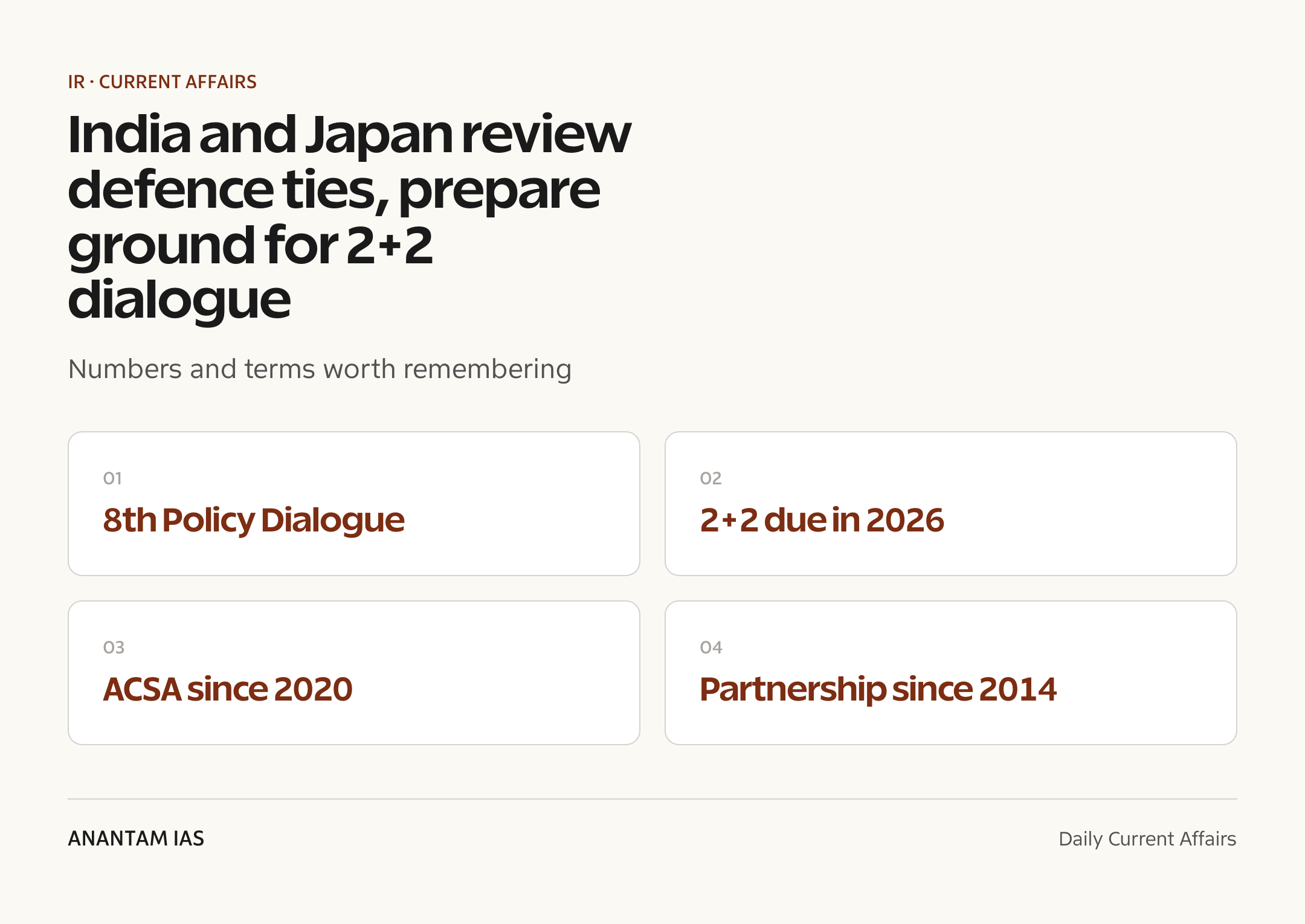
- India-Japan ties were upgraded to a Special Strategic and Global Partnership in 2014.
- The relationship is a core pillar of India’s Act East Policy and its Indo-Pacific engagement.
UPSC Relevance
Prelims Relevance
- India-Japan Special Strategic and Global Partnership (upgraded 2014).
- 2+2 Dialogue format: Foreign + Defence ministers; India’s 2+2 partners include the US, Japan, Australia and Russia.
- ACSA (Acquisition and Cross-Servicing Agreement) signed 2020 for reciprocal logistics support.
- Quadrilateral Security Dialogue (Quad): India, US, Japan, Australia.
- Malabar naval exercise now includes India, US, Japan and Australia.
- Dharma Guardian: India-Japan bilateral army exercise; JIMEX: bilateral naval exercise.
- Free and Open Indo-Pacific (FOIP): concept articulated by Japan.
- Defence Policy Dialogue is a Defence Secretary / Vice Minister level institutional mechanism.
Mains Relevance
GS Paper 2
- India-Japan defence and security cooperation as a stabilising factor in the Indo-Pacific.
- Role of 2+2 ministerial dialogues in deepening strategic partnerships.
- Bilateral defence-industrial and technology collaboration and Atmanirbharta in defence.
Essay
- Balance of power and cooperative security in a multipolar Asia.
Background and Context
The 8th Defence Policy Dialogue: what happened
The Tokyo meeting was an institutional stock-take of defence ties, not a treaty-signing event.
- Held on Monday in Tokyo, led by Defence Secretary Rajesh Kumar Singh and Vice Minister Kano Koji.
- As per the Ministry of Defence, both sides assessed progress since the last round and reaffirmed the Special Strategic and Global Partnership.
- Talks spanned the regional and global security environment and issues of mutual strategic interest.
- Reviewed military-to-military exchanges, cooperation between the two countries’ joint headquarters, maritime cooperation and bilateral and multilateral exercises.
- Also reviewed capacity building and defence equipment and technology collaboration, particularly in the maritime domain.
- Both sides stressed the importance of sustaining regular high-level exchanges and institutional dialogue.
- Defence Secretary Rajesh Kumar Singh called on Japan’s Defence Minister Shinjiro Koizumi and laid a wreath at the Self-Defense Forces Memorial in Tokyo.
- Both agreed to promote a free, open and rules-based regional order grounded in respect for international law.
India-Japan Special Strategic and Global Partnership
The partnership is the top tier of India’s bilateral relationships, upgraded in 2014.
- Elevated to a Special Strategic and Global Partnership during PM Modi’s 2014 visit to Japan.
- Anchored in shared democratic values, maritime interests and a stable, rules-based Indo-Pacific.
- Japan is a key partner in India’s Act East Policy and in high-speed rail, infrastructure and connectivity.
- Japan is financing the Mumbai-Ahmedabad High-Speed Rail (bullet train) project through low-interest yen loans.
- Regular annual summits between the two Prime Ministers guide the relationship.
- The two economies are linked through the India-Japan Comprehensive Economic Partnership Agreement (CEPA) of 2011.
- Development cooperation extends to India’s North East and to third-country projects in South Asia and Africa.
- Defence has moved from cautious engagement to institutionalised cooperation across the three services.
The 2+2 dialogue format
The 2+2 brings foreign and defence ministers together to align diplomacy with security.
- A 2+2 dialogue pairs the Foreign and Defence ministers of both countries in a single mechanism.
- India holds 2+2 dialogues with the United States, Japan, Australia and Russia.
- The India-Japan 2+2 was launched in 2019, upgrading an earlier foreign-and-defence secretary-level format; the next round is expected later in 2026.
- The format lets partners synchronise strategic messaging with concrete defence deliverables.
- It sits above working-level mechanisms such as the Defence Policy Dialogue and service-to-service staff talks.
- The 2+2 typically reviews maritime security, defence-technology cooperation and the regional security environment.
- The Tokyo policy dialogue was explicitly aimed at preparing outcomes for the coming ministerial 2+2.
Defence agreements and exercises
A web of pacts and drills gives the partnership operational depth.
- The ACSA (Acquisition and Cross-Servicing Agreement), signed in 2020, enables reciprocal provision of supplies and services between the two militaries, easing joint exercises and operations.
- An Agreement on Transfer of Defence Equipment and Technology (2015) underpins joint development efforts.
- Both are members of the Quad (with the US and Australia) and of the Malabar naval exercise, which Japan joined permanently.
- Bilateral drills include Dharma Guardian (army), JIMEX (navy) and the Shinyuu Maitri air-force exercise.
- Cooperation is expanding into Unmanned Ground Vehicles and other defence-technology projects.
- The two navies have collaborated on the UNICORN (Unified Complex Radio Antenna) mast for warships, an early India-Japan defence-industrial project.
- Fighter-pilot and staff-level exchanges add depth to service-to-service ties.
Emerging domains: cyber, space and industry
The new frontier of cooperation is technology and economic security, not just hardware.
- Both sides agreed to deepen ties in cyber security, space and advanced technologies.
- Defence-industrial collaboration aims to link Indian manufacturing with Japanese technology and capital.
- Cooperation supports India’s push for Atmanirbharta (self-reliance) in defence production.
- Economic security – resilient supply chains and critical technologies – is now a shared strategic concern.
- The two sides cooperate on semiconductors and critical and emerging technologies, including under an industry-competitiveness partnership.
- Critical minerals and rare-earth supply chains are a focus, given the drive to reduce dependence on a single supplier.
- Space cooperation includes potential collaboration on lunar exploration and satellite-based maritime domain awareness.
- Read more on India’s neighbourhood and strategic outreach in our international relations notes.
Strategic drivers in the Indo-Pacific
Shared anxieties about a changing regional balance push the two closer.
- Both back a Free and Open Indo-Pacific (FOIP), a concept first articulated by Japan.
- Concerns over China’s assertive maritime behaviour in the East and South China Seas shape the convergence.
- The partnership complements minilaterals such as the Quad and the India-Japan-Australia Supply Chain Resilience Initiative (SCRI).
- Maritime domain awareness, freedom of navigation and secure sea lanes of communication are recurring priorities.
- Japan’s evolving security posture, including higher defence spending, expands the scope for cooperation.
- Stability in the Indo-Pacific matters for India’s trade, energy imports and diaspora interests across the region.
- See our broader coverage of the Indo-Pacific and Quad for context.
Way Forward
Convert dialogue into deliverables
- Firm up concrete outcomes for the 2+2 ministerial, including new defence-technology projects.
- Operationalise ACSA through more frequent logistics support during joint exercises.
- Advance defence-industrial co-development, including Unmanned Ground Vehicle collaboration.
- Deepen cyber and space cooperation with clear working-level mechanisms.
- Strengthen economic-security coordination on critical technologies and supply chains, alongside the Quad.
Conclusion
The 8th Defence Policy Dialogue shows a maturing India-Japan partnership that is moving steadily from summit rhetoric to institutionalised, technology-led defence cooperation across the maritime, cyber and space domains.
With the 2+2 ministerial due later in 2026, the challenge for both capitals is to translate strategic convergence into concrete industrial, cyber and maritime deliverables that anchor a stable, rules-based Indo-Pacific and reinforce the wider Quad framework.
UPSC Practice Questions
Prelims MCQ 1
With reference to India-Japan defence cooperation, consider the following statements:
- India and Japan have signed an Acquisition and Cross-Servicing Agreement (ACSA) for reciprocal logistics support.
- India holds a 2+2 dialogue involving Foreign and Defence Ministers with Japan.
- Japan is a participant in the Malabar naval exercise.
How many of the above statements are correct?
(a) Only one (b) Only two (c) All three (d) None
Answer: (c) All three
Explanation:
All three are correct. India and Japan signed the ACSA in 2020. The India-Japan 2+2 (Foreign + Defence Ministers) was launched in 2019. Japan is a permanent participant in the Malabar exercise, which also includes the US and Australia.
Prelims MCQ 2
The 8th India-Japan Defence Policy Dialogue held in Tokyo was chaired on the Indian side by which official?
(a) The Defence Minister (b) The Defence Secretary (c) The Chief of Defence Staff (d) The National Security Adviser
Answer: (b) The Defence Secretary
Explanation:
The Defence Policy Dialogue is an institutional mechanism at the Defence Secretary / Vice Minister level. The 8th round was led by Defence Secretary Rajesh Kumar Singh and Japan’s Vice Minister of Defence for International Affairs, Kano Koji.
UPSC Mains Questions
- India-Japan defence cooperation has become a stabilising pillar of the Indo-Pacific order. Discuss the institutional mechanisms and emerging domains driving this partnership. (GS Paper 2)
- The 2+2 ministerial format has emerged as a key instrument of India’s strategic diplomacy. Examine its significance with reference to India-Japan relations. (GS Paper 2)
Sources: The Hindu and Ministry of Defence, Government of India.
Frequently Asked Questions
What is the India-Japan Defence Policy Dialogue?
It is an institutional mechanism at the Defence Secretary / Vice Minister level where India and Japan review the full spectrum of their defence cooperation. The 8th round was held in Tokyo, led by Defence Secretary Rajesh Kumar Singh and Vice Minister Kano Koji.
What is the 2+2 ministerial dialogue?
A 2+2 dialogue brings together the Foreign and Defence Ministers of both countries in a single mechanism, aligning diplomacy with security cooperation. India holds 2+2 dialogues with the US, Japan, Australia and Russia; the next India-Japan 2+2 is expected later in 2026.
What is the Special Strategic and Global Partnership?
It is the highest tier of the India-Japan relationship, upgraded to this status in 2014. It covers strategic, economic, technological and defence cooperation across a shared Indo-Pacific vision.
What is the ACSA between India and Japan?
The Acquisition and Cross-Servicing Agreement, signed in 2020, allows the militaries of both countries to provide each other supplies and services such as fuel and provisions on a reciprocal basis, easing joint exercises and operations.
Which exercises do India and Japan conduct together?
Bilaterally they hold Dharma Guardian (army) and JIMEX (navy). Japan also participates with India, the US and Australia in the multilateral Malabar naval exercise and the Quad framework.
Why does this partnership matter for the Indo-Pacific?
Both countries support a free, open and rules-based Indo-Pacific. Their defence-industrial, cyber and maritime cooperation, along with the Quad, helps balance regional power shifts and secure critical sea lanes and supply chains.