India-Japan Forest Roadmap: Trees Outside Forests and Better Inventories
Why in News?
India and Japan endorsed a 2027-2031 forest cooperation roadmap at their Joint Working Group meeting in Bengaluru on 8 September 2026.
- The roadmap operates under the existing Memorandum of Cooperation; both delegations also signed the meeting’s minutes.
- Discussions covered trees outside forests, forest genetics, and forest inventory, stock assessment and geospatial monitoring.
- The PIB release reports endorsement, but does not supply numerical planting targets, financing commitments or the complete roadmap text.
- Forest policy also concerns farm trees and scattered tree resources, making agricultural landscapes relevant to resource assessment and livelihoods.
- Cooperation can connect resource location, planting material and measurement; these solve different problems and should not be treated as interchangeable achievements.
UPSC Relevance
Prelims Relevance
- Recorded forest area versus forest cover
- Tree cover versus trees outside forests
- Forest inventory and growing stock
- Germplasm conservation and tree breeding
- India-Japan forest cooperation
Mains Relevance
GS Paper 3
- Integrating agroforestry, biodiversity conservation and resource monitoring
- Limits of canopy area as a measure of ecological quality
GS Paper 2
- Technical cooperation as an instrument of bilateral relations
Essay
- What we measure shapes what we conserve.
Background and Context
Recorded forests, forest cover and trees outside forests
These terms answer different questions: where land is recorded, where canopy exists, and which trees grow outside recorded forest areas.
- Recorded forest area concerns land recorded as forest in government records. It is not a satellite estimate, and every part need not currently support dense tree canopy.
- Forest cover, under FSI’s assessment definition, includes qualifying canopy patches irrespective of ownership or legal status. Mapping a plantation as cover does not itself change the land’s legal classification.
- Trees outside forests are tree resources outside recorded forest areas. Some occur in large patches counted as forest cover; others occur as smaller patches or scattered trees.
- Tree cover is the separately estimated canopy outside recorded forest areas that is not already counted as forest cover. It is narrower than the overall trees-outside-forests resource.
- Exam trap: a rise in mapped canopy does not establish an equal rise in natural forest, protected habitat or legally recorded forest land. Check which measure the question uses.
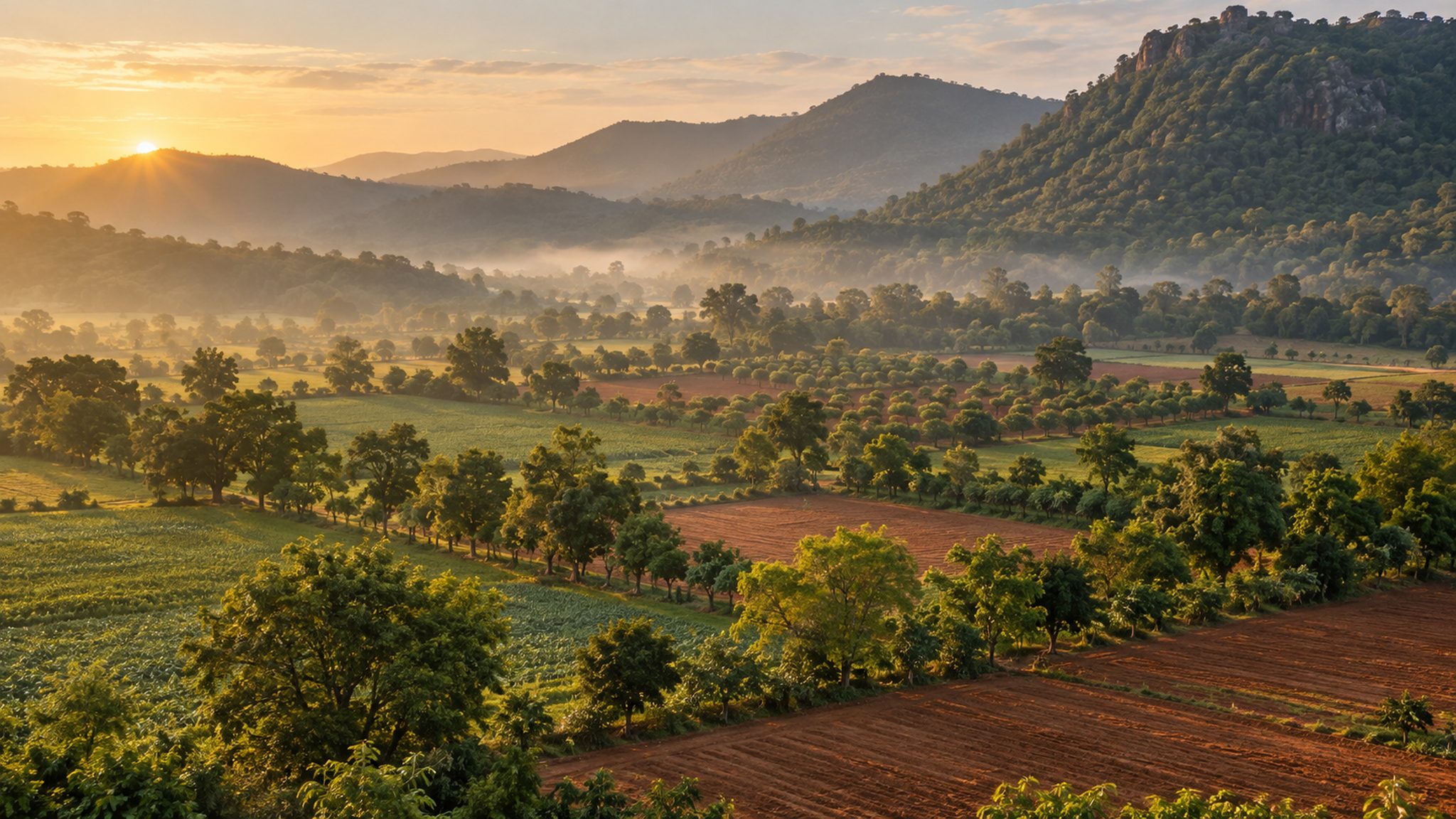
Agroforestry connects trees with working farms
Trees outside forests matter because tree management extends beyond forest departments’ conventional territorial focus.
- Agroforestry integrates trees with crops or livestock on the same land-management unit. Farm trees can supply useful products while retaining an agricultural function in the wider landscape.
- Resource assessment must capture scattered trees and linear plantings as well as larger patches. Looking only at continuous canopy can miss resources important to individual farming households.
- Management choices include species selection, spacing and harvesting cycles. For farmers, the relevant question is whether trees fit existing production needs, rather than how many seedlings are distributed.
- Site suitability matters: trees interact with crops through shade, water and nutrient use. A planting model suitable in one locality should not automatically become a universal prescription.
- Policy implication: evaluate farm-tree programmes through survival, usable produce and household returns alongside canopy gains. Planting activity alone cannot demonstrate durable ecological or livelihood benefits.
Forest genetics concerns the quality of planting material
Genetic cooperation addresses which biological resources are conserved and propagated, not simply where more trees can be planted.
- Genetic resource conservation protects variation within tree species. That variation matters when selecting material for different environments instead of assuming all seedlings of a species perform identically.
- Tree breeding seeks desirable inherited traits, while improved planting material carries selected characteristics into planting programmes. Improvement should be judged against the intended site and management objective.
- Germplasm is biological material used to conserve or reproduce genetic resources. Its conservation supports future research and breeding rather than serving merely as a stockpile for immediate planting.
- Productivity and diversity are separate concerns. Selecting material for a particular trait does not remove the need to conserve broader genetic resources or protect existing natural ecosystems.
Inventory turns canopy observations into resource evidence
Measurement is a distinct workstream: locating trees does not reveal everything about their condition or the resources they contain.
- Geospatial monitoring helps identify canopy distribution and changes across landscapes. Comparable observations are valuable, but a mapped green patch does not independently establish its species composition or ecological quality.
- Forest inventory adds measurements of tree resources. Field observations complement mapped cover when estimating growing stock and interpreting what a change in canopy actually represents.
- Growing stock concerns standing tree volume, whereas forest cover concerns canopy area. Equal areas can contain different resource volumes; the two measures answer different management questions.
- Implementation test: useful cooperation should improve comparable methods, field capacity and interpretation. The endorsed roadmap is a framework for work, not evidence that these improvements have already occurred.
Way Forward
Connect planting decisions with reliable assessment
- Match planting material to local conditions and evaluate survival and farmer outcomes after establishment.
- Combine field inventories with geospatial observations; document definitions so reported changes remain comparable.
- Protect genetic diversity and natural habitats while developing productive farm-tree systems; assess these objectives separately.
Conclusion
- Forest cooperation is strongest when it connects where trees grow, which genetic resources are maintained and how those resources are measured.
- In an answer, distinguish canopy, legal status and ecological quality; use the roadmap to illustrate technical cooperation without claiming unreported targets or completed outcomes.
UPSC Practice Questions
Prelims MCQ 1
With reference to forest assessment in India, consider the following statements:
- Forest cover can occur outside recorded forest areas.
- All trees outside forests are counted only under the separate tree-cover estimate.
- Mapping an area as forest cover does not itself change its legal classification.
How many of the above statements are correct?
(a) Only one (b) Only two (c) All three (d) None
Answer: (b) Only two
Explanation:
Statements 1 and 3 are correct. Trees outside recorded forests include qualifying patches counted as forest cover as well as resources represented in the separate tree-cover estimate.
Prelims MCQ 2
Which distinction best explains why forest inventory complements canopy mapping?
(a) Inventory automatically converts agricultural land into forest land (b) Canopy mapping alone establishes every tree’s genetic quality (c) Inventory adds tree-resource measurements beyond canopy area (d) Inventory makes field observations unnecessary
Answer: (c) Inventory adds tree-resource measurements beyond canopy area
Explanation:
Canopy area and growing stock measure different features. Inventory provides resource measurements that complement spatial observations of cover.
UPSC Mains Questions
- Explain why trees outside forests require different assessment and management approaches from a policy focused only on recorded forest areas. (150 words)
- How can cooperation in forest genetics and resource inventories strengthen forest governance? Discuss the limitations of canopy area as a standalone performance measure. (250 words)
Sources: PIB, Ministry of Environment, Forest and Climate Change and Forest Survey of India, India State of Forest Report 2023.
Frequently Asked Questions
What did India and Japan endorse?
They endorsed a forest cooperation roadmap for 2027-2031 at the Bengaluru Joint Working Group meeting. The reported workstreams concern trees outside forests, forest genetics, and inventory and monitoring technologies.
Are trees outside forests the same as tree cover?
No. Trees outside forests include tree resources outside recorded forest areas, including qualifying patches counted as forest cover. Tree cover is a separate estimate excluding the canopy already counted as forest cover.
Does forest cover establish legal forest status?
No. Forest cover is an assessment of qualifying canopy, irrespective of ownership or legal status. It should not be confused with recorded forest land or used alone to establish legal classification.
Why does the roadmap discuss forest genetics?
Genetic cooperation concerns conserving tree genetic resources, breeding and improved planting material. These address biological quality and variation, while inventories and geospatial monitoring address resource measurement and spatial distribution.