PM Modi’s Jordan Visit: West Asia Outreach at 75 Years
Why in News?
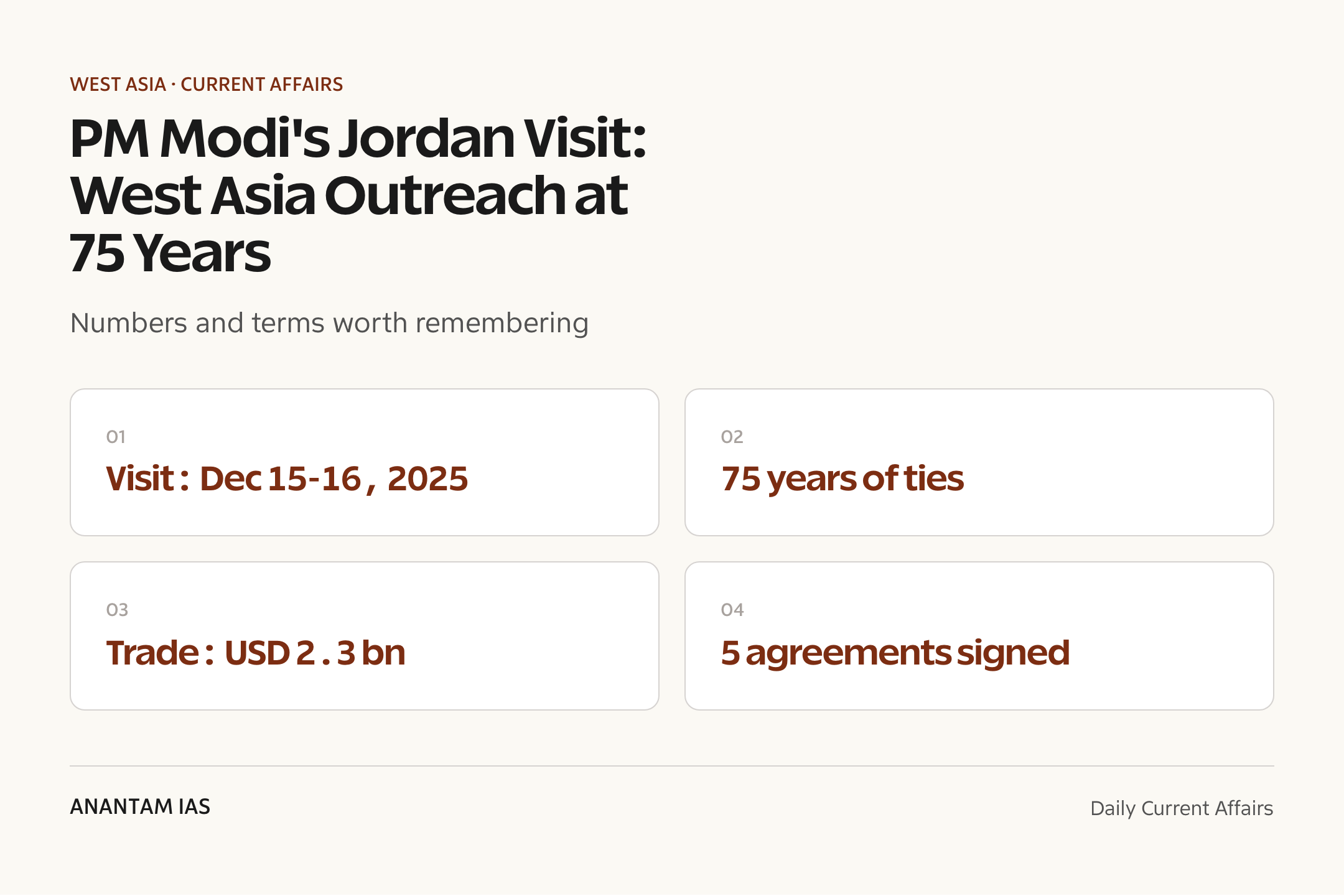
On December 15-16, 2025, the Prime Minister made the first-ever full bilateral state visit by an Indian PM to the Hashemite Kingdom of Jordan, at the invitation of King Abdullah II ibn Al Hussein. The PMINDIA Joint Statement records that the visit coincided with the 75th anniversary of the establishment of India-Jordan diplomatic relations.
PIB and the Prime Minister’s Office confirmed that the two sides signed five instruments spanning renewable energy, water-resource management, a cultural exchange programme, a Petra-Ellora Caves twinning agreement, and a letter of intent on Digital Public Infrastructure (DPI) – advancing India’s Link West engagement amid regional instability.
- Talks held in Amman on 15 December 2025; the Jordan-India Business Forum met on 16 December 2025.
- Bilateral trade stood at USD 2.3 billion (2024), making India the third largest trading partner for Jordan.
- MoUs signed on New and Renewable Energy and on Water Resources Management and Development.
- Cultural Exchange Programme 2025-2029 plus a Twinning Agreement between the City of Petra and the Ellora Caves site.
- Letter of intent on sharing India’s Digital Public Infrastructure (DPI) experience; ITEC slots for Jordan raised from 35 to 50.
The development matters in the context of:
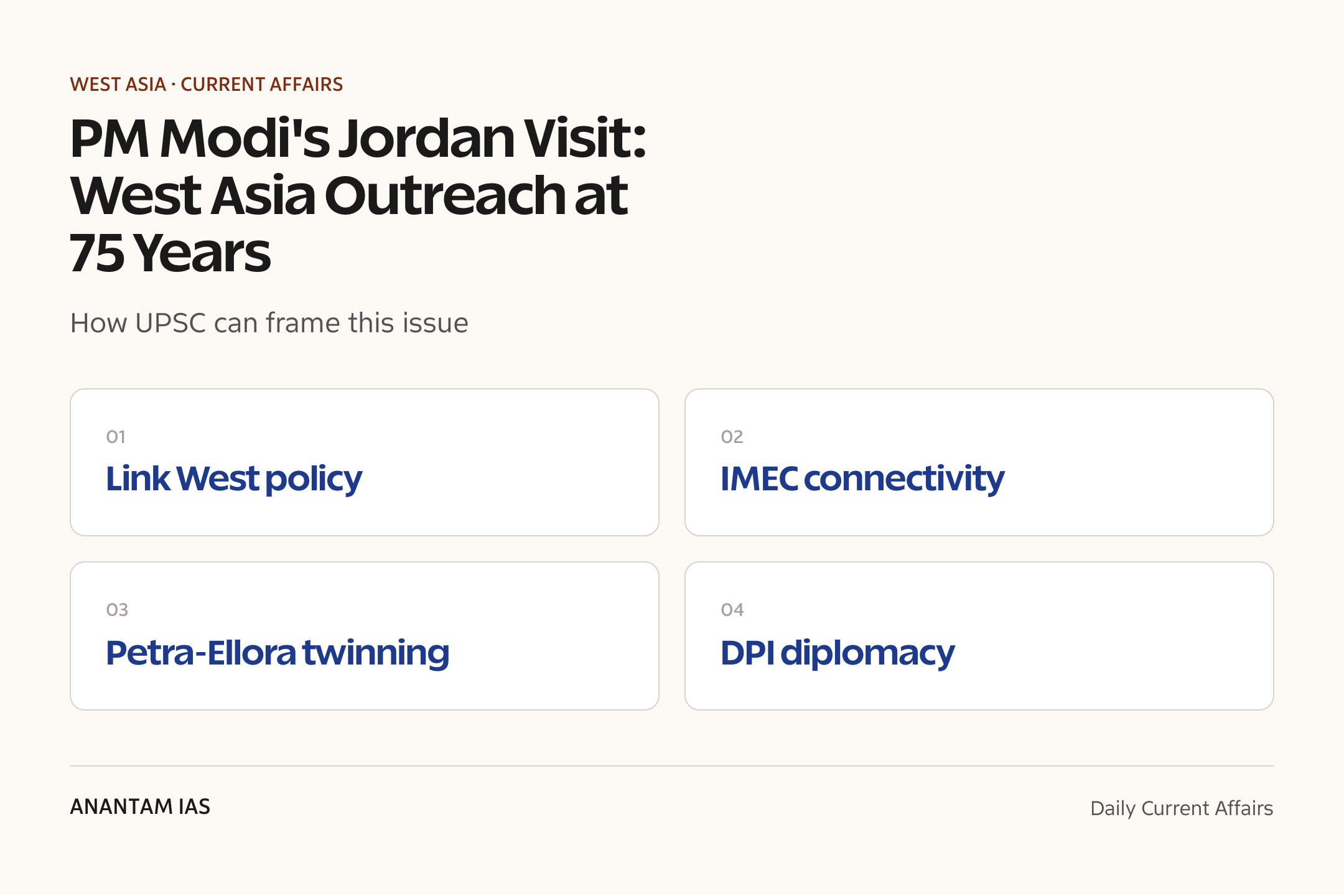
- Jordan sits at the western anchor of India’s Link West policy and on routes feeding the India-Middle East-Europe Economic Corridor (IMEC).
- The outreach comes amid West Asia instability, where Jordan is a stabilising, moderate Arab interlocutor neighbouring Israel, the West Bank and Iraq.
- Jordan is a major source of rock phosphate and potash for India’s fertiliser security.
UPSC Relevance
Prelims Relevance
- Jordan: capital Amman; monarch King Abdullah II; Crown Prince Al-Hussein bin Abdullah II.
- Hashemite Kingdom: bordered by Saudi Arabia, Iraq, Syria, Israel and the West Bank; short Red Sea coast at Aqaba.
- Petra and the Ellora Caves are both UNESCO World Heritage Sites linked by the 2025 twinning pact.
- India-Middle East-Europe Economic Corridor (IMEC): launched at the 2023 G20 New Delhi Summit.
- International Solar Alliance (ISA), Coalition for Disaster Resilient Infrastructure (CDRI) and Global Biofuels Alliance (GBA) are India-led groupings.
- ITEC (Indian Technical and Economic Cooperation) is India’s flagship capacity-building programme.
- India-Jordan bilateral trade: USD 2.3 billion (2024); India is Jordan’s third largest trading partner.
- India-Jordan Centre of Excellence in IT is hosted at Al Hussein Technical University, Amman.
Mains Relevance
GS Paper 2
- India’s Link West / West Asia policy and bilateral engagement with Gulf and Levant states.
- Effect of policies of developed and developing countries on India’s interests; IMEC connectivity diplomacy.
GS Paper 3
- Energy security via renewable-energy cooperation and fertiliser security through phosphate/potash supply.
- Digital Public Infrastructure as a tool of economic diplomacy and capacity building.
Essay
- Connectivity as the new currency of diplomacy.
- Soft power: heritage, technology and trust in India’s neighbourhood-plus outreach.
Background and Context
India-Jordan ties at 75 years
The visit anchored a long, low-friction relationship now formalised in fresh agreements.
- Diplomatic relations were established in 1950; the 2025 visit marked the 75th anniversary.
- It was the first full bilateral state visit by an Indian PM to Jordan, hosted by King Abdullah II in Amman.
- The Joint Statement described ties as built on mutual trust, warmth and goodwill across political, economic, defence, security, culture and education.
- Leaders recalled prior meetings in New York (2019), Riyadh (2019), Dubai (2023) and Italy (2024).
The five agreements signed
Five instruments gave the visit concrete deliverables across energy, water, culture and digital governance.
- MoU on New and Renewable Energy: exchange of scientific personnel, joint research and non-commercial technology transfer.
- MoU on Water Resources Management and Development: water-saving farm technology, aquifer management and climate adaptation – vital for water-scarce Jordan.
- Cultural Exchange Programme 2025-2029 covering music, dance, theatre, archives, libraries, literature and festivals.
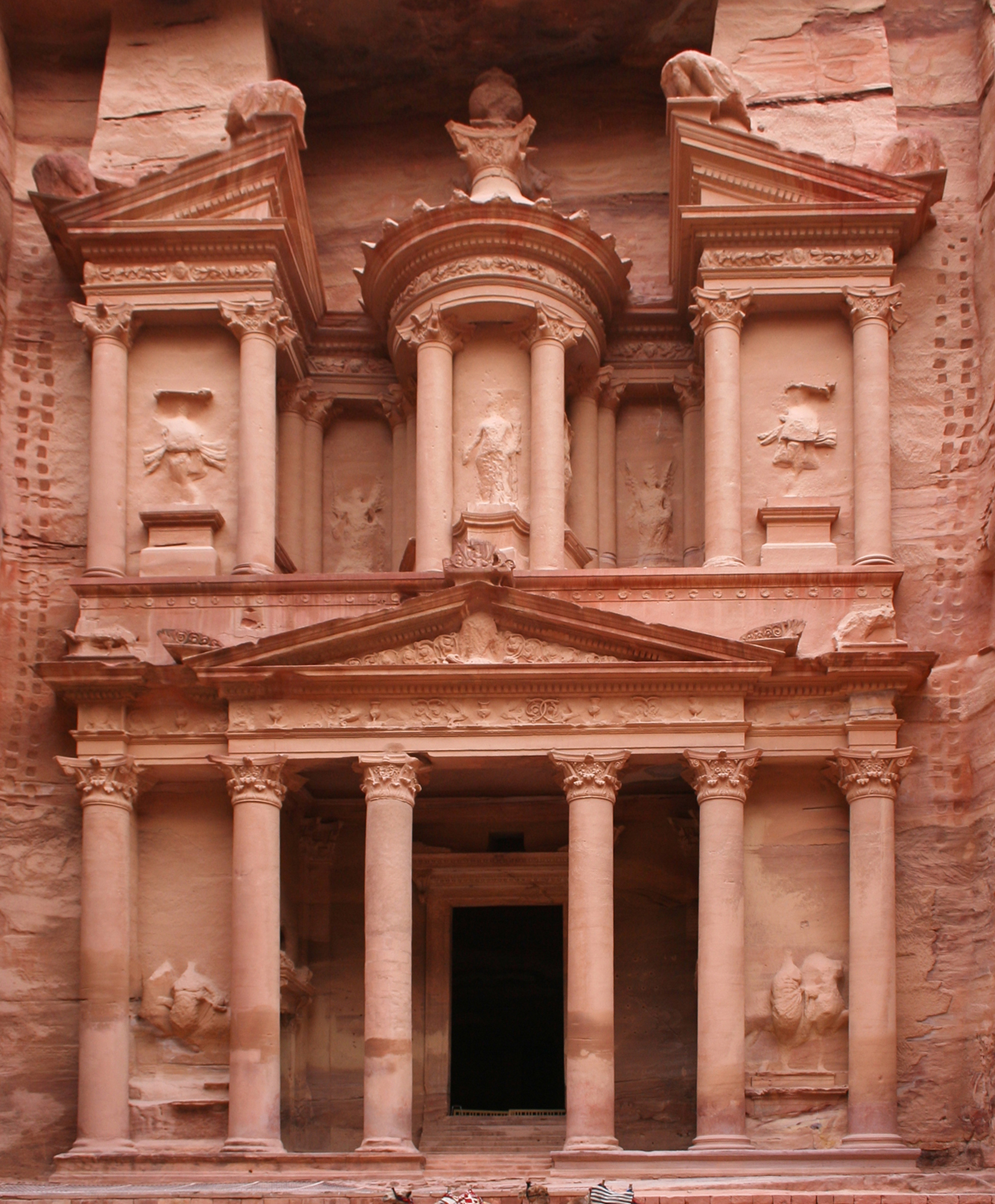
- Twinning Agreement between the City of Petra and the Ellora Caves, linking two heritage rock sites for site development and people-to-people ties.
- A letter of intent on sharing India’s Digital Public Infrastructure (DPI) experience (an agreement-in-the-making, not yet a full MoU).
Economic and trade architecture
Trade is modest but strategic, and both sides set a timeline to scale it.
- Bilateral trade was USD 2.3 billion in 2024; India is Jordan’s third largest trading partner.
- The 11th Trade and Economic Joint Committee was slated for the first half of 2026 to track progress.
- The Jordan-India Business Forum convened on 16 December 2025 with a high-level delegation.
- Both sides flagged Jordan’s logistics strengths and the port of Aqaba as gateways for regional integration.
Energy, fertiliser and the resource link
Jordan matters to India for clean energy collaboration and critical farm inputs.
- Cooperation on fertilisers, especially phosphates, supports India’s fertiliser security.
- Jordan is a leading global source of rock phosphate and potash, key inputs for Indian agriculture.
- King Abdullah II praised India’s role in the ISA, CDRI and GBA; Jordan signalled willingness to join all three.
- Both sides recognised biofuels as a low-carbon route to decarbonisation.
Digital, capacity building and people-to-people
Technology cooperation and training form the soft-infrastructure layer of the partnership.
- Roadmap agreed on Digital Public Infrastructure (DPI) and digital-transformation capacity building.
- The India-Jordan Centre of Excellence in IT at Al Hussein Technical University is to be upgraded.
- ITEC slots for Jordan rose from 35 to 50; cooperation extended to tele-medicine and health workforce training.
- Direct air connectivity to boost trade, tourism and exchanges is to be explored.
Strategic logic: Link West and IMEC
The visit fits India’s wider push to deepen its western neighbourhood beyond the Gulf core.
- Jordan is a stable, moderate Arab partner amid West Asia instability, adjacent to Israel, the West Bank and Iraq.
- Its location feeds connectivity ideas tied to the India-Middle East-Europe Economic Corridor (IMEC).
- Engagement complements India’s deepening ties with the UAE, Saudi Arabia and Egypt under the Link West policy.
- Heritage diplomacy via the Petra-Ellora link adds a durable soft-power dimension.
Way Forward
Operationalise the agreements
- Convene the 11th Trade and Economic Joint Committee and the fifth round of political consultations in New Delhi on schedule.
- Move the DPI letter of intent to a full agreement so India’s stack can support Jordanian e-governance.
Build the connectivity case
- Explore direct air links and integrate Jordan’s Aqaba logistics into India’s IMEC and trade routes.
- Diversify the trade basket beyond phosphates toward green tech, pharma and IT services.
Sustain heritage and education ties through the Cultural Exchange Programme and a fully scaled Centre of Excellence in IT, turning goodwill into institutional habit.
Conclusion
The Jordan visit shows India broadening its West Asia footprint beyond the Gulf core, pairing energy and water cooperation with heritage and digital diplomacy at a symbolic 75-year milestone.
Its strategic value lies less in trade volume than in positioning: a trusted, stable partner on the western flank of IMEC, where India seeks reliable friends amid regional turbulence.
UPSC Practice Questions
Prelims MCQ 1
With reference to the India-Jordan partnership, consider the following statements:
- Jordan’s capital is Amman and it has a coastline on the Red Sea at Aqaba.
- India is currently Jordan’s largest trading partner.
- A twinning agreement links the City of Petra with the Ellora Caves.
How many of the above statements are correct?
(a) Only one (b) Only two (c) All three (d) None
Answer: (b) Only two
Explanation:
Statements 1 and 3 are correct. Statement 2 is wrong – India is Jordan’s third largest trading partner, not the largest, with trade of about USD 2.3 billion in 2024.
Prelims MCQ 2
The India-Middle East-Europe Economic Corridor (IMEC), often cited in India’s Link West engagement, was launched at which event?
(a) 2023 G20 Summit in New Delhi (b) 2022 Voice of Global South Summit (c) 2024 SCO Summit (d) 2023 BRICS Summit in Johannesburg
Answer: (a) 2023 G20 Summit in New Delhi
Explanation:
IMEC was announced on the sidelines of the G20 Summit hosted by India in New Delhi in September 2023, connecting India with the Gulf and Europe.
UPSC Mains Questions
- India’s outreach to Jordan reflects a maturing Link West policy. Examine how connectivity, energy and heritage diplomacy together advance India’s strategic interests in West Asia. (250 words)
- Digital Public Infrastructure has emerged as an instrument of India’s foreign policy. Discuss its role in deepening partnerships with West Asian and Global South nations, with reference to recent agreements. (250 words)
Sources: PMINDIA (Prime Minister's Office), Joint Statement and Press Information Bureau (PIB).
Frequently Asked Questions
When did PM Modi visit Jordan and why was it significant?
The Prime Minister visited Jordan on December 15-16, 2025. It was the first-ever full bilateral state visit by an Indian PM to Jordan and coincided with the 75th anniversary of India-Jordan diplomatic relations, signalling a major upgrade in the partnership.
How many agreements were signed during the visit?
Five instruments were finalised: MoUs on New and Renewable Energy and on Water Resources Management and Development, a Cultural Exchange Programme for 2025-2029, a twinning agreement between Petra and the Ellora Caves, and a letter of intent on sharing India’s Digital Public Infrastructure experience.
What is the Petra-Ellora twinning agreement?
It links Jordan’s ancient rock-cut city of Petra with India’s Ellora Caves, both UNESCO World Heritage Sites. The pact focuses on developing the archaeological sites and promoting cultural and people-to-people ties between the two heritage destinations.
How large is India-Jordan trade?
Bilateral trade was valued at about USD 2.3 billion in 2024, making India the third largest trading partner for Jordan. Both sides agreed to diversify the trade basket and convene the 11th Trade and Economic Joint Committee in the first half of 2026.
How does Jordan fit India’s Link West policy?
Jordan is a stable, moderate Arab partner on the western edge of West Asia, near Israel, the West Bank and Iraq. Its location supports connectivity tied to the India-Middle East-Europe Economic Corridor and complements India’s ties with the Gulf states.
Why does Jordan matter for India’s resource security?
Jordan is a major global source of rock phosphate and potash, critical inputs for Indian agriculture. Cooperation on fertilisers, especially phosphates, supports India’s fertiliser and food security alongside renewable-energy collaboration.